保险业

Search documents
从“压舱石”到“波动源”:日本国债缘何让全球投资者紧张?
Zhi Tong Cai Jing· 2026-01-21 08:39
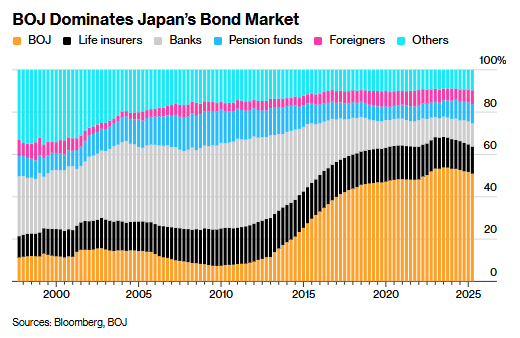
Core Viewpoint - Japan's bond market, once a stabilizing force globally, is experiencing significant volatility as the yield on 40-year government bonds has surged above 4%, the highest in over 30 years, due to reduced bond purchases by the Bank of Japan and proposed tax cuts by the government [1][2]. Group 1: Factors Behind Rising Yields - The Bank of Japan, historically the largest buyer of government bonds, has begun to reduce its bond holdings, which had peaked in November 2023 [4]. - The Japanese government approved a substantial economic stimulus plan worth 21.3 trillion yen (approximately 137 billion USD), raising concerns about increased borrowing and bond issuance [5]. - Proposed tax cuts by Prime Minister Fumio Kishida, which may require additional government borrowing, have further fueled investor anxiety regarding rising bond supply and potential price declines [6]. Group 2: Market Reactions and Implications - The increase in bond yields has led to a significant decline in the value of domestic bond portfolios, with Japan's four major life insurance companies reporting unrealized losses of approximately 60 billion USD, tripling from the previous fiscal year [7]. - The volatility in the bond market has prompted both the Bank of Japan and the government to express concerns, with the central bank planning to slow its exit from bond purchases to stabilize the market [8]. - Despite rising yields, foreign investors are increasing their holdings in Japanese bonds, now accounting for about 65% of monthly trading volume, up from 12% in 2009, as they seek to hedge against currency risks [6]. Group 3: Global Context - The global bond market is also under pressure, with rising yields observed in various major markets due to inflation concerns and expectations of central banks slowing or halting monetary easing [9].

人身险预定利率研究值再微降,但离定价调整线尚有距离
Di Yi Cai Jing· 2026-01-21 08:24
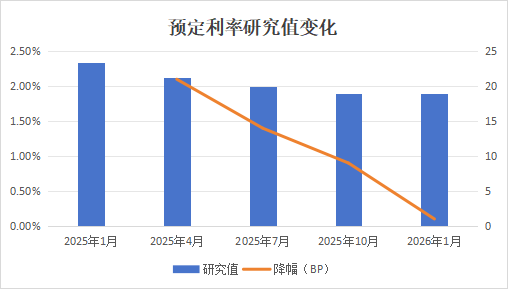
中期来看人身险新产品预定利率上限调整可能性并不高。 离定价调整线尚有距离 尽管研究值出现四连降,但离用以定价的人身险预定利率上限调整线仍有相当距离。 尽管研究值从去年初公布的首期就开始一路下降,但降幅逐季收窄,目前离以此为基准再次下调人身险 产品定价的阈值尚有距离。业内分析师预测,中期来看,新产品预定利率上限调整可能性并不高。 研究值四连降,降幅逐季收窄 根据2025年初国家金融监管总局发布的《关于建立预定利率与市场利率挂钩及动态调整机制有关事项的 通知》(下称《通知》)的要求,当在售普通型人身保险产品预定利率最高值连续两个季度比预定利率 研究值高25BP及以上时,要及时下调新产品预定利率最高值。而预定利率又是人身险产品定价的重要 因素,因此,每季度发布的预定利率研究值就成了人身险产品是否会又一次大规模调价的"标准线"。 中国保险行业协会2025年1月发布的首期人身险预订利率研究值为2.34%,此后各季度分别为2.13%、 1.99%、1.9%以及此次的1.89%。虽然经历四连降,但调降幅度逐季收窄。 根据《通知》内容,上述研究值作为人身险预定利率最高值的"锚",是结合5年期以上贷款市场报价利 率(LPR)、 ...
这一指标四连降 人身险产品定价怎么走?
Zheng Quan Ri Bao Wang· 2026-01-21 02:52
Core Viewpoint - The key indicator for pricing life insurance products, the predetermined interest rate, has been updated to 1.89% as of January 20, reflecting a downward trend in the insurance industry [1][2]. Group 1: Predetermined Interest Rate Updates - The China Insurance Industry Association has held five meetings since the establishment of the dynamic adjustment mechanism for predetermined interest rates, with the latest value showing a decline from previous values of 2.34%, 2.13%, 1.99%, and 1.90% [2]. - The current maximum predetermined interest rates are set at 2.0% for ordinary life insurance products, 1.75% for participating insurance products, and 1.0% for universal insurance products [2]. - The recent adjustment in the predetermined interest rate has not triggered the adjustment mechanism, as the current rates do not exceed the threshold for necessary changes [2]. Group 2: Influencing Factors - The recent decline in the predetermined interest rate is primarily influenced by the stability of the Loan Prime Rate (LPR), which has not changed for eight consecutive months, as well as fluctuations in fixed deposit rates and 10-year government bond yields [2][3]. - The predetermined interest rate serves as a core indicator for pricing life insurance products and is used by regulatory authorities to manage industry risk related to interest rate spreads [3].
久久为功 驰而不息——静宁县牛产业综合保险项目扬帆再启航
Qi Huo Ri Bao· 2026-01-21 02:25
久久为功,驰而不息。在2024年静宁县牛产业综合保险项目取得良好成效的基础上,1月14日,2025年 度"金融赋能红牛产业暨'保险+期货'培训会"在甘肃省静宁县隆重举行,标志着该项目连续第二年落地 实施。这是金融服务静宁县红牛产业发展,强化保障养殖户收入,稳定农户养殖积极性的重要举措和全 新篇章。 古城镇二堡村村支书曹彦龙已经是第二年参加启动会了,他满怀热情,来之前就积极发动村民投保了。 他高兴的讲到,牛产业综合保险,是村集体最为期待的助农项目,去年为老百姓降低了养殖成本,让村 民"能养牛"和"敢养牛"了,了年底红牛还能卖上个好价钱,保护了村民的养殖积极性。今年项目继续实 施,规模还扩大了,让我们全村更加坚定的走好养牛这条致富路。作为全村的带头人,他已将更多学 习"保险+期货"知识当做了今年个人的工作重点。 作为"平凉红牛"的核心产区,当前,静宁县正依托万头肉牛育肥基地、牛肉深加工冷链物流项目等载 体,推动产业向数字化养殖、精深加工、品牌营销延伸,而"保险+期货"带来的收益稳定性,加速"养牛 大县"向"养牛强县"迈进,充分展现了中投银河的金融帮扶从"输血"到"造血"的核心升级。 会上,银河期货、太平洋财险、深 ...
未知机构:花旗中国保险业2026年展望寿险迎历史机遇财险乘监管东风寿险行业因财富重-20260121
未知机构· 2026-01-21 02:05
Summary of the Conference Call on the Chinese Insurance Industry Outlook for 2026 Industry Overview - The report focuses on the Chinese insurance industry, highlighting significant opportunities in both life insurance (寿险) and property insurance (财险) due to wealth reallocation and regulatory changes [1][2][3]. Key Insights and Arguments Life Insurance Sector - The life insurance industry is expected to face a historic opportunity driven by a massive reallocation of wealth, with over 70 trillion RMB in bank deposits maturing by 2026 [1][5][9]. - Retail investors, seeking higher returns in a low-interest-rate environment, are likely to shift their investments towards insurance products, particularly dividend-related products sold through bancassurance channels [1][5]. - Although the shift towards dividend products may pressure profit margins, a scheduled interest rate cut in September 2025 is anticipated to offset this impact, keeping overall profit margins stable [2][5]. - The report predicts a K-shaped growth differentiation in the market, with leading companies like China Life and Ping An benefiting from concentrated resources and growth amid tightening regulatory scrutiny [2][5][8]. Property Insurance Sector - The property insurance sector is projected to achieve a stable premium growth rate of 4% by 2026, primarily driven by auto insurance and personal property insurance [2][5]. - Regulatory improvements, such as the promotion of the "non-auto insurance report and approval integration" policy and enhanced cost management for auto insurance, are expected to provide significant room for improvement in the combined ratio (CoR) [3][6][8]. - The report identifies PICC Property and Casualty as the biggest beneficiary of these regulatory changes, potentially achieving the best performance in the industry [3][8]. Additional Important Content - The report emphasizes the structural reforms aimed at enhancing underwriting profitability, which include extending cost control from auto to non-auto insurance and gradually relaxing pricing limits for new energy vehicle insurance [6][7]. - Key data points include: - Over 70 trillion RMB in bank deposits maturing by 2026, a significant source of growth for the life insurance sector [9]. - A projected 4% growth rate for property insurance premiums in 2026 [9]. - The relaxation of the pricing coefficient for new energy vehicle insurance from 1.35 to 1.5, which will help improve profitability for property insurance companies [9]. - In 2019, cash and deposits accounted for 63.9% of Chinese households' financial assets, indicating a substantial potential for reallocating funds towards insurance products [9]. Recommended Investment Targets - China Life (2628.HK): Buy rating, target price raised to HK$38.00, favored for its market leadership and robust underwriting strategy [10][11]. - Ping An (2318.HK): Buy rating, target price raised to HK$79.00, expected to benefit from K-shaped growth differentiation [10][11]. - PICC Property and Casualty (2328.HK): Buy rating, target price of HK$21.20, anticipated to be the largest beneficiary of regulatory tailwinds [10][11]. - China Pacific Insurance (2601.HK): Buy rating, target price raised to HK$44.40 [10][11]. - People’s Insurance Group (1339.HK): Buy rating, target price of HK$7.80 [10][12].
从“边缘”到“主流” A股上市公司董责险投保大增
Jin Rong Shi Bao· 2026-01-21 01:44
Core Insights - The market for Directors and Officers Liability Insurance (D&O Insurance) in the A-share market is entering a phase of accelerated adoption, with 643 A-share listed companies announcing D&O insurance plans in 2025, a year-on-year increase of 19% [1] Group 1: Market Demand and Trends - The demand for D&O insurance has been revitalized due to the implementation of new securities and company laws, alongside high-profile incidents like Kangmei Pharmaceutical and Luckin Coffee, which have heightened awareness of executive liability [2] - Among the newly insured companies in 2025, the manufacturing sector leads in numbers, particularly in "Computer, Communication and Other Electronic Equipment Manufacturing," followed by "Specialized Equipment Manufacturing" and "Software and Information Technology Services" [2] - Private enterprises account for nearly 60% of the new D&O insurance policies, indicating a rising awareness of risk management among private companies, while state-owned enterprises still have the highest penetration rate [2] Group 2: Company Size and Insurance Penetration - Medium to large enterprises are the backbone of D&O insurance uptake, with companies having assets between 10 billion to 50 billion yuan making up 26% of new policies, and those with over 50 billion yuan having a penetration rate of 68% [3] - The overall penetration rate of D&O insurance in A-shares remains low compared to international markets, where rates exceed 90% in the U.S. and 86% in Canada [3] Group 3: Pricing and Market Dynamics - The average premium for D&O insurance has entered a downward trend, with rates dropping from 0.3% in 2017 to below 0.05% by the fourth quarter of 2025, driven by increased supply and irrational competition [4][5] - The most common policy limits for D&O insurance are between 40 million to 60 million yuan, with larger companies opting for higher limits, such as the 750 million yuan policy issued to SF Express [4] Group 4: Claims and Transparency Issues - In the first three quarters of 2025, there were 13 claims totaling 89.47 million yuan, indicating a rising claim rate as the market matures [5] - The lack of transparency in claims and insurance information is hindering market development, making it difficult for companies to assess policy rationality and for insurers to price accurately [6] - The introduction of mandatory disclosure of key D&O insurance terms, premiums, and significant claims is suggested to improve market health and governance [6]
万能险结算利率持续缩水 重构产品吸引力迫在眉睫
Bei Jing Shang Bao· 2026-01-20 23:45
Core Viewpoint - The continuous decline in the settlement interest rates of universal insurance products necessitates a reconstruction of their attractiveness in a low-interest-rate environment [1][2]. Group 1: Current Situation of Universal Insurance - As of January 2025, the annual settlement interest rates for most universal insurance products have dropped to the range of 2.5% to 3%, with only a few exceeding 3% [1]. - Out of 458 universal insurance products, 167 have settlement rates of 3% or higher, accounting for 36%, while only 25 products exceed 3% [2]. - Compared to previous years, the majority of products had settlement rates above 3% in early 2024 and several hundred products exceeded 4% in early 2023 [2]. Group 2: Regulatory Environment and Challenges - Regulatory bodies have been clear in their stance on strengthening the management of universal insurance products, leading to a downward adjustment of settlement rates to reduce the liability costs for insurance companies [2]. - The recent regulatory changes allow insurance companies to adjust the minimum guaranteed interest rates, which were previously long-term commitments, now becoming time-limited agreements [3]. Group 3: Strategies for Enhancing Attractiveness - To enhance the attractiveness of universal insurance, companies need to focus on building a robust protection product system and optimizing product design within compliance frameworks [4]. - There is a shift from a "high-yield driven" model to a "functional value driven" model, emphasizing the integration of insurance with services such as health management and retirement planning [5]. - Companies are encouraged to innovate products and services to meet long-term consumer needs, transforming universal insurance from a mere financial tool into a comprehensive "wealth + service" solution [5].
保险业筑牢灾害安全屏障
Jing Ji Ri Bao· 2026-01-20 22:08
Core Insights - Munich Re's 2025 Natural Disaster Loss Report highlights significant economic losses due to climate change, estimating total losses at approximately $224 billion, with the insurance industry bearing around $108 billion of this amount [1] - Meteorological disasters are identified as the primary risk factor, accounting for 92% of global losses and 97% of insurance losses [1] - The report emphasizes the increasing frequency and severity of extreme weather events linked to climate change, with recent years being the warmest on record [1] Group 1: Global Impact - The report indicates that multiple natural disasters in 2025, such as wildfires in Los Angeles and hurricanes in the North Atlantic, are closely related to climate change [1] - The economic losses from natural disasters in the Asia-Pacific region reached approximately $73 billion, surpassing the 10-year average of $66 billion, while insurance losses were only about $9 billion [2] - The report notes that low-income countries have an insurance penetration rate of less than 5%, exacerbating the impact of natural disasters [2] Group 2: Regional Challenges - In China, natural disasters in 2025 primarily included floods, geological disasters, earthquakes, and typhoons, affecting over 67 million people and causing direct economic losses of approximately 241.6 billion yuan [2] - The Ministry of Emergency Management's data highlights the urgent need for the insurance industry to enhance its integrated service capabilities for disaster prevention, emergency response, and timely compensation [2] - A new policy aims to expand the coverage of catastrophe insurance to include common natural disasters, effectively doubling the basic insurance amount [3] Group 3: Insurance System Development - The establishment of a multi-layered catastrophe risk diversification system is underway, with pilot programs in over 20 provinces to strengthen disaster prevention and mitigation [3] - The report underscores the importance of a robust catastrophe insurance system in enhancing societal disaster response capabilities and risk prevention [3] - There remains significant potential for growth in both commercial and government-led catastrophe insurance in terms of coverage and depth of protection [3]
Dow Jones Faces Big Week As Four Heavyweights Report Earnings
Benzinga· 2026-01-20 20:30
Core Viewpoint - The earnings season is gaining momentum as major publicly traded companies report quarterly financial results, with a focus on four Dow Jones Industrial Average companies this week and their potential impact on the SPDR Dow Jones Industrial Average ETF (DIA) [1] Group 1: Earnings Reports - 3M Company reported earnings, missing revenue expectations but beating earnings per share (EPS) estimates, marking its first revenue miss after seven consecutive beats [3][4] - Johnson & Johnson is expected to report EPS of $2.48 and revenue of $24.15 billion, both showing year-over-year growth, continuing its trend of beating EPS estimates for over 10 quarters [5][6] - Travelers is anticipated to report EPS of $8.60 and revenue of $11.65 billion, both lower than the previous year's figures, while maintaining a strong track record of beating analyst estimates [9][10] - Procter & Gamble is projected to report EPS of $1.87 and revenue of $22.27 billion, with a focus on consumer shopping trends and health, despite a slight decline in EPS expectations [11][12] Group 2: Company Performance and Stock Movements - 3M's stock fell 7.8% to $155.84, with a 52-week range of $121.98 to $174.69, while being up 5.4% over the last year [4] - Johnson & Johnson's stock trades near all-time highs at $217.89, reflecting a 47.1% increase over the past 52 weeks [8] - Travelers shares are priced at $270.57, up 13.1% over the last year, with a 52-week range of $230.42 to $296.85 [10] - Procter & Gamble's shares are down 9.3% over the last 52 weeks, trading at $146.72 with a range of $137.62 to $179.99 [13] Group 3: ETF Impact - The earnings from the four companies are expected to create volatility in ETFs like DIA, which is currently trading at $484.45, up 10.8% over the past year [14][15]

50万亿定存到期 谁能接住“泼天富贵”
Bei Jing Shang Bao· 2026-01-20 16:57
Core Viewpoint - A significant wave of "high-interest fixed deposit maturities" is expected in 2026, with approximately 50 trillion yuan of funds set to be unlocked, impacting residents' asset allocation strategies [1][4][5]. Group 1: Market Context - The high-interest deposit wave is a result of a previous surge in deposit rates during 2020-2021, where five-year fixed deposit rates reached as high as 5% due to increased credit demand and competitive banking strategies [3][4]. - The period of 2022-2023 saw a rise in "passive savings" due to market pressures, leading to a significant increase in the amount of fixed deposits maturing in 2026 [3][5]. Group 2: Deposit Maturity Scale - Estimates suggest that the scale of fixed deposits maturing in 2026 will be around 45 trillion to 50 trillion yuan, with a notable increase from 2025 [4]. - A more comprehensive analysis indicates that the maturing amount of residents' fixed deposits could reach approximately 75 trillion yuan, reflecting a 12% increase compared to 2025 [5]. Group 3: Investment Preferences - Despite declining interest rates, many conservative investors are likely to continue renewing their fixed deposits due to a low tolerance for risk and a preference for capital safety over higher returns [6][7]. - The shift in investment behavior is evident as residents are moving from riskier assets to more stable income-generating assets, indicating a cautious approach to asset allocation [5][10]. Group 4: Financial Products and Trends - The demand for stable financial products, such as "solid income+" funds and conservative insurance products, is increasing as investors seek safer alternatives to traditional deposits [8][14]. - The insurance market is witnessing a revival, with products like dividend life insurance becoming popular due to their stable returns compared to fluctuating financial products [11][12]. Group 5: Future Outlook - The insurance sector is expected to gain market share as a result of the deposit migration trend, driven by changing demographics and regulatory support for floating income products [13]. - Financial institutions are adapting to the changing landscape by offering competitive rates on fixed deposits and diversifying their product offerings to attract cautious investors [7][16].