家电

Search documents
湖北春节消费市场热度攀升 7天交易额305.5亿同比增11.5%
Chang Jiang Shang Bao· 2026-02-24 13:24
Core Insights - The consumption market in Hubei province experienced a significant boost during the Spring Festival, with retail and catering industries achieving a total transaction volume of 30.55 billion yuan, marking an 11.57% increase compared to the same period in 2025 [1][3] Group 1: Consumption Trends - The theme "Enjoy in Hubei, Shop for the New Year" was promoted, leading to a rise in quality, integrated, and experiential consumption trends, with hot sales in bulk commodities and local cuisine [1][5] - The government provided nearly 600 million yuan in consumption subsidies starting January 24, which stimulated a total consumption of 3.155 billion yuan across various sectors [2] Group 2: Retail Performance - Major retail categories such as automotive, home appliances, and electronic products saw transaction volume increases of 23.68%, 36.55%, and 28.52% respectively during the holiday period [2] - Offline shopping areas experienced a surge in foot traffic, with significant increases reported in stores like JD MALL in Wuchang [2] Group 3: Experiential Consumption - The integration of commerce, culture, and sports created diverse new consumption scenarios, shifting consumer focus from mere purchasing to experiential enjoyment [4] - Key monitored pedestrian streets in Hubei saw revenue and foot traffic growth of 22.24% and 23.25% respectively during the holiday [4] Group 4: Culinary Innovations - The local cuisine gained popularity through initiatives like the "My Ideal Hubei New Year Dinner" contest, which involved over a thousand restaurants offering unique dishes [5] - Innovative dining experiences, such as themed banquets and cultural performances, attracted large crowds and enhanced the festive atmosphere [5]
春节假期全市商品销售额同比增长5%:新春消费亮点纷呈 市场活力持续迸发
Sou Hu Cai Jing· 2026-02-24 11:32
Core Insights - The article highlights the vibrant consumer activity in Kunming during the Spring Festival, driven by various promotional initiatives and government policies aimed at boosting spending [4][5][6]. Group 1: Consumer Activity and Sales Performance - During the Spring Festival, Kunming's key monitored enterprises reported a 5% year-on-year increase in sales, indicating a strong start to the new year for consumer spending [4]. - The trial of the prize invoice system in Kunming saw over 38,000 winners and distributed more than 6.2 million yuan in prizes, directly stimulating over 64 million yuan in consumption [6]. - Sales of daily necessities surged by 30.5% year-on-year during the holiday period, reflecting robust consumer resilience [6]. Group 2: Government Initiatives and Promotions - The Kunming municipal government implemented a series of consumer incentives, including trade-in programs, consumption vouchers, and prize invoices, to enhance market activity [5]. - The "Indian Ocean Seafood Festival" received increased consumption voucher allocations to encourage spending, particularly in the dining sector [5]. - The prize invoice initiative, covering eight essential sectors, incentivized consumers to request invoices, fostering a culture of active participation in the economy [5]. Group 3: Consumer Experience and Market Innovation - Kunming focused on upgrading consumption experiences by promoting trade-in policies and launching various themed activities to attract consumers [7]. - The city organized promotional events for automobiles, home appliances, and digital products, combining government subsidies with merchant discounts to maximize consumer benefits [7]. - Sales of home appliances and audio-visual equipment increased by 21% year-on-year during the Spring Festival, showcasing the effectiveness of these initiatives [7]. Group 4: Cultural Integration and Tourism - Major commercial districts in Kunming transformed their spaces into cultural venues, hosting events that blended commerce with cultural experiences to enhance consumer engagement [8]. - Activities such as art exhibitions and traditional performances were organized to create a festive atmosphere, attracting both locals and tourists [8]. - The integration of commerce and culture effectively extended visitor stay times and diversified consumer demands, contributing to a lively holiday economy [9]. Group 5: Future Outlook - Kunming's business system plans to continue monitoring market trends and implementing consumer policies to sustain economic momentum, particularly as the Lantern Festival approaches [9]. - The city aims to deepen the impact of the prize invoice trial and further promote the integration of commerce and tourism to convert holiday traffic into economic growth [9].


每日投行/机构观点梳理(2026-02-24)
Jin Shi Shu Ju· 2026-02-24 11:15
Group 1: Gold Market Insights - UBS maintains a positive outlook on gold, predicting an international spot gold target price of $6200 per ounce in the coming months, driven by geopolitical risks and continued Fed easing [1] - Goldman Sachs forecasts a gradual increase in gold prices, expecting them to reach $5400 per ounce by the end of 2026, supported by central bank purchases and increased private investment [2] Group 2: Oil Price Predictions - Goldman Sachs raises its Q4 2026 oil price forecast for Brent and WTI to $60 and $56 respectively, assuming no disruptions in oil supply from Iran [3] Group 3: Economic Growth and Inflation - Goldman Sachs anticipates global economic growth to exceed expectations due to diminishing tariff effects, fiscal support, and a loose financial environment, with inflation rates approaching target levels [4] Group 4: Lithium Market Outlook - UBS expresses strong optimism for the "China lithium" market, significantly raising price forecasts for lithium spodumene and carbonate, indicating the market has entered a third super cycle [5] Group 5: Currency and Economic Trends - Morgan Stanley suggests that the Swiss Franc may rise by up to 17% against the US dollar, as it is viewed as a safe-haven currency amid US policy uncertainties [6] - Barclays notes that the overturning of Trump-era tariffs could lead to moderate export growth in emerging Asia [8] Group 6: Japanese Economic Indicators - Dutch International Group expects positive signals from upcoming Japanese economic data, predicting a strong rebound in industrial production and retail sales [9] Group 7: A-Share Market Outlook - Xingzheng Strategy remains optimistic about a new upward trend in A-shares post-Spring Festival, driven by global liquidity adjustments and geopolitical factors [8] Group 8: Brain-Computer Interface Industry - CITIC Securities predicts a significant advancement in the domestic brain-computer interface industry, with the first domestic implantable product expected to apply for market registration [9] Group 9: Robotics Industry Focus - CITIC Jian Investment recommends focusing on quality segments within the humanoid robotics industry, as Tesla's Optimus V3 continues to gain traction [10] Group 10: Home Appliance and Smart Hardware Opportunities - CITIC Jian Investment identifies three structural opportunities in the emerging home appliance and smart hardware sectors, driven by changes in the tariff system and robust overseas demand [11] Group 11: Multimodal Technology Evolution - CITIC Jian Investment highlights the potential of native multimodal and world model technologies to reshape various industries, including marketing and gaming [12] Group 12: Spring Market Trends - CITIC Securities anticipates that the spring market will continue to thrive, with price increases being a key focus for the first quarter [12]
整个社会都在喊没钱了,为什么这些公司反而年赚百亿?
创业家· 2026-02-24 10:28
Core Insights - The article emphasizes that despite the prevailing narrative of economic hardship, certain industries are thriving and generating substantial profits, particularly in the context of Japan's "lost 30 years" and its implications for various sectors [3][4]. Group 1: Economic Trends - The concept of a "low-desire society" does not equate to a lack of opportunities, as consumer behavior is shifting towards different spending patterns [4]. - The article identifies eight key industries that are capitalizing on changing consumer demands, highlighting that demand migration and consumption segmentation present significant business opportunities [5]. Group 2: Key Industries - **Second-Hand Economy**: The second-hand luxury market in Japan, exemplified by companies like Daikokuya, has seen a dramatic increase in revenue. In China, platforms like Hongbulin and Panghu are experiencing similar growth [6][7]. - **Pet Economy**: With declining birth rates, spending on pets is increasing, as seen with brands like Inaba in Japan and Guobao in China, which are witnessing strong sales in pet food and healthcare products [12][13][15]. - **Adult Care**: The adult diaper market in Japan has surpassed $10 billion, indicating that aging populations can drive significant economic opportunities [18][19]. - **Health Food and Beverages**: The rise in health consciousness has led to increased demand for products like sugar-free tea and functional beverages in both Japan and China [21]. - **Beauty and Aesthetics**: The beauty industry continues to thrive, with products like collagen supplements and home beauty devices gaining popularity, indicating a strong consumer desire for self-improvement [23][25][26]. - **Outdoor Recreation**: Companies in the outdoor equipment sector, such as Snow Peak in Japan, are profiting from the growing interest in outdoor activities, with Chinese brands also seeing rapid sales growth [29][31]. - **Convenience Economy**: The demand for convenience is driving growth in frozen food and smart home appliances, as consumers seek to save time in their daily routines [39][40]. - **Lazy Economy**: The trend towards convenience is evident in the increasing popularity of products that save time, suggesting that time-saving solutions may hold more commercial value than cost-saving ones in a low-desire economy [42]. Group 3: Market Dynamics - The article posits that while many perceive the current market as a "winter," the true winners will be those who identify and invest in counter-cyclical opportunities [44].




税收数据显示:春节假期中国消费市场火热
Xin Lang Cai Jing· 2026-02-24 10:05
Core Insights - The Chinese consumption market showed significant growth during the 2026 Spring Festival holiday, with daily sales revenue in consumption-related industries increasing by 13.7% compared to the previous year [1] Group 1: Consumption Trends - The demand for high-quality and high-tech smart products surged, with sales revenue for household appliances like robotic vacuum cleaners and projection TVs increasing by 19% [1] - The sales revenue from electric vehicle charging services saw a dramatic increase of 163.9% during the holiday period, attributed to the improvement of charging infrastructure [1] Group 2: Tourism and Cultural Consumption - The extended Spring Festival holiday led to a significant release of tourism consumption demand, with tourism-related service sales revenue rising by 39.6% year-on-year [2] - The "ice and snow economy" experienced rapid growth, particularly in regions like Heilongjiang, Jilin, Liaoning, and Xinjiang, where tourism-related service sales revenue collectively increased by 62.4% [2] - Hainan Free Trade Port attracted a large number of tourists, resulting in a 70.9% year-on-year increase in sales revenue from scenic area services [2] - Digital cultural services and artistic performances saw substantial growth, with sales revenue for digital cultural services and performance venues increasing by 38.8% and 136.6% respectively [2] Group 3: Food and Retail Consumption - The restaurant sector experienced a booming market, with overall dining revenue increasing by 31.2% during the holiday, driven by special dining events and family gatherings [2] - Sales revenue from full-service dining rose by 26.5%, while snack services saw a notable increase of 42.1%, highlighting regional culinary diversity [2] - Department store retail sales grew by 39.3%, and online retail saw a 10.4% increase year-on-year, providing convenience for New Year shopping [2] Group 4: Economic Outlook - The vibrant consumption data during the Spring Festival reflects the vitality and potential of the Chinese consumption market, laying a solid foundation for sustaining and expanding economic stability and growth in the coming year [2]
红利低波ETF华泰柏瑞(512890)近60天狂吸金48.6亿!机构:2026年科技与非科技都有机会,质量策略正当时
Xin Lang Cai Jing· 2026-02-24 09:02
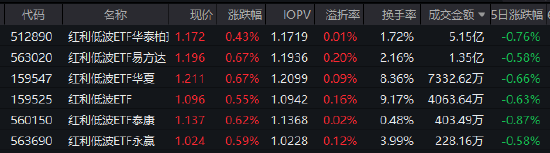
Core Viewpoint - The market experienced fluctuations with the ChiNext Index rising over 2% at one point, while the Shanghai Composite Index closed up by 0.87%. In this context, the Huatai-PineBridge Low Volatility ETF (512890) increased by 0.43%, closing at 1.172 yuan, with a turnover rate of 1.72% and a trading volume of 5.15 billion yuan, leading its category [1][6]. ETF Performance - The Huatai-PineBridge Low Volatility ETF (512890) reported a trading volume of 154.12 billion yuan over the last 20 trading days, averaging 7.71 billion yuan per day. Since the beginning of the year, the total trading volume reached 250.40 billion yuan, with an average of 8.08 billion yuan per day [2][7]. - The ETF has seen significant net inflows, with 3.6 billion yuan in the last 5 trading days, 9 billion yuan in the last 10 days, 29.2 billion yuan in the last 20 days, and 48.6 billion yuan in the last 60 days [2][7]. Top Holdings - The top ten holdings of the Huatai-PineBridge Low Volatility ETF include major companies across various sectors such as banking, food and beverage, home appliances, and pharmaceuticals. Notable holdings include Shanghai Bank, Nanjing Bank, Ping An Bank, and Gree Electric Appliances, with a total market value of approximately 6.72 billion yuan, accounting for 25.34% of the ETF's total market value [2][7]. Market Outlook - Multiple institutions have expressed optimistic views on the post-holiday market and dividend strategies. CITIC Securities believes that the A-share market, primarily driven by manufacturing and finance, will be less affected by AI disruptions compared to US and Hong Kong markets, suggesting a continuation of the spring rally [4][9]. - Guotai Junan Securities noted that with China's economic policy focusing on domestic demand, investor pessimism towards traditional domestic industries is likely to be corrected, contributing to a more stable economic outlook for 2026 [4][9]. Investment Strategy - The Huatai-PineBridge Low Volatility ETF, established on December 19, 2018, has achieved a return of 76.88% over the past five years, outperforming its benchmark and ranking 51st among 909 funds. Investors are encouraged to consider regular investment strategies to mitigate volatility risks [10].
开工即登榜 美菱荣获安徽省制造业发明专利50强
Sou Hu Wang· 2026-02-24 08:19
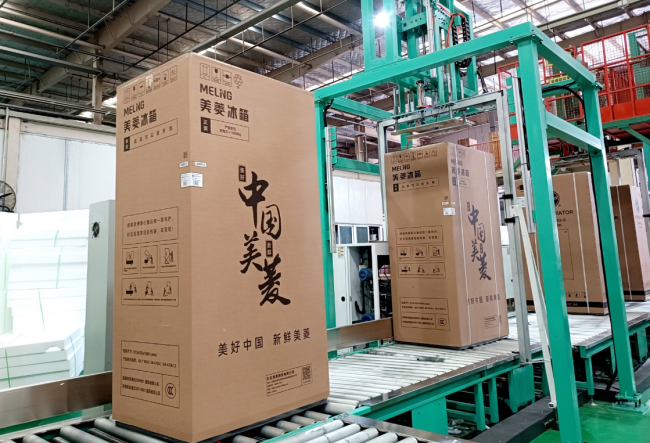
Core Viewpoint - Meiling has been recognized as one of the top 50 manufacturing patent holders in Anhui Province for the third consecutive year, showcasing its strong innovation capabilities and commitment to technological advancement [1][3]. Group 1: Innovation and Development - Innovation is a key driving force for the company's development and is one of its core operational principles [3]. - Meiling has developed new refrigerator models, such as the M Fresh Ultra570S and Ultra501S, featuring five major preservation technologies, establishing itself as a pioneer in full-scene preservation refrigerators [3]. - The company has also focused on its washing machine products, launching the Hand Wash Big Whale series, and has expanded into small kitchen appliances with the Little Wind Wing series, addressing user needs through technological innovation [3]. Group 2: Historical Achievements - Meiling has a history of innovation, being the first to produce various types of refrigerators, including China's first large freezer and the world's first four-door refrigerator [5]. - The company emphasizes that being recognized as a top patent holder is a new starting point, highlighting the need for continuous innovation to meet diverse user demands and maintain market leadership [5]. Group 3: Future Directions - In 2026, Meiling plans to accelerate technological innovation, focusing on improving product structure and driving sustainable development through technology [5]. - The company aims to set a new benchmark for the home appliance industry in China and provide innovative solutions for global users [5].

概率驱动的行业轮动决策框架:基于胜率与盈亏比的行业博弈策略
Huafu Securities· 2026-02-24 08:04
Group 1 - The report emphasizes a probability-driven approach to industry rotation, treating industry indices as repeatable gaming objects rather than one-time market judgments, focusing on win rates and profit-loss structures to assess long-term gaming value [3][12][14] - A counter-cyclical selection mechanism is introduced, which utilizes historical performance memory for weak industries, allowing for the retention of industries with reversal potential during rotation and style shifts [4][35] - The application of the Kelly formula optimizes weight distribution among selected industries, enhancing capital efficiency and long-term return quality while maintaining the selection results [5][42] Group 2 - The report outlines a basic win rate scheme based on a 24-month window, indicating that this mid-term win rate is more stable and sustainable for future returns compared to shorter periods [17][18] - The performance results show an annualized excess return of 9.6% since 2015, with a smoother return path, indicating a shift from phase-based betting to pricing long-term success capabilities [39][46] - The strategy demonstrates a systematic preference for consumer-related industries, particularly in home appliances, food and beverage, and pharmaceuticals, driven by win rates and profit-loss structures [57] Group 3 - The report highlights the importance of using comprehensive profit-loss indicators to enhance signal effectiveness, allowing for a more stable assessment of industry performance [39][46] - The strategy's weight distribution is designed to favor high win rate and high profit-loss ratio industries, improving both return stability and risk-adjusted returns [46][47] - The analysis indicates a low turnover rate, suggesting that the strategy does not chase market hotspots but rather relies on rational selection based on win rates and profit-loss metrics [57] Group 4 - The report identifies a high concentration in industry selection, with notable frequencies in sectors such as non-ferrous metals, food and beverage, and home appliances [55] - Recent holdings reflect a focus on industries with potential for recovery, indicating a strategic approach to capitalizing on past successful sectors [56] - The findings suggest that the strategy is not overly dependent on specific industries, as it maintains a diversified approach while still achieving significant returns [58]
金鹰基金:节后关注科技成长+顺周期+高股息的“三角组合”
Xin Lang Cai Jing· 2026-02-24 05:57
Core Viewpoint - The spring market excitement for 2026 has partially shifted to January, with a round of growth style realization before the festival, combined with regulatory easing and significant ETF outflows. It is expected that the overall index in February will mainly fluctuate, with a stronger performance anticipated after the festival. In this environment, a "structure-first, index-second" approach may be more suitable [1][8]. Group 1: Investment Focus Areas - **Technology Growth: AI + Humanoid Robots**: Focus on midstream components (gear reducers, servo motors, sensors, actuators), core materials, and some main body manufacturers. The resonance between the Spring Festival Gala and overseas world model progress may lead to a shift from "event-driven" to "scene landing" throughout the year. The computing chain includes storage chips, optical modules, PCB/IC substrates, and data center distribution and liquid cooling in power equipment, directly supporting the capital expenditure expansion of overseas cloud vendors. It is recommended to focus on large-cap leaders and some high-growth niche leaders while controlling overall valuation and position concentration to prevent short-term crowded trades and overseas volatility-induced pullbacks [2][9]. - **Cyclical Price Increases: Oil, Petrochemicals + Non-ferrous Metals + Building Materials/Chemicals**: Due to the rebound in oil prices and bulk commodity prices, marginal improvement in PPI, and the rhythm of the "14th Five-Year Plan" infrastructure commencement, it is suggested to pay attention to oil, petrochemicals, and oil and gas services. Additionally, focus on non-ferrous metals like copper and aluminum, steel building materials, and some chemical products with more sustainable price increases [3][10]. - **High Dividend Yield: Banks + Energy + Telecom/Public Utilities**: Before the festival, A-shares showed a clear preference for dividend and defensive sectors due to external disturbances and regulatory easing, with banks and food and beverage sectors being favored. After the festival, it may be beneficial to continue using high-dividend sectors like banks, energy, telecom, and public utilities as a base, which can hedge against overseas volatility and geopolitical risks while providing stable absolute returns in the context of macroeconomic stabilization and strong dividend yield and valuation attractiveness [4][11]. - **Domestic Consumption: Automotive Chain + Home Appliances + Travel Consumption**: Supported by the old-for-new policy and Spring Festival consumption data, the automotive and automotive electronics, home appliances, and white goods components benefit from the old-for-new policy and sales recovery. In the context of rising external demand and tariff uncertainties, these consumption directions, which are mainly driven by domestic demand and are policy-friendly, may exhibit both defensive and offensive characteristics [5][12].
消费电子巨头松下撤退,将欧美电视销售移交创维,该合作将于4月1日生效
Xin Lang Cai Jing· 2026-02-24 03:57
Core Viewpoint - Panasonic Holdings has officially announced that it will transfer its television sales business in North America and Europe to Chinese home appliance manufacturer Skyworth Group starting from April 2026, while focusing on the domestic market in Japan and the development and production of high-end models [1] Group 1 - Panasonic will fully hand over its television sales operations in North America and Europe to Skyworth Group [1] - The transition is set to take effect in April 2026 [1] - Panasonic aims to concentrate on the Japanese domestic market and the research and development of high-end television models [1]