建筑

Search documents
魔幻开局!唐罗主义与百年孤独!
Ge Long Hui· 2026-01-05 00:53
马杜罗政权的跌宕起伏,只是南美百年宿命的又一次精准重演。 左翼以反美口号裹挟福利民粹,用短期利益绑架民意; 右翼靠出卖国家主权换取霸权扶持,垄断核心资源中饱私囊。 看似针锋相对的政治博弈,实则都是逃避发展本质的短视自毁之路,一步步将委内瑞拉推向万劫不复的 深渊。 左右翼拉扯只是表象,拉美困局的死结,是从未深耕生产力、革新生产关系,终究逃不出自强缺位的循 环。 "多年以后,面对行刑队,奥雷里亚诺·布恩迪亚上校将会回想起父亲带他去见识冰块的那个遥远的下 午。" 马尔克斯这句独白,是南美宿命的绝佳注脚。 加拉加斯夜空被直升机轰鸣声撕裂,警笛与人群的嘈杂交织,马杜罗"闪电被捕"的仓促结局,不过是这 片大陆百年轮回中又一帧荒诞又真实的魔幻画面,与马尔克斯笔下的叙事如出一辙。 这个手握全球17%石油储量的国家,曾靠滚滚油流跻身富裕之列,街头椰林掩映着繁华商圈,民众一度 享受着石油红利带来的优渥生活。 如今,却深陷恶性通胀与极端贫困的双重泥沼,货架空空如也,货币贬值如废纸,霸权、失序、内耗三 重枷锁紧紧缠身。 01 霸权枷锁: 从门罗主义到唐罗主义的百年掠夺 南美走到如今这步无解的境地,从不是一时的意外,而是百余年累积的沉 ...
多维度掘金2026 26只潜力股出炉
证券时报· 2026-01-05 00:25
Core Viewpoint - The article highlights the optimistic outlook for the A-share market in 2026, emphasizing the selection of 26 potential stocks across various categories, driven by favorable earnings expectations and market conditions [2][5][11]. Group 1: Market Outlook - The A-share market is expected to experience a structural bull market in 2026, transitioning from a technology-driven focus to a more balanced growth across sectors [5][6]. - Major indices are projected to see significant gains, with the Shanghai Composite Index expected to rise by 12% by the end of 2026 [7]. - The overall market sentiment is supported by positive macroeconomic policies, improving fundamentals, and a steady influx of capital [6][9]. Group 2: Earnings Growth - Forecasts indicate that the net profit growth rates for the CSI 300 index are expected to reach 9.18% and 9.23% for 2026 and 2027, respectively, while the ChiNext index is projected to grow by 30.52% and 22.98% [9]. - The profitability of non-financial companies in the A-share market is anticipated to stabilize, driven by rising producer prices [9]. - Goldman Sachs predicts a more optimistic profit growth of 14% and 12% for 2026 and 2027, respectively [9]. Group 3: Selected Potential Stocks - Data Treasure has identified 26 potential stocks for 2026, categorized into six cyclical stocks, five AI technology stocks, five undervalued dividend stocks, five domestic recovery stocks, and five overseas chain stocks [2][11]. - The cyclical stocks are expected to benefit from price increases due to the Federal Reserve's interest rate cuts and recovering producer prices [11][13]. - AI technology stocks are selected based on their anticipated strong performance in the TMT sector, with companies like SiTwei-W and Hohhot Information being highlighted [14]. Group 4: Investment Themes - The investment themes for 2026 include AI technology, high-end manufacturing, cyclical recovery, and domestic consumption recovery, with dividend stocks serving as a stable foundation [12][17]. - The focus on dividend stocks is reinforced by their high predicted dividend yields, with companies like Jianghe Group expected to have a dividend yield close to 6% [15]. - The potential stocks exhibit diverse characteristics, balancing growth potential and defensive qualities to navigate market volatility [17].

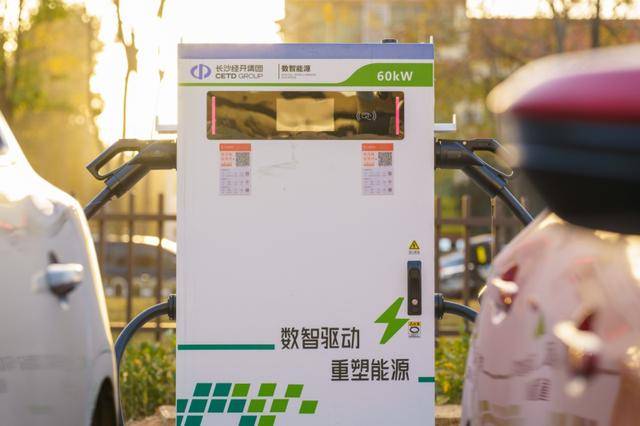
长沙经开集团:以深度市场化改革激活国企高质量发展
Sou Hu Cai Jing· 2026-01-05 00:18
Core Viewpoint - The year 2025 marks a critical juncture for the deepening reform of state-owned enterprises, with Changsha Economic and Technological Development Group (hereinafter referred to as Changsha Group) undertaking comprehensive market-oriented transformation across various dimensions to drive regional economic development [1] Group 1: Reform and Organizational Restructuring - Changsha Group has initiated a "true reform" approach by reshaping its organizational mechanisms to facilitate market-oriented transformation [2] - The company has restructured its business framework to focus on "large investment, large construction, large capital, large operations, and large intelligent manufacturing," addressing issues such as low marketization and long management chains [2] - The group has achieved over 30% reduction in the number of subsidiaries and an 18% optimization rate in middle management personnel, while also compressing management levels from five to three [2] Group 2: Performance and Compensation System - The performance and compensation reform emphasizes a "profit-based" approach, linking employee income directly to performance and efficiency [3] - A strict system has been implemented where "increased efficiency leads to increased pay, while decreased efficiency results in reduced pay," ensuring that income is closely tied to contributions [3] Group 3: Strategic Business Expansion - The restructuring has laid the groundwork for strategic business expansion, with subsidiaries targeting new markets and business models for growth [4] - The company has successfully attracted 43 quality industrial projects, with total investment reaching 7.5 billion yuan, transitioning from policy-driven to value-driven investment strategies [4] Group 4: Service Optimization and Value Creation - Changsha Group is evolving from a provider of infrastructure to an enabler of industrial development, enhancing its service offerings to improve the regional business environment [10][11] - The company has implemented a comprehensive service model that includes policy consulting and resource integration, supporting the growth of enterprises within its ecosystem [10] Group 5: Risk Management and Safety - Risk management is prioritized as a cornerstone of high-quality development, with a multi-dimensional risk control network established to ensure sustainable reform [12] - The group has innovated financing tools to optimize its debt structure, achieving an 11.78% reduction in average financing costs compared to the previous year [12] - Safety production measures have been strictly enforced, resulting in zero accidents over multiple years and numerous industry awards for quality and safety [13]
8点1氪:雷军回应“小字营销”:确实是行业陋习;宇树科技:未涉及申请“绿色通道”相关事宜,上市工作正常推进;罗马仕启动重组方案
36氪· 2026-01-04 23:59
Core Viewpoint - Lei Jun, the chairman of Xiaomi Group, acknowledged the issue of "small print marketing" as a common industry practice and committed to immediate rectification, emphasizing that compliance measures should not be misinterpreted as false or excessive marketing [4][5]. Group 1: Xiaomi's Response to Marketing Practices - Lei Jun stated that "small print marketing" is an industry flaw that Xiaomi will correct starting now [4]. - He clarified that some practices used for compliance should not be labeled as misleading marketing, which he views as a significant misunderstanding of Xiaomi [4]. - Xiaomi's assistant, Xu Jieyun, mentioned that the use of small print in promotional materials has been a common practice, but they have overlooked consumer perceptions [5]. Group 2: Industry Developments - Xiaomi aims to deliver 550,000 cars by the end of 2026, focusing more resources on automotive development [16]. - The company has introduced a safety feature in its vehicles called "wheel loss protection," which is designed to enhance safety by allowing wheels to detach under certain conditions [16]. - The overall market for electric vehicles is expected to grow, with companies like Enchem entering long-term supply agreements to boost production capabilities [13].
老城区委经济工作会议召开
Sou Hu Cai Jing· 2026-01-04 17:08
Core Viewpoint - The meeting emphasized the importance of economic work for 2026, marking the beginning of the "15th Five-Year Plan," focusing on high-quality development and the integration of cultural tourism and good governance as key strategies for economic growth [5][6][8]. Group 1: Economic Performance and Achievements - The year 2025 was highlighted as a significant year for the old city, with economic operations showing stability and growth, driven by strong leadership and effective implementation of policies [4]. - The "People's Cultural Tourism" brand gained national recognition, with rapid expansion of related industries and successful awards for tourism excellence [4]. - Infrastructure improvements and urban renewal efforts were noted, enhancing city functions and quality, alongside effective management of idle assets and a growing number of market entities [4]. Group 2: Strategic Focus for 2026 - The overall economic work requirement for 2026 includes adherence to Xi Jinping's economic thought and the implementation of a comprehensive development strategy [5]. - Key tasks include promoting high-quality development, expanding domestic demand, optimizing supply, and enhancing the integration of cultural tourism with local governance [5][7]. - The meeting outlined ten priority areas, including employment stability, education enhancement, healthcare improvements, and cultural tourism development, aimed at fostering economic resilience and social stability [7][9]. Group 3: Policy Implementation and Governance - The meeting stressed the need for strong party leadership in economic development, ensuring that policies are effectively implemented and adapted to local conditions [8]. - Emphasis was placed on creating a favorable political and economic environment to stimulate innovation and collaboration across sectors [8]. - The importance of risk management and safety in production was highlighted, with a focus on preventing systemic risks and ensuring social stability [6][9].

2026年-周期怎么看
2026-01-04 15:35
Summary of Key Points from Conference Call Records Industry Overview - **Construction and Building Materials Industry**: The overall situation shows that orders are relatively sufficient, but funding remains a core constraint on companies' output. Despite the initiation of major projects by the government, these investments are unlikely to yield significant growth due to the vast existing infrastructure stock. [2][3] Core Insights and Arguments - **Investment Recommendations**: - For traditional infrastructure, companies with high dividends and low valuations are recommended, such as China State Construction, Sichuan Road and Bridge, Tunnel Shares, and China National Materials. These companies have strong core competitiveness and stable operations. [2] - In the consumer building materials sector, leading companies are increasing market share and stabilizing operations. Companies like Oriental Yuhong and Rabbit Baby are suggested for left-side positioning. [2][3] - The rise of AI is expected to increase demand for high-end products from companies like China Jushi and China National Materials Technology. [2][3] - **Real Estate Sector**: - The real estate industry is expected to remain a significant stabilizer for the economy, with annual new housing construction projected between 10 million to 14 million units. [2][17] - The development model is shifting towards integrated products, services, and operations, with a focus on housing services and second-hand property transactions. [17][19] - Companies with strong cash flow and comprehensive capabilities, such as China Resources Land and Jinfa Co., are recommended. [20] Additional Important Insights - **Transportation Sector**: - The transportation industry showed positive performance during the 2025 New Year holiday, with significant increases in passenger flow and sales in duty-free shopping. [4][5] - The airline sector is expected to perform well during the 2025 Spring Festival, with ticket prices projected to increase. Companies like Juneyao Airlines and China Spring Airlines are recommended. [5] - **Express Delivery Industry**: - The express delivery sector is viewed positively, especially in overseas markets, with recommendations for Jitu Express and Jiayou International. [6][8] - Domestic express delivery data is pending verification for January and February, with current volumes showing no significant growth. [6] - **Metals and Commodities**: - Recent trends indicate a general increase in prices for non-ferrous metals, with notable rises in diamonds, nickel, and silver. [11] - The investment focus for 2026 includes copper, aluminum, and lithium, driven by macroeconomic policies and supply constraints. [14] - **Coal Sector**: - The coal sector has seen a slight decline but is showing signs of stabilization, with demand from electricity generation and steel production remaining high. [15][16] Conclusion - The conference call highlighted various sectors with distinct investment opportunities and challenges. The construction and real estate sectors are undergoing significant transformations, while transportation and express delivery industries are poised for growth. The non-ferrous metals market is also experiencing upward trends, suggesting potential investment avenues.
周期论剑|新年周期打头阵-思路详解
2026-01-04 15:35
Summary of Key Points from Conference Call Industry Overview - **A-Share Market Performance**: The Shanghai Composite Index rose by 18.41% in 2025, indicating a positive market outlook for 2026, driven by expectations of U.S. interest rate cuts and increased liquidity in overseas markets [2][3]. - **Chemical Industry**: The chemical sector showed strong performance in 2025, with expectations of continued growth into 2026, as supply pressures ease and some products see price increases [10][11]. - **Aviation Industry**: The aviation sector experienced a 13% increase in passenger traffic during the New Year period, with ticket prices rising over 10% year-on-year. Future growth is anticipated due to low supply growth and recovering demand [6]. - **Oil Shipping Industry**: The oil shipping sector is at a four-year high, driven by increased oil production. The next five years are expected to see continued demand growth [8][9]. Core Insights and Arguments - **Market Trends**: The A-share market is expected to benefit from several factors, including anticipated U.S. interest rate cuts, a stable and appreciating RMB, and supportive policies for investment and real estate [2][3]. - **Price Increase Logic**: Price increases are emerging in sectors like chemicals and new energy materials due to improved demand and constrained supply. The TMT supply chain is also experiencing price hikes due to demand expansion [4]. - **Investment Recommendations**: - **Technology Growth**: Positive outlook for technology sectors, including internet, electronics, and power equipment [5]. - **Non-Banking Financials**: Favorable conditions for insurance and brokerage firms [5]. - **Cyclical Sectors**: Sectors benefiting from domestic demand and stable real estate policies, such as tourism and consumer goods, are recommended [5]. Additional Important Insights - **Industrial Metals**: The industrial metals market is optimistic for 2026, with supply disruptions and increased demand from AI and traditional sectors driving growth [15]. - **Chemical Sector Recommendations**: Key companies to watch include Hualu Hengsheng in coal chemicals and leading firms in the refrigerant and new materials sectors [11]. - **Coal Market Outlook**: The coal market is expected to stabilize, with prices projected to rise in the latter half of 2026 after a period of decline [22][24]. - **Real Estate Sector**: The real estate sector is receiving renewed attention from policymakers, indicating potential recovery and investment opportunities in leading companies [25]. This summary encapsulates the key points discussed in the conference call, highlighting the performance and outlook of various industries, along with strategic investment recommendations.
建筑行业周报:核电大模块渗透率有望提升驱动需求放量、安全主线继续重点推荐利柏特,国产替代提速叠加海外持续景气、继续看多洁净室-20260104
GF SECURITIES· 2026-01-04 09:39
Core Viewpoints - The report emphasizes the expected increase in the penetration rate of nuclear power modules, which is anticipated to drive demand growth, with a continued focus on safety, recommending Libat for investment [1][9][14] - The domestic and overseas demand for cleanroom projects remains robust, despite recent stock price corrections, indicating a positive outlook for companies in this sector [1][9][32] Group 1: Nuclear Power Modules - Libat's Nantong base is highlighted for its strategic location, which enhances its transportation capabilities for large industrial modules, crucial for nuclear power construction [14][17] - The report notes that from 2022 to 2025, there has been a sustained approval pace for nuclear power projects in China, with a total of 41 units approved, including 28 units of the Hualong One design, which constitutes about 68% of the total [23][29] - The construction of the Ningde Nuclear Power Phase II project marks a significant milestone in modular construction technology, showcasing the shift towards integrated module design [29][30] Group 2: Cleanroom Sector - Companies such as Taiji Industrial, Bocheon, Yaxiang Integration, and Shensanda A have secured contracts for cleanroom projects, benefiting from increased capital expenditures in Southeast Asia and the U.S. [32][34] - The report highlights that Taiji Industrial has won multiple contracts for cleanroom projects with Longxin Technology, with project values reaching approximately 26.2 million, 50.5 million, and 6.7 million CNY [33][34] - The cleanroom sector is expected to see further order growth as Longxin Technology prepares for its IPO, which could lead to increased demand for related services [32][34] Group 3: Coal Chemical Projects - The report indicates that coal chemical projects are progressing steadily, with significant milestones achieved, such as the safety completion of the ethylene oxide reactor for a high-end chemical materials project in Shaanxi [38] - Steel prices for rebar and medium-thick plates have remained stable, with slight decreases noted, reflecting the current market conditions [38] Group 4: Financial Tracking - The report mentions that as of December 25, 2025, 18 regions have announced local bond issuance plans totaling 1.37 trillion CNY, indicating a significant increase in the issuance of special bonds compared to the previous year [5][6] - The financial landscape shows a notable increase in the issuance of new special bonds, while the net financing of urban investment bonds has decreased, reflecting changing funding dynamics in the industry [5][6]

超级工程 重塑四川经济地理
Xin Lang Cai Jing· 2026-01-03 22:19
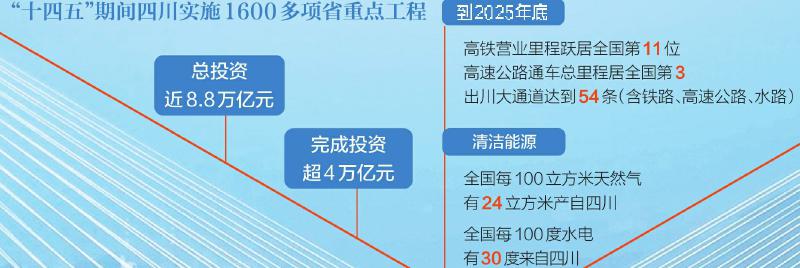
Core Viewpoint - Sichuan is undergoing a significant transformation through the implementation of over 1,600 key projects during the "14th Five-Year Plan" period, with a total investment of nearly 8.8 trillion yuan, reshaping its economic geography and enhancing its infrastructure capabilities [4][16]. Infrastructure Development - The completion of the Jinshajiang-Hubei ±800 kV UHVDC project allows clean energy to be transmitted over 1,900 kilometers in just 0.006 seconds, marking a milestone in energy transmission [3]. - The Leshan to Xichang expressway, which opened on December 31, 2025, features a high bridge-tunnel ratio of 82% and incorporates innovative snow-melting technology for high-altitude sections [3]. - Sichuan has built over 3,000 kilometers of new expressways in the past five years, connecting 15 previously isolated counties to national transport networks [7]. Transportation Achievements - The province's railway network has expanded significantly, with over 7,000 kilometers of operational railways, including the newly opened Chengdu-Yibin high-speed railway, which has transported over 29 million passengers in two years [6][8]. - The total length of highways in Sichuan has surpassed 11,000 kilometers, ranking third nationally, while the overall transportation network reaches 443,000 kilometers, the largest in the country [7]. Energy Sector Advancements - Sichuan has become the first province in China to exceed 100 million kilowatts in hydropower installed capacity, equivalent to 4.5 Three Gorges dams, capable of supplying electricity to approximately 500 million people [11]. - The province's clean energy initiatives include the completion of major hydropower projects and the establishment of new energy transmission corridors, enhancing its role in national energy security [11][12]. Economic Impact - The construction of these mega-projects has stimulated the development of Sichuan's equipment manufacturing and construction industries, with local firms expanding their operations internationally [16]. - Sichuan's strategic location and infrastructure improvements are expected to facilitate greater integration into national and international markets, enhancing its economic competitiveness [9][10].
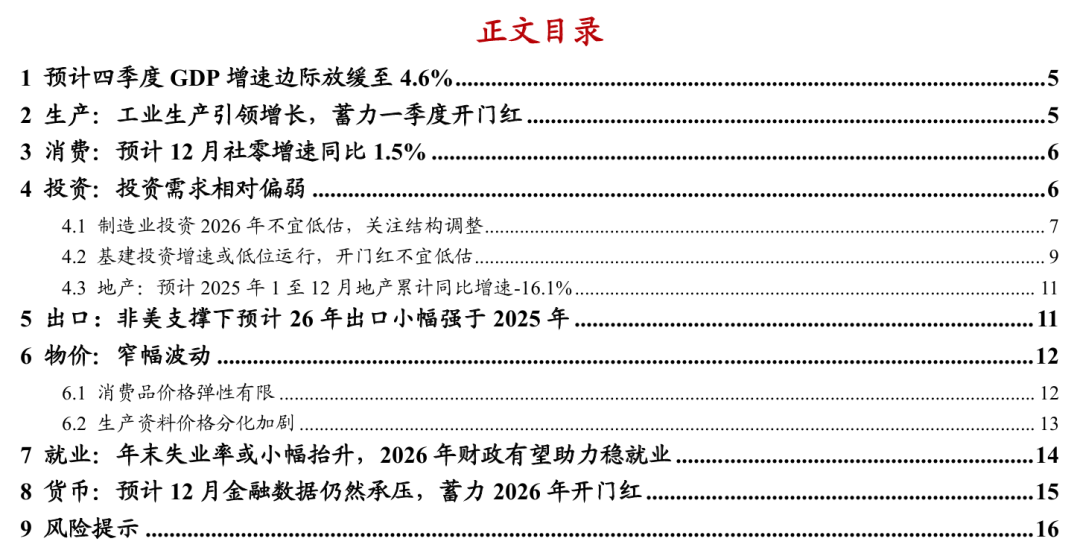
【浙商宏观||李超】12月经济前瞻:工业生产引领增长,蓄力一季度开门红
Xin Lang Cai Jing· 2026-01-03 09:59
炒股就看金麒麟分析师研报,权威,专业,及时,全面,助您挖掘潜力主题机会! (来源:李超宏观研究与资产配置) 分析师:李超/林成炜/廖博/何佳烨/潘高远/费瑾/王瑞明 研究助理:汤子玉 具体参见2026年1月2日报告《12月经济前瞻:工业生产引领增长,蓄力一季度开门红——2025年12月宏观数据预测》,如需报告全文或数据底稿,请联系 团队成员或对口销售。 全文约16000字,阅读大约需要36分钟 我们预计2025年四季度GDP同比增速为4.6%,经济运行呈现生产偏强、需求修复偏温和的格局:供给端,工业生产延续稳增长态势,对增长形成主要支 撑;需求端,12月社零同比预计小幅回升,以旧换新资金前置与元旦"拼假"效应对消费构成托底,但汽车在销量同比下滑与年末加大折扣导致的量价双压 下仍是主要拖累。投资端仍处低位,制造业投资相对有韧性,但基建偏弱、地产继续承压,制约内需弹性。外需保持韧性,出口增速预计维持正增长。价 格层面,CPI温和、PPI负值收敛但通胀修复仍偏缓。金融数据仍显示信用扩张偏弱,M1、M2增速小幅回落。综合来看,一方面,12月经济活动相较上月 总体加快,12月随着内外需修复及年底各行业年度收官冲刺,有望 ...