美妆

Search documents
【毛戈平(1318.HK)】与路威凯腾达成战略合作,进一步迈向全球化——与路威凯腾达成战略合作框架协议点评(姜浩/朱洁宇/孙未未)
光大证券研究· 2026-01-08 23:04
Core Viewpoint - 毛戈平 has signed a strategic cooperation framework agreement with L Catterton, aiming to enhance global market expansion, acquisitions, strategic investments, capital structure optimization, talent introduction, and governance [4]. Group 1: Strategic Cooperation - The agreement will leverage L Catterton's global investment network to assist 毛戈平 in expanding its high-end retail channels overseas [4]. - Both parties plan to establish a private equity investment fund focused on the global high-end beauty sector, injecting new momentum into 毛戈平's long-term development [4]. - Collaboration will also occur in optimizing capital structure, talent acquisition, and governance [4]. Group 2: L Catterton's Investment Expertise - L Catterton manages approximately $39 billion in equity capital across private equity, credit, and real estate platforms, with extensive experience in the beauty and personal care brand sectors [5]. - The firm has invested in over 300 globally recognized consumer brands, with individual investments ranging from $5 million to $5 billion [5]. - L Catterton has a global presence with 18 offices and over 200 investment and operational experts, continuously creating differentiated value for its portfolio [5].


【光大研究每日速递】20260109
光大证券研究· 2026-01-08 23:04
Group 1: Financial Data and Trends - The expected new loans for December are projected to be around 0.8 to 1 trillion, with a loan growth rate near 6.3% [5] - Social financing growth is anticipated to be around 8.3%, influenced by seasonal credit expansion and increased loan write-offs [5] - M2 growth is expected to stabilize with potential increases due to heightened fiscal spending, while M1 growth may be relatively moderate due to high base effects [5] Group 2: Industry Insights - China National Offshore Oil Corporation (CNOOC) has established a comprehensive marine energy development system, focusing on conventional and deep-water oil and gas, LNG, and offshore wind power [6] - CNOOC aims to enhance oil and gas reserves and production, drive technological innovation, and transition towards a new energy system, contributing to the construction of a marine power nation [6] - Sinopec, as a major oil and gas producer and refiner, is transitioning from a fossil fuel giant to a leader in green transformation, aligning with national energy strategies [7] Group 3: Company Developments - Shuanglin Co., Ltd. has expanded its automotive parts business through acquisitions and is now focusing on screw rod business, which is expected to drive future growth [8] - Maogeping has entered a strategic cooperation framework with the global consumer investment firm, RWC, to enhance global market expansion and optimize capital structure [8]

华源晨会精粹20260108-20260108
Hua Yuan Zheng Quan· 2026-01-08 14:17
Automotive Industry - The year 2026 is expected to witness the operational launch of Tesla's Robotaxi without safety drivers and the rollout of the FSD unsupervised version, with accelerated commercialization in regions like Europe and Southeast Asia [2][6] - A key focus for Tesla's Robotaxi is the expansion of its fleet size; achieving a rapid increase to over 1,000 vehicles could indicate a feasible path from L2 to L4 autonomy [2][6] - The importance of the foundational model in the VLA framework is anticipated to continue rising, with stronger computing power supporting larger parameter models and higher frame rates [2][6][8] - The integration of line-controlled chassis is expected to reduce execution control latency, with "computing power expansion + chassis line control" becoming a hardware foundation for advancements in autonomous driving capabilities [2][6] M&A Activity in North Exchange - In 2025, the North Exchange saw a total of 58 equity transactions, with a total transaction value of 2.7 billion yuan, indicating a trend of "reduced quantity but improved quality" in equity trading [11][12] - The majority of transactions were concentrated in the technology manufacturing sectors, particularly in machinery and electronics, while the number of mergers in the new energy sector decreased significantly [11][12] - Notable large-scale acquisitions included a 890 million yuan private placement acquisition by Chuangyuan Xinke, marking a record for the year [11][12] New Consumption Sector - The company Mao Ge Ping (01318.HK) announced a voluntary share reduction plan, with major shareholders planning to reduce their holdings by up to 3.51% of the total issued shares within six months [14][15] - The proceeds from the share reduction will be used for investments in the beauty industry and personal improvements, with the company's major shareholders expressing confidence in its development [14][15] - A strategic cooperation framework agreement was signed with L Catterton Asia Advisors to establish a private equity fund focused on the global high-end beauty sector [14][15] Chemical Industry - Jinhua New Material - Jinhua New Material (920015.BJ) focuses on the ketoxime series of fine chemicals and has established a unique "oxime-oxime silane-hydroxylamine salt" industrial chain [18][19] - The company has achieved a compound annual growth rate of 28% in revenue from 2018 to 2024, with projected revenue of approximately 1.24 billion yuan in 2024 [18][19] - Hydroxylamine solution is a key product for entering the semiconductor chemicals market, with significant potential for domestic substitution [20][21]
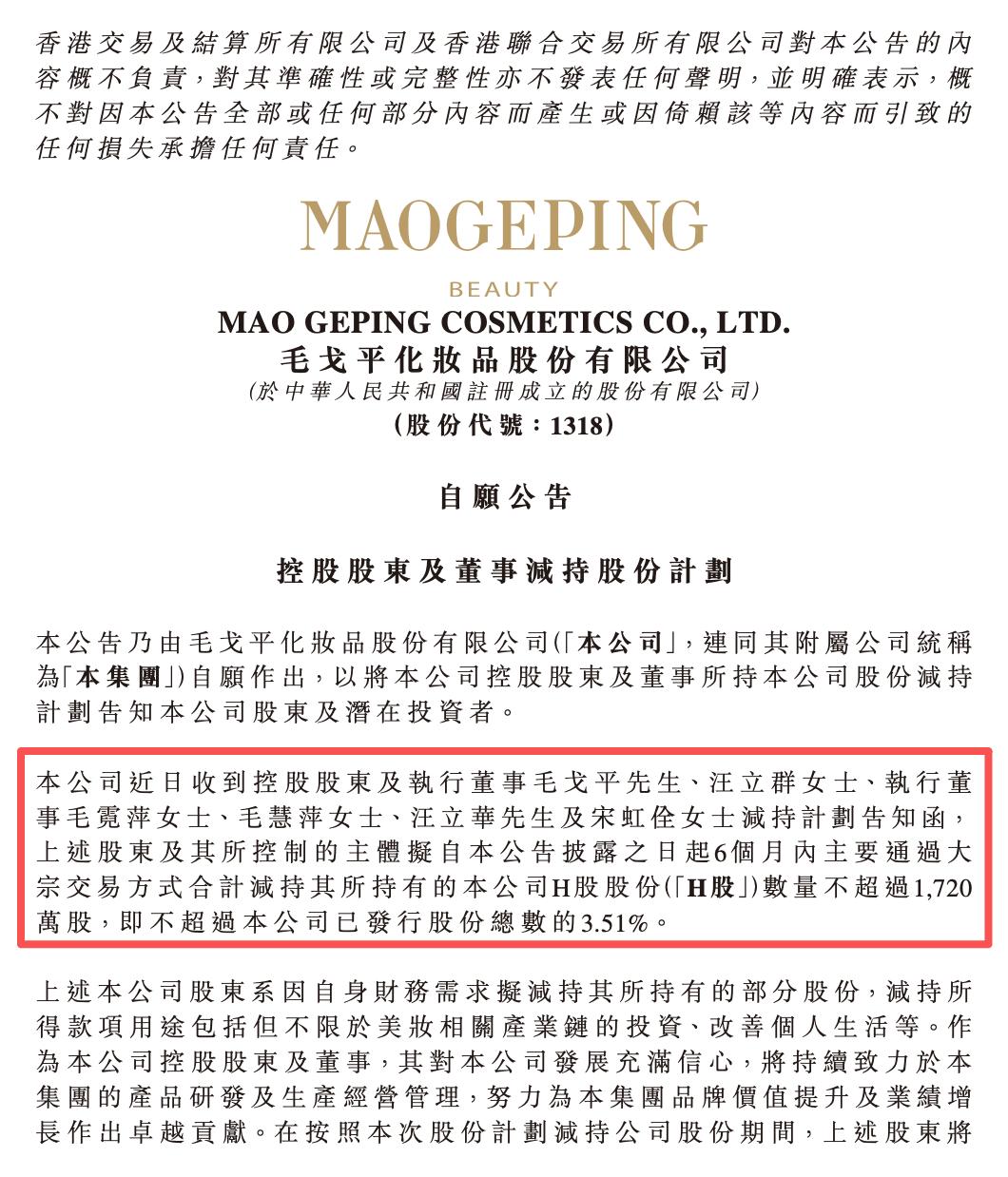
上市刚满一年披露减持计划 毛戈平家族拟套现约14亿港元
Mei Ri Jing Ji Xin Wen· 2026-01-08 13:37
Group 1 - The core point of the news is that the controlling shareholder and several executive directors of Mao Geping Cosmetics plan to collectively reduce their holdings by up to 17.2 million H shares, accounting for no more than 3.51% of the company's total issued shares, due to personal financial needs [1][2] - The planned reduction is expected to raise approximately 1.4 billion HKD based on the closing price of 82 HKD per share on the announcement date [1] - Despite the reduction, the company emphasizes that it will not lead to a change in control or significantly impact governance and ongoing operations [1][2] Group 2 - The beauty industry is experiencing frequent reduction plans, with Mao Geping's announcement occurring just after its first anniversary of listing, amidst a backdrop of declining valuations in the domestic beauty market [2][3] - Mao Geping's stock price peaked at 130.6 HKD per share, but has since fallen by about 33%, resulting in a market cap loss of nearly 20 billion HKD [2] - The company reported a revenue of 2.588 billion CNY for the first half of 2025, a year-on-year increase of 31.3%, and a net profit of 670 million CNY, up 36.1%, although revenue growth has begun to slow [2][7] Group 3 - The domestic beauty industry is shifting from an incremental market to a stock market, with a high entry and elimination rate among brands [6] - High-end beauty products are becoming a significant focus, with sales growth for products priced over 1,000 CNY increasing by 531.6% during the 2025 Double Eleven shopping festival [6] - Mao Geping maintains a high gross margin of over 80%, but faces scrutiny over its low R&D investment, which was only 15.257 million CNY in the first half of 2025 [7] Group 4 - The company is characterized by a high degree of founder centralization, with Mao Geping's personal brand being integral to the company's identity and operations [4][5] - The company is constructing a research and development center in Hangzhou, expected to be completed by the end of 2026, to enhance product design and development capabilities [7] - Balancing family wealth management with corporate growth while addressing R&D shortcomings and reducing dependence on the founder will be crucial for the company's sustained presence in the high-end beauty market [7]
13000+场线下实战之后,丸美把实体渠道做成了增长引擎
FBeauty未来迹· 2026-01-08 13:30
Core Viewpoint - The beauty industry is experiencing a complex relationship with offline channels, as brands are increasingly returning to physical stores despite the challenges posed by online growth saturation and declining advertising efficiency [2][3]. Group 1: Offline Market Trends - As of the first three quarters of 2025, the total number of CS stores in China reached 136,000, with 38,000 new stores opened in that period. Although sales saw a 2.8% year-on-year decline, the decrease has significantly narrowed, indicating a strong recovery signal in offline beauty retail [2]. - The decline in the number of department store beauty counters has also slowed to nearly 30%, suggesting a stabilization in the offline beauty market [2]. Group 2: Marubi's Offline Strategy - Marubi's founder and CEO, Dr. Sun Huaqing, emphasized a proactive approach to offline channels, advocating for continuous investment and long-term development, encapsulated in the four key terms: faith, belief, trust, and confidence [3][14]. - In 2025, Marubi launched five major new products and conducted numerous promotional events, including a nationwide "One-Day Store Manager" tour across 24 cities, which effectively converted online interest into offline store visits [5][12]. Group 3: Product and Consumer Engagement - Marubi's strategy focuses on a value chain that combines product, emotion, and experience to encourage consumer visits and conversions in stores [5][12]. - The introduction of innovative products, such as the "Small Gold Needle Hydrating Mask" and "Big Red Shield Sunscreen," addresses specific consumer needs and enhances in-store experiences [6][9][8]. Group 4: Emotional and Experiential Marketing - Marubi's marketing campaigns, such as the collaboration with spokesperson Yang Zi for International Women's Day, aim to empower women and deepen the brand's commitment to feminist themes [10]. - The brand also partnered with contemporary artist Song Santu for the Eye Cream Festival, adding emotional and cultural depth to its products [10][11]. Group 5: Building Trust and Confidence - Marubi's approach to trust involves maintaining a collaborative relationship with distribution channels, ensuring clear product strategies and stable pricing, which fosters sustainable partnerships [18][13]. - The company's confidence stems from its strong research capabilities and understanding of market trends, positioning offline channels as essential for long-term investment [20][26]. Group 6: Research and Development Strength - Marubi's commitment to R&D is evident in its substantial patent portfolio, with 673 patent applications and 384 granted, which supports its ability to innovate and maintain a competitive edge [20][24]. - Collaborations with 33 universities and research institutions have enhanced Marubi's understanding of Chinese skin, further solidifying its market position [21][24]. Group 7: Future Outlook - In 2026, Marubi plans to refine its offline strategy by focusing on core product lines and enhancing emotional marketing, while continuing to engage consumers through salons and promotional activities [26][28]. - The brand views offline channels not merely as a supplementary strategy but as a primary focus for future growth, emphasizing the importance of sustained investment in physical retail [28].


若特朗普在最高法院败诉,进口商或将掀起1500亿美元关税退款争夺战
Xin Lang Cai Jing· 2026-01-08 12:52
Core Viewpoint - The U.S. Supreme Court is expected to rule on the legality of tariffs imposed by former President Donald Trump, which could lead to a $150 billion refund battle for importers seeking to reclaim previously paid tariffs [1][9]. Group 1: Legal Context and Implications - Trump is the first U.S. president to impose tariffs under the International Emergency Economic Powers Act (IEEPA), typically used for sanctions against hostile nations [2][11]. - As of December 14, tariffs imposed under this act have generated approximately $133.5 billion in revenue, nearing $150 billion based on recent averages [2][11]. - The Supreme Court's ruling could invalidate these tariffs, but there are concerns that the government may resist refunding the collected amounts [1][9]. Group 2: Refund Process and Electronic Reforms - The U.S. Customs and Border Protection (CBP) announced a shift to electronic refunds starting February 6, which aims to streamline the refund process [3][12]. - This electronic system is expected to reduce errors and fraud, although it does not guarantee a fully automated refund process [3][12]. - The potential scale of refunds is unprecedented for the CBP, which typically manages large tax refunds but has not dealt with such a significant tariff refund scenario [3][12]. Group 3: Legal Actions and Market Reactions - Some companies, including Costco and others, have preemptively filed lawsuits to secure their rights to refunds, fearing that without judicial intervention, they may not recover the tariffs paid [6][14]. - Smaller companies are opting to sell their refund claims in a burgeoning secondary market at steep discounts, with some claims selling for as low as 9% of their face value [7][15]. - Companies are advised to maintain detailed transaction records and act quickly to ensure they can claim refunds if the Supreme Court rules in their favor [7][15]. Group 4: Industry Perspectives - Executives express skepticism about the likelihood of receiving refunds, citing concerns over government reluctance to return funds [1][10]. - The trade representative indicated that even if tariff revenues decline, the government could introduce new tariffs under different legal authorities to compensate for lost revenue [4][13]. - Companies are preparing for a potentially lengthy wait for refunds, with expectations that processing could take years [8][16].
毛戈平携手路威凯腾 全球化发展提速
Zheng Quan Ri Bao Wang· 2026-01-08 12:45
Core Insights - 毛戈平化妆品股份有限公司 has signed a strategic cooperation framework agreement with L Catterton to enhance global market expansion, acquisitions, strategic investments, capital structure optimization, and talent introduction [1][3] - The company reported strong performance in Q4 2025, driven by consumer recovery and brand upgrades, with a clear global growth trajectory [1] - 毛戈平's online penetration continues to rise, complementing offline high-end counters, forming a "dual engine" for growth [1] Financial Performance - In H1 2025, 毛戈平's makeup business revenue reached 1.422 billion yuan, a year-on-year increase of 31.1%, while skincare revenue was 1.087 billion yuan, up 33.4% [1] - The company is actively expanding high-value product categories, launching two premium perfume series, which are crucial for its global strategy [1] Product Development - 毛戈平 continues its "high-end + differentiation" strategy, with new skincare series "琉光赋活" targeting higher-priced and more loyal consumer segments [2] - The new lip product, air warehouse lip glaze 808, has gained popularity on social media, enhancing the brand's influence in the lip category [2] Brand Strategy - 毛戈平 is deepening its differentiation in Oriental aesthetics through significant marketing events, such as the "Belt and Road" themed event and innovative product launches that blend cultural elements with beauty products [2] - The opening of the first flagship store in Hong Kong has shown promising operational data, indicating potential for further expansion into Southeast Asia and beyond [2] Strategic Partnership - L Catterton, managing approximately $39 billion in equity capital, will assist 毛戈平 in expanding overseas high-end retail channels and forming a global beauty investment fund [3] - The partnership reflects 毛戈平's commitment to entering the global high-end market, enhancing its international presence and influence [3]

自然堂集团与上海自然博物馆共启“美与自然共生”生物多样性主题展
Zheng Quan Ri Bao Wang· 2026-01-08 12:41
Group 1 - The core viewpoint of the article highlights the collaboration between Shanghai Natural堂 Group and Shanghai Natural History Museum to launch a biodiversity-themed exhibition titled "Beauty and Nature Coexist" [1] - The exhibition aims to integrate the beauty industry with science education and natural sciences, promoting public scientific communication and sustainable consumption concepts through a new model of "cultural tourism + industrial tourism" [1] - The exhibition, centered around the theme of "harmonious coexistence between humans and nature," features immersive experiences that combine scientific displays, interactive experiences, and artistic collaboration, running until March 15 [1] Group 2 - The exhibition showcases the results of the "Natural Coexistence" annual public science project from the Shanghai Natural History Museum and introduces a customized "Natural Treasure Box" for the Fengxian district, merging beauty technology with natural science [1] - The company plans to deepen its collaboration with the Shanghai Natural History Museum to explore new pathways for linking the beauty industry with science education, nature conservation, and sustainable development [1] - The initiative aims to promote consumption while contributing to the construction of a "Beautiful China" and a "Technologically Strong Nation," providing the public with innovative experiences that blend science, art, and beauty in life [1]
特朗普想要的,被李在明抢先一步,难怪他用4个字回味访华
Sou Hu Cai Jing· 2026-01-08 11:51
Core Insights - The visit of South Korean President Lee Jae-myung to China marks a significant advancement in Sino-Korean trade relations, potentially making U.S. President Trump's aspirations for increased Chinese purchases of American goods seem less attainable [1][5]. Group 1: Trade Agreements - During Lee's visit, South Korea and China signed 24 export contracts worth approximately $4.411 million, equivalent to about 30.8 million yuan [3]. - The agreements span traditional sectors as well as emerging markets such as future technology, robotics, and Korean beauty products, indicating a broadening of trade cooperation [3]. - The collaboration between South Korea's New World Group and Chinese companies aims to sell quality Korean products worth 1 trillion won annually through Chinese online platforms over the next five years [3]. Group 2: Economic Growth - The trade volume between China and South Korea has surged from $6.5 billion at the time of diplomatic relations to $272.9 billion, reflecting a 40-fold increase [3]. - China is now South Korea's largest trading partner, while South Korea ranks as China's second-largest trading partner, highlighting the depth of their economic ties [3]. Group 3: Future Cooperation - Lee emphasized future cooperation in manufacturing innovation and cultural exchanges, showcasing the strong friendship between the two nations [5]. - The successful outcomes of Lee's visit are expected to create more opportunities for Korean products in the Chinese market, potentially leading to a new wave of consumer interest in Korean goods [9]. - The agreements reached during this visit may serve as a model for other countries looking to enhance their trade relations with China [9].

套现14亿港元,毛戈平家族减持反引股价大涨7.26%
3 6 Ke· 2026-01-08 11:51
Core Viewpoint - The major shareholders of the company, including founder Mao Geping and family members, plan to reduce their holdings by up to 17.2 million shares through block trades, amounting to approximately HKD 1.41 billion. The proceeds will be used for investments in the beauty industry and personal improvements. Despite this significant reduction, the stock price rose by 7.26% on the announcement day, indicating a complex market perception of the company's value and future concerns [3][4][6]. Group 1: Shareholder Actions - The reduction plan involves six key family members, including Mao Geping and his spouse, indicating a collective family governance structure [4]. - The proposed reduction represents 3.51% of the company's total issued shares, which will lower the family's holding to approximately 65%, just below the two-thirds control threshold [6]. - The timing of the reduction, shortly after the company's IPO and while the stock price remains significantly above the issue price, suggests a clear intention for personal financial needs [6] Group 2: Market Reaction - Typically, large shareholder reductions are viewed negatively, but the stock price's increase reflects a market perception that transcends the simple "sell-off equals bearish" logic [7]. - The company's strong financial performance, with a 31.3% year-on-year revenue growth to HKD 2.588 billion and a 36.1% increase in net profit to HKD 670 million, has mitigated the negative impact of the reduction announcement [7]. - The choice of block trades for the reduction is seen as a way to alleviate market concerns, as this method typically does not directly impact market prices and may involve long-term institutional investors [7][8]. Group 3: Long-term Concerns - Despite short-term performance supporting the stock price, the company faces long-term growth challenges due to its heavy reliance on marketing over research and development, with sales and distribution expenses significantly outpacing R&D investments [10]. - The beauty industry is shifting from "incremental competition" to "stock competition," with slowing growth and increasing price pressures, posing challenges for maintaining high margins in the premium segment [11]. - The brand's dependence on the founder's personal IP presents both a unique advantage and a potential risk, as the company attempts to diversify its product offerings beyond the founder's image [11][13].