动力电池

Search documents
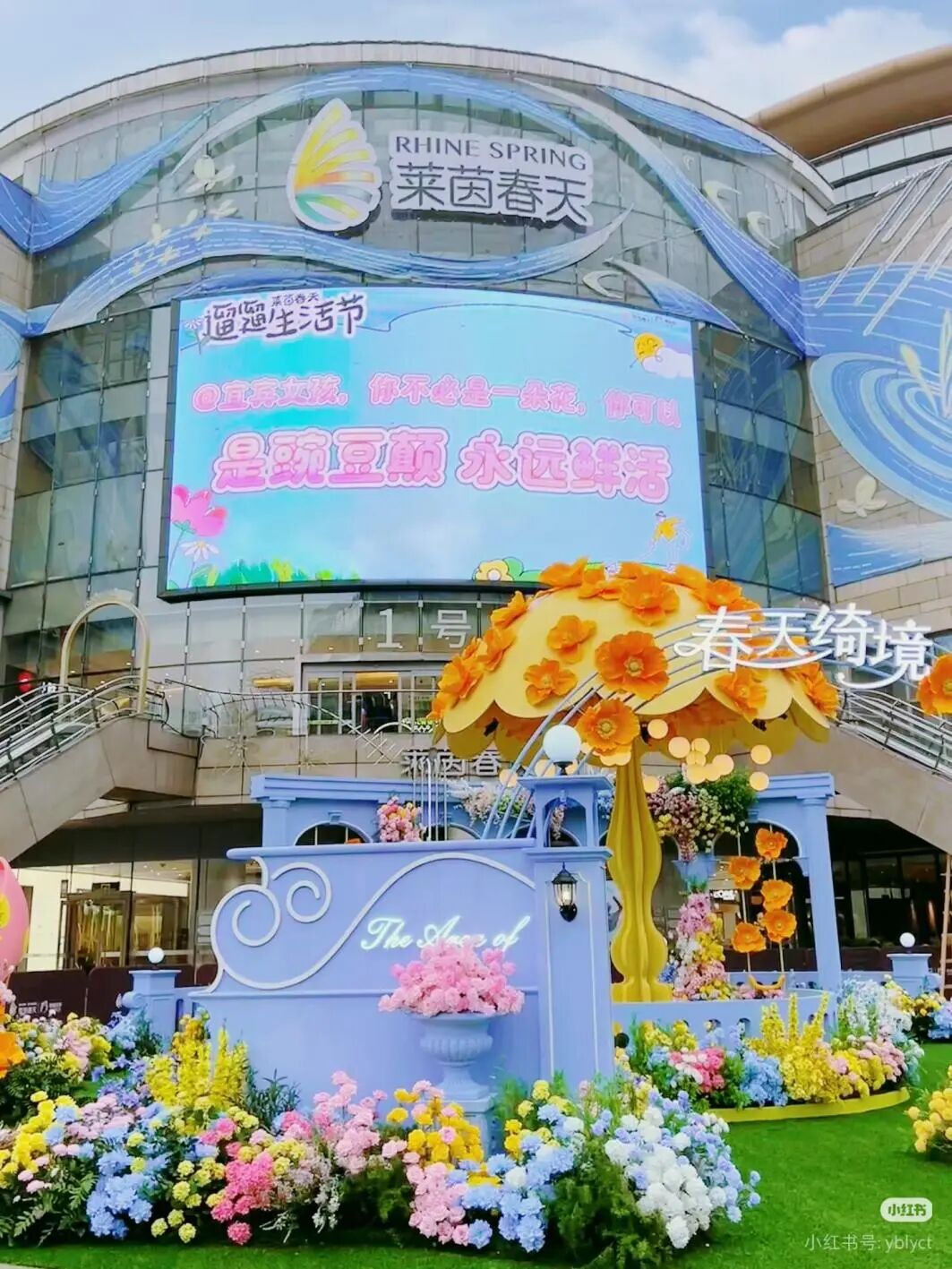
西南这座四线小城,华润、万达、新城、王府井抢着进!
3 6 Ke· 2025-12-09 22:27
Core Insights - Yibin, known as "China's Liquor Capital," has transformed into a popular tourist destination, expecting to receive 97.38 million visitors and generate 89.8 billion yuan in revenue by 2024 [1] - The city's GDP has surged from 152.59 billion yuan in 2015 to 400.58 billion yuan in 2024, marking a significant economic leap [1] - Yibin has shifted from a traditional industrial base of coal and liquor to new sectors like digital economy and green energy, branding itself as the "Power Battery Capital" [1] Economic Growth - Yibin's GDP growth reflects a strategic shift in its industrial structure, moving towards a dual focus on liquor and new energy sectors [1] - The city has established two major industrial clusters: liquor and power batteries, contributing to its economic transformation [1] Commercial Development - Yibin's commercial landscape has evolved significantly, with existing commercial space exceeding 1.24 million square meters, predominantly in the form of small to medium-sized retail [3] - The city has undergone three phases of commercial development: initial exploration (2009-2010), rapid expansion (2011-2015), and stable growth (2016-present) [4][10] Urban Structure - The urban commercial structure has been reshaped, with a focus on the core areas of Cuiping District and Xuzhou District, which are now the main commercial hubs [17] - Five major commercial zones have emerged, characterized by a blend of historical and modern elements, enhancing the city's commercial vitality [19] Young Population and Consumer Trends - The establishment of a university town has significantly increased the young population, with student numbers rising from 25,000 to 100,000, fostering a vibrant consumer base [29] - Young consumers are driving demand for diverse and experiential consumption, leading to the emergence of new retail formats and cultural experiences [29] Policy Initiatives - Yibin's government has implemented a comprehensive policy framework aimed at boosting consumption, with an estimated investment of 1 billion yuan to stimulate various sectors [30] - Specific measures targeting employment, trade, and tourism have been introduced to create a favorable environment for consumer spending [30] Tourism and Cultural Integration - Yibin's tourism sector has shown robust growth, with a significant increase in visitor numbers and spending, particularly during holiday periods [31] - The city is leveraging its cultural heritage and natural resources to enhance its tourism appeal, aiming to become a regional consumption center [31][32]


告别“黑马”标签!中创新航跻身全球TOP3,一场靠技术“蓄谋已久”的突围
高工锂电· 2025-12-09 13:11
Core Insights - The global power battery industry has reached a significant turning point, with the top three companies in installed capacity now all being Chinese firms [2] - The competition among leading Chinese battery manufacturers is shifting from a focus on scale and cost to defining technological trends, building industry ecosystems, and leading the global value chain [3][4] - The rise of CALB to the global top three highlights the need to redefine the height of the Chinese battery industry beyond mere scale [5] Group 1: Electrification Trends - The electrification market is maturing, with consumers globally unified in their pursuit of charging experience, emphasizing range and fast-charging capabilities [6] - CALB's core competency lies in its ability to translate industry consensus and trends into mass-producible technological solutions [7] - CALB's fast-charging battery technology, featuring a 5C supercharging capability, meets the core demand of consumers for "charging in 15 minutes for a range of 400 kilometers" [8] Group 2: Strategic Alliances - CALB's choice of partners reflects a high degree of consensus in technology philosophy and market judgment, particularly with high-growth new energy vehicle manufacturers [10] - A notable example is CALB's joint investment of 7.5 billion yuan with Leap Motor to establish a battery company, solidifying a long-term cooperative relationship based on shared strategic goals [11] - CALB's deep collaboration with XPeng Motors, where all models of the XPeng G7 are equipped with CALB's 5C supercharging battery, underscores their mutual commitment to advanced electrification and intelligent integration [12] Group 3: Delivery and Global Expansion - CALB has entered the supply chains of major global automotive groups such as Volkswagen, Hyundai, and Toyota, indicating trust in its manufacturing and quality control capabilities [14] - The recent decision by SAIC Audi to adopt CALB's battery solutions for its high-end electric model E5 Sportback demonstrates CALB's alignment with the demands of the premium electric vehicle market [15] - CALB's production capacity is strategically synchronized with the production and market plans of its global customers, ensuring agile responses to market needs [16] Group 4: China's Electrification Power - CALB's ascent signifies that Chinese battery companies have achieved a historic milestone by occupying the top three positions globally [22] - The evolution of Chinese power battery and new energy vehicle supply chain companies into a paradigm force reflects a fundamental shift in global electrification competition logic [23] - This transformation positions China as a leader in innovation and value creation in the electrification sector, moving from a manufacturing hub to a source of technological advancement [24]

今日财经要闻TOP10|2025年12月9日
Xin Lang Cai Jing· 2025-12-09 12:34
Group 1 - Trump announced that the U.S. government will allow Nvidia to sell its H200 AI chips to China, with a 25% revenue share for the U.S. on each chip sold [1][7][13] - Nvidia's stock rose by 1.2% in after-hours trading following the announcement, indicating positive market sentiment [1] - The decision marks a shift in U.S. policy, as the Trump administration previously restricted AI chip sales to China, representing a significant victory for Nvidia's CEO Jensen Huang [1][7] Group 2 - China's Ministry of Foreign Affairs responded to inquiries about the sale of H200 chips, emphasizing the importance of cooperation for mutual benefit [8] - The establishment of Beijing Guanghe Qiancheng Technology Co., Ltd. aims to explore strategic cooperation opportunities within the polysilicon industry [6] - The company has a registered capital of 3 billion and is set to focus on technology upgrades, market expansion, and cost optimization [6] Group 3 - Alibaba has formed a new C-end business group called Qianwen, aiming to develop a super app that serves as an AI assistant across various platforms [10] - The group consolidates previous business units and will focus on integrating AI into everyday applications [10] - The initiative reflects Alibaba's strategy to enhance user engagement and accessibility to AI technologies [10] Group 4 - The Chinese stock market showed a positive trend with the ChiNext Index rising by 1.07%, driven by strength in computing hardware sectors [4][11] - Various sectors, including CPO and retail, demonstrated significant activity, with multiple stocks hitting their daily limits [4][5] - The market's overall trading volume decreased by 353 billion compared to the previous day, indicating a potential shift in investor sentiment [4]

面向欧美,LG能源与奔驰签署近百亿电池供应合同
Zhong Guo Neng Yuan Wang· 2025-12-09 07:58
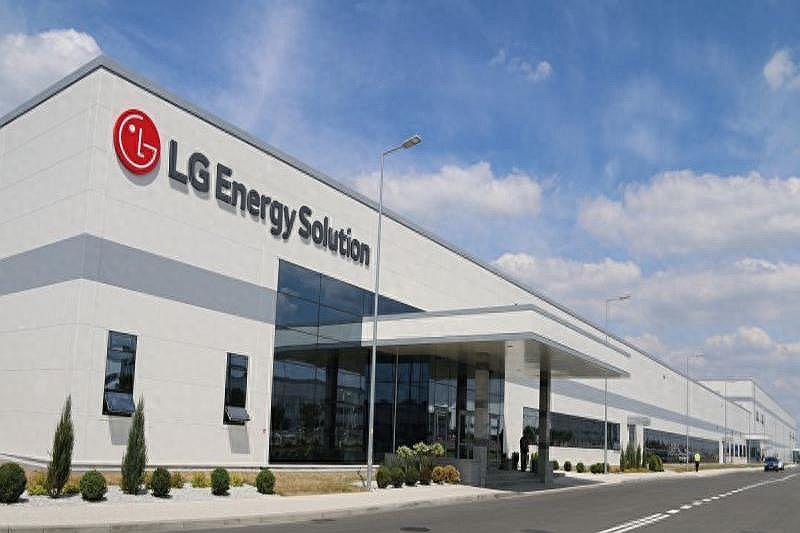
Core Insights - LG Energy has signed a contract with Mercedes-Benz Group for battery supply worth 2.06 trillion KRW (approximately 9.89 billion RMB), which represents 8% of LG Energy's total sales last year [1][3] Group 1: Contract Details - The contract stipulates that LG Energy will supply batteries to Mercedes-Benz's North American and European factories from March 2028 to June 2035, primarily for mid-range electric vehicles [3] - LG Energy previously signed contracts to supply 50.5 GWh of batteries to Mercedes-Benz in October last year, and additional contracts for 75 GWh and 32 GWh in September this year [3] Group 2: Market Position and Competition - LG Energy's main clients include Tesla and General Motors, and the company is currently building battery factories in the U.S. and Europe [3] - According to SNE Research, LG Energy ranked third in global battery installation volume with 79.7 GWh and a market share of 9.8% for the first three quarters of 2025, while CATL and BYD led with 36.6% and 17.9% market shares, respectively [3] - However, LG Energy's year-on-year growth rate of 14.7% in installation volume for the first three quarters is the lowest among the top ten battery manufacturers, only surpassing Samsung SDI, while six Chinese battery companies exceeded 30% growth [4]
中创新航晋级全球前三:多客户放量驱动高增长,护城河持续拓宽
Sou Hu Wang· 2025-12-08 13:59
维科网锂电报道,中创新航在2025年10月创下历史排名,位列全球动力电池装机量第三。分析指出,公 司精准的乘用车战略与多元化客户结构是其逆势超车的核心驱动力。除深耕广汽埃安、小鹏、零跑等存 量客户外,中创新航近期在智界、奥迪、丰田、现代等新平台产品的定点正加速转化为业绩。得益于全 球13大生产基地的产能释放及高压中镍三元产品,公司在行业竞争加剧的环境下展现出极强的"阿尔 法"收益能力。 ...
扩产来不及、不扩产跟不上,动力电池产能告急下进退两难
Zhong Guo Qi Che Bao Wang· 2025-12-08 09:19
Core Insights - The Chinese electric vehicle (EV) market is experiencing a "battle for battery supply" as companies rush to secure battery resources ahead of a significant tax policy change set to take effect on January 1, 2026 [2][3] - The impending reduction of the EV purchase tax from full exemption to a 50% reduction has triggered a surge in demand, leading to a scramble among automakers to lock in battery supplies [3][4] - The rapid growth in EV demand is creating a mismatch with battery production capacity, exacerbated by structural issues within the battery industry [2][5] Demand Surge - The demand for EVs has surged due to the impending tax policy change, with automakers offering purchase tax guarantees to customers to stimulate sales [3][4] - In the first ten months of 2025, China's EV production and sales reached 13.015 million and 12.943 million units, respectively, both showing over 30% year-on-year growth [4] - The domestic battery installation volume reached 84.1 GWh in October 2025, marking a 10.7% month-on-month increase and a 42.1% year-on-year increase [4] Supply Constraints - Battery production capacity is lagging behind demand, with a typical production line taking 18 months to become operational, and high investment costs of 150-200 million yuan per GWh [5] - The supply chain is further strained by rising prices of key raw materials like lithium carbonate, which increased by 20% year-on-year to 93,900 yuan per ton as of December 3, 2025 [5][10] - The current supply-demand mismatch is characterized as a structural issue rather than an absolute shortage, with experts predicting a return to more rational demand levels post-policy implementation [6] Technological Advancements - The battery industry is undergoing rapid technological innovation, with advancements in lithium iron phosphate and nickel-rich batteries posing challenges to existing production capacities [7][8] - The shift towards new battery technologies creates risks for production investments, as companies must adapt to avoid obsolescence [8] - The market is increasingly concentrated, with the top five battery manufacturers holding an 81.8% market share, indicating a decline in capacity utilization among smaller firms [8] Resource Allocation Challenges - The explosive growth of the energy storage sector is diverting battery production capacity, as both energy storage and EV batteries share similar technological resources [9][10] - Companies are prioritizing energy storage orders due to higher profit margins, which complicates the balance between energy storage and EV battery production [10] - The Chinese government is taking steps to regulate competition in the battery industry to promote high-quality development and address capacity allocation issues [10] International Market Dynamics - While the Chinese market faces battery supply shortages, the U.S. market is experiencing a contraction in battery projects due to concerns over oversupply and insufficient demand [11][12] - The disparity between the two markets is attributed to different stages of industry development, with China in a growth phase and the U.S. still in a cultivation phase [12] - Chinese battery companies are positioned to leverage their technological and cost advantages to expand into international markets, particularly in regions experiencing rapid EV growth [12]



记者观察 || 加强协同合作 构筑安全可控供应链
Zhong Guo Qi Che Bao Wang· 2025-12-08 09:19
动力电池产能吃紧的背后,是需求增长、技术迭代、资源分流和全球竞争等多重因素的综合作用。 记者认为,解决这一问题,不能仅依靠单一环节的努力,而需要整车企业、电池企业、原材料企业、政 府部门等多方协同,构建安全可控的供应链生态。 对于电池企业而言,精准的产能规划是核心。企业应建立常态化的市场监测机制,结合新能源汽车和储 能市场的发展趋势,科学预测需求增长,避免盲目扩产或扩产不足。同时,加大柔性产能建设投入,提 升产线对技术迭代的适应性,降低产能闲置风险。在技术研发方面,应聚焦固态电池、钠离子电池等下 一代技术,提前布局相关产能,抢占未来市场先机。 整车企业与电池企业的深度协同至关重要。当前,车企与电池厂的绑定合作模式已成为行业趋势,比亚 迪与自身整车业务的协同、宁德时代与特斯拉的长期合作,都证明了这种模式的有效性。双方可通过联 合研发、长期协议、股权合作等方式,稳定供需关系,共同应对技术迭代和市场波动。例如,车企可提 前向电池企业反馈车型规划和技术需求,帮助电池企业精准布局产能;电池企业则可将技术研发方向与 车企需求相结合,提升产品匹配度。 上游原材料产业的配套升级是基础。原材料企业应加快扩产步伐,尤其是锂、镍、 ...
中国酒都”奔向“万亿产业高地
Zheng Quan Shi Bao· 2025-12-07 19:12
Core Viewpoint - Yibin is leveraging its unique geographical advantages and forward-looking policy layout to diversify its industrial base beyond traditional sectors like liquor and coal, focusing on digital economy and green energy industries, which are expected to drive economic growth and elevate its position in Sichuan province [1][2]. Group 1: Economic Development - Yibin's economic output is projected to exceed 400 billion yuan in 2024, ranking third in Sichuan province, with expectations for further improvement in its ranking [1]. - The city is positioned as a key node in the Western Land-Sea New Corridor, enhancing its logistics capabilities and reducing shipping times for large goods [2]. Group 2: Financial Innovation and Support - Yibin has introduced a collaborative development strategy combining "industrial chain + fund + scenario," establishing a fund matrix exceeding 60 billion yuan [3]. - The city has seen a continuous increase in loan balances, leading the province in growth rates, with annual increments exceeding 100 billion yuan [3]. - Specialized financial products have been developed to cater to the diverse needs of enterprises, including low-interest loans for green projects and innovation financing for tech companies [3]. Group 3: Emerging Industries - Yibin is establishing a modern industrial system with a focus on digital economy and green energy, forming a robust new energy landscape with power batteries, crystalline silicon photovoltaics, and new energy storage [4]. - The city has become a major hub for the power battery industry, with production capacity reaching 180 GWh and significant contributions to the global market [4][6]. - Yibin's new energy storage sector is rapidly developing, with production value expected to rise from 5 billion yuan to over 10 billion yuan [6]. Group 4: Traditional and New Industry Synergy - The traditional liquor industry is successfully integrating with emerging sectors like power batteries and digital economy, creating a mutually beneficial relationship that enhances overall competitiveness [7]. - Yibin's traditional industries are providing foundational support and expertise to new sectors, while innovations in new industries are feeding back into traditional sectors, creating a synergistic effect [7][8]. Group 5: Cultural and Brand Integration - Yibin is working to combine its rich liquor culture with new energy technology to create unique tourism experiences, enhancing brand influence and cultural significance [8][9]. - The city is organizing events that promote cultural integration, such as the "Rose Wedding" and collaborative activities with neighboring cities, fostering community engagement and brand recognition [9].

“中国酒都”奔向“万亿产业高地”
Zheng Quan Shi Bao· 2025-12-07 17:56
Core Viewpoint - Yibin is leveraging its unique geographical advantages and forward-looking policy layout to diversify its economy beyond traditional industries, focusing on digital economy and green energy sectors, thus injecting new momentum into urban industrial upgrades [1][2]. Economic Growth - In 2024, Yibin's economic output is expected to exceed 400 billion yuan, ranking third in Sichuan province, with optimistic projections for further improvement in its ranking [2]. - The dual development of traditional and emerging industries is accelerating Yibin's rise as a significant player in the trillion-yuan battery industry [2]. Policy and Infrastructure - Yibin benefits from its strategic location along the Yangtze River, facilitating efficient transportation and becoming a key node in the new western land-sea corridor [3]. - The city has introduced a collaborative development strategy involving "industry chain + fund + scenario," establishing a fund matrix exceeding 60 billion yuan to support industrial growth [4]. Financial Innovation - Yibin has launched various financial products tailored to different enterprise needs, including "innovation loans" for tech companies and low-interest loans for green projects, contributing to a robust financial ecosystem [4]. - The city has seen a continuous increase in loan balances, leading the province in growth rates, with annual increments exceeding 100 billion yuan [4]. Emerging Industries - Yibin is establishing a modern industrial system with a focus on digital economy and green energy, particularly in the fields of power batteries, crystalline silicon photovoltaics, and new energy storage [5]. - The city has become a global leader in power battery production, with a capacity of 180 GWh and a significant share of the global market [5][6]. Industry Collaboration - Yibin has attracted over 120 upstream and downstream projects in the power battery sector, creating a comprehensive green industrial chain [6]. - The city is set to host the 2025 World Power Battery Conference, which will feature 180 green energy projects with an estimated total investment of 86.13 billion yuan [6]. Storage Market Development - Yibin is actively developing its new energy storage industry, with signed agreements for 18 GWh of storage system capacity and a projected increase in output value from 5 billion yuan to over 10 billion yuan [7]. - The crystalline silicon photovoltaic industry in Yibin has achieved a production value of 299.9 billion yuan in the first ten months of the year, marking a 34.5% year-on-year increase [7]. Synergy Between Traditional and Emerging Industries - Yibin is fostering a collaborative environment where traditional industries like liquor production and emerging sectors such as power batteries mutually benefit from shared resources and expertise [8]. - The integration of traditional and new industries is expected to enhance Yibin's competitive edge, creating a multiplier effect on its economic growth [8]. Ecological Collaboration - Yibin is aligning its industrial development with "dual carbon" goals, utilizing new energy technologies to enhance traditional industries, such as applying battery storage technology in liquor production [9]. - The city is promoting a green ecosystem by incorporating ESG criteria into supplier assessments and establishing a comprehensive green supply chain [9]. Cultural and Tourism Integration - Yibin is planning to merge its liquor culture with new energy technology to create unique tourism experiences, enhancing brand influence and economic synergy [9][10]. - The city is organizing events that celebrate both its cultural heritage and technological advancements, aiming to attract tourism and investment [10].

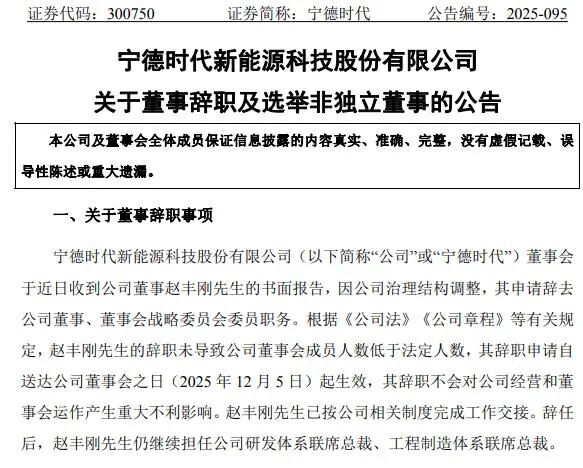
宁德时代赵丰刚辞去董事职务:仍担任董事研发联席总裁,去年薪酬331万元持股约24万股,毕业中科大
Xin Lang Cai Jing· 2025-12-07 15:05
(来源:读懂10万+) 12月7日消息,宁德时代(证券代码:300750)发布公告称,董事赵丰刚因公司治理结构调整,其申请 辞去公司董事、董事会战略委员会委员职务。辞任后,赵丰刚仍继续担任公司研发体系联席总裁、工程 制造体系联席总裁。 待遇方面,赵丰刚直接持有公司14,924股A股股份,其持有公司已授予但尚未行权的53,728份A股股票期 权及已授予但尚未归属的174,175股A股限制性股票。去年薪酬331.3万元。 待遇方面,赵丰刚直接持有公司14,924股A股股份,其持有公司已授予但尚未行权的53,728份A股股票期 权及已授予但尚未归属的174,175股A股限制性股票。去年薪酬331.3万元。 赵丰刚2024年12月26日被选举为公司董事。今年59岁,主要负责公司研发及工程制造体系管理。赵先生 于2015年12月加入公司,担任公司工程副总裁至2019年12月,目前为公司研发体系及工程制造体系联席 总裁,并于2024年12月起担任董事。在加入公司之前,赵先生曾(i)在中国石化集团南京化学工业公司担 任高级工程师;(ii)在东莞新科磁电厂担任高级工程师;(iii)在东莞新能源科技有限公司担任研发总监; 及( ...