
铁矿石

Search documents
中国布局了整整15年,终于对西方铁矿定价权,发动了致命一击
Sou Hu Cai Jing· 2025-12-17 18:05
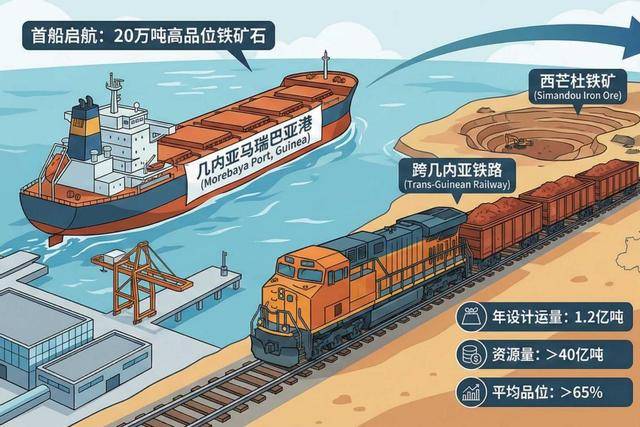
Core Viewpoint - The successful launch of the Simandou iron ore project marks a significant shift in China's iron ore supply strategy, potentially reducing reliance on Australian and Brazilian mining companies [1][16]. Group 1: Project Launch and Infrastructure Development - A cargo ship carrying 200,000 tons of high-grade iron ore departed from Guinea's Marrebaya port, indicating the official commencement of the Simandou iron ore project after 15 years of planning [1][3]. - The project benefited from China's infrastructure capabilities, with China Railway constructing a 650-kilometer railway and China Harbour Engineering building the Marrebaya deep-water port, which has a capacity of 120 million tons per year [5][8]. - The railway and port construction utilized modular construction techniques, significantly reducing the timeline for completion [5][7]. Group 2: Historical Context and Stakeholder Dynamics - Chinese companies gradually gained control over the Simandou project, starting with a 2010 agreement between Chalco and Rio Tinto, leading to the formation of a consortium in 2011 [12][14]. - A pivotal moment occurred in 2019 when a consortium of Chinese firms invested $14 billion to secure the northern block, marking the first time Chinese companies held a dominant position in the project [14]. - By 2024, China Baowu Steel purchased a 49% stake from the winning alliance, establishing a balance of power among Baowu, Rio Tinto, and the Guinean government [14][16]. Group 3: Market Impact and Strategic Significance - The Simandou project is expected to account for approximately 5% of global iron ore supply and 10% of China's imports, which could weaken the market dominance of Australian and Brazilian firms [16]. - Recent changes in pricing strategies, such as BHP accepting payments in RMB, indicate an increase in China's influence over iron ore pricing [16]. - The project enhances China's long-term steel supply security, allowing for potential exports to emerging markets in Southeast Asia and Africa in the future [18][20]. Group 4: Collaborative Model and Global Strategy - The success of the Simandou project is attributed not only to financial investment and technology but also to a balanced approach to local partnerships, creating jobs and improving infrastructure in Guinea [20][22]. - This model of cooperation helps avoid accusations of neo-colonialism while ensuring that local governments and communities benefit from resource development [20][22]. - The launch of the Simandou project exemplifies China's dual strategy of resource security and global governance, showcasing the evolution of Chinese companies from participants to leaders in international projects [22].


银河期货铁矿石日报-20251217
Yin He Qi Huo· 2025-12-17 12:03
研究所 黑色研发报告 | | 今日 | 昨日 | 涨跌 | | 今日 | 昨日 | 涨跌 | | --- | --- | --- | --- | --- | --- | --- | --- | | DCE01 | 788.5 | 783.5 | 5.0 | I01-I05 | 20.5 | 22.5 | -2.0 | | DCE05 | 768.0 | 761.0 | 7.0 | I05-I09 | 22.5 | 21.5 | 1.0 | | DCE09 | 745.5 | 739.5 | 6.0 | I09-I01 | -43.0 | -44.0 | 1.0 | | 现货 | 昨天 | 前天 | 涨跌 | 折标准品 | 01厂库基差 | 05厂库基差 | 09厂库基差 | | PB粉(60.8%) | 779 | 773 | 6 | 846 | 54 | 77 | 98 | | 纽曼粉 | 781 | 776 | 5 | 854 | 63 | 85 | 107 | | 麦克粉 | 780 | 774 | 6 | 861 | 70 | 92 | 114 | | 金布巴粉(60.5%) | 736 | 731 ...
黑色产业链日报-20251217
Dong Ya Qi Huo· 2025-12-17 09:40
1. Report Industry Investment Rating No relevant content provided. 2. Core Views of the Report - After the Central Economic Work Conference, the macro - positive factors faded, and steel pricing reverted to fundamentals. Supply is affected by iron - water production cuts, but profit rebounds may slow down the cut - off speed. Demand is seasonally weak due to shrinking real - estate steel use and construction restrictions, and new export regulations suppress export expectations. The overall trend of steel is oscillating weakly [3]. - After macro - events, the trading logic of iron ore has returned to fundamentals. With restrained shipments from major mines, falling freight rates, low steel - mill inventories, and high coking - coal production and inventory, the downside of iron - ore prices is limited [21]. - For coking coal, supply changes are limited, but steel - mill profit pressure leads to iron - water production cuts. Coking enterprises control procurement, and mine inventory pressure is increasing, so short - term coal prices will be under pressure. For coke, production has declined slightly due to environmental protection. After two rounds of price cuts, if there is no policy intervention, coke supply - demand may deteriorate, and prices may continue to fall [31]. - The fundamentals of ferroalloys are weak, but news from relevant departments has led to a price rebound. However, price increases may stimulate enterprises to hedge, suppressing prices [46]. - With the strengthening of new - capacity production expectations, the over - supply expectation of soda ash is intensifying. Glass cold - repair is accelerating, weakening the rigid - demand expectation. Although exports are high, high upper - and middle - stream inventories restrict prices [60]. - From December to before the Spring Festival, some glass production lines may be cold - repaired, affecting far - month pricing. Near - month contracts will follow the delivery logic, and currently, high intermediate inventories and off - season demand create pressure on spot prices [83]. 3. Summary by Related Catalogs 3.1 Steel 3.1.1 Futures Prices and Spreads - On December 17, 2025, the closing prices of rebar and hot - rolled coil contracts showed minor fluctuations compared to the previous day. For example, the rebar 01 contract closed at 3095 yuan/ton, up 5 yuan from the previous day [4]. - The month - spreads of rebar and hot - rolled coil also changed slightly. The rebar 01 - 05 month - spread was 11 yuan/ton on December 17, up 2 yuan from the previous day [4]. 3.1.2 Spot Prices and Basis - On December 17, 2025, the summary prices of rebar and hot - rolled coil in different regions showed little change. The summary price of rebar in China was 3299 yuan/ton, up 4 yuan from the previous day [9]. - The basis of rebar and hot - rolled coil in different regions was mostly negative or showed a downward trend. For example, the 01 rebar basis in Shanghai was not available on December 17, while it was 190 yuan/ton the previous day [9]. 3.1.3 Other Ratios - The ratios of rebar to iron ore and rebar to coke remained stable on December 17, 2025, compared to the previous day. For example, the 01 rebar/01 iron ore ratio was 4 [18]. 3.2 Iron Ore 3.2.1 Futures Prices and Basis - On December 17, 2025, the closing prices of iron - ore contracts increased slightly compared to the previous day. The 01 contract closed at 788.5 yuan/ton, up 5 yuan [22]. - The basis of iron - ore contracts decreased. The 01 basis was - 0.5 yuan/ton, down 1.5 yuan from the previous day [22]. 3.2.2 Fundamental Data - From November 14 to December 12, 2025, the average daily iron - water production decreased by 7.68 tons, the 45 - port shipping volume decreased by 7.76 tons, and the global shipment volume increased by 76.1 tons [25]. 3.3 Coking Coal and Coke 3.3.1 Futures Spreads and Ratios - On December 17, 2025, the month - spreads of coking coal and coke contracts changed. For example, the coking coal 09 - 01 month - spread was 162.5 yuan/ton, down 8 yuan from the previous day [34]. - The coking profit on the disk was 21 yuan/ton, up 17.353 yuan from the previous day [34]. 3.3.2 Spot Prices and Profits - On December 17, 2025, the spot prices of coking coal and coke in different regions mostly remained unchanged or decreased slightly. The ex - factory price of Anze low - sulfur coking coal was 1500 yuan/ton, unchanged from the previous day [37]. - The immediate coking profit was 21 yuan/ton, up 3 yuan from the previous day [37]. 3.4 Ferroalloys 3.4.1 Silicon Iron - On December 17, 2025, the silicon - iron basis in Ningxia was - 76 yuan/ton, down 94 yuan from the previous day. The silicon - iron 01 - 05 month - spread was - 62 yuan/ton, down 14 yuan [47]. - The silicon - iron spot prices in different regions showed minor changes. The silicon - iron spot price in Ningxia was 5220 yuan/ton, down 30 yuan from the previous day [47]. 3.4.2 Silicon Manganese - On December 17, 2025, the silicon - manganese basis in Inner Mongolia was 132 yuan/ton, down 22 yuan from the previous day. The silicon - manganese 01 - 05 month - spread was - 60 yuan/ton, down 2 yuan [48]. - The silicon - manganese spot prices in different regions were mostly stable or increased slightly. The silicon - manganese spot price in Inner Mongolia was 5540 yuan/ton, unchanged from the previous day [48]. 3.5 Soda Ash 3.5.1 Futures Prices and Spreads - On December 17, 2025, the soda - ash 05 contract was 1170 yuan/ton, unchanged from the previous day. The month - spread (9 - 1) was 94 yuan/ton, up 6 yuan from the previous day [61]. - The basis of soda ash in different regions decreased. The Shahe heavy - alkali basis was - 27 yuan/ton, down 37 yuan from the previous day [61]. 3.5.2 Spot Prices - On December 17, 2025, the spot prices of heavy and light soda ash in different regions were mostly stable. The heavy - alkali market price in North China was 1300 yuan/ton, unchanged from the previous day [61]. 3.6 Glass 3.6.1 Futures Prices and Spreads - On December 17, 2025, the glass 05 contract was 1038 yuan/ton, unchanged from the previous day. The month - spread (9 - 1) was 176 yuan/ton, up 5 yuan from the previous day [84]. - The basis of the glass 01 contract in different regions increased. The 01 contract basis in Shahe was 68 yuan/ton, up 4 yuan from the previous day [84]. 3.6.2 Sales and Production - From December 5 - 12, 2025, the glass sales - to - production ratios in different regions fluctuated. The Shahe sales - to - production ratio on December 12 was 59% [85].
日度策略参考-20251217
Guo Mao Qi Huo· 2025-12-17 05:55
Industry Investment Ratings - There is no clear overall industry investment rating provided in the report. However, some individual commodity ratings are as follows: - Platinum: Bullish in the long - term [1] - Palladium: Bullish in the short - term; consider [long platinum, short palladium] arbitrage strategy in the medium - term [1] - Fuel oil: Bearish [1] Core Views - In the short term, the market is adjusting due to factors such as decreased risk appetite, weak economic data, and limited policy signals. But the market adjustment since mid - November has opened up space for the upward movement of stock indices next year [1]. - Asset shortage and weak economy are favorable for bond futures, but the central bank has recently warned of interest rate risks, and attention should be paid to the Bank of Japan's interest rate decision [1]. - Different commodities have different trends based on their own supply - demand fundamentals, cost factors, and macro - economic and policy environments. Summary by Categories Macro - finance - Stock indices are expected to continue a weak trend in the short term, but investors can consider gradually establishing long positions during the adjustment phase and using the discount structure of stock index futures to optimize long - term investment costs and win - rates [1]. - Bond futures are favored by asset shortage and weak economy, but short - term interest rate risks are signaled by the central bank, and the Bank of Japan's interest rate decision should be watched [1]. Metals Non - ferrous metals - Aluminum: Prices are in high - level wide - range oscillations due to limited industrial drivers and fluctuating risk appetite [1]. - Alumina: Production and inventory are both increasing, the fundamental situation is weak, some short - positions are closed in the short term with a price rebound, but the upward driving force is limited [1]. - Zinc: After the digestion of short - term macro - benefits, the fundamentals have improved, the cost center has moved up, but the price is under pressure due to news such as LME position limits, and low - long opportunities can be focused on [1]. - Nickel: The overall US non - farm data is weak, the macro - sentiment is fluctuating. Indonesian nickel ore premiums are stable in December. Global nickel inventory is high, and short - term prices may oscillate weakly. In the long - term, the primary nickel market remains in an oversupply situation [1]. - Stainless steel: The price of raw material nickel has declined, and the stainless steel futures are oscillating weakly. Short - term operations are recommended, and opportunities for selling hedging at high prices can be considered [1]. - Tin: Prices are oscillating in the short term due to the tense situation in the Congo and fluctuating macro - sentiment, but a bullish view is held in the long term, and opportunities for low - long after corrections can be focused on [1]. Precious metals - Gold: Prices are expected to oscillate in the short term but have upward potential in the long term [1]. - Silver: Prices are fluctuating sharply and are likely to have wide - range oscillations in the short term [1]. - Platinum: Prices are expected to be strong in the short term and can be bought at low prices in the long term [1]. - Palladium: May follow platinum to be strong in the short term; a [long platinum, short palladium] arbitrage strategy can be considered in the medium term [1]. New Energy - related - Industrial silicon: Northwest production is increasing while southwest production is decreasing. Polycrystalline silicon and organic silicon production schedules are decreasing in December. There is an expectation of capacity reduction in the long - term, and terminal installation is improving marginally in the fourth quarter [1]. - Polycrystalline silicon: It is the traditional peak season for new energy vehicles, energy storage demand is strong, supply - side复产 is increasing, and there is pressure at the 100,000 - yuan key point [1]. Black Metals - Rebar and hot - rolled coil: For both, the value of futures - spot positive arbitrage positions can be rolled for profit - taking. The futures - spot basis and production profit are not high, indicating that the price valuation is not high, and short - chasing is not recommended [1]. - Iron ore: Near - month contracts are restricted by production cuts, but the commodity sentiment is good, and there are upward opportunities for far - month contracts [1]. - Manganese silicon: Direct demand is weak, supply is high, inventory is accumulating, and the price is under pressure [1]. - Ferroalloy: Supply and demand provide support, the valuation is low, but short - term sentiment dominates, and the price is fluctuating strongly [1]. - Glass: Follows the general trend, with acceptable supply - demand and low valuation, and the downward space is limited, and it may be under pressure and oscillate [1]. - Soda ash: Follows glass, with acceptable supply - demand and low valuation, and may be under pressure and oscillate [1]. - Coking coal and coke: After the release of negative news, there are signs of stabilization, and attention should be paid to the spot situation this week and whether downstream enterprises will start winter storage replenishment [1]. Agricultural Products - Soybeans: The USDA report has no highlights. The short - term negative impact of imported soybean auctions on the supply side should be focused on. It is recommended to short the 05 contract due to the expected bumper harvest in global main producing areas [1]. - Cotton: There is strong expectation of a domestic bumper harvest, and the purchase price of seed cotton supports the cost of lint. The downstream opening rate is low, but the yarn mill inventory is not high, with rigid replenishment demand. The cotton market is currently in a situation of "having support but no driver", and future policies, planting area, weather, and demand in the peak season should be watched [1]. - Sugar: There is a global surplus and a significant increase in domestic new - crop supply, with a strong consensus among short - sellers. If the price continues to fall, there is strong cost support, but the short - term fundamentals lack continuous drivers, and changes in the capital side should be watched [1]. - Corn: The quantity of grain entering the port drying towers is increasing, but farmers are still reluctant to sell. The short - term expectation is weakly oscillating, and attention should be paid to the grain - selling progress and inventory changes at each link [1]. - Soybean meal: US soybean exports are weak, South American weather has no obvious driving factors for speculation, and domestic far - month crushing margins are good. The short - term expectation is oscillating, and attention should be paid to subsequent auction volumes and the domestic customs inspection and quarantine policy [1]. - Pulp: Paper pulp futures are fluctuating due to the contradiction between "weak demand" and "strong supply" expectations. It is recommended to wait and see for unilateral operations, and consider a 1 - 5 reverse spread for the monthly spread [1]. - Logs: Log futures are falling due to the decline in foreign quotes and spot prices. The 01 contract is under great pressure as the delivery month approaches and is expected to oscillate weakly [1]. Energy and Chemicals - Crude oil: OPEC+ has suspended production increases until the end of 2026, the Russia - Ukraine peace agreement is being promoted, and the US has increased a new round of sanctions against Russia [1]. - Fuel oil: Follows crude oil in the short term. The demand for "14th Five - Year Plan" construction is likely to be disproven, the supply of Ma Rui crude oil is sufficient, and the asphalt profit is high [1]. - Asphalt: The raw material cost provides strong support, the futures - spot price difference is at a low level, and the mid - stream inventory may start to accumulate [1]. - Natural rubber: The cost of butadiene has increased, supporting downstream products. The private factory's transaction price has increased, and the main factory's listed price has been raised. The operating rate of butadiene rubber is high, and there are rumors of a South Korean factory closing, boosting market sentiment [1]. - PTA: The cost of PX is high, and the PTA profit is under pressure, but integrated enterprises have an advantage in raw material self - sufficiency. The polyester load is maintained at a high level, and the PTA consumption remains high [1]. - Short - fiber: The price continues to closely follow the cost [1]. - Styrene: The cost of benzene and naphtha provides some support, but the overall production economy is negative. The spot market sentiment is warming up, and the short - term replenishment demand is reflected in the slight premium of forward prices. The total inventory remains high without significant destocking [1]. - Propylene: There is limited upside space due to weak export sentiment and insufficient domestic demand, but there is support from anti - reflux and the cost side [1]. - PP: There are fewer overhauls, the operating load is high, the supply pressure is large, downstream improvement is less than expected, and the cost is supported by high - priced propylene monomers [2]. - PE: The operating load is high, the supply pressure is large, downstream improvement is less than expected, and the cost is affected by the decline in oil prices [2]. - PVC: The market is returning to fundamentals, with more new capacity coming online, increasing supply pressure, and weakening demand [2]. - Caustic soda: The delivery of alumina in Guangxi has started, some alumina plants have postponed production, and the procurement rhythm has slowed down. There is inventory pressure in Shandong, and the price of liquid chlorine is high [2]. - LPG: Geopolitical and tariff issues are easing, the international oil and gas market is returning to a fundamentally loose situation. CP and FEI have recently rebounded. The northern hemisphere's combustion demand is gradually being released, and the domestic C3/C4 production and sales are smooth. The PG price is oscillating within a range after a correction [2]. Others - Shipping: In the container shipping market, the price increase in December did not meet expectations, and the price increase expectation during the peak season has been priced in. The supply of shipping capacity in December is relatively loose [2]. - Paper: The paper pulp futures are fluctuating due to the contradiction between "weak demand" and "strong supply" expectations. It is recommended to wait and see for unilateral operations, and consider a 1 - 5 reverse spread for the monthly spread. The log futures are expected to oscillate weakly [1].
黑色建材日报:环保限产扰动,钢价震荡运行-20251217
Hua Tai Qi Huo· 2025-12-17 02:39
1. Report Industry Investment Rating - The report does not explicitly provide an overall industry investment rating. However, for each product, the strategies suggest a "sideways" movement: - Steel: Sideways [1] - Iron ore: Sideways [2][3] - Coking coal and coke: Sideways [3][4] - Thermal coal: The report does not provide a clear strategy but indicates a weak price trend [4] 2. Core View of the Report - The overall market of black building materials is affected by multiple factors such as environmental protection production restrictions, seasonal production cuts, and changes in supply - demand relationships. Each product shows different supply - demand characteristics and price trends, and most products are in a state of price fluctuations. 3. Summary by Product Steel - **Market Analysis**: Yesterday, the main contract of rebar futures closed at 3,081 yuan/ton, and the main contract of hot - rolled coil closed at 3,246 yuan/ton. The spot trading volume of steel was average. The low - price transactions in the morning were good, but there were few transactions after price increases, and the basis shrank. The national building materials trading volume was 99,186 [1]. - **Supply - Demand and Logic**: For building materials, there is no significant production pressure currently, and inventory is continuously decreasing. For plates, high inventory continues to suppress prices, but demand resilience remains. In the short term, the supply side is affected by environmental protection and seasonal production cuts, and raw material support may weaken [1]. - **Strategy**: Sideways for single - side trading; no strategies for inter - period, inter - variety, spot - futures, and options trading [1] Iron Ore - **Market Analysis**: Yesterday, iron ore futures prices fluctuated. The iron ore 2605 contract closed at 761 yuan, up 0.92%. Spot prices rose slightly, but trading volume was low. Traders' enthusiasm for quoting was average, and steel mills maintained on - demand restocking, with purchase prices mostly following the market [2]. - **Supply - Demand and Logic**: The demand side of iron ore is currently weak. The steel product market has weak supply and demand, and steel mills' production enthusiasm is not high under the state of small profits, resulting in a continuous decline in hot metal production. Although the demand is weak, the iron ore price remains high due to the tight supply of some varieties at ports and weak liquidity, temporarily covering up the supply - demand contradiction. In the future, as steel mills start seasonal production cuts and are affected by environmental protection production restrictions, hot metal production is expected to further decline. If the port resource liquidity improves, combined with the fundamental supply - demand contradiction, the iron ore price will face significant downward pressure [2]. - **Strategy**: Sideways for single - side trading; no strategies for inter - period, inter - variety, spot - futures, and options trading [2][3] Coking Coal and Coke - **Market Analysis**: Yesterday, coking coal and coke futures continued the previous pattern of sideways and slightly stronger, and continued to rebound slightly. For imported Mongolian coal, the customs clearance volume remained high, port inventory continued to accumulate, prices fluctuated with the market, and downstream market procurement was cautious, with limited overall trading activity [3]. - **Supply - Demand and Logic**: Coking coal currently shows a pattern of weak supply and demand. Coal mines are mainly operating with low supply, and supply has slightly shrunk. Downstream coke has the expectation of further price cuts, and enterprises' enthusiasm for restocking is average, mostly for on - demand procurement. Coke also faces pressure on both supply and demand. Supply has slightly declined, and on the demand side, some steel mills are undergoing maintenance and production cuts, and the winter storage restocking plan has not yet been launched, with a relatively light trading atmosphere in the market [4]. - **Strategy**: Sideways for both coking coal and coke in single - side trading; no strategies for inter - period, inter - variety, spot - futures, and options trading [3][4] Thermal Coal - **Market Analysis**: In the producing areas, the coal prices in the main producing areas continued to run weakly. Downstream demand was mainly for on - demand hauling, and speculative demand was weak. Most coal mines sold at reduced prices, but sales did not improve, and mine inventory accumulated. At ports, affected by the continuous weakness in the producing areas, port quotes continued to decline. Some traders were extremely pessimistic about the future market, and the phenomenon of selling at a loss intensified. Currently, port inventory is high, the number of anchored ships is small, and the turnover rate has not increased. Traders at ports generally have a pessimistic attitude, believing that the current decline is large and there is still an expectation of further decline in the future. In terms of imports, affected by domestic coal prices, the tender price of imported coal continued to decline, and the market trading atmosphere was cold [4]. - **Supply - Demand and Logic**: Recently, coal prices have continued to run weakly, with downstream consumption falling short of expectations and relatively high inventory. Some coal mines have completed their annual tasks, so it is difficult to have significant improvement in supply in the later period. In the medium and long term, attention should be paid to changes in the supply pattern, as well as coal consumption and restocking [5]. - **Strategy**: The report does not provide a clear trading strategy but mentions factors such as coal mine safety supervision dynamics, port inventory accumulation changes, daily consumption of thermal coal and chemical coal, and other unexpected accidents that need to be concerned [5]
铁矿石早报-20251217
Yong An Qi Huo· 2025-12-17 01:33
Group 1: Spot Market Information - Newman powder price is 780, with a daily change of 5 and a weekly change of 0, and the import profit is -3.64 [1] - PB powder price is 783, with a daily change of 5 and a weekly change of 0, and the import profit is -16.24 [1] - Macfarlane powder price is 777, with a daily change of 6 and a weekly change of 4, and the import profit is 25.46 [1] - Jimbobara powder price is 736, with a daily change of 5 and a weekly change of 0, and the import profit is 23.54 [1] - Mainstream mixed powder price is 725, with a daily change of 5 and a weekly change of 4, and the import profit is -0.47 [1] - Super special powder price is 670, with a daily change of 5 and a weekly change of 2, and the import profit is -13.29 [1] - Carajás powder price is 864, with a daily change of 9 and a weekly change of -1, and the import profit is -30.88 [1] - Brazilian blend price is 814, with a daily change of 5 and a weekly change of 0, and the import profit is -9.27 [1] - Roy Hill powder price is 770, with a daily change of 5 and a weekly change of 0, and the import profit is 16.54 [1] - Tangshan iron concentrate price is 969, with a daily change of 0 and a weekly change of -14 [1] Group 2: Futures Market Information - i2601 contract price is 783.5, with a daily change of 6.5 and a weekly change of 3.5, and the monthly spread is -44.0 [1] - i2605 contract price is 761.0, with a daily change of 8.0 and a weekly change of 3.5, and the monthly spread is 22.5 [1] - i2609 contract price is 739.5, with a daily change of 8.0 and a weekly change of 6.0, and the monthly spread is 21.5 [1] - FE01 contract price is 101.53, with a daily change of -0.45 and a weekly change of -0.53, and the monthly spread is -4.08 [1] - FE05 contract price is 99.48, with a daily change of -0.24 and a weekly change of -0.10, and the monthly spread is 2.05 [1] - FE09 contract price is 97.45, with a daily change of -0.11 and a weekly change of 0.05, and the monthly spread is 2.03 [1]
《黑色》日报-20251217
Guang Fa Qi Huo· 2025-12-17 01:29
1. Report Industry Investment Ratings - No specific industry investment ratings are provided in the reports [1][2][5][6] 2. Core Views of the Reports - **Steel Industry**: Steel prices continue the low - level rebound trend. The basis of rebar is slightly stronger, while that of hot - rolled coil is weaker. Coke and coking coal prices may affect steel price stability. Steel mills are reducing production and inventory, but the inventory of plates is rising year - on - year. It is expected that steel prices will continue to fluctuate, and attention should be paid to the impact of the steel export licensing system on export expectations. When the hot metal production drops to a low level, one can participate in the expansion of the rebar - iron ore ratio of the January and May contracts [2] - **Iron Ore Industry**: The iron ore futures rebounded in a volatile manner. The global shipment volume of iron ore increased, and the arrival volume at 45 ports rebounded. Steel mills continued to cut production, hot metal production decreased, and the profitability of steel mills declined. The iron ore port inventory increased, and the inventory of steel mills' equity ore decreased. It is recommended to go long on the 2605 contract of iron ore at low prices and conduct a positive spread arbitrage between the January and May contracts of iron ore [5] - **Coke Industry**: Coke futures rebounded after over - falling. The second round of price cuts for coke was implemented on December 12th, and there is still an expectation of further cuts in the short term. The supply side shows that the price reduction range of coking coal in the Shanxi market has expanded, and coking profits have been slightly repaired. The demand side indicates that steel mills are increasing maintenance due to losses, and the hot metal production has declined. The inventory of coke has increased in coking plants, ports, and steel mills, and the supply - demand situation has weakened. It is recommended to stop losses on short positions, bet on short - term rebound expectations, or conduct a reverse spread arbitrage between the January and May contracts of coke [6] - **Coking Coal Industry**: Coking coal futures rebounded after over - falling. The spot price in Shanxi continued to fall, and the Mongolian coal price decreased. The supply side shows that coal mine shipments have worsened, daily production has slightly declined, and coal mines are accumulating inventory again. The demand side indicates that steel mills are increasing maintenance due to losses, and the demand for replenishment is weak. The inventory has increased in steel mills, coal mines, washing plants, ports, coking enterprises, and ports. It is recommended to stop losses on short positions, bet on short - term rebound expectations, or conduct a reverse spread arbitrage between the January and May contracts of coking coal [6] 3. Summaries According to Relevant Catalogs Steel Industry - **Steel Prices and Spreads**: Rebar and hot - rolled coil spot and futures prices showed different trends, with some prices increasing and some remaining stable. The profit of steel products showed a downward trend, and the cost of some steel products decreased slightly [2] - **Supply**: The daily average hot metal production, the output of five major steel products, rebar production, and hot - rolled coil production all decreased. The output of electric - arc furnace rebar and converter rebar also declined [2] - **Inventory**: The inventory of five major steel products, rebar, and hot - rolled coil all decreased [2] - **Trading and Demand**: The trading volume of building materials increased, but the apparent demand for five major steel products, rebar, and hot - rolled coil decreased [2] Iron Ore Industry - **Iron Ore - Related Prices and Spreads**: The warehouse receipt cost of various iron ore powders increased slightly, and the basis and spreads of some contracts changed [5] - **Supply**: The weekly global shipment volume and the 45 - port arrival volume of iron ore increased, but the monthly national import volume decreased [5] - **Demand**: The weekly daily average hot metal production of 247 steel mills, the 45 - port daily average desilting volume, the monthly national pig iron production, and the monthly national crude steel production all decreased [5] - **Inventory Changes**: The 45 - port inventory decreased slightly, the 247 - steel - mill imported ore inventory decreased, and the inventory available days of 64 steel mills increased [5] Coke Industry - **Coke - Related Prices and Spreads**: The prices of some coke varieties remained stable, and the basis and spreads of some contracts changed. The coking profit decreased [6] - **Supply**: The weekly daily average output of all - sample coking plants decreased, while that of 247 steel mills remained unchanged [6] - **Demand**: The weekly hot metal production of 247 steel mills decreased [6] - **Inventory Changes**: The total coke inventory, the coke inventory of all - sample coking plants, and the 247 - steel - mill coke inventory increased, while the port inventory decreased slightly [6] - **Coke Supply - Demand Gap Changes**: The coke supply - demand gap increased [6] Coking Coal Industry - **Coking Coal - Related Prices and Spreads**: The prices of some coking coal varieties remained stable, and the basis and spreads of some contracts changed. The profit of sample coal mines decreased [6] - **Supply**: The weekly raw coal production and clean coal production of Fenwei sample coal mines decreased slightly [6] - **Demand**: The weekly daily average output of all - sample coking plants decreased, while that of 247 steel mills remained unchanged [6] - **Inventory Changes**: The clean coal inventory of Fenwei coal mines decreased, the coking coal inventory of all - sample coking plants increased, the 247 - steel - mill coking coal inventory decreased, and the port inventory increased [6]
山金期货黑色板块日报-20251217
Shan Jin Qi Huo· 2025-12-17 01:23
Report Summary 1. Report Industry Investment Rating No investment rating information is provided in the report. 2. Core Viewpoints - The steel market is in a state of weak supply and demand during the off - season, with significant inventory pressure. Steel production is expected to continue to decline slowly due to reduced mill margins and the end of the consumption peak. The implementation of the steel export license system and changes in the production license system still exert some pressure on the market [2]. - For iron ore, as the consumption off - season approaches, iron ore demand is likely to decline seasonally. The high global shipments and rising port inventories are putting pressure on prices, and iron ore faces relatively greater pressure [5]. 3. Summary by Sections 3.1. Threaded Bars and Hot - Rolled Coils - **Supply and Demand**: Last week, the production of threaded bars and hot - rolled coils decreased week - on - week, and the overall inventory continued to decline. However, the inventory of hot - rolled coils remains significantly higher than the same period in previous years, and the de - stocking pressure for threaded bars is relatively small. This week, the apparent demand has declined overall, and the market is in a state of weak supply and demand [2]. - **Cost**: The recent sharp decline in coking coal prices has weakened the cost support for steel [2]. - **Technical Analysis**: On the daily K - line chart, the 05 contract briefly fell below the oscillation range and then rebounded quickly, but it has not yet broken out of the recent oscillation range [2]. - **Operation Suggestion**: Long positions can be held with a light position. If the market continues to decline and forms a new downward trend, appropriate position reduction or liquidation can be considered. Shorting is not recommended at the current position [2]. - **Data**: The closing price of the threaded bar futures main contract was 3081 yuan/ton, up 0.06% week - on - week; the closing price of the hot - rolled coil futures main contract was 3246 yuan/ton, down 0.18% week - on - week. The 247 - steel - mill blast furnace开工率 was 80.16%, down 0.93 percentage points week - on - week; the average daily pig iron output was 229.2 million tons, down 1.33% week - on - week [3]. 3.2. Iron Ore - **Demand**: Last week, the production and apparent demand of the five major steel products decreased week - on - week. As the consumption off - season arrives, iron ore demand is likely to decline seasonally. The reduction of steel production by mills is suppressing raw material prices. Due to the late Spring Festival this year, the pre - holiday replenishment demand will also come later than in previous years [5]. - **Supply**: Global shipments remain at a high level, and the continuous increase in port inventories is putting pressure on futures prices. The building steel production license system and the inclusion of some steel products in export license management will affect exports next year, and iron ore faces relatively greater pressure [5]. - **Technical Analysis**: The 05 contract has not yet broken out of the wide - range oscillation pattern at a relatively high level [5]. - **Operation Suggestion**: Long positions can be held with a light position for medium - term trading. Adopt an oscillation mindset and avoid chasing highs or selling lows [5]. - **Data**: The settlement price of the DCE iron ore main contract was 753 yuan/dry ton, down 3.28% week - on - week; the settlement price of the SGX iron ore continuous - first contract was 102.55 US dollars/dry ton, down 0.81% week - on - week. Australian iron ore shipments were 1764.1 million tons, down 1.20% week - on - week; Brazilian iron ore shipments were 819.5 million tons, up 37.92% week - on - week [5]. 3.3. Industry News - As of December 16, 5 steel mills announced their 2026 winter - storage policies, covering the Northeast, North, and Northwest regions. The policies require full payment by December 20, and the unsettled resources will be settled at the average price from March 16 to April 15 next year, with a daily settlement cap of 15%, and the interest calculation method is 6‰ per day, with interest stopping on the point - pricing day [7]. - According to the official notice of the Handan Ecological Environment Bureau, Handan officially launched a level - II emergency response for heavy pollution weather at 12:00 on December 14. Steel enterprises in the jurisdiction need to strictly implement production - restriction control measures. Three blast furnaces of plate mills in Handan are under maintenance, and it is expected that the average daily pig iron output will decrease by about 15,000 tons. Another blast furnace plans to join the maintenance, which will further affect the average daily pig iron output by about 5,000 tons [7]. - The Yimin Coal Mine of Inner Mongolia Youheng Coal Co., Ltd. was ordered to suspend production for rectification for 2 days due to major safety hazards [7].
新纪元期货:铁矿石供应格局面临重塑
Qi Huo Ri Bao· 2025-12-17 00:40
2025年下半年以来,全球铁矿石市场呈现供需结构转变的关键特征。主流矿山发运逐步恢复,到港量持 续攀升,而国内终端需求持续疲弱,钢厂利润受成本挤压明显,铁矿石价格高位宽幅震荡。进入12月, 港口库存升至同期新高,钢厂减产带动铁水产量回落,叠加双焦、成材价格走低,矿价短期承压明显。 从中长期看,铁矿石供需格局正由偏紧转向宽松,这一结构性变化主要由供给端产能扩张与需求增长乏 力共同驱动,预计价格中枢面临长期下行压力。 全球主流矿山产量稳步增长 2025年一季度,四大矿山受天气、资源条件及项目节奏等因素影响,生产相对低迷;随后不利因素消 退,二、三季度供应持续恢复。前三季度四大矿山累计产量达8.32亿吨,同比增长2.45%。其中,淡水 河谷累计产量2.46亿吨,同比增加326万吨;FMG产量1.80亿吨,同比大幅增长10.57%;必和必拓小幅 增产至1.96亿吨;力拓产量2.10亿吨,环比微降。增量主要来自淡水河谷S11D项目与FMG铁桥项目的产 能释放。 四季度为四大矿山产量季节性高峰,假设产量与2024年同期持平,全年四大矿山产量仍将较去年增长 3719万吨,增幅3.44%。加之力拓西坡项目(2500万吨产能) ...
铁矿石供应格局面临重塑
Qi Huo Ri Bao· 2025-12-17 00:22
全球主流矿山产量稳步增长 2025年一季度,四大矿山受天气、资源条件及项目节奏等因素影响,生产相对低迷;随后不利因素消 退,二、三季度供应持续恢复。前三季度四大矿山累计产量达8.32亿吨,同比增长2.45%。其中,淡水 河谷累计产量2.46亿吨,同比增加326万吨;FMG产量1.80亿吨,同比大幅增长10.57%;必和必拓小幅 增产至1.96亿吨;力拓产量2.10亿吨,环比微降。增量主要来自淡水河谷S11D项目与FMG铁桥项目的产 能释放。 2025年下半年以来,全球铁矿石市场呈现供需结构转变的关键特征。主流矿山发运逐步恢复,到港量持 续攀升,而国内终端需求持续疲弱,钢厂利润受成本挤压明显,铁矿石价格高位宽幅震荡。进入12月, 港口库存升至同期新高,钢厂减产带动铁水产量回落,叠加双焦、成材价格走低,矿价短期承压明显。 从中长期看,铁矿石供需格局正由偏紧转向宽松,这一结构性变化主要由供给端产能扩张与需求增长乏 力共同驱动,预计价格中枢面临长期下行压力。 传统需求持续走弱。2025年1—11月,全国房地产开发投资累计7.86万亿元,同比下降15.9%,建筑用钢 需求疲软态势延续。主流贸易商建筑钢材日均成交量长期在 ...