服务器

Search documents
美股前瞻 | 三大股指期货齐涨 超微电脑(SMCI.US)绩后大跌 特朗普盘后发表声明
智通财经网· 2025-08-06 12:06
Market Overview - US stock index futures are all up ahead of the market opening, with Dow futures rising by 0.35%, S&P 500 futures up by 0.24%, and Nasdaq futures increasing by 0.23% [1] - European indices also show positive movement, with Germany's DAX up by 0.02%, UK's FTSE 100 up by 0.20%, France's CAC40 up by 0.28%, and the Euro Stoxx 50 up by 0.22% [2][3] - WTI crude oil prices increased by 1.63% to $66.22 per barrel, while Brent crude oil rose by 1.52% to $68.67 per barrel [3][4] Economic Insights - There is a growing divergence among Wall Street investment banks regarding interest rate cuts, with Goldman Sachs and Citigroup suggesting aggressive cuts in September, while Bank of America and Barclays remain cautious [4] - The upcoming months are critical for determining the Federal Reserve's interest rate decisions, especially if employment and inflation data continue to show weakness [4] - Concerns about the credibility of government data have arisen following President Trump's criticism of employment data, which could impact the TIPS market significantly [5] Company News - Supermicro (SMCI.US) reported a 7.5% year-over-year increase in Q4 sales to $5.76 billion, but this fell short of market expectations of $6.01 billion, leading to a nearly 17% pre-market drop [7][8] - AMD (AMD.US) saw a 32% year-over-year revenue increase to $7.7 billion in Q2, but its adjusted earnings per share of $0.48 fell below expectations, resulting in a nearly 6% pre-market decline [8] - Novo Nordisk (NVO.US) reported a 32% year-over-year increase in net profit for Q2, driven by strong sales of its semaglutide products, which generated $16.68 billion in revenue [9] - Honda (HMC.US) adjusted its full-year guidance upward despite a 1.2% year-over-year decline in Q1 revenue, anticipating a reduction in tariff-related losses [10] - McDonald's (MCD.US) reported a 5.4% year-over-year revenue increase in Q2, exceeding expectations, with same-store sales growth driven primarily by higher customer spending [11] - Uber (UBER.US) exceeded revenue expectations for Q2, reporting $12.65 billion, and provided a positive outlook for Q3 [11] - Disney (DIS.US) reported Q3 earnings that surpassed expectations, although traditional TV revenue fell short, overshadowing strong performance in theme parks and streaming [12] - Lucid (LCID.US) reported a Q2 adjusted loss of $0.24 per share, below expectations, and lowered its annual production guidance to 18,000-20,000 vehicles [13] - Snap (SNAP.US) experienced a significant drop in advertising revenue growth, leading to a nearly 18% pre-market decline following its Q2 earnings report [13]




A股又涨!沪指冲击新高!
Sou Hu Cai Jing· 2025-08-06 07:22
Market Overview - The A-share market continued its volatile rebound, with all three major indices rising: the Shanghai Composite Index increased by 0.45%, the Shenzhen Component Index rose by 0.64%, and the ChiNext Index gained 0.66. The rise was supported by the performance of robot concept stocks, PEEK materials, and military stocks [1][2]. Key Drivers of Market Movement - The market's upward trend is attributed to three main factors: 1. High expectations for a Federal Reserve interest rate cut in September, with probabilities fluctuating around 80-85% [1]. 2. U.S. tariffs on pharmaceuticals and chips, with proposed increases from 150% to 250%, leading to a surge in domestic substitution concepts [1][2]. 3. Stability in heavyweight stocks, which helped maintain market confidence [2]. Sector Performance - **Robot Concept Stocks**: The sector saw a significant surge, particularly with the launch of Unitree A2, a quadruped robot weighing approximately 37 kg with a range of 20 km and a maximum speed of 5 m/s. The market anticipates 2025 as a pivotal year for the embodied intelligent robot industry, marking a deep integration of AI and robotics [2]. - **Military Stocks**: The military sector is experiencing a recovery, with expectations for continued order announcements in the first half of 2025. China's equipment is projected to capture a global market share of 15-30% by 2030, with an estimated market demand of 150-200 billion yuan annually [2]. - **Liquid Cooling Servers**: This sector is gaining traction due to advancements in technology and its integration with AI and cloud computing. The market for liquid cooling servers in China is expected to grow at a compound annual growth rate of approximately 48% from 2025 to 2029, reaching a market size of about $16.2 billion by 2028 [3].
液冷服务器概念拉升,科创新源20%涨停,方盛股份创新高
Zheng Quan Shi Bao Wang· 2025-08-06 02:33
Group 1 - The concept of liquid cooling servers has seen significant gains, with companies like Kexin Innovation rising by 20%, Fangsheng shares increasing by approximately 13%, and others like Feilong and Rihai reaching their daily limit [1] - In the industry, North America's four major internet companies are projected to have a total capital expenditure of $95.8 billion in Q2 2025, representing a 64% year-on-year increase, indicating a strong growth trend [1] - Google and Meta have raised their guidance for the year, while Amazon indicated that Q2 capital expenditure reflects the level for the second half of the year, and Microsoft expects its next quarter's capital expenditure to exceed $30 billion, with a year-on-year growth of over 50% [1] Group 2 - CITIC Construction Investment Securities forecasts that 2025 will see a significant increase in the penetration of NVIDIA's AI chip liquid cooling, with the market size expected to grow substantially due to rising single-chip power consumption [1] - The adoption of liquid cooling in ASIC cabinet solutions and the introduction of domestic manufacturers' super-node solutions are expected to accelerate the penetration of liquid cooling in both the ASIC market and the domestic market, further expanding market space [1] - The firm emphasizes the strong demand in the computing power industry driven by AI and continues to recommend the computing power industry chain, including both North American and domestic chains [1]




A股开盘速递 | A股红盘震荡!军工板块延续强势 液冷服务器概念继续走强
智通财经网· 2025-08-06 02:04
Market Overview - The A-share market showed slight fluctuations in the morning of August 6, with the Shanghai Composite Index up 0.04%, the Shenzhen Component Index up 0.12%, and the ChiNext Index up 0.13% [1] Key Sectors Liquid Cooling Server Concept - The liquid cooling server concept continued to strengthen, with Dayhai Intelligent achieving a consecutive two-day increase, and Feilong Co. hitting the daily limit. Other companies like Kexin New Source, Chuanhuan Technology, Zhongshi Technology, and Chunzhong Technology also saw gains [2] - According to IDC, the Chinese liquid cooling server market is expected to grow at a compound annual growth rate of approximately 48% from 2025 to 2029, reaching a market size of about $16.2 billion by 2028 [2] Military Industry Sector - The military industry sector maintained its strong performance, with Changcheng Military Industry and Guojijiangong achieving three consecutive increases, both reaching historical highs. Other companies like Hengyu Xintong, Beifang Changlong, China Shipbuilding, and Zhenxin Technology also saw gains [3] - Shanxi Securities indicated that with the initiation of the 14th Five-Year Plan and the approaching 2027 centenary military goal, the military sector's performance is expected to bottom out and rebound in the second half of 2025, entering an upward cycle [3] Institutional Perspectives Huatai Securities - Huatai Securities noted that the trend of market risk appetite is expected to continue into August. Although high-dividend sectors may lack relative returns due to strong opposing assets, some stable and potential high-dividend stocks have become attractive for allocation as their dividend yields have improved [4] Zheshang Securities - Zheshang Securities expressed that the overall market outlook remains positive, with a "slow bull" market still anticipated. They recommend a balanced allocation strategy of "1+1+X" focusing on large financials (banks, brokerages) and sectors like military, computing, media, electronics, and new energy [5] Dongfang Securities - Dongfang Securities highlighted that despite occasional external minor negative impacts, domestic policy remains favorable, and the market exhibits structural bull market characteristics. They recommend focusing on growth sectors such as technology and advanced manufacturing, with continued attention on military, AI, humanoid robots, and self-controllable sectors [6]


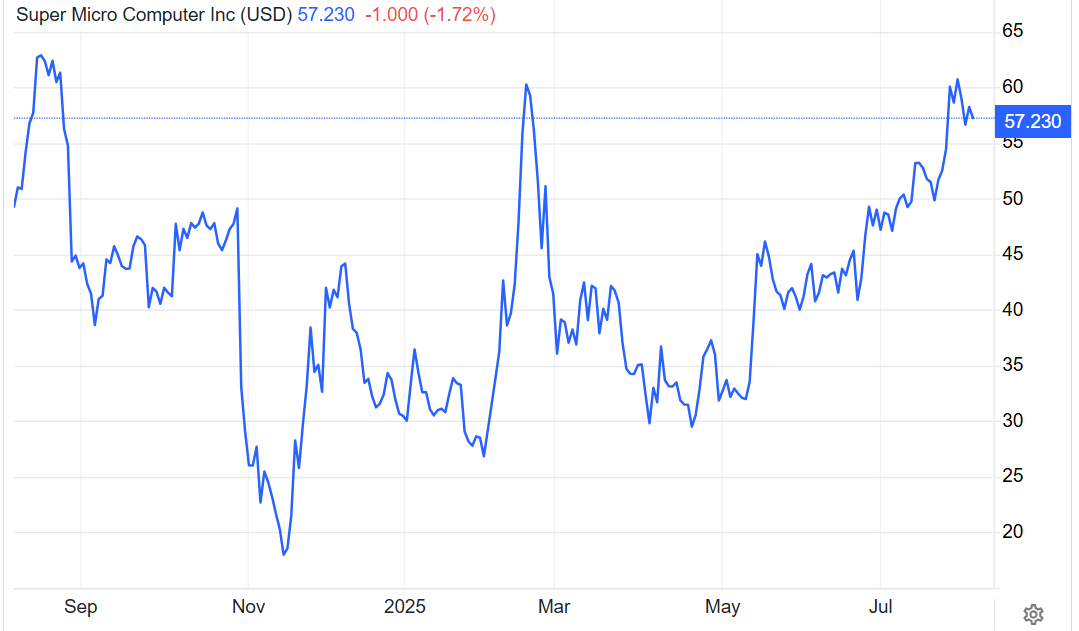
戳破AI估值泡沫的首张多米诺? 大砍业绩展望之后 AI算力龙头超微电脑(SMCI.US)股价闪崩17%
Zhi Tong Cai Jing· 2025-08-06 00:11
该公司于美东时间周二公布的业绩展望显示,预计截至2026年6月的财年总销售额将至少达到330亿美元。然而作为对比,在今年2月,超微电脑管理层在 当时因AI服务器产品线需求强劲而给出非常乐观的长期展望,称财年销售额将达到400亿美元,当时几乎是华尔街分析师们对财年预估值的两倍,因此本 次发布财报是下修业绩预期引发股票市场剧烈抛售。 此外,超微电脑管理层对于截至9月季度的利润预测意味着营业利润率仅仅为5%,不及华尔街平均预期的10%利润率,凸显出AI服务器领域激烈竞争持续 吞噬利润率。 超微电脑的AI服务器市场份额遭重大侵蚀? 由于投资者押注市场对其AI服务器和液冷服务器集群解决方案的强劲需求,超微电脑股价今年迄今已上涨88%,市场自今年以来乐观地认为该AI服务器 制造商将大幅受益于美国大型科技巨头们对于AI算力基础设施设备的愈发旺盛需求。 今年以来股价疯狂飙升88%,大幅跑赢纳斯达克100指数与标普500指数乃至"AI芯片霸主"英伟达的全球最大规模AI服务器制造商之一超微电脑(SMCI.US) 在下调其财年销售额预测,以及公布不及市场预期的整体季度业绩与季度利润预测后股价盘后暴跌超17%。 华尔街分析师们长期以 ...
七部门明确金融支持新型工业化路径:构建全覆盖、差异化、专业性金融服务体系
Shang Hai Zheng Quan Bao· 2025-08-05 23:38
Core Viewpoint - The article discusses the recent issuance of the "Guiding Opinions on Financial Support for New Industrialization" by seven Chinese government departments, aiming to enhance financial support for key manufacturing sectors and promote a financial system that aligns with new industrialization goals [1][2]. Group 1: Financial Support Framework - The Opinions emphasize the need for a comprehensive, differentiated, and specialized financial service system to support new industrialization, focusing on major strategic tasks [2][3]. - By 2027, the goal is to establish a mature financial system that supports the high-end, intelligent, and green development of the manufacturing industry, with improved product offerings and enhanced service adaptability [2][4]. Group 2: Key Areas of Support - The Opinions outline targeted support measures for enhancing technological innovation capabilities and supply chain resilience, including optimizing financial policy tools and providing long-term financing for critical technologies [4][5]. - Specific sectors highlighted for support include integrated circuits, industrial mother machines, medical equipment, servers, instrumentation, and foundational software [4][5]. Group 3: Long-term Capital and Investment - The Opinions call for the implementation of a "Technology-Industry Financial Integration" initiative, promoting investment roadshows and nurturing specialized small and medium enterprises for public listing [5][6]. - Encouragement is given for venture capital funds to collaborate with innovation centers and universities to facilitate technology transfer and commercialization [5][6]. Group 4: Strengthening Financial Services - Financial institutions are urged to provide comprehensive financial services to key enterprises in the industrial chain, utilizing diverse tools such as loans, bonds, equity, and insurance [5][6]. - The Opinions stress the importance of enhancing the flexibility of financial services for industrial transfers and improving cross-border financial service convenience [6][7]. Group 5: Policy Coordination and Mechanism Building - The Opinions highlight the need for improved coordination between financial and industrial policies, establishing mechanisms for cross-departmental collaboration and risk prevention [7][8]. - Financial institutions are encouraged to develop differentiated credit policies based on industry characteristics and the growth stages of enterprises [8].
到2027年 制造业企业有效信贷需求得到充分满足
Sou Hu Cai Jing· 2025-08-05 23:37
Core Viewpoint - The People's Bank of China and several ministries have jointly issued guidelines to support new industrialization, focusing on 18 targeted measures to enhance financial support for key industries and prevent excessive competition [1][2]. Group 1: Financial Support Measures - The guidelines emphasize a categorized approach to financial support, aiming to meet the effective credit demand of manufacturing enterprises by 2027, with an increase in the number and scale of bond issuances and significant improvements in equity financing levels [1][2]. - Financial policies will be optimized to support key technological products and breakthroughs, with a focus on introducing patient capital for the transformation of technological achievements [1][2][3]. Group 2: Encouragement of Investment and Innovation - The guidelines encourage financial institutions to provide medium- to long-term financing for key manufacturing sectors such as integrated circuits, medical equipment, and advanced materials [2][3]. - Support will be given to technology companies that break through core technologies, including expedited access to public financing, mergers and acquisitions, and bond issuance [2][3]. Group 3: Development of Financial Mechanisms - Financial institutions are urged to expand technology loan offerings and implement an "innovation points system" to standardize the development of intellectual property pledge loans [3]. - The guidelines propose a dual approach to cultivate financial talent in the technology sector and establish a comprehensive mechanism for cross-departmental collaboration and policy incentives [3][4]. Group 4: Implementation and Future Steps - The People's Bank of China and the Ministry of Industry and Information Technology will work with relevant departments to ensure the implementation of these measures and enhance the financial support system for new industrialization [4].
重磅!七部门印发,大利好!
Zhong Guo Ji Jin Bao· 2025-08-05 12:00
Core Viewpoint - The People's Bank of China and six other departments have jointly issued the "Guiding Opinions on Financial Support for New-Type Industrialization," which aims to enhance financial support for key industries and promote technological innovation and industrial upgrading [1][12]. Group 1: Financial Support for Key Industries - Financial institutions are encouraged to provide medium- and long-term financing for key manufacturing sectors such as integrated circuits, industrial mother machines, medical equipment, servers, and advanced materials [5][14]. - The policy aims to enhance the financing accessibility for small and micro enterprises in the manufacturing sector [6][20]. Group 2: Support for Emerging Industries - The guidance supports financing for emerging industries like new-generation information technology, smart vehicles, renewable energy, and biomedicine in multi-tiered capital markets [7][18]. - It emphasizes the importance of long-term capital and patient investment to accelerate the transformation of technological achievements into commercial applications [15][18]. Group 3: Enhancing Financial Services for Traditional Manufacturing - Financial institutions are directed to optimize credit policies to support the high-end, intelligent, and green development of traditional manufacturing [17][24]. - The guidance encourages the use of diverse financial tools, including loans, bonds, and insurance, to support the digital transformation of manufacturing enterprises [17][24]. Group 4: Green Finance and Sustainable Development - The policy promotes the establishment of a financial standard system to support the green and low-carbon transformation of high-carbon industries [19][26]. - It encourages the development of green financial products and the application of green credit and bonds in manufacturing [19][26]. Group 5: Strengthening Digital Financial Services - Financial institutions are urged to leverage technologies like big data and blockchain to enhance service efficiency for manufacturing, especially for small and medium-sized enterprises [20][21]. - The guidance supports the construction of digital financial service platforms to facilitate financing and cash management for the manufacturing sector [20][21]. Group 6: Policy Coordination and Risk Management - The document emphasizes the need for coordination between financial and industrial policies to create a supportive environment for new-type industrialization [26][27]. - It calls for the establishment of a joint risk assessment mechanism to monitor and manage financial risks associated with industrial projects [27][28].
重磅!七部门印发,大利好!
中国基金报· 2025-08-05 11:43
Core Viewpoint - The article discusses the joint issuance of the "Guiding Opinions on Financial Support for New-Type Industrialization" by seven departments, including the People's Bank of China, aimed at accelerating the construction of a financial system that supports new-type industrialization and enhances the resilience of industrial chains [3][12]. Group 1: Financial Support for Key Industries - Financial institutions are encouraged to provide medium- and long-term financing for key manufacturing industries such as integrated circuits, industrial mother machines, medical equipment, servers, and advanced materials [4][14]. - The policy aims to enhance the financing accessibility for small and micro enterprises in the manufacturing sector [5][20]. Group 2: Support for Emerging Industries - The article highlights support for emerging industries like new-generation information technology, smart (connected) vehicles, and biomedicine to access multi-tiered capital markets for financing [6][18]. - It emphasizes the need for long-term capital and patient investment to accelerate the transformation of technological achievements into practical applications [15][18]. Group 3: Enhancing Financial Services for Traditional Manufacturing - Financial institutions are urged to optimize credit policies to support the high-end, intelligent, and green development of traditional manufacturing [17][19]. - The article suggests that banks should enhance their support for digital transformation in manufacturing, particularly for small and medium-sized enterprises [17][20]. Group 4: Promoting Green and Digital Finance - The article discusses the importance of green finance in supporting the low-carbon transformation of high-carbon industries, advocating for the development of green financial products [19][28]. - It also emphasizes the role of digital finance in improving the efficiency of financial services for the manufacturing sector, particularly through the use of big data and AI [20][28]. Group 5: Strengthening Policy Coordination - The article calls for enhanced coordination between financial policies and industrial policies to ensure effective implementation of the financial support measures [27][28]. - It highlights the need for a collaborative approach among various government departments to create a conducive environment for financing new-type industrialization [27][28].

云厂商资本开支高增与政策红利叠加,AI基础设施需求持续旺盛
Sou Hu Cai Jing· 2025-08-05 08:59
Group 1 - Generative AI technology is driving a surge in AI computing power demand, prompting tech companies, especially in cloud computing, to increase investments in AI and computing products to enhance competitiveness in the AI era [1][2] - North American tech giants are experiencing sustained high growth in performance driven by AI, with significant capital expenditures on AI infrastructure, as evidenced by a report from Pacific Securities [1][2] - The capital expenditure of the four major North American internet companies reached $95.8 billion in Q2 2025, a 64% year-on-year increase, indicating a strong growth trend [2][3] Group 2 - Microsoft is expanding its data center scale to meet the growing AI workload demands, planning to invest over $30 billion in capital expenditures next quarter, a 50% year-on-year increase [2][3] - Meta's capital expenditure for 2025 is projected to be between $66 billion and $72 billion, with a 20 billion increase from previous estimates, primarily to expand AI infrastructure capacity [2][3] - AI technology is positively impacting the performance and development of tech companies, with Meta's advertising revenue increasing by 21% year-on-year, driven by AI optimization of its recommendation system [3] Group 3 - The demand for computing power is expected to continue growing, with IDC predicting that China's accelerated server market will exceed $100 billion by 2029, with nearly 50% of that being non-GPU servers [3] - The Chinese government is actively supporting AI development through policies, which is expected to accelerate domestic AI application commercialization and increase computing power demand [3][5] - Lenovo Group is positioned as a leading provider of computing infrastructure and services, leveraging AI-driven product offerings to support the evolution of AI technology [5][6] Group 4 - Lenovo's heterogeneous computing platform aims to provide comprehensive computing support across various scenarios, addressing challenges in traditional AI deployment [8][9] - Lenovo's server business has shown strong growth due to its technological advancements and market positioning, with new product launches enhancing its competitiveness in the AI server market [8][9] - The company is focusing on green and sustainable computing solutions, with liquid cooling technology being a key feature of its offerings, which helps reduce operational costs for clients [9] Group 5 - The robust demand for computing power and strong server market performance highlight the continued high prosperity of the computing power sector [4][5] - Lenovo's comprehensive business layout and market performance are expected to drive significant revenue growth, with analysts predicting positive financial results for the company [9][10] - The outlook for the computing power sector remains optimistic, with North American cloud providers' capital expenditures showing high growth, indicating ongoing development potential for infrastructure products [10]