
油气

Search documents
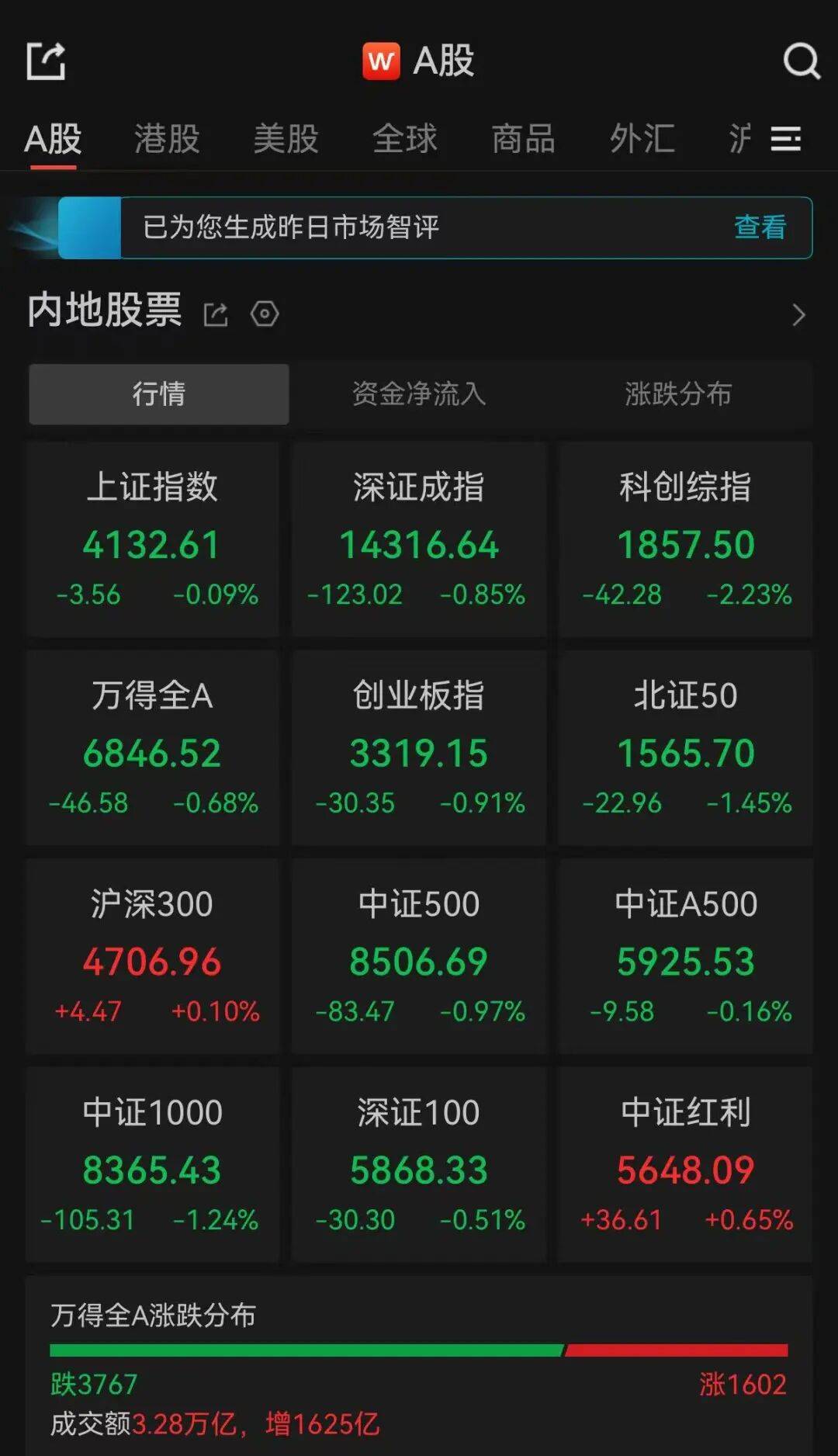
A股收评:超3700只个股飘绿,三大指数集体收跌
Sou Hu Cai Jing· 2026-01-26 09:25
新闻荐读 板块方面,贵金属再度爆发,带动有色金属概念股集体走强,化工等方向同样涨幅居前;AI应用概念股局部发力,浙文互联盘中涨停,浙数文化、盛天 网络、天舟文化等直线拉升;午后油气股持续走高,中曼石油盘中涨停,通源石油、中国海油、中国石油、中国石化、潜能恒信跟涨;生物医药概念午后 快速拉升。商业航天概念持续走弱,中国卫通、中国卫星等多股跌停;半导体设备概念震荡走弱,白酒板块震荡下挫,军工、卫星等方向跌幅居前。 26日,A股三大指数集体高开,随后震荡下行,集体收跌。截至收盘,沪指跌0.09%,深证成指跌0.85%,创业板指跌0.91%。全市成交额3.28万亿,超 3700只个股下跌。 | L | w A股 | | | Q | | --- | --- | --- | --- | --- | | A股 港股 美股 | 全球 | 商品 | 汁 三 外汇 | | | 已为您生成昨日市场智评 | | | 查看 | | | 内地股票 它 ○ | | | | | | 行情 | 资金净流入 | | 涨跌分布 | | | 上证指数 | 深证成指 | | 科创综指 | | | 4132.61 | 14316.64 | | 1857 ...

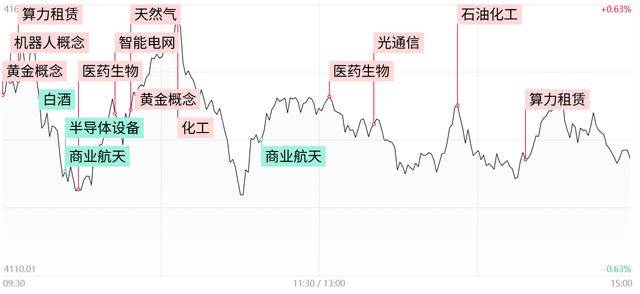
每日收评三大指数集体收跌,两市成交额连续2日突破3万亿,商业航天再陷整理
Sou Hu Cai Jing· 2026-01-26 09:14
智通财经1月26日讯,市场全天震荡调整,大小指数分化明显,深成指、创业板指高开低走,盘中均跌 超1%。沪深两市成交额3.25万亿,较上一个交易日放量1630亿。盘面上,市场热点较为杂乱,全市场 超3700只个股下跌。从板块来看,有色金属板块涨幅居前,其中贵金属概念领涨,四川黄金8天4板,晓 程科技、湖南黄金、盛达资源等多股涨停,紫金矿业创历史新高。油气概念走强,中国海油创历史新 高,洲际油气4天3板。化工板块震荡拉升,红宝丽、澄星股份涨停。下跌方面,商业航天再度陷入调 整,多只商业航天人气股大跌,中国卫通、中国卫星跌停。截至收盘,沪指跌0.09%,深成指跌 0.85%,创业板指跌0.91%。 板块方面 贵金属板块全天强势,湖南黄金、中金黄金、招金黄金、恒邦股份、西部黄金、四川黄金、山东黄金等 10余股涨停。消息面上,国际金价持续创下新高,现货黄金日内涨突破5100美元/盎司,纽约期金日内 涨2.26%突破5130美元/盎司。 中信证券研报认为,市场对美联储宽松货币政策的预期是推动贵金属价格上涨的最重要因素。另一方 面,全球央行购金潮的持续涌动,也成为支撑本轮黄金大牛市的核心驱动力,据中国人民银行官方储备 资产 ...
帮主郑重收评:震荡放量,主力在打什么牌?
Sou Hu Cai Jing· 2026-01-26 08:57
Core Viewpoint - The market is experiencing a divergence where indices are down while trading volume remains high, indicating significant shifts in investor sentiment and strategy [1][3]. Group 1: Market Dynamics - The market shows a stark contrast with resources like gold and energy commodities performing well, while previously popular sectors such as commercial aerospace and semiconductors are declining [3]. - There is a substantial amount of capital reallocating from high-growth sectors to resource-based and lower-valued sectors, suggesting a "high-low switch" in investment strategies [3]. Group 2: Trading Strategy Recommendations - Investors should avoid chasing after the high-performing resource sectors due to elevated sentiment and instead focus on maintaining positions in these areas while being cautious about new entries [4]. - For the technology growth sectors experiencing deep corrections, it is advised to remain calm and differentiate between irrational sell-offs and genuine fundamental issues, as this could present buying opportunities for fundamentally strong stocks [4]. - A critical task for investors is to reassess their portfolios, shifting away from speculative holdings towards sectors with clear growth prospects and strong company fundamentals, using market volatility as an opportunity for "health checks" and "blood transfusions" in their asset allocations [4].

港股收盘 | 恒指收涨0.06% 有色、油气股走高 商业航天概念集体回调
Zhi Tong Cai Jing· 2026-01-26 08:49
华泰证券指出,资金面上,外资与南向资金持续流入,4Q公募港股仓位降至23%,潜在抛压大幅减 弱,IPO市场募资和解禁同样放缓。情绪指数回到中性区间,看涨预期升温。该行认为一季度延续反弹 依然可期,看重空间,淡化斜率。 蓝筹股表现 港股今日小幅高开后走低,恒科指数盘中一度跌近2%,恒指则全天走势反复,尾盘成功翻红。截至收 盘,恒生指数涨0.06%或16.01点,报26765.52点,全日成交额为2616.99亿港元;恒生国企指数跌 0.15%,报9147.21点;恒生科技指数跌1.24%,报5725.99点。 热门赛道,而是清晰划定"真价值"与"伪炒作"的边界。经济日报此前也发文称,勿让概念炒作带歪商业 航天。 中国神华(601088)(01088)领涨蓝筹。截至收盘,涨4.42%,报42.5港元,成交额5.36亿港元,贡献恒 指9.34点。申万宏源1月26日研报指出,需求端,寒潮来袭,中东部地区气温偏低。该行预计春节前安 监趋严,展望后市,节前冷空气扰动仍存,预计日耗高位运行、将支撑动力煤价格。 其他蓝筹股方面,紫金矿业(601899)(02899)涨4.35%,报42.18港元,贡献恒指17点;中海油(00 ...
超3700只个股下跌
第一财经· 2026-01-26 08:37
2026.01. 23 本文字数:1750,阅读时长大约3分钟 作者 | 一财阿驴 15:01 A股收盘丨三大股指集体收跌 黄金股掀涨停潮 三大股指今日集体收跌,沪指跌0.09%,深成指跌0.85%,创业板指跌0.91%。科创综指跌2.23%,下 跌个股超3700家。 | 行情 | 资金净流入 | 涨跌分布 | | --- | --- | --- | | 上证指数 | 深证成指 | 科创综指 | | 4132.61 | 14316.64 | 1857.50 | | -3.56 -0.09% | -123.02 -0.85% | -42.28 -2.23% | | 万得全A | 创业板指 | 北证50 | | 6846.52 | 3319.15 | 1565.70 | | -46.58 -0.68% | -30.35 -0.91% | -22.96 -1.45% | 商业航天指数回调,半导体、机器人、金融科技、AI算力、消费电子、固态电池概念股跌幅靠前。 黄金股掀涨停潮,煤炭、有色金属、油气板块齐走强,疫苗概念股逆势大涨。 14:39 沪深两市成交额连续第2个交易日突破3万亿元。 14:33 AI应用概念股局部 ...

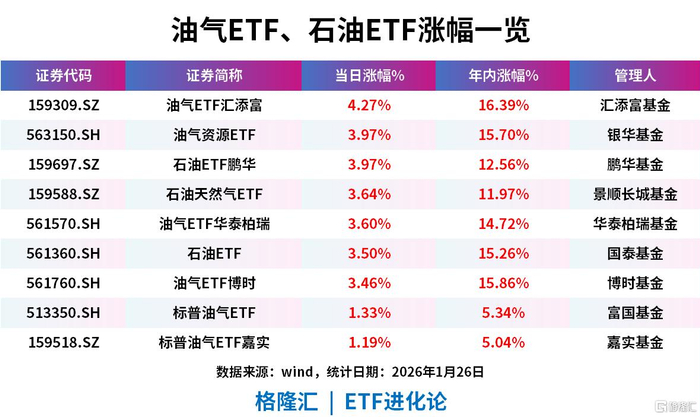
油气股走高,油气ETF汇添富涨超4%,油气资源ETF、石油ETF涨超3%
Ge Long Hui A P P· 2026-01-26 08:25
Core Viewpoint - The oil and gas sector is experiencing a significant rise, with various stocks and ETFs showing substantial gains, indicating a positive market sentiment towards the industry. Group 1: Stock Performance - Tongyuan Petroleum saw a rise of over 13%, while Heshun Petroleum, Intercontinental Oil & Gas, and Zhongman Petroleum reached their daily limit up [1] - The oil and gas ETFs, including Huatai-PB Oil & Gas ETF, increased by over 4%, with several others also showing gains of more than 3% [1] Group 2: ETF Performance - The Huatai-PB Oil & Gas ETF increased by 4.27% year-to-date, reflecting a 16.39% annual gain [2] - The Oil & Gas Resource ETF rose by 3.97% on the day and 15.70% year-to-date [2] - The Petroleum ETF from Penghua also saw a daily increase of 3.97% and a year-to-date increase of 12.56% [2] Group 3: Industry Insights - The China Securities Oil and Gas Resource Index, which tracks companies involved in oil and gas extraction, services, and equipment manufacturing, rose by 13.11% in the fourth quarter, outperforming the overall A-share market [6] - The global oil market is facing supply-demand imbalances, with OPEC+ increasing production by nearly 3 million barrels per day starting April 2025, primarily from major oil-producing countries [6] - Despite a 6.5% year-on-year increase in China's crude oil imports in October and November, the increase mainly contributed to strategic reserves and port inventory rather than actual consumption [6] Group 4: Company Strategies - Companies in the oil and gas sector are focusing on cost reduction and efficiency improvements, such as digital management to lower extraction costs while maintaining stable cash flow generation [7] - The sector's resilience in fundamentals provides investment value even when oil prices are under pressure [7] - The China National Offshore Oil Corporation (CNOOC) is positioned as a leading player in offshore resource development, aiming to strengthen its oil and gas business and explore marine mineral resources [7]


分析:欧洲对美国液化天然气的依赖或成为特朗普的施压工具
Xin Lang Cai Jing· 2026-01-26 08:00
2022年俄乌冲突爆发时,俄罗斯曾削减向欧洲的天然气供应。但液化天然气(LNG)运输量的增加 ——其中很大一部分来自美国——帮助缓解了这一压力。欧洲日益担心,特朗普可能会将美国在油气行 业取得的强势地位,转化为向其他国家施压的工具。哥伦比亚大学全球能源政策中心巴黎研究学者 Anne-Sophie Corbeau表示:"最近,人们开始意识到,欧洲可能对美国液化天然气的依赖有点过头了。" 特朗普政府事实上也在鼓励这种依赖。作为去年与欧盟达成的贸易协议的一部分,美国推动欧洲增加对 美能源进口。根据智库布鲁盖尔(Bruegel)的数据,2025年美国对欧盟的液化天然气供应量同比增长 约60%。 分析人士称,这一趋势可能还会持续。尽管欧洲加大了对风能、太阳能等可再生能源的投 资,但在供暖和制造领域,天然气仍不可或缺。 ...
署名文章丨国家能源局局长王宏志:深入学习贯彻党的二十届四中全会精神 为能源强国建设提供坚强监管保障
国家能源局· 2026-01-26 07:55
Core Viewpoint - The article emphasizes the importance of energy regulation in achieving the goals set forth in the 14th and 15th Five-Year Plans, particularly in building a strong energy nation and ensuring high-quality development in the energy sector [2][10]. Group 1: Progress in Energy Regulation - The National Energy Administration (NEA) has made significant progress in energy regulation, focusing on energy security and implementing various regulatory tasks in line with the central government's directives [3]. - The NEA has strengthened the political attributes of energy regulation, enhancing party building and implementing strict oversight mechanisms to ensure compliance with regulations [3][4]. Group 2: Energy Supply and Market Development - The NEA has successfully monitored energy supply during peak seasons and has implemented measures to ensure the smooth execution of major energy projects [4]. - A unified national electricity market has been established, with over 60% of electricity transactions being market-based for four consecutive years, indicating a robust market structure [5]. Group 3: Regulatory Enforcement and Safety - The NEA has intensified regulatory enforcement, addressing over 700 administrative violations in the energy sector and ensuring fair access to energy infrastructure [6][13]. - Safety measures have been upgraded, with significant actions taken to address safety risks and improve emergency response capabilities in the electricity sector [7][14]. Group 4: Enhancing Public Energy Services - New policies have been implemented to improve access to electricity, benefiting approximately 1.5 million households and saving around 20 billion yuan in investment costs [8]. - The NEA has focused on resolving public energy issues, enhancing complaint handling processes, and improving service quality for consumers [8][15]. Group 5: Innovation in Energy Regulation - The NEA is innovating regulatory mechanisms, promoting digital oversight, and enhancing the regulatory framework to adapt to new energy market dynamics [9][16]. - Collaborative efforts with international regulatory bodies are being pursued to share best practices and improve the overall regulatory environment [9]. Group 6: Future Directions in Energy Regulation - The NEA aims to achieve a clean, low-carbon, safe, and efficient energy system by 2026, aligning with national goals for energy transition and sustainability [10][11]. - Continuous reforms and innovative strategies will be implemented to enhance the regulatory framework and ensure effective energy governance [12][16].

A股三大指数收跌,贵金属、油气板块逆市领涨
Sou Hu Cai Jing· 2026-01-26 07:33
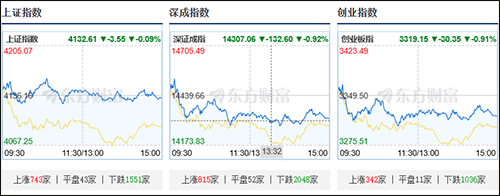
Market Overview - The A-share market experienced a collective decline on January 26, with the Shanghai Composite Index down by 0.09% to close at 4132.61 points, the Shenzhen Component Index down by 0.92% to 14307.06 points, and the ChiNext Index down by 0.91% to 3319.15 points [1][3] - The total trading volume in the Shanghai and Shenzhen markets approached 3.3 trillion yuan, an increase of nearly 200 billion yuan compared to the previous trading day [1] Sector Performance - The market showed a broad decline across various sectors, with the non-ferrous metals sector leading the gains, particularly in precious metals, where Sichuan Gold achieved four consecutive trading limits in eight days, and Zijin Mining reached a historical high [3] - The oil and gas sector also performed well, with China National Offshore Oil Corporation hitting a historical high and Intercontinental Oil and Gas achieving three trading limits in four days [3] - The space photovoltaic sector was notably active, with companies like Mingyang Smart Energy, Tuojiri New Energy, and GCL-Poly Energy hitting trading limits [3] - The chemical sector saw fluctuations, with Hongbaoli and Chengxing shares reaching trading limits [3] Individual Stock Movements - Over 1600 stocks rose, with more than 70 stocks hitting trading limits, while over 3700 stocks declined [3] - The precious metals sector experienced a surge, with stocks like Xiaocheng Technology hitting a 20% trading limit, along with other companies such as Zhaojin Mining, Zhongjin Gold, and Hunan Silver also reaching trading limits [3]

A股收评:创业板指跌近1% 贵金属、油气概念逆势爆发
2 1 Shi Ji Jing Ji Bao Dao· 2026-01-26 07:25
Market Overview - The market experienced a day of volatile adjustments with significant divergence between large and small indices, as the Shenzhen Component Index and ChiNext Index opened high but fell over 1% during the day [1][2] - By the close, the Shanghai Composite Index decreased by 0.09%, the Shenzhen Component Index fell by 0.85%, and the ChiNext Index dropped by 0.91% [1][2] - The total trading volume in the Shanghai and Shenzhen markets reached 3.25 trillion yuan, an increase of 163 billion yuan compared to the previous trading day [1][2] Sector Performance - The non-ferrous metals sector led the gains, particularly the precious metals concept, with Sichuan Gold achieving four consecutive trading limits in eight days [1][2] - Several stocks, including Xiaocheng Technology, Hunan Gold, and Shengda Resources, hit the daily limit, while Zijin Mining reached a historical high [1][2] - The oil and gas sector also showed strength, with China National Offshore Oil Corporation hitting a historical high and Continental Oil achieving three trading limits in four days [1][2] - The space photovoltaic concept was actively traded, with stocks like Mingyang Smart Energy, Tuori New Energy, and GCL-Poly Energy hitting the daily limit [1][2] - The chemical sector saw fluctuations, with Hongbaoli and Chengxing Shares reaching the daily limit [1][2] Declining Sectors - The commercial aerospace and semiconductor equipment sectors experienced the largest declines, with several commercial aerospace concept stocks plummeting, including China Satellite Communications and China Satellite, which both hit the daily limit down [1][2]
