数码

Search documents
提振消费动真格了,金融市场会怎么走?
Sou Hu Cai Jing· 2025-12-15 02:32
Core Viewpoint - The core idea of the document is that finance should more directly and proactively support increased consumer spending, which has significant implications for the financial market, particularly the A-share market [1] Group 1: Financial Support for Consumption - The document outlines three main areas and eleven measures aimed at revitalizing consumer confidence, capacity, and scenarios [1] - The first main line emphasizes that financial support for commodity consumption is detailed and direct, focusing on making it easier for consumers to spend money [2] - Policies include more flexible consumer loan limits, extended terms, differentiated interest rates, and potential waivers on early repayment penalties for car loans [2] Group 2: Service Consumption - Service consumption is prioritized, addressing the need for consumers to spend on experiences rather than just goods [2] - Key sectors highlighted for support include dining, accommodation, cultural tourism, education, elderly care, childcare, sports and entertainment, and health services [3] Group 3: Financial Products and Services - The policy aims to make financial products more aligned with consumption scenarios, moving beyond just providing loans [4] - Specific initiatives include special loans for service consumption, refinancing for elderly care, and financing for intangible assets like intellectual property and technological achievements [4] Group 4: New Consumption Models - The document emphasizes the importance of new consumption models, including digital, green, and AI-driven consumption, as well as content and social e-commerce [5] - Financial institutions are encouraged to collaborate with platforms and merchants to reach more "long-tail users," indicating a shift towards sustainable growth supported by finance [5] Group 5: Economic and Market Implications - This initiative represents a shift where finance becomes a primary driver rather than a supporting role, with a focus on credit expansion rather than just subsidies [5] - The emphasis on stabilizing consumption is expected to improve corporate cash flows, restore profit expectations, stabilize bank asset quality, and lead to a more optimistic market outlook [5] Group 6: Market Sentiment - The measures aim to create conditions for a recovery in market risk appetite, with increased policy certainty for consumption-related sectors and growing opportunities in finance, technology, and services [6] - The document suggests that changes in consumer spending behavior can signal a turning point in the financial market [7]
三部门:更大力度提振消费,适当减免汽车以旧换新提前结清贷款违约金
Cai Jing Wang· 2025-12-15 02:07
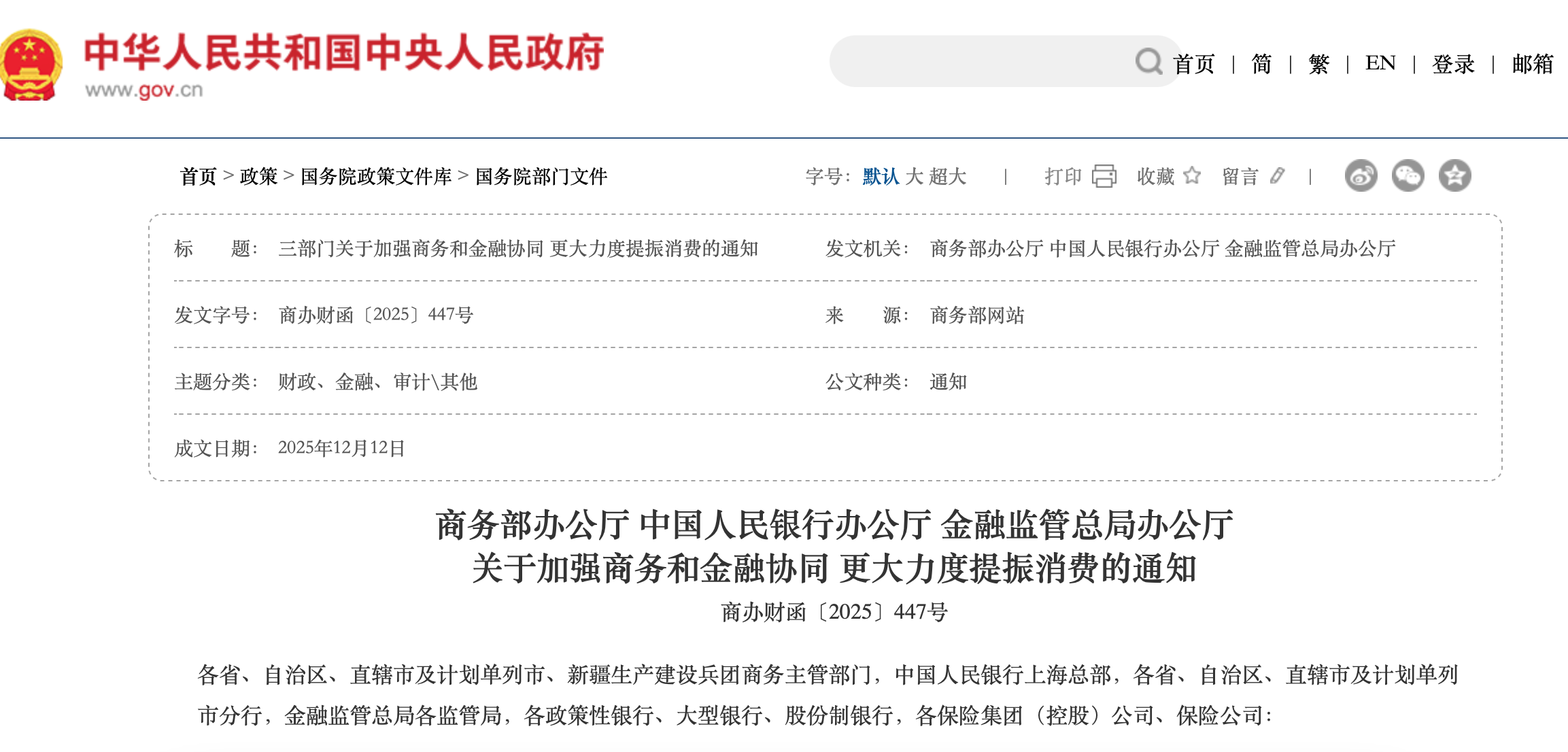
其中提到,升级商品消费。加强大宗耐用消费品、数码产品等消费金融服务,挖掘商品消费升级潜能。 推动金融机构与平台、重点商户合作,加快推动个人消费贷款业务发展。适当减免汽车以旧换新过程中 提前结清贷款产生的违约金。完善消费品以旧换新服务平台,扩大金融机构参与范围。 近日,商务部办公厅、中国人民银行办公厅、金融监管总局办公厅发布《关于加强商务和金融协同,更 大力度提振消费的通知》。 ...
加大力度扩大消费 三部门:适当减免汽车以旧换新过程中提前结清贷款产生的违约金
Zhong Guo Jing Ying Bao· 2025-12-14 14:51
Core Viewpoint - The notification aims to enhance collaboration between commerce and finance to boost consumer spending through various supportive measures [3]. Group 1: Financial Support Measures - The notification emphasizes resolving difficulties in implementing financial support for expanding consumption [3]. - It suggests exploring various methods such as financing guarantees, loan interest subsidies, and risk compensation to guide credit funds towards key consumption areas [3]. - There will be a focus on enhancing financial services for durable consumer goods and digital products [3]. Group 2: Consumer Services Improvement - The notification mentions improving installment payment options, credit card services, mobile banking, and digital currency to better meet consumer upgrade demands [3]. - It highlights the reduction of penalties for early loan settlement during vehicle trade-ins and aims to enhance the service platform for consumer goods exchange [3]. Group 3: New Consumption Models - The notification indicates an active exploration of financial support for green consumption and new consumption models involving artificial intelligence [3]. - It aims to provide more diverse and differentiated financial services to adapt to evolving consumer needs [3].

定调!明年“国补”继续
Sou Hu Cai Jing· 2025-12-14 11:12
Group 1 - The Central Economic Work Conference held in Beijing on December 10-11 outlined the economic work for 2026, emphasizing the need to optimize the implementation of the "Two New" policies, which include large-scale equipment updates and the consumer goods trade-in policy known as "national subsidies" [1] - In 2024, China will issue 150 billion yuan in long-term special government bonds for the consumer goods trade-in program, referred to as "national subsidies," with a significant increase to 300 billion yuan in 2025, doubling the amount from 2024 [1] - The "national subsidies" policy will be further optimized in 2025, expanding the categories eligible for trade-in to include new digital products and various home appliances [1] Group 2 - From January to November this year, the consumer goods trade-in program has driven sales exceeding 2.5 trillion yuan, benefiting over 360 million people, with significant contributions from the automotive and home appliance sectors [2] - Experts suggest that the "national subsidies" amount for 2026 may see a moderate increase from 2025 levels, with a continued focus on optimizing funding allocation to enhance service consumption and further stimulate economic growth [2]
确认了,“国补”不会结束!但有大调整
猿大侠· 2025-12-13 04:11
Core Viewpoint - The "National Subsidy" policy has significantly boosted consumption, benefiting over 360 million consumers and generating over 2.5 trillion yuan in consumption from January to November 2025 [1]. Group 1: Policy Impact - The "National Subsidy" has led to substantial exchanges, including over 11.2 million old cars, 12.844 million old home appliances, and 9.015 million digital products [1]. - The official deadline for the 2025 "National Subsidy" is set for the end of this month, with no extensions or additional budgets available once the funds are exhausted [1][2]. Group 2: Future Expectations - The "National Subsidy" policy is expected to continue into 2026, with potential adjustments to its core rules [3][6]. - The funding for the "National Subsidy" increased from 150 billion yuan in 2024 to 300 billion yuan in 2025, with expectations for a slight increase or maintenance of this scale in 2026 [8][9]. Group 3: Changes in Subsidy Categories - The 2025 policy expanded to include three new digital product categories and four new home appliance categories, indicating a shift towards more diverse consumer goods [13]. - Future policies may focus more on service consumption, targeting areas such as cultural tourism, sports, and health care, while also emphasizing green and smart products [13][14]. Group 4: Regulatory Adjustments - Due to issues like scalping and fraudulent transactions in 2025, the 2026 "National Subsidy" may implement stricter eligibility criteria and smarter regulatory measures to ensure funds reach genuine consumers [16].

明年“国补”继续!还有优化
Sou Hu Cai Jing· 2025-12-12 14:24
年初,国家发展改革委 财政部关于2025年加力扩围实施大规模设备更新和消费品以旧换新政策的通知公布。家电、手机、平板、汽车等产品 都在覆盖范围内。 随后,多家电商平台都开启了补贴专区,想必不少小伙伴在购买符合条件的产品时,都会先看一眼是否能享受补贴。 随着时间来到2025年12月中旬,不少小伙伴都在关心随着今年的结束,"国补"是否还会继续。 近日,大家关心的这部分内容也有了确切消息。 据新华社报道,中央经济工作会议12月10日至11日在北京举行。 会议将"坚持内需主导,建设强大国内市场"摆在明年8项重点任务之首,并作出"优化'两新'政策实施""清理消费领域不合理限制措施"等一系列 部署。 参考第一财经日报的报道,"两新"政指的是指大规模设备更新和消费品以旧换新政策。其中与大家利益直接相关的消费品以旧换新政策备受关 注,被称为"国补"。 也就是说,可以确定明年还会有国补,且具体国补政策将会有所优化,想要在明年进行各种用品购置的小伙伴可以关注一下相关消息。 参考来看,2024年发行了1500亿元超长期特别国债资金用于消费品以旧换新,2025年发行3000亿元超长期特别国债资金用于消费品以旧换新。 同时,2025 ...

定调!“国补”明年继续
Sou Hu Cai Jing· 2025-12-12 13:26
Core Viewpoint - The Central Economic Work Conference held on December 10-11 in Beijing outlined key economic tasks for the upcoming year, emphasizing the optimization of the "Two New" policy implementation [1]. Group 1: Policy Implementation - The "Two New" policy refers to large-scale equipment updates and a consumer goods trade-in program, which is particularly relevant to the public and is referred to as "national subsidies" [1]. - In 2024, China will issue 150 billion yuan in ultra-long-term special government bonds for the consumer goods trade-in program, with an increase to 300 billion yuan in 2025, doubling the subsidy amount compared to 2024 [1]. Group 2: Expansion of Subsidy Areas - The scope of the "national subsidies" will expand in 2025 to include three new categories of digital products: mobile phones, tablets, and smartwatches, as well as four categories of home appliances: microwave ovens, water purifiers, dishwashers, and rice cookers [1]. Group 3: Impact on Sales - From January to November this year, the consumer goods trade-in program has driven sales of related products exceeding 2.5 trillion yuan, benefiting over 360 million people [1]. - Specific figures include over 11.2 million vehicles traded in, over 128.44 million home appliances, over 9.015 million digital products, over 1.291 million electric bicycles, and over 120 million home renovation items [1].
重磅会议定调!提振消费政策持续发力,机构看好消费
Sou Hu Cai Jing· 2025-12-12 03:06
大消费相关ETF: 聚焦提振内需主线,消费意愿提升:食品饮料ETF(515170) 元旦假期催化+海南全岛封关利好:旅游ETF(562510) 12月10-11日,中央经济工作会议在京举办,在消费层面指出"坚持内需主导,建设强大国内市场",本 次会议将"内需"摆在优先位置,消费鼓励政策有望持续加码。 "居民消费率明显提高,内需拉动经济增长主动力作用持续增强"是"十五五"时期经济社会发展的主要目 标之一。本次会议则将发展内需作为明年经济工作的第一条,凸显消费在经济发展中的重要性。 中金公司表示,2025年"国补"在2024年基础上扩围,新增了手机、平板、智能手表手环等3类数码产品 和微波炉、净水器、洗碗机、电饭煲等4类家电产品等。2026年全国性补贴品类或仍有优化空间,带动 相关品类需求提振。 以上内容与数据,与有连云立场无关,不构成投资建议。据此操作,风险自担。 ...
联合解读中央经济工作会议
2025-12-12 02:19
Summary of Key Points from the Central Economic Work Conference Industry or Company Involved - The summary pertains to the overall economic policies and strategies discussed during the Central Economic Work Conference, focusing on various sectors including real estate, consumer goods, and agriculture. Core Points and Arguments - **Consumer Demand and Investment**: The conference emphasized expanding domestic demand as a primary task for 2026, with measures to increase residents' income, remove consumption restrictions, and stabilize investment and the real estate market [2][5][12] - **Fiscal and Monetary Policy**: A commitment to maintaining an active fiscal policy and a moderately loose monetary policy was reiterated, with a focus on innovative drivers and supporting effective supply [1][3][8] - **Real Estate Market**: The conference provided a positive outlook on the real estate sector, emphasizing measures to stabilize the market, control supply, reduce inventory, and improve housing quality [5][9][10] - **Capital Market Reform**: There was a call for deepening capital market reforms, focusing on long-term investor returns and preventing market volatility, with a positive outlook on growth sectors like AI and new energy [6][11] - **Household Appliances Sector**: The government signaled a likelihood of extending national subsidies, which could boost domestic demand for household appliances, with expectations of a recovery in sales growth [11][13] - **Consumer Spending**: The conference highlighted the need to enhance consumer spending through various measures, including income growth and policy optimization, to drive economic growth [12][14] - **Pharmaceutical Industry**: Key discussions included optimizing drug procurement and reforming medical insurance payment methods, which are expected to stabilize and grow the pharmaceutical sector [15] - **Agricultural Development**: The focus was on ensuring food security and promoting high-quality development in the pig industry, with an emphasis on technological advancements in agriculture [16] Other Important but Possibly Overlooked Content - **Risk Management**: The conference addressed the need for proactive risk management in key areas, particularly in real estate and local government financing, to prevent systemic financial risks [5][9] - **Quality of Monetary Policy**: There was a shift towards emphasizing the quality of monetary policy rather than just the quantity, indicating a potential acceleration in monetary easing in 2026 [8][7] - **New Consumption Trends**: The conference acknowledged emerging consumption trends such as the "first launch economy" and "silver economy," which could create new growth opportunities in the consumer market [14]
中央定调:2026“国补”将继续!| 头条
第一商用车网· 2025-12-11 22:43
2025年12月10日至11日,中央经济工作会议在北京举行。此次会议部署2026年经济工 作,其中在部署明年"坚持内需主导,建设强大国内市场"时称,要优化"两新"政策实施。 所谓"两新"政策,是指大规模设备更新和消费品以旧换新政策。其中与老百姓利益直接相 关的消费品以旧换新政策又备受关注,被称为"国补"。 此次会议明确2026年优化"两 新"政策实施,意味着明年会继续实施国补政策,但具体政策会有所优化。 为了促进消费,中国在2024年发行了1500亿元超长期特别国债资金用于消费品以旧换新, 也就是老百姓口中的"国补"。由于当年实施效果不错,2025年中国发行3000亿元超长期 特别国债资金用于消费品以旧换新,"国补"额度较2024年增长一倍。 "国补"政策也在不断优化。2025年"国补"领域在2024年基础上扩围,比如新增了手机、 平板、智能手表手环等3类数码产品和微波炉、净水器、洗碗机、电饭煲等4类家电产品 等。 商务部数据显示,2025年1月至11月,消费品以旧换新带动相关商品销售额超2.5万亿元, 惠及超3.6亿人次。其中,汽车以旧换新超1120万辆,家电以旧换新超12844万台,手机 等数码产品购新补 ...