生物制造

Search documents
华熙生物中试平台荣膺首批国家级生物制造中试能力建设平台五星评级
2 1 Shi Ji Jing Ji Bao Dao· 2025-11-17 02:04
Core Insights - Huaxi Biological Technology (Tianjin) Co., Ltd. has been recognized as one of the first five "five-star" service capability units in the national list of biomanufacturing pilot platforms, showcasing its leading position in the biomanufacturing sector [1][2] - The pilot platform evaluation is part of the implementation of the "Implementation Opinions on the Innovative Development of Manufacturing Pilot" and focuses on three major tracks and nine key areas, aiming to accelerate the commercialization of scientific research achievements [1][2] - The platform has already served over 20 external companies and completed more than 30 projects transitioning scientific achievements to industrial applications, thus shortening the marketization cycle of innovative products [2] Group 1 - The pilot platform has met stringent standards in technology equipment, public infrastructure, service capability, and intellectual property protection, reflecting the company's technological accumulation and innovation capacity in biomanufacturing [2] - The company has established a complete innovation chain from basic research to industrial application, supported by a "research-development-pilot-industrialization" system that ensures efficient conversion of bioactive substances [2] - The platform is equipped with world-class fermentation systems, purification equipment, and testing instruments, with 64 flexible pilot production lines capable of large-scale conversion of six categories of bioactive substances [2] Group 2 - Looking ahead, the company aims to leverage its national-level platform to collaborate with upstream and downstream partners in the industry, providing comprehensive solutions and fostering a biotechnological innovation ecosystem [3] - The company plans to increase R&D investment, enhance pilot conversion efficiency, and accelerate the industrialization of biotechnological achievements, contributing to high-quality industry development [3] - The establishment of an industrialization ecological alliance is intended to create a cluster effect, promoting collaborative industry cooperation and advancing biomanufacturing into the 5.0 era [3]

国常会部署“促消费稳投资”,新一轮降准降息有望实施
第一财经· 2025-11-16 15:48
Core Viewpoint - The article discusses the fluctuations in major economic indicators in China due to external demand slowdown, weakened domestic demand, and high base effects from the previous year, emphasizing the need for stronger macroeconomic policies to stabilize growth [3][4]. Economic Indicators - In October, the industrial added value for large-scale enterprises grew by 4.9% year-on-year, slowing down by 1.6 percentage points from September [3]. - The total retail sales of consumer goods increased by 2.9% year-on-year, a slight decline of 0.1 percentage points from September [3]. - From January to October, fixed asset investment (excluding rural households) reached 408,914 billion yuan, a year-on-year decrease of 1.7% [3]. Government Response - The State Council, led by Premier Li Qiang, held a meeting to discuss the implementation of "two major" constructions aimed at enhancing consumption and investment [3][4]. - The government plans to enhance the adaptability of supply and demand in consumer goods to stimulate consumption and achieve a dynamic balance [3][4]. Investment Trends - Despite a decline in overall investment, emerging industries such as digital manufacturing and smart equipment are showing significant growth, with the digital industry manufacturing value-added increasing by 9.5% year-on-year [7][8]. - The investment in fixed assets has seen a historical decline, particularly in infrastructure, manufacturing, and real estate sectors [9]. "Two Major" Construction - The "two major" construction initiative is set to allocate 800 billion yuan to support 1,459 projects, focusing on strategic areas such as ecological restoration and major infrastructure [11][12]. - This initiative aims to optimize project reviews and enhance the quality of investments, promoting new productive forces [11][12]. Consumer Trends - Service consumption is becoming a significant growth point, with retail sales in services growing by 5.3% year-on-year [7]. - Digital and green consumption are expanding, with online retail sales increasing by 9.6% year-on-year, indicating a shift towards a more diversified consumption structure [8][14]. Supply and Demand Adaptability - Enhancing supply and demand adaptability is crucial for releasing consumption potential and ensuring economic circulation [13][15]. - The article highlights the need for a balance between supply and demand, with a focus on quality and personalized consumption [14][15].


新股消息 | 华恒生物(688639.SH)拟港股上市 中国证监会要求补充说明近三年技术出口业务的开展情况等
智通财经网· 2025-11-14 12:09
Group 1 - The China Securities Regulatory Commission (CSRC) has requested Huaheng Biological (688639.SH) to provide supplementary information regarding its technology export business and compliance over the past three years [1] - Huaheng Biological has submitted its listing application to the Hong Kong Stock Exchange, with Huatai International as the sole sponsor [1] - The CSRC has outlined specific areas for Huaheng Biological to clarify, including the status of its technology export business, compliance with regulations, and the use of raised funds for overseas investments [1] Group 2 - Huaheng Biological is a pioneer in synthetic biology, focusing on the research, large-scale production, and commercialization of bio-based products [2] - The company is recognized as one of the most comprehensive enterprises globally in commercial applications of bio-based products through synthetic biology [2] - Huaheng Biological is the first company to industrialize the anaerobic fermentation of a series of amino acids, including L-Alanine and L-Valine, and holds the largest market share for these products globally as of 2024 [2]

【图解】权威解读|一图秒懂“十五五”规划建议核心热词
Zhong Guo Jing Ji Wang· 2025-11-14 03:26
Core Viewpoint - The article emphasizes the importance of achieving a moderate level of development for China by 2035, with a focus on enhancing GDP and fostering emerging industries to adapt to global economic changes [2][5][14]. Group 1: Economic Development Goals - The target is to exceed the threshold of $20,000 in per capita GDP by 2020 standards and to double the per capita GDP by 2035 compared to 2020 levels [2]. - Achieving a moderate level of development is seen as crucial for China's economic strategy moving forward [2]. Group 2: Emerging Industries - The "14th Five-Year Plan" aims to develop new pillar industries such as renewable energy, new materials, aerospace, and low-altitude economy [5]. - There is a call for a focus on key areas like quantum technology, biomanufacturing, hydrogen energy, and sixth-generation mobile communication to drive future industrial growth [6]. Group 3: Regional Innovation Systems - The establishment of regional innovation systems is essential, involving collaboration among government, enterprises, universities, and research institutions to enhance innovation capabilities [9]. - A tailored approach based on local resources and industrial foundations is recommended to prevent market bubbles and ensure sustainable development [6]. Group 4: Investment Strategies - Investment in physical assets (infrastructure, buildings, machinery) is crucial for solidifying the material and technical foundation for economic development [10]. - Investment in human capital (education, healthcare, skills training) is equally important for enhancing the capabilities and potential of the population [10]. Group 5: Digital Trade - Digital trade, characterized by data as a key production factor and digital services, is rapidly growing and is identified as a new trend in international trade and economic growth [12]. Group 6: Energy Strategy - Building an energy powerhouse is highlighted as a significant goal, with energy security being critical for national stability and development [13][14]. - The transition to green and low-carbon energy sources is emphasized as a timely and necessary step in the current global context [14].

中金 | 深度布局“十五五”:医药生物篇
中金点睛· 2025-11-14 00:18
Core Viewpoint - The article emphasizes the acceleration of innovation in the pharmaceutical and medical device industries in China, driven by supportive policies and a shift from generic to innovative drug development, which is expected to enhance the industry's quality and global competitiveness [2][3][5]. Policy Support for Innovation - Since 2020, numerous favorable policies have been introduced to improve the ecosystem for innovative drugs, focusing on research standards, review and approval systems, patent protection, and reimbursement mechanisms [2]. - The "14th Five-Year Plan" highlights the importance of supporting innovative drugs and medical devices, indicating their critical role in national health and economic development [3][5]. Clinical Trials and Market Dynamics - The number of clinical trials for innovative drugs in China has surpassed 1,900, outpacing the US, Europe, and Japan, reflecting a significant increase in research quality and efficiency [3][8]. - By 2024, 39 innovative drugs approved for the first time in China were domestically developed, increasing from 31% in 2020 to 42% in 2024, indicating a strong trend towards domestic innovation [3][5]. Medical Insurance and Payment Systems - The narrowing surplus of the national medical insurance fund has created a mismatch between the commercialization of innovative drugs and their approval timelines, necessitating improvements in the commercial insurance system [8][27]. - The "15th Five-Year Plan" aims to establish a multi-tiered medical insurance system, which is expected to enhance the role of commercial health insurance in providing payment support for innovative drugs [27][32]. Medical Devices and Technological Innovation - The approval of innovative medical devices has increased by 43% from 2016-2020 to 2021-2024, driven by improved regulatory mechanisms and support for high-end medical device innovation [10][13]. - The article notes that while domestic brands are gaining global competitiveness, the industry still faces challenges in achieving systematic original innovation and key technology breakthroughs [13][19]. Emerging Technologies - The application of AI and brain-machine interfaces in healthcare is progressing towards industrialization, with the establishment of preliminary frameworks for clinical applications and payment rules [14][18]. - The integration of high-quality data flow in healthcare is anticipated to enhance the clinical benefits of new technologies, improving resource utilization and patient outcomes [18][19]. Biomanufacturing Developments - The biomanufacturing sector in China is transitioning from a "follower" to a "runner" stage, with significant advancements in technology and policy support, laying a solid foundation for future growth [19][20]. - The article highlights the importance of focusing on high-value, environmentally friendly products, such as biodegradable materials, to expand market opportunities [22][26].

如何应对“电风扇”行情,机构建议这样布局丨每日研选
Shang Hai Zheng Quan Bao· 2025-11-13 01:37
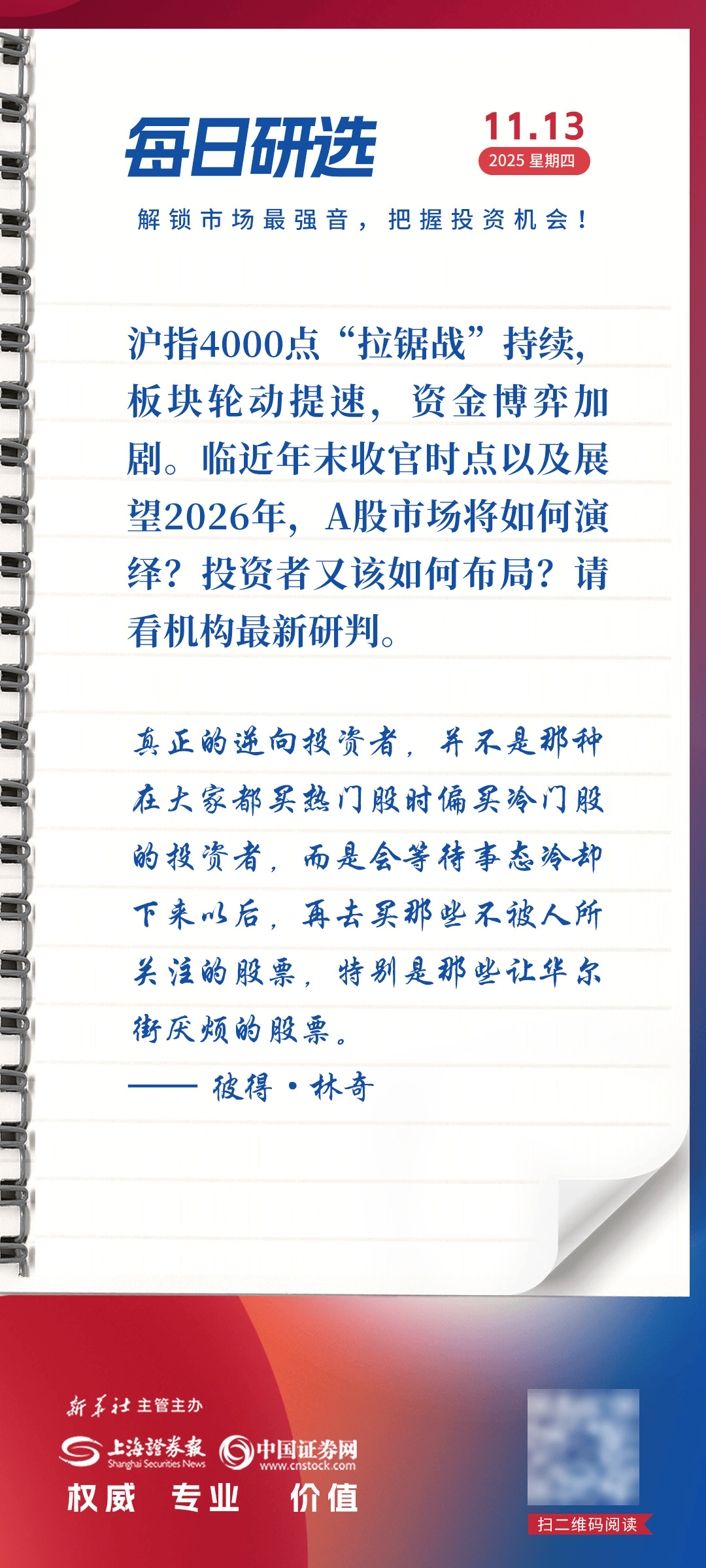
Core Viewpoint - The A-share market is currently experiencing a "tug-of-war" around the 4000-point level, with accelerated sector rotation and intensified capital competition as the year-end approaches and outlook for 2026 is considered [1] Market Overview - The Shanghai Composite Index is in a phase of consolidation, with a lack of strong catalysts leading to a relatively stable market momentum, characterized by oscillation and accumulation [1] - The internal market dynamics show a significant increase in the speed of style and sector rotation, with profit opportunities concentrating in specific sub-sectors [1] - A "wait-and-see" strategy is recommended to avoid risks associated with chasing trends [1] Mid-term Market Outlook - The core support logic for the market is becoming clearer, with similarities drawn to the market conditions of 2020-2021, driven by policy guidance, industrial upgrades, and capital resonance [1] - The market is currently in the early stages of a new policy-driven and industry trend-driven cycle [1] - The fourth quarter is expected to be more stable, with November entering an earnings vacuum period, while the "14th Five-Year Plan" provides new hotspots for the market [1] Strategic Outlook for 2026 - The performance of RMB-denominated equity assets is strategically favored for three reasons: 1. The rise of new economic drivers in China, such as advanced manufacturing and technological innovation, is expected to drive a re-evaluation of China's growth model by overseas capital [1] 2. A marginal easing of Sino-US relations is anticipated to enhance risk appetite [1] 3. Increasing certainty of global liquidity easing is expected to support the RMB and equity markets [1] - Incremental capital sources for the market in 2026 are likely to come from foreign investment and public funds, with a gradual appreciation of the RMB against the USD expected [1] Asset Allocation Strategy - A balanced asset allocation strategy is recommended for the fourth quarter, with an emphasis on defensive and recovery opportunities [2] - High-dividend sectors are highlighted as valuable alternatives to deposits and real estate in a low-interest-rate environment [2] - The mid-term focus remains on technology growth and advanced manufacturing, with an emphasis on domestic production processes and new productive forces [2] - Key sectors for investment include new energy, new materials, aerospace, and strategic emerging industries as outlined in the "14th Five-Year Plan" [2]
11月13日每日研选|如何应对“电风扇”行情,机构建议这样布局
Sou Hu Cai Jing· 2025-11-13 00:34
Core Viewpoint - The A-share market is experiencing a tug-of-war around the 4000-point level, with accelerated sector rotation and intensified capital competition as the year-end approaches and looking ahead to 2026 [3] Market Overview - The Shanghai Composite Index is currently in a phase of consolidation, with a lack of strong catalysts leading to relatively stable market momentum. The market is expected to exhibit a pattern of oscillation and accumulation [3] - Internal market dynamics show a significant increase in the speed of style and sector rotation, with profit opportunities concentrating in specific sub-sectors [3] Short-term Strategy - A "watch and wait" strategy is recommended to avoid the risks of chasing highs and cutting losses, as investors adopt a more cautious approach near year-end [3] Mid-term Outlook - The core support logic for the market is becoming clearer, with similarities to the 2020-2021 market conditions. The current market is in the early stages of a new policy-driven and industry trend-driven cycle [3] - The "14th Five-Year Plan" is expected to provide new hotspots for the market, leading to a stable A-share market towards the end of the year [3] Long-term Perspective (2026) - The outlook for RMB-denominated equity assets is strategically optimistic due to three main reasons: 1. The rise of new economic drivers in China, such as advanced manufacturing and technological innovation, is expected to drive a re-evaluation of China's growth model by overseas funds [3] 2. A marginal easing of Sino-U.S. relations is likely to enhance risk appetite [3] 3. Increasing certainty of global liquidity easing will support the RMB and equity markets [3] - Incremental capital sources for the market in 2026 are likely to come from foreign investment and public funds, with a gradual appreciation of the RMB against the USD anticipated [3] Asset Allocation Strategy - A balanced asset allocation strategy is recommended for the fourth quarter, with an emphasis on defensive and recovery opportunities in the short term [4] - High-dividend sectors are highlighted as important alternatives to deposits and real estate, while sectors such as finance, energy resources, public utilities, consumption, operators, and transportation are noted for their specific focus areas [4] - In the mid-term, the focus remains on technology growth and advanced manufacturing, with an emphasis on domestic production processes and new productive forces [4]
中国经济信心说丨加快场景培育和开放 尽快把“试验田”变成“高产田”
Yang Shi Xin Wen Ke Hu Duan· 2025-11-10 03:06
Core Viewpoint - The Chinese government emphasizes the importance of creating application scenarios to accelerate the commercialization of "black technology" and enhance new productive forces, ultimately supporting high-quality economic and social development [1][2]. Group 1: Importance of Scenarios - Scenarios are likened to "experimental fields" for testing new technologies, which are essential for transforming "black technology" into new productive forces [1]. - The government aims to build various types of scenarios, including comprehensive major scenarios and high-value niche scenarios, to facilitate the rapid application of new technologies and products [1][2]. Group 2: Challenges and Solutions - Despite the potential of "black technology," large-scale commercial applications face challenges, such as the need for policy adjustments and technological upgrades [2]. - The approach of "testing in small areas" is suggested to address development issues, allowing for gradual exploration and problem-solving [2][3]. Group 3: Role of Government and Market - The government is tasked with expanding the supply of production, work, and living scenarios to encourage social capital investment and facilitate the transformation of technological achievements into productive forces [3]. - Opening up scenario resources is expected to stimulate market competition, enabling companies to benefit from technological advancements and efficiency improvements [3]. Group 4: Future Growth Areas - The "14th Five-Year Plan" suggests promoting emerging industries such as quantum technology, biomanufacturing, hydrogen energy, and brain-computer interfaces as new economic growth points [3]. - Establishing typical application scenarios for these future industries, along with innovative regulatory approaches, is crucial for fostering the development of small and medium-sized enterprises and nurturing unicorn companies [3].
发挥新型举国体制优势 更大力度激发企业创新活力
Zheng Quan Shi Bao· 2025-11-09 22:57
Core Viewpoint - Technological innovation is essential for developing new productive forces and is a key element in the current global competition among major powers. The recent strategic deployment in the 14th Five-Year Plan emphasizes accelerating high-level technological self-reliance and innovation [1]. Group 1: Technological Innovation and National Strategy - The 14th Five-Year Plan suggests enhancing original innovation and tackling key core technologies through a new type of national system, focusing on critical areas such as integrated circuits and advanced materials [1][2]. - Experts believe that the new national system can integrate resources across the country, addressing the challenges faced in key technology sectors [2]. Group 2: Financial Support and Innovation Ecosystem - The plan emphasizes the need for a diversified financial service system that aligns with the lifecycle financing needs of technology enterprises, enhancing support for major national technology tasks and small to medium-sized tech firms [3]. - There is a call for financial institutions to develop specialized credit products for technology service organizations, aiming to lower financing thresholds and enhance support for innovation [4]. Group 3: Encouraging Corporate R&D - The plan proposes increasing the tax deduction ratio for corporate R&D expenses and enhancing government procurement of innovative products to stimulate corporate innovation [5]. - Since 2017, the R&D expense deduction ratio has been progressively increased, with certain sectors now eligible for a 120% deduction, directly reducing R&D costs for companies [5]. - Government procurement has significantly supported small and medium enterprises, with contracts exceeding 2.5 trillion yuan in 2023, accounting for 74.4% of total government procurement [5]. Group 4: Resource Integration and Standardization - The plan advocates for the integration of innovation resources, supporting leading enterprises and research institutions in forming innovation alliances to tackle technological challenges and share patents [6]. - It also emphasizes the establishment of industry standards, with the Ministry of Industry and Information Technology leading efforts to create a standardized technical committee to enhance market access for compliant enterprises [6].
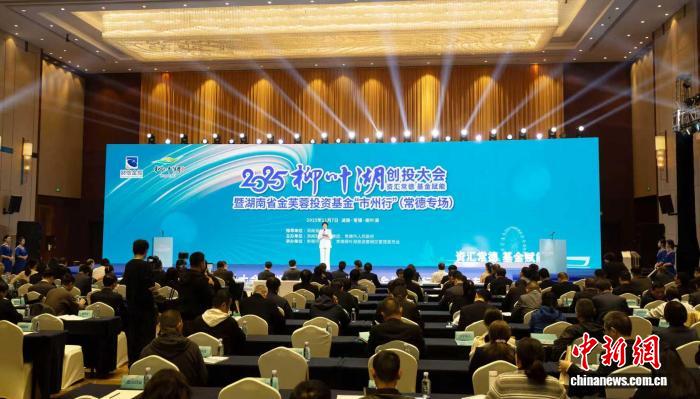
资本与产业的“双向奔赴” 湖南常德打造产融协同新样本
Zhong Guo Xin Wen Wang· 2025-11-07 13:52
Core Insights - The 2025 Liuyue Lake Venture Capital Conference and Hunan Jin Furong Investment Fund "City Tour" (Changde Special Session) was held on November 7, 2023, aiming to facilitate precise connections between capital and industry [1][3] - The conference resulted in cooperation intentions for 10 quality industrial projects across various sectors, including biomanufacturing, intelligent manufacturing, new energy materials, and semiconductors [3] - The event showcased 32 fund investment results and included on-site inspections of enterprises, highlighting the effectiveness of capital and industry collaboration [3] Investment Landscape - The Liuyue Lake Venture Capital Conference has been held four times, attracting 125 funds and fund management institutions with a total registered capital management scale of 39.962 billion [3] - Changde City has established three municipal mother funds with a total scale of 8 billion, focusing on comprehensive industrial guidance, synthetic biomanufacturing, and technology achievement transformation [3][4] - Hunan Xingxiang Capital Management Co., Ltd. has created a fund matrix totaling 8.521 billion, investing in 24 projects and directly investing over 500 million, leveraging social capital exceeding 3 billion [3] Industry Development - Hunan Xiangtou Jintian Titanium Industry, a high-tech enterprise in the high-end titanium alloy sector, plans to go public on the Sci-Tech Innovation Board in 2024, experiencing significant growth in revenue and profit [4] - The conference aimed to break down regional and informational barriers, allowing provincial financial resources to discover and invest in local Changde projects, thus promoting a dual approach of capital and industry [4]