玩具

Search documents
群兴玩具:关于续聘会计师事务所的公告
Zheng Quan Ri Bao· 2025-12-11 14:07
Core Viewpoint - The company announced the convening of its sixth board meeting on December 11, 2025, to review the proposal for the reappointment of the accounting firm [2] Group 1 - The board meeting is scheduled for December 11, 2025 [2] - The agenda includes the review of the proposal to reappoint the accounting firm [2]


重磅会议明确:努力稳定新出生人口规模
第一财经· 2025-12-11 11:44
Core Viewpoint - The article emphasizes the importance of stabilizing the new birth population in China to avoid rapid population decline and to optimize the age structure, which is crucial for balanced population development [3][4]. Group 1: Population Trends - In 2024, China's birth population is projected to be 9.54 million, an increase of 520,000 from 2023, marking the first rise since 2017, with a birth rate of 6.77‰, up by 0.38 per thousand from the previous year [3]. - Since 2022, China's population has entered a reduction phase, with a total decrease of 4.32 million over the past three years, characterized by declining birth rates, aging population, and regional population disparities [3]. Group 2: Marriage and Birth Support Policies - The article highlights the advocacy for a positive marriage and childbirth culture, with policies aimed at reducing the costs of childbirth, upbringing, and education through subsidies and tax deductions [4][6]. - Data from the Ministry of Civil Affairs shows that in the first three quarters of 2025, marriage registrations reached 5.152 million pairs, an increase of 405,000 pairs or 8.5% year-on-year [4]. Group 3: Incentives for Marriage - Various regions in China are implementing marriage incentives, such as cash rewards for newlyweds, with some areas offering up to 1,500 yuan for couples meeting specific criteria [5]. - The implementation of the revised Marriage Registration Regulations has made marriage registration more convenient, allowing couples to register anywhere in the country without needing a household registration book [5]. Group 4: Childcare Support System - A comprehensive childcare support system is being established, including annual subsidies of 3,600 yuan for each child under three years old starting January 1, 2025, and the removal of fees for the last year of public kindergarten [6][7]. - As of now, there are 126,000 childcare service institutions in China, with a total of 6.657 million childcare spots, exceeding the target set in the 14th Five-Year Plan [8].

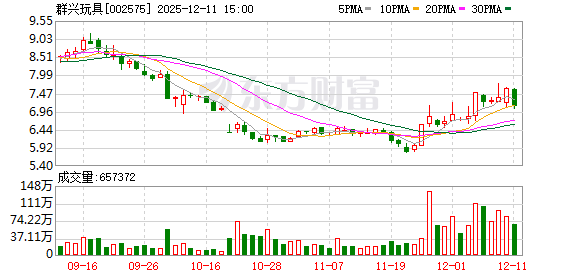
群兴玩具:12月11日召开董事会会议
Mei Ri Jing Ji Xin Wen· 2025-12-11 10:43
Group 1 - The core viewpoint of the article highlights that Qunxing Toys (SZ 002575) held its sixth second board meeting on December 11, 2025, to discuss the proposal for the second extraordinary shareholders' meeting of 2025 [1] - For the first half of 2025, Qunxing Toys reported that its revenue composition was as follows: 80.56% from liquor sales, 10.32% from intelligent computing business, and 9.12% from leasing of self-owned properties and operation services of entrepreneurial parks [1] - As of the report date, Qunxing Toys has a market capitalization of 4.4 billion yuan [1]
突发!南美与亚洲两国同时对中国商品加税!最高50%!2026年起实施→
Xin Lang Cai Jing· 2025-12-11 10:17
Core Viewpoint - The Mexican Congress has overwhelmingly approved a significant tariff bill that will impose tariffs on 1,463 products from Asian countries, including China, that do not have free trade agreements with Mexico, with rates ranging from 10% to 50% [1][6] Group 1: Tariff Details - The new tariffs will increase from the previous range of 0-20% to a new range of 10-50%, with most products falling between 10-30% [1][6] - The legislation is expected to be finalized by December 15, 2025, and will take effect on January 1, 2026 [1][6] - Affected countries include China, South Korea, India, Vietnam, Thailand, Indonesia, Russia, Turkey, Brazil, Nicaragua, the UAE, and South Africa, while countries with free trade agreements with Mexico, such as the EU, the US, and Canada, will not be affected [1][6] Group 2: Impact on Trade - Approximately 70% of the affected trade volume originates from China, with projected trade between China and Mexico reaching $109.426 billion in 2024, where Chinese exports are expected to be $90.232 billion, leading to a growing trade deficit that has prompted the tariff increase [3][8] - The Chinese Ministry of Commerce has expressed strong opposition to this unilateral and protectionist approach, stating that it will significantly harm Chinese interests and urging Mexico to correct its course [3][8] Group 3: Specific Industries Affected - The tariff bill will impact various industries, including: - Textiles and apparel (1,014 tariff codes, rates 10%-35%) - Steel and products (249 tariff codes, rates 15%-50%) - Automotive and parts (235 tariff codes, rates 20%-50%) - Plastics (81 tariff codes, rates 10%-35%) - Home appliances (18 tariff codes, rates 15%-30%) - Toys (37 tariff codes, rates 10%-25%) - Furniture (28 tariff codes, rates 15%-35%) - Footwear and leather (67 tariff codes, rates 10%-30%) - Paper and cardboard (47 tariff codes, rates 10%-20%) - Motorcycles (8 tariff codes, rates 20%-40%) - Aluminum products (21 tariff codes, rates 15%-35%) - Cosmetics and soaps (24 tariff codes, rates 10%-25%) [4][11]

展望“十五五” | 广东省发布“十五五”规划建议:着力打造新兴支柱产业,实施产业创新工程
Xin Lang Cai Jing· 2025-12-11 10:16
Core Viewpoint - The Guangdong Provincial Committee emphasizes the importance of the 15th Five-Year Plan in advancing China's modernization, highlighting the achievements during the 14th Five-Year Plan and setting ambitious goals for economic and social development in the upcoming period [3][4][7]. Group 1: Achievements During the 14th Five-Year Plan - Guangdong has achieved significant economic growth, reaching a total economic output of 14 trillion yuan, with over 7 million new urban jobs created and a rise in per capita disposable income outpacing economic growth [3][4]. - The province has made strides in high-quality development, technological innovation, and ecological improvements, showcasing a balanced and coordinated development approach [3][4][10]. Group 2: Historical Context and Development Environment - The 15th Five-Year Plan period is seen as crucial for consolidating the foundations of socialist modernization and creating new advantages for Guangdong [4][5]. - The province faces both opportunities and challenges, including global geopolitical shifts and the need for technological advancements to maintain competitive advantages [5][6]. Group 3: Guiding Principles and Goals for the 15th Five-Year Plan - The guiding principles include upholding the leadership of the Communist Party, prioritizing people-centered development, and focusing on high-quality growth [8][9]. - Key goals include achieving significant improvements in economic quality, enhancing self-reliance in technology, and promoting coordinated urban and rural development [10][11]. Group 4: Economic and Social Development Strategies - Strategies include deepening reforms, expanding openness, and enhancing the quality of the business environment to stimulate economic vitality [31][33]. - The plan emphasizes the importance of integrating domestic and international markets, fostering innovation, and developing a modern industrial system [30][36]. Group 5: Infrastructure and Technological Development - The plan outlines the need for a modern infrastructure system that supports economic activities and enhances resilience [21][22]. - It highlights the importance of technological self-reliance and innovation as key drivers for economic transformation and productivity enhancement [22][24]. Group 6: Consumer Market and Investment - The strategy focuses on boosting domestic consumption and investment, with initiatives aimed at enhancing consumer spending and optimizing investment structures [28][29]. - The plan aims to create a unified national market, facilitating resource sharing and economic integration across regions [30].

港股开盘丨恒指高开0.66% 汇丰控股涨逾2%
Di Yi Cai Jing· 2025-12-11 04:11
Group 1 - The Hang Seng Index opened up by 0.66% and the Hang Seng Tech Index rose by 0.55% [1] - Pop Mart, Zijin Mining, and HSBC Holdings each increased by over 2% [1] - Tech stocks such as NetEase, Alibaba, and Bilibili showed strong performance [1]

玩具产品质量标准更严格:强化安全要求,多个关键技术指标变化
Ren Min Ri Bao· 2025-12-11 00:03
Core Viewpoint - The article discusses the recent updates to China's mandatory toy safety standards, highlighting the need for improved safety measures in the toy industry to protect children from harmful substances and ensure product quality [1][2]. Group 1: Industry Overview - China is a major player in the toy industry, both in production and consumption, with the domestic toy retail market expected to exceed 100 billion yuan in 2025 [1]. - The toy industry is experiencing growth in scale and diversity, but the emergence of substandard toys poses significant risks to consumer safety [1]. Group 2: Regulatory Changes - The Ministry of Industry and Information Technology has revised four mandatory national standards (GB 6675.1 to GB 6675.4) for toy safety, which have been approved by the State Administration for Market Regulation [1][2]. - New standards include limits on ten harmful substances, such as formaldehyde and volatile organic compounds, to enhance the safety of toys [2]. - Specific technical requirements have been added for new product categories, including flame-retardant properties for headwear toys and safety measures for soft toys [2]. Group 3: Specific Safety Measures - The revised standards set a formaldehyde limit of 30 mg/kg for toys intended for children under 36 months and introduce a limit of 0.5 mg/m³ for total volatile organic compounds, filling a gap in both domestic and international toy safety standards [2]. - The number of phthalate types regulated has increased from six to ten, addressing concerns over plasticizers' impact on children's health [2]. - The limit for boron content in "slime" and similar toys is set at 300 mg/kg to mitigate potential risks [2]. Group 4: Ongoing Oversight - The State Administration for Market Regulation will continue to enhance supervision of children's products, focusing on popular items like magnetic beads and "blind box" toys, to ensure quality and safety [3].
强化安全要求,多个关键技术指标变化 玩具产品质量标准更严格(政策速递)
Ren Min Ri Bao· 2025-12-10 22:12
Core Viewpoint - The recent revisions to China's mandatory national standards for toy safety aim to enhance consumer protection and ensure the safety of toys for children, addressing concerns over harmful substances and improving overall product quality [1][2]. Group 1: Regulatory Changes - The Ministry of Industry and Information Technology has revised four mandatory national standards (GB 6675.1 to GB 6675.4) for toy safety, which have been approved by the State Administration for Market Regulation [1]. - New standards have been introduced to cover ten categories of harmful substances, including formaldehyde and volatile organic compounds, significantly increasing the scope of chemical safety requirements for toys [1][2]. Group 2: Specific Safety Requirements - The revised standards include new technical requirements for toys such as flame-retardant properties for headwear toys and specific testing methods for soft toys and play tents, enhancing fire safety [2]. - For popular toys like "squishy" and "crystal mud," the limits for harmful substances have been optimized, including a formaldehyde limit of 30 mg/kg for toys intended for children under 36 months [2]. Group 3: Ongoing Monitoring and Enforcement - The State Administration for Market Regulation will continue to implement a three-year action plan focused on the safety of children's and student products, targeting emerging products like magnetic beads and "blind box" toys for enhanced regulatory oversight [3].
幼稚经济消费趋势洞察
Yi En Zi Xun· 2025-12-10 11:11
Group 1: Overview of the "Childish Economy" - The "Childish Economy" is driven by the trend of "self-rejuvenation," where adults consume childlike products to cope with real-life uncertainties, reflecting emotional consumption[3] - The popularity of the "Childish Economy" has increased by 26% compared to the previous year, with social media engagement reaching 108,212,508 interactions in 2025[11] - Key consumer segments include "Circle Followers" (44.4%), "Pressure Experience Seekers" (36.2%), and "Compensatory Healers" (19.4%)[43] Group 2: Consumer Behavior and Preferences - Consumers are drawn to products that evoke childhood memories, such as blind boxes, miniature landscapes, and electronic pets, which serve as emotional outlets[10] - Emotional values sought by consumers include surprise, companionship, healing, and nostalgia, with surprise being a significant driver[26][27] - The "Compensatory Healers" segment shows a 564% increase in interest in AI smart companion toys from 2024 to 2025, indicating a growing demand for emotional support products[82] Group 3: Social Media Marketing Insights - Marketing strategies on platforms like Xiaohongshu focus on community resonance and lifestyle presentation, with a 73.2% increase in commercial posts and a 52.2% increase in spending over the past year[93] - On Douyin, the most effective content types include blind box unboxing, creative storytelling, and immersive scene content, which enhance consumer engagement[112] - The emotional and sensory experiences provided by products are crucial for attracting consumers, with ASMR and immersive storytelling being particularly effective[119][123]
实丰文化获疯狂动物城IP正版授权 相关潮流玩具预计明年上市
Zheng Quan Shi Bao Wang· 2025-12-10 11:00
Group 1 - The film "Zootopia 2" has gained significant popularity since its release, with the capital market showing high interest in the film [1] - Shifeng Culture (002862) has successfully obtained the official licensing rights for the Zootopia IP this year, and related trendy toy products are in the development phase, expected to launch in the market next year [1] - The company aims to deeply explore the core characteristics and emotional value of the Zootopia IP, aligning product development with consumer demand and market trends, focusing on high-quality design to create competitive products [1] Group 2 - As of December 10, the domestic box office for "Zootopia 2" reached 3.13 billion yuan, ranking among the top three in China's annual box office and becoming the highest-grossing imported animated film [1] - The global box office for "Zootopia 2" reached $938 million, making it the fourth highest-grossing film globally this year, with China being the largest single market [2] - Shifeng Culture has built a diverse IP matrix covering multiple fields, including popular IPs like Pokémon, Frozen, Toy Story, and others, as well as mobile game IPs and national animation IPs [2] Group 3 - Shifeng Culture's main business involves toys and games, with over 1,000 product varieties sold in nearly 100 countries and regions [2] - The company's market capitalization is approximately 3.4 billion yuan as of December 10, with around 25,500 shareholders as of the end of the third quarter [3]