
科技股

Search documents
高盛交易员:美股涨势"极端窄化",七巨头屡创新高但整体跑输全球市场
Hua Er Jie Jian Wen· 2025-11-01 02:37
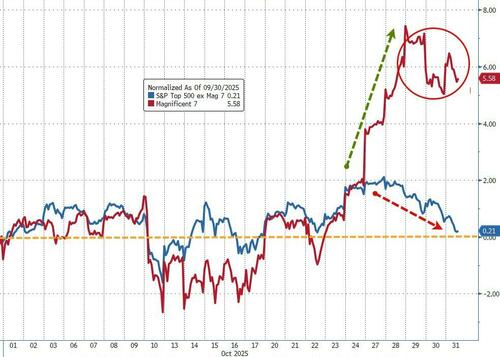
Core Insights - The U.S. stock market is exhibiting two major contradictions: tech giants are driving indices to new highs, yet market breadth has narrowed to extreme levels, with U.S. stocks lagging behind global markets for 18 consecutive months [1][5]. Group 1: Market Performance - The Nasdaq index recorded a 5% increase for two consecutive months, but market concentration has reached historical extremes [1][6]. - On a recent Tuesday, the ratio of advancing to declining stocks in the S&P 500 hit the lowest level on record, indicating that large tech stocks are dominating while the other 493 components remain stagnant [1][8]. - Despite the strong performance of U.S. tech giants, the overall U.S. market has underperformed compared to global markets, failing to generate excess returns over the past 18 months [5][6]. Group 2: Tech Giants and Investment Trends - The seven major tech companies (Mag-7) significantly outperformed the remaining S&P 500 components, which remained nearly flat during the same period [6]. - Meta is facing investor skepticism regarding its return on investment, yet its $125 billion bond issuance received record demand, indicating its continued investment capability [7]. - Following the third-quarter earnings report, the capital expenditure plans for the seven giants may be adjusted upward by $60 billion for 2026, with Nvidia becoming the first company to surpass a $5 trillion market cap [7][9]. Group 3: Global Market Dynamics - The global market breadth is impressive, supported by valuation and positioning, suggesting a continuation of this trend [3][12]. - Significant changes are occurring in the European market, with companies like Airbus and Thales merging satellite businesses, indicating a shift in traditional industries towards AI efficiency [10]. - The Asian market is also showing positive trends, with expectations for earnings per share and overall market performance supported by the dollar's trajectory and an upward revision of China's GDP forecast [12].


7000点“磁场”生效 期权仓位扎堆标普500整数关口 但然后呢.....
智通财经网· 2025-10-31 11:28
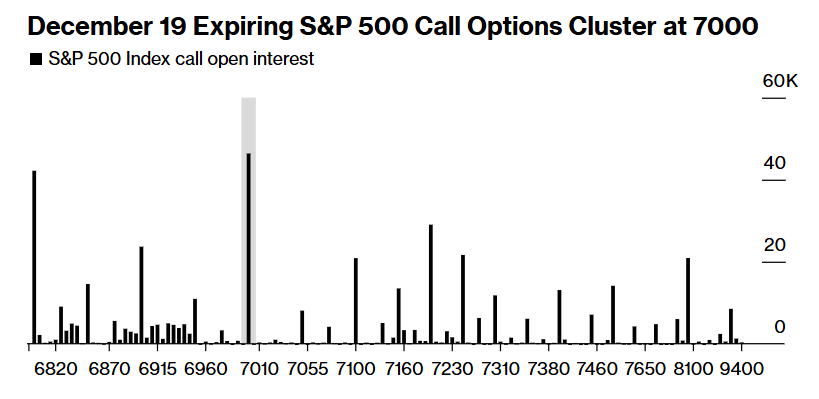
Core Viewpoint - The S&P 500 index is expected to face limited upward movement, with a potential increase of only 2.5% to reach the psychological level of 7000 points by the end of the year, despite a strong performance in the U.S. stock market since the beginning of 2023 [1][2]. Group 1: Market Sentiment and Predictions - Investor sentiment remains bullish, with hedge funds and institutional investors betting on the S&P 500 index breaking the 7000-point mark by year-end, driven by positive signs in U.S.-China trade, expectations of interest rate cuts, and improved earnings forecasts related to AI [1][2]. - The options market shows a concentration of bets around the 7000-point level, indicating a significant psychological milestone for the index, which could suggest a 19% increase for the entire year of 2025 [2][5]. Group 2: Economic Indicators and Risks - Despite the overall bullish outlook, there are concerns regarding the sustainability of the economic growth, with signs of a slowdown and cracks in high-risk assets within the credit market, raising questions about consumer health and credit support [5][6]. - The performance of the S&P 500 index has been heavily reliant on a few tech giants, known as the "Magnificent Seven," which account for approximately 35% of the index's weight. A downturn in any of these stocks could lead to a concerning "quasi-bear market" atmosphere [6][7]. Group 3: Options Market Dynamics - The popularity of the 7000-point strike price is attributed to its psychological appeal among investors, with many opting for options trading near large round numbers due to their perceived "magnetic attraction" [8][9]. - The complexity of the derivatives market, including strategies like box spreads and whale trades, contributes to the concentration of open interest at the 7000-point level, indicating a mix of bullish and cautious strategies among institutional investors [8][9].




美股新纪录!暴涨暴跌为何频现?
第一财经· 2025-10-30 03:36
Core Viewpoint - The article discusses the increasing volatility in the U.S. stock market, particularly among large technology stocks, and highlights the role of derivatives in amplifying this volatility [3][4][7]. Group 1: Market Volatility - As of this year, there have been 119 instances of individual U.S. stocks experiencing a market cap change of over $100 billion in a single day, a record high compared to 84 instances last year and only 33 during the bear market of 2022 [4]. - Major tech stocks like Nvidia, Microsoft, and Apple have been responsible for some of the largest single-day market cap fluctuations, with Nvidia losing $592.7 billion on January 27 and gaining $441 billion on April 9 [4]. - The VIX index, which measures market volatility, has risen sharply in October, exceeding the average level of the past 20 years by nearly 5% [4]. Group 2: Derivatives Market Impact - The derivatives market is identified as a key driver of increased volatility, with retail investors and hedge funds making short-term bets on individual stocks, leading market makers to hedge their positions and further exacerbate price swings [7]. - In October, trading volume for single-stock options reached its highest level since the retail trading boom in 2021, with retail investors accounting for 60% of this market [7]. - The rise of leveraged products, including double or triple leveraged ETFs, has contributed to the prevalence of significant single-day stock fluctuations, as seen when $26 billion worth of stocks were forcibly liquidated to maintain leverage requirements [7]. Group 3: Market Themes and Risks - Current market themes such as artificial intelligence, tax policy changes, and global trade tensions are affecting certain stocks while benefiting others, leading to a temporary suppression of correlations among individual stocks [8]. - If correlations among stocks rise again, it could lead to coordinated sell-offs among major stocks, posing greater risks to overall market stability [8].

10月30日证券之星早间消息汇总:中美元首将举行会晤
Sou Hu Cai Jing· 2025-10-30 00:56
Macro News - Chinese President Xi Jinping is scheduled to meet with U.S. President Donald Trump on October 30 in Busan, South Korea, to discuss U.S.-China relations and mutual concerns, with Trump expressing optimism about the meeting's outcomes [1] - The Federal Reserve announced a 25 basis point cut in the federal funds rate target range to 3.75% to 4.00%, aligning with market expectations, and will end its balance sheet reduction on December 1 [1] Industry News - The State Administration of Foreign Exchange in China released nine policy measures to facilitate cross-border trade and support foreign trade development, including expanding pilot areas for high-level trade openness and simplifying procedures for multinational companies [2] - The Beijing Securities Regulatory Bureau, along with other financial authorities, issued implementation opinions to promote long-term capital market entry, emphasizing the establishment of a long-term performance evaluation mechanism for commercial insurance funds [2] Overseas News - U.S. stock indices showed mixed results on October 29, with the Nasdaq reaching a new all-time high. Nvidia rose nearly 3%, surpassing a market cap of $5 trillion, while Apple slightly increased, marking its first closing market cap over $4 trillion [3] - Microsoft reported Q1 revenue of $77.67 billion, an 18% year-over-year increase, with net profit of $27.747 billion, a 12% increase. The intelligent cloud business generated $30.9 billion in revenue, exceeding estimates [3]
深夜重磅!美联储降息25个基点,解读来了
2 1 Shi Ji Jing Ji Bao Dao· 2025-10-29 22:50
Group 1 - The Federal Reserve announced a 25 basis point cut in the federal funds rate target range to 3.75% to 4.00%, marking the fifth rate cut since September 2024 [1] - Fed Chairman Jerome Powell indicated that the decision for a rate cut in December is uncertain, with current expectations for a rate cut probability at 65%, down from 90% prior to the meeting [6] - Powell mentioned that a government shutdown could impact economic activity and the upcoming December meeting [6] Group 2 - The Fed's FOMC statement revealed that the asset purchase program will end on December 1, with Powell noting that market pressures necessitate immediate adjustments to the balance sheet operations [7] - Following Powell's comments, U.S. stock markets experienced a downturn, with only the Nasdaq showing a slight increase [8] - Notable performances in the tech sector included Nvidia rising approximately 3% to a market cap of $5 trillion, while Apple surpassed a $4 trillion market cap for the first time [10] Group 3 - The two-year U.S. Treasury yield surged to 3.59%, and the dollar index saw a short-term increase, while the onshore RMB depreciated against the dollar [11] - Bitcoin experienced a decline, with approximately 129,165 traders liquidated in the last 24 hours, totaling around $558 million in liquidations [12][13] - Analysts suggest that the recent rate cuts may enhance the attractiveness of emerging markets, potentially leading to improved global financial conditions and lower global financing costs [14]

深夜重磅!美联储降息25个基点,美股跳水,黄金跌破3930美元,加密货币近13万人爆仓,解读来了
2 1 Shi Ji Jing Ji Bao Dao· 2025-10-29 22:16
Core Viewpoint - The Federal Reserve announced a 25 basis point reduction in the federal funds rate target range to 3.75% to 4.00%, marking the fifth rate cut since September 2024 and a cumulative reduction of 150 basis points in this cycle [1][3]. Market Impact - U.S. stock markets are expected to continue rising, with potential volatility before the end of the year; foreign investors anticipate strong structural opportunities in the A-share market, particularly favoring the technology growth sector [6]. - The expectation of rate cuts supports gold prices, although excessive speculation has been noted, suggesting investors should be cautious of potential pullbacks [7]. - The status of U.S. Treasuries as a "risk-free asset" is under scrutiny, with bond yields likely to be suppressed [7]. - The U.S. dollar index faces risks from uncertainties regarding tariffs, government shutdowns, and credit pressures, likely leading to a continued weak trend [7]. Federal Reserve Outlook - Fed Chairman Jerome Powell indicated that the December rate decision is uncertain, with a 65% probability of a rate cut, down from 90% prior to the meeting [9]. - Powell noted that the government shutdown could impact economic activity and the upcoming rate decision, emphasizing the need for caution in the absence of data [9]. Stock Market Performance - Major tech stocks showed strong performance, with NVIDIA rising approximately 3% and surpassing a market cap of $5 trillion; Apple also closed above $4 trillion for the first time [12]. - Meta Platforms saw a significant drop of over 8% in after-hours trading due to disappointing earnings [12]. Bond and Currency Movements - The two-year U.S. Treasury yield surged to 3.59%, while the dollar index rose briefly, and the onshore RMB depreciated against the dollar [13]. - Spot gold prices fell below $1,930 per ounce [13]. Emerging Markets - The current rate cut is viewed as a preventive measure, with expectations for a dual bull market in stocks and bonds if economic data supports a soft landing; however, persistent inflation or a sharp decline in the job market could increase asset volatility [17]. - The decline in U.S. Treasury yields is expected to improve global financial market conditions, driving down global financing costs and enhancing the attractiveness of emerging market assets [18].

深夜重磅!美联储降息25个基点,美股跳水,黄金跌破3930美元,加密货币近13万人爆仓,解读来了
21世纪经济报道· 2025-10-29 22:06
Core Viewpoint - The Federal Reserve has lowered the federal funds rate target range by 25 basis points to 3.75% to 4.00%, marking the fifth rate cut since September 2024 and a cumulative reduction of 150 basis points in this cycle [1][3]. Market Impact - The U.S. stock market is expected to continue rising, with potential fluctuations before the end of the year; foreign capital is generally optimistic [6]. - Following comments from Fed Chair Jerome Powell regarding uncertainty around December's rate actions, U.S. stocks experienced a drop, although tech stocks like NVIDIA and Apple showed strong performance [12]. - The yield on two-year U.S. Treasury bonds surged to 3.59%, while the dollar index rose slightly, and the onshore RMB depreciated against the dollar [13]. Economic Outlook - Powell indicated that the December rate cut is not guaranteed, and uncertainties such as a government shutdown could impact economic activity [10][11]. - The probability of a rate cut in December has decreased to 65%, down from 90% prior to the meeting [11]. - The Fed plans to end its balance sheet reduction on December 1, with indications that it may be time to halt quantitative tightening [11]. Emerging Markets - The attractiveness of emerging markets is expected to increase as U.S. Treasury yields decline, which may lower global financing costs and support better performance in global stock markets [19].

李迅雷专栏 | 黄金暴涨、股市波动,普通人机会在哪?
中泰证券资管· 2025-10-29 11:33
Core Viewpoints - The current market dynamics and potential for a "slow bull" market are under discussion, with emphasis on the importance of understanding the underlying drivers of stock and gold prices [4][11][12]. Group 1: Market Dynamics - The stock market's volatility is influenced by investor psychology, particularly greed and fear, which are common pitfalls for many investors [6][5]. - The A-share market is characterized by high turnover rates, leading to elevated valuations and a tendency for prolonged bear markets compared to bull markets [9][10]. - The recent market rally is attributed to a combination of improved corporate fundamentals, declining interest rates, and supportive policies, although the sustainability of this rally remains uncertain [14][19][20]. Group 2: Investment Strategies - Investors are advised to focus on the fundamentals of listed companies and avoid chasing trends, emphasizing the importance of buying low and selling high [6][7]. - The concept of "slow bull" is still under evaluation, with a consensus that a sustained upward trend would require several years of consistent growth [13][14]. - The current valuation levels of A-shares are considered moderate, suggesting that while there is potential for growth, caution is warranted [16][24]. Group 3: Gold Market Insights - The recent surge in gold prices, which has increased by over 50% this year, raises concerns about potential corrections, indicating that current levels may not be the best entry point for new investments [41][43]. - Central banks globally are increasing their gold reserves to enhance monetary authority, reflecting a strategic shift away from reliance on the US dollar [47]. - Recommendations for gold investment allocation suggest a cautious approach, with a current optimal allocation of around 10% of an investment portfolio [48].

28日美国三大股指上涨
Sou Hu Cai Jing· 2025-10-29 00:26
Core Viewpoint - The Federal Reserve's two-day monetary policy meeting is taking place, with investors also focusing on a series of earnings reports from large publicly listed companies. Optimism regarding the ongoing AI boom is rising, leading to an increase in major tech stocks and record closing highs for the three major U.S. stock indices [1]. Group 1 - The market is buoyed by favorable industry news, contributing to a positive outlook on the sustainability of the AI trend [1]. - Major U.S. stock indices have reached new closing highs, with the Dow Jones Industrial Average rising by 0.34%, the S&P 500 increasing by 0.23%, and the Nasdaq gaining 0.80% [1].
股市面面观|美股“超级财报周”来袭 AI投资回报再成焦点
Xin Hua Cai Jing· 2025-10-28 12:05
Core Insights - The investment boom in artificial intelligence (AI) is driving a strong rally in the U.S. stock market, with the S&P 500 and Nasdaq indices reaching new historical highs [1] - Major tech companies, including Microsoft, Apple, Google, Amazon, and Meta, are set to release their Q3 earnings reports, which will be crucial for the future trajectory of the U.S. stock market [1] - Analysts emphasize that investor focus will be on AI-related capital expenditures and the returns on AI investments, which are expected to impact companies' free cash flow and gross margins [1] AI-Related Capital Expenditure - The expectation of interest rate cuts by the Federal Reserve, combined with a resilient macroeconomic environment, continues to fuel interest in the tech sector [2] - A report from Wells Fargo indicates that the market's focus will shift to large tech companies' AI capital expenditure plans, which are critical for Q3 earnings and further stock market gains [2] - Gartner forecasts global AI spending to reach nearly $1.5 trillion by 2025, a 50% increase from 2024, and to rise to $2 trillion by 2026, marking a further 37% growth [2] - Morgan Stanley analysts believe that AI investment is still in its early stages, predicting a multi-year capital expansion cycle, with total capital expenditures for large tech companies expected to grow by 24% to nearly $550 billion by 2026 [2] Focus on Cloud and Infrastructure - Industry insiders suggest that tech giants will prioritize AI spending on cloud and foundational infrastructure, with capital expenditures directed towards building data centers and acquiring high-performance servers and GPUs [3] - Microsoft anticipates Q3 capital expenditures of $30 billion, a year-over-year increase of over 50%, with continued growth expected in FY2026, albeit at a slower rate [3] - Google has raised its annual capital expenditure forecast, expecting it to reach $85 billion by 2025, with further increases anticipated for 2026 [3] Investment Returns and Market Sentiment - The debate over whether U.S. tech stocks are in a bubble is intensifying, with the profitability of AI remaining uncertain, making Q3 earnings critical for market outlook [5] - Citigroup's report highlights that AI infrastructure investments are exceeding expectations, with real enterprise demand providing a "release valve" for this investment wave, distinguishing it from the 2000 internet bubble [6] - Coatue Management asserts that the long-term fundamentals in the AI sector remain strong, supported by healthy operating cash flows rather than excessive leverage [6] - Analysts are closely monitoring the free cash flow of major cloud service providers, noting a trend of decline that could signal the end of the AI capital expenditure boom [6] Cloud Service Growth Rates - For Q3, analysts expect Microsoft Azure's revenue growth to reach approximately 36%, accounting for 40% of total revenue; Google Cloud's growth is projected at 29%-30%, reaching $14.66 billion; while AWS is expected to grow at a slower rate of 17.8%, with revenues of $32.33 billion [7]

