家居

Search documents
渤海证券研究所晨会纪要(2025.11.18)-20251118
BOHAI SECURITIES· 2025-11-18 03:00
Macro and Strategy Research - The scale of off-balance sheet financing and direct financing has increased, with a notable rise in entrusted loans and corporate bond financing, while overall social financing showed a year-on-year decrease of nearly 600 billion yuan in October [2][3] - The loan data indicates a weak demand, with a year-on-year decrease of 280 billion yuan in RMB loans, and a significant increase in corporate bill financing, reflecting a trend of companies being cautious about expanding capacity [2][3] - M2 growth rate slightly declined to 8.2% in October, primarily due to base effects and reduced loan-generated deposits, while M1 growth rate fell to 6.2% [3] Mergers and Acquisitions - Mergers and acquisitions are seen as crucial tools for supporting economic transformation and achieving high-quality development, with a significant increase in market activity following the introduction of new policies in 2024 [4][5] - Historical trends show that the U.S. mergers and acquisitions market has experienced several waves, characterized by horizontal, vertical, diversification, and cross-border mergers [5] - The previous wave of mergers and acquisitions in China (2014-2015) positively impacted listed companies' performance, with a notable improvement in ROE following successful mergers [6] Economic Data Analysis - In October 2025, the industrial added value grew by 4.9% year-on-year, below expectations, while retail sales increased by 2.9% [7][8] - Seasonal factors and reduced working days contributed to the slowdown in industrial production, with certain sectors like transportation equipment manufacturing performing well [8] - Fixed asset investment showed a cumulative year-on-year decline of 1.7%, with manufacturing and infrastructure investments particularly affected by weak demand and policy implementations [10] Fund Research - The cross-border ETF market continues to see net inflows, with an expansion of the "Southbound ETF Connect" list, indicating growing interest in international investments [12][13] - The overall ETF market experienced a net inflow of 24.426 billion yuan, with significant contributions from cross-border ETFs [13][14] Industry Research - The medical and biological sector is witnessing a surge in flu cases, with the proportion of flu-like cases in the northern region reaching a four-year high, suggesting potential investment opportunities in diagnostics and vaccine production [16][17] - The light industry and textile sectors are benefiting from strong performance during the "Double Eleven" shopping festival, with apparel sales leading the growth [18][20]
今日重点推荐:晨会报告-20251118
Shenwan Hongyuan Securities· 2025-11-18 02:15
Group 1: Global Asset Allocation Strategy - The global asset allocation environment is expected to transition from preemptive interest rate cuts by the Federal Reserve to a re-inflation cycle driven by both fiscal and monetary policy easing [2][8] - The focus for 2026 will be on the liquidity turning point's impact on asset rotation, with a gradual shift from liquidity-driven to fundamental trend-driven asset logic in domestic markets [8][11] - The report emphasizes the importance of monitoring inflation trends as a tactical timing cue for investment strategies, suggesting a balanced allocation between equities and bonds in the first quarter of 2026 [8][11] Group 2: Industry Investment Strategies - The defense and military industry is entering a new cycle driven by both domestic demand growth and external potential release, with a focus on modernization and technological advancements [2][15] - The young manufacturing industry is highlighted for its global supply chain opportunities, emphasizing the irreversible trend of globalization and the competitive landscape for Chinese enterprises [3][14] - The report identifies key sectors for investment, including defense, aerospace, and advanced manufacturing, driven by government policies and market demand [15][16] Group 3: Economic and Market Outlook - Economic demand is expected to stabilize and recover in 2026, with PPI bottoming out and turning positive, leading to a rotation in industry styles from technology growth to cyclical assets [10][11] - The report predicts that the overall market will see a recovery in corporate earnings, particularly in sectors benefiting from the recovery of industrial product inflation [11][12] - The analysis indicates that the current valuation of cyclical consumer assets remains below historical averages, suggesting potential for future appreciation [12][13]
高盛:上调敏华控股目标价至4.8港元 维持“中性”评级
Zhi Tong Cai Jing· 2025-11-17 05:58
Core Viewpoint - Goldman Sachs has raised the target price for Minhua Holdings (01999) by 2% from HKD 4.7 to HKD 4.8, maintaining a "Neutral" investment rating [1] Financial Performance - Minhua's revenue for the first half of the year met expectations, while profits exceeded expectations [1] - For the fiscal year 2026, total revenue and net profit are projected to be HKD 8.045 billion and HKD 1.146 billion, representing a year-on-year decline of 3% and a growth of 1% respectively [1] - Compared to global figures, revenue and net profit are expected to show no change and a growth of 7% respectively [1] Business Segments - Minhua's overseas business growth continues to outpace domestic business growth [1] - Domestic business revenue has seen a reduced decline in quarterly comparisons, primarily due to the growth of online business and a lower base effect [1] Profitability - The profit margin exceeded expectations mainly due to favorable cost conditions, although this was partially offset by an increase in expenses [1] - In response to the latest performance, Goldman Sachs has adjusted its earnings per share forecasts for Minhua for the fiscal years 2026 to 2028 upwards by 1-3% [1]
高盛:上调敏华控股(01999)目标价至4.8港元 维持“中性”评级
智通财经网· 2025-11-17 05:57
Core Viewpoint - Goldman Sachs has raised the target price for Minhua Holdings (01999) by 2% from HKD 4.7 to HKD 4.8, maintaining a "Neutral" investment rating [1] Financial Performance - Minhua's revenue for the first half of the year met expectations, while profits exceeded expectations [1] - For the fiscal year 2026, total revenue and net profit are projected to be HKD 8.045 billion and HKD 1.146 billion, representing a year-on-year decline of 3% and a growth of 1% respectively [1] - Compared to global figures, revenue and net profit are expected to show no growth and a 7% increase respectively [1] Business Segments - Minhua's overseas business growth continues to outpace domestic business growth [1] - Domestic business revenue has seen a reduced decline in quarterly comparisons, primarily due to the growth of online business and a lower base effect [1] Profitability - The profit margin exceeded expectations mainly due to favorable cost conditions, although this was partially offset by increased expenses [1] - Goldman Sachs has adjusted its earnings per share forecasts for Minhua for the fiscal years 2026 to 2028 upwards by 1-3% to reflect the latest performance [1]
敏华控股发布中期业绩:营收82.41亿港元 中国市场销售跌幅收窄
Huan Qiu Wang· 2025-11-17 05:51
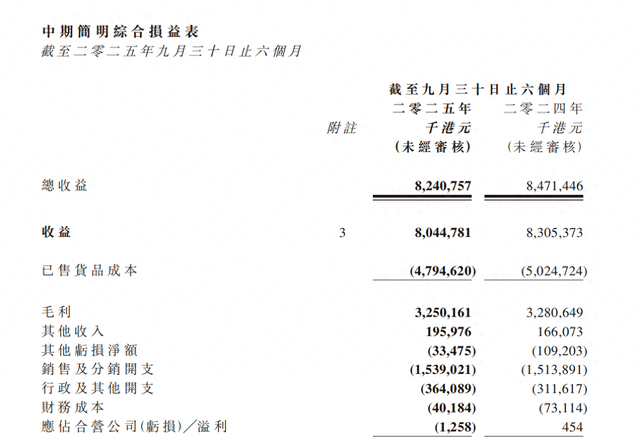
Core Viewpoint - Minhua Holdings reported a total revenue of HKD 82.41 billion for the six months ending September 30, 2023, representing a year-on-year decline of approximately 2.7%, while profit attributable to equity holders increased by 0.6% to HKD 11.46 billion [1]. Financial Performance - Total revenue for the period was HKD 82,407.57 million, down from HKD 84,714.46 million in the previous year [2]. - Revenue from sold goods amounted to HKD 80,447.81 million, a decrease of 3.1% compared to HKD 83,053.73 million [3]. - Cost of goods sold was HKD 47,946.20 million, leading to a gross profit of HKD 32,501.61 million [2]. - Other income increased by 18% to HKD 195.976 million from HKD 166.073 million [3]. Product Segment Analysis - Revenue from sofas and related products was HKD 55.50 billion, down 4.6% year-on-year [2]. - Revenue from bedding and related products decreased by 7.4% to HKD 11.19 billion [2]. - Other products saw an increase in revenue by 11.4%, reaching HKD 9.31 billion [2]. - Home Group business revenue was HKD 3.80 billion, reflecting a growth of 2.2% [2]. Regional Performance - Revenue from the Chinese market (excluding real estate and shopping mall properties) fell by 6% to approximately HKD 46.75 billion, although there was a quarter-on-quarter improvement [5]. - Overseas market revenue was approximately HKD 24.66 billion, down about 2.6% from HKD 25.31 billion in the previous year [5]. Future Outlook - The company plans to continue advancing its "smart home" strategy, focusing on product innovation and brand building to strengthen its global market leadership [5]. - In the Chinese market, the company aims to enhance market penetration through themed marketing campaigns and increase resources for online sales [5]. - The company will also adjust its store layout in China to improve operational efficiency and actively participate in international exhibitions to navigate changes in the trade environment [5].

港股异动 | 敏华控股(01999)涨超3% 中期纯利同比增长0.6% 延续高比例股东回馈
智通财经网· 2025-11-17 03:16
消息面上,11月14日,敏华控发布截至2025年9月30日止六个月业绩,总收益82.41亿港元,同比下降 2.7%;公司拥有人应占溢利11.456亿港元,同比增长0.6%。公告指,期内,集团营业收入同比下降约 3.1%,但凭借严谨控制成本及良好经营效益,毛利率得以按年上升0.9个百分点至40.4%,净利率亦上升 0.5个百分点至14.2%,处于业内领先水平。派中期息15港仙。 智通财经APP获悉,敏华控股(01999)涨超3%,高见5.24港元创年内新高。截至发稿,涨3.37%,报5.22 港元,成交额1913.85万港元。 信达证券点评称,面对国际贸易摩擦加剧、内需疲软的综合背景,公司凭借灵活经营策略&稳健财务管 理,收入整体表现平稳、盈利能力逆势提升。展望未来,该行判断关税分摊影响逐步落地,表观报表盈 利能力或有影响,但公司持续降本增效,整体有望维持平稳。此外,公司FY26H1派利比例为50.8%, 延续50%+高比例股东回馈。 ...
新消费潜力迸发
Jing Ji Ri Bao· 2025-11-16 21:52
Core Insights - The third-quarter reports of listed companies reflect the resilience and vitality of China's consumer market, indicating a structural adjustment period with both challenges and opportunities [1] Overall Recovery - The consumer sector shows a steady recovery overall, but there is uneven performance across different segments. Essential consumption remains stable, while discretionary consumption is experiencing a divide [2] - Essential consumption sectors like food and beverages are performing well due to their necessity, with leading companies showing stable revenue and profit growth. For instance, Wuliangye reported a 52.66% year-on-year decline in Q3 revenue to 8.174 billion yuan, and a 65.62% drop in net profit to 2.019 billion yuan [2] - In contrast, the new energy vehicle industry is thriving, benefiting from policy support and product upgrades, becoming a key growth driver in the consumer sector [2] Channel Transformation - Traditional retail companies are accelerating their online transformation, integrating online and offline channels. Companies that embrace digitalization are capturing the benefits of this channel transformation [3] Cost Pressures - Global commodity prices remain high, putting pressure on raw material and logistics costs, which challenges the gross margins of mid-to-low-end consumer companies. Companies that optimize product structures and improve supply chain efficiency are showing stronger profitability [4] Structural Highlights - A number of structural highlights are emerging, driving high-quality development in consumer-related listed companies through innovation in technology, business models, and consumer scenarios [5] - In the smart home sector, companies like Ecovacs and Haier are experiencing significant profit growth, with Ecovacs reporting a 131% year-on-year increase in net profit [5] Innovation in Business Models - Traditional consumption sectors are exploring new business models, with companies like Kweichow Moutai and Water Mercury Home Textiles achieving double-digit growth through innovative product offerings and marketing strategies [6] New Consumption Scenarios - Companies are actively transforming to capture new consumption trends, with firms like Golden Dragon Fish and Miaokelando reporting significant profit increases due to cost improvements and channel optimization [8] - The rise of domestic brands is notable, with many achieving excellent performance in revenue growth and market share, particularly in sectors like sportswear and beauty products [8] Market Dynamics - The consumer market is undergoing structural upgrades, with disparities in recovery driven by factors such as income expectations and consumer confidence. Companies with strong brand barriers and unique market advantages are favored by capital [9] - The competition is intensifying among quality sectors, with a focus on operational efficiency and strategic vision. Companies that adapt to new trends and innovate their product offerings are likely to find growth opportunities [10]
月度社零解读:大消费景气展望
2025-11-16 15:36
Summary of Key Points from Conference Call Records Industry Overview - **Consumer Goods and Retail**: October saw a significant decline in consumer spending, particularly in home appliances and automobiles, with declines of -14.6% and -6.6% respectively. However, communication equipment and cultural office supplies experienced growth due to low base effects from the previous year [1][2] - **E-commerce and Logistics**: During the Double Eleven shopping festival, express delivery volume reached 13.938 billion packages, with a daily average collection significantly above normal levels, indicating strong consumer enthusiasm [4] - **International Trade**: The 2025 China International Import Expo recorded a historic high in transaction volume at $83.49 billion, reflecting active international trade and potential economic recovery [5] Economic Trends - **Investment Trends**: Investment fell further to -1.7% in October, with fixed asset investment declining to -12.2%. The real estate sector showed a notable downturn, but stabilization in second-hand housing prices may lead to a recovery in new home sales by the second half of 2026 [6][7] - **Economic Growth Forecast**: The target for 5% growth in 2025 remains achievable, but policies need to be implemented to address pressures from export and consumption bases. The real estate market is expected to stabilize with policy support, enhancing economic resilience [8] Emerging Consumer Trends - **New Consumption Areas**: Key trends include the 2.0 era of brand globalization, emotional value, AI applications, and channel transformation. Regulatory measures are expected to increase industry concentration, benefiting compliant large e-commerce companies [9][10] - **AI and 3D Printing**: The AI and 3D printing category saw over 200% growth during Double Eleven, with prices dropping significantly, indicating a growing market and increased consumer penetration [13] Sector-Specific Insights - **Alcohol Industry**: The liquor sector is entering a low season with limited price expectations due to dealer losses, but the downward space is expected to be limited [14][15] - **Restaurant Sector**: The restaurant chain sector showed signs of improvement in October, with a year-on-year growth of 3.81% in retail sales [16] - **Soft Drinks**: The soft drink sector experienced a year-on-year growth of 7.11% in October, with expectations for stable growth despite competitive pressures [17][18] - **Snack Industry**: The snack sector remains in a high prosperity phase, with strong sales expected during the upcoming Spring Festival [19] Regulatory and Market Dynamics - **Tax Regulation Impact**: The implementation of tax regulations has leveled the competitive landscape, favoring larger compliant companies [10] - **Partnerships in the Toy Industry**: The collaboration between Pop Mart and Sony Pictures is expected to enhance IP lifecycle and global market reach, despite some market concerns [11] Technology and Innovation - **Xiaomi's Milok OS**: Xiaomi launched the Milok operating system, marking a significant innovation in the home appliance sector, with potential for market leadership [12] - **AI Glasses Market**: The AI glasses market is expected to grow rapidly, with several new products set to launch [29] Automotive Sector Analysis - **October Performance**: October saw a slight decline in automotive sales, with narrow growth in new energy vehicles. Exports remained strong, particularly for new energy vehicles [37][38] - **Future Outlook**: The automotive market is expected to remain stable in November and December, with new energy vehicle penetration projected to exceed 60% [38][39] Conclusion - The overall economic landscape shows signs of resilience despite challenges in specific sectors. Emerging trends in consumer behavior, regulatory impacts, and technological advancements present both opportunities and risks for investors. Continued monitoring of these dynamics will be crucial for identifying potential investment opportunities.
需求与技术双重叠加,羽绒服市场前景广阔
Huaan Securities· 2025-11-16 13:50
Investment Rating - The industry investment rating is "Hold" [1] Core Insights - The down jacket market in China is expanding, with the market size increasing from 120.9 billion yuan in 2019 to 196 billion yuan in 2023, representing a CAGR of 12.84%. It is projected to reach 227 billion yuan in 2024 and exceed 330 billion yuan by 2028 [3][20][21]. Summary by Sections Market Overview - China is the largest consumer market for down jackets globally, showing steady growth and resilience within the apparel sector [20]. - The market's growth is driven by consumer upgrading trends and increasing demand for quality products [20]. Consumer Preferences - Over 53% of consumers prioritize quality when purchasing down jackets, followed by style (48.72%) and color (43.96%). Price (45.79%) and brand (44.51%) are also significant factors [4][21]. - The main purchasing channels include large shopping malls and e-commerce platforms, indicating a shift towards online shopping convenience [4][21]. Supply Side Dynamics - Consumer preferences for filling materials show that duck down is the most popular choice (53.3%), followed by down cotton (49.45%) and goose down (49.27%) [5][24]. - The price of down has seen a significant decline, with 95% white goose down prices dropping by 18.14% compared to the previous year [5][24]. Technological Innovations - Brands are focusing on technological innovations to enhance product performance. For instance, Gao Fan's "future wool" down jackets have advanced waterproofing and insulation capabilities [6][26]. - The industry is transitioning from a focus on material quantity to technological advancements, including eco-friendly materials and smart temperature control [6][29]. Competitive Landscape - The market exhibits a "head concentration, small dispersion" structure, with domestic brands like Bosideng and Gao Fan leveraging cost-effectiveness and channel advantages [8][30]. - Bosideng has shown robust growth, with revenue increasing from 13.517 billion yuan in 2020 to 25.902 billion yuan in 2024, achieving a CAGR of 17.66% [8][33]. Recent Market Performance - From November 10 to November 14, 2025, the textile and apparel sector saw a 4.41% increase, outperforming the broader market indices [9][37].

双11观察:年轻人开始“整顿”客厅 买爆了300多种趋势品类
格隆汇APP· 2025-11-15 08:33
Core Insights - The article highlights a significant shift in the consumption patterns of young people, particularly in how they define and invest in their living spaces, moving from traditional views of home to a more personalized and multifunctional concept of "self-space" [4][10][22]. Group 1: Changing Consumption Trends - Young consumers are increasingly focused on upgrading their homes with items that enhance their lifestyle, such as yoga mats and ergonomic desks, rather than traditional products like shoes and skincare [3][5]. - Data from the Double Eleven shopping festival indicates that home appliances and furniture accounted for over 22% of total sales, with a notable growth rate of 12.5% in the home appliance sector [7][12]. - The trend reflects a broader shift from single-item purchases to a holistic approach to home improvement, where consumers seek to create flexible living spaces tailored to their individual needs [9][13]. Group 2: Evolving Definitions of Home - The concept of home is evolving from a static living space to a dynamic environment that accommodates fitness, work, relaxation, and self-expression [10][21]. - Young consumers are no longer just purchasing items for their functionality; they are investing in products that align with their lifestyle aspirations and emotional needs [25][27]. - Brands that successfully tap into this trend are focusing on providing lifestyle solutions rather than merely selling products, which has led to a significant rise in new brands gaining market share [14][17]. Group 3: Market Dynamics and Future Outlook - Despite discussions around "consumption downgrade," the data suggests that young consumers are not reducing their spending but are instead redefining their purchasing priorities [12][29]. - The ongoing demand for personalized home solutions is expected to continue, driven by the evolving expectations of Generation Z regarding their living environments [27][28]. - The article concludes that the transformation of home consumption is not a fleeting trend but a long-term narrative that reflects deeper changes in consumer values and lifestyle choices [28][30].