
建筑

Search documents
一问一答丨建筑行业预缴税款热点问答
蓝色柳林财税室· 2025-12-25 14:38
Group 1 - The article discusses the tax obligations of small-scale taxpayers in the construction industry regarding VAT prepayment based on their monthly sales figures [2][4]. - It clarifies that if the total sales amount of multiple projects in the same prepayment location exceeds 100,000 yuan, VAT must be prepaid at a reduced rate of 1% [2]. - The article emphasizes that the monthly sales amount considered for VAT prepayment is the amount after deducting any subcontracting fees [4][5]. Group 2 - It states that if the quarterly sales amount does not exceed 300,000 yuan, small-scale taxpayers are not required to prepay VAT, and any prepaid tax can be refunded [5]. - The type of invoice issued (special VAT invoice or general VAT invoice) does not affect the obligation to prepay VAT for projects located in different regions [5]. - The article references specific tax regulations and announcements from the State Taxation Administration to support its points [2][4].


城市更新数管齐下:政策加码、资金多元、央企主导
Jing Ji Guan Cha Wang· 2025-12-25 10:41
Group 1 - The Ministry of Housing and Urban-Rural Development reported that from January to November 2025, 25,800 urban old community renovation projects were initiated, exceeding the annual target of 25,000 by 800 projects, achieving a completion rate of 103% [1] - The ministry emphasized the "Four Goods" construction (good houses, good communities, good neighborhoods, good urban areas) during the national urban renewal promotion meeting in November 2025, linking urban renewal with stabilizing the real estate market and addressing safety hazards to release housing demand [1] - Local governments, including Guangdong, Shanghai, and Chongqing, are actively responding with detailed policies to support urban renewal initiatives [1] Group 2 - The Ministry of Finance has pre-allocated 56.6 billion yuan for urban affordable housing projects for 2026 and encouraged local special bonds for urban renewal [2] - The National Development and Reform Commission included urban renewal facilities in the REITs issuance scope, expanding long-term financing channels by adding asset types such as commercial offices, hotels, and sports venues [2] - Central economic work meetings may promote special bonds and ultra-long-term special treasury bonds to support urban renewal, with potential policy financial tools reaching a leverage ratio of 14 times in 2026 [2] Group 3 - The focus on "high-quality urban renewal" is a key aspect of the 14th Five-Year Plan, with a shift in policy from "large-scale implementation" to "high-quality advancement," emphasizing localized and sustainable operations [3] - Investment in underground pipelines related to urban renewal is expected to exceed 5 trillion yuan by 2026, driving demand in construction and renovation sectors [3] - The current urban renewal landscape is characterized by increased policy support, diversified funding, and leading participation from major state-owned construction enterprises, with a completion rate of approximately 86.8% for 2025 and an acceleration expected in 2026 [3]


12.25犀牛财经晚报:沪市年报预披露时间表出炉
Xi Niu Cai Jing· 2025-12-25 10:27
Group 1: Financial Reports and Market Trends - The Shanghai Stock Exchange has released the annual report disclosure schedule, with Chipway Technology set to disclose its report on February 3, leading the list [1] - The main board will see *ST Huawang disclose its report on February 13, followed by Shangwei Co. on February 14 [1] - Multiple international financial institutions predict a decline in the attractiveness of dollar-denominated assets by 2026, leading to a continued rise in gold prices as a hedge against risks [2] - The asset management firm Schroders highlights increasing uncertainty in U.S. policies and fiscal vulnerabilities, which are driving investors towards gold for diversification [2] Group 2: Private Equity and Investment Activity - In 2025, 54 new private equity firms were registered in China, marking a 10.20% increase from 49 in 2024, with 98.15% being domestic firms [2] - Notable new private equity firms include three with management scales exceeding 5 billion yuan, indicating a significant influx of insurance capital into the private equity sector [2] Group 3: Semiconductor and Technology Sector - Major silicon wafer manufacturers have significantly raised prices due to increased costs of upstream silicon materials, with average price hikes reaching 12% [3] - Kingston has led the price increase in DDR4 and DDR5 memory products, with overall market prices remaining strong despite a slight slowdown in growth [3] Group 4: Automotive Market Insights - The automotive market is experiencing a quiet end-of-year period, with consumers showing a tendency to wait for new subsidy policies, impacting sales [4][5] - The China Automobile Industry Association notes that the withdrawal of subsidy policies has led to increased consumer hesitation in making purchases [5] Group 5: AI and Technology Forecasts - Global spending on generative AI is projected to grow from $225 billion in 2023 to $699 billion by 2030, with a compound annual growth rate (CAGR) of 21% [5] - The AI dialogue platform segment is expected to see the fastest growth, with monthly active users projected to exceed 5 billion by 2030 [5] Group 6: Corporate Financing and Investments - Starry Space has completed nearly 300 million yuan in Pre-A round financing, led by Shenzhen Innovation Investment Group, to enhance its global satellite control network [9] - Zhi Li Technology has secured 100 million yuan in B round financing to establish a manufacturing base for battery swap systems [9] - Deep Blue Automotive has announced a C round financing totaling 6.122 billion yuan, backed by major investors [9] Group 7: Corporate Governance and Compliance - Shanghai Washba has announced penalties for executives due to short-term trading violations, with fines of 100,000 yuan and 150,000 yuan imposed [10] - Haotou Co. has reported the resignation of its general manager, Zhang Xianjun, due to work relocation [11]
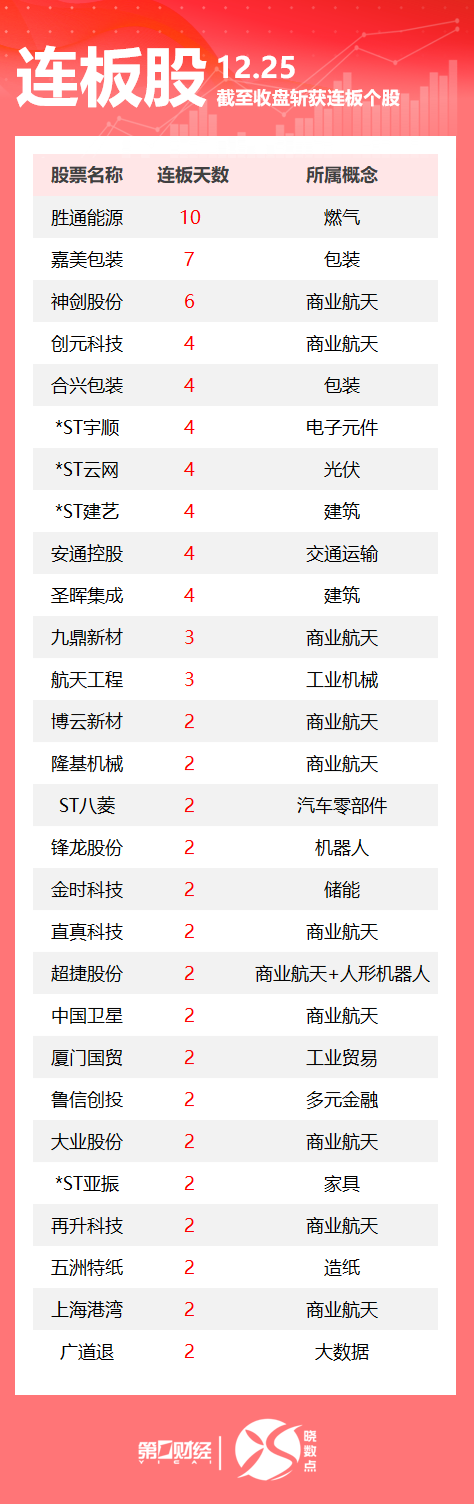
连板股追踪丨A股今日共96只个股涨停 这只商业航天股6连板
Di Yi Cai Jing· 2025-12-25 08:48
Group 1 - The core focus of the news is on the performance of stocks in the A-share market, highlighting the significant number of stocks that have reached their daily limit up, particularly in the packaging and commercial aerospace sectors [1][2] - A total of 96 stocks in the A-share market hit the daily limit up on December 25, indicating strong market activity and investor interest [1] - Notable stocks include Jiamei Packaging with 7 consecutive limit ups and Hexing Packaging with 4 consecutive limit ups, showcasing the packaging sector's robust performance [1] Group 2 - In the commercial aerospace sector, Shenjian Co. achieved 6 consecutive limit ups, while Chuangyuan Technology recorded 4 consecutive limit ups, reflecting strong investor sentiment in this industry [1] - Other stocks with notable consecutive limit ups include Shengtong Energy with 10 days, indicating a strong upward trend in the gas sector [1] - The data also lists various other stocks with consecutive limit ups across different sectors, including electronic components, photovoltaic, construction, and transportation, indicating a broad market rally [1][2]



建筑装饰行业周报(20251215-20251221):重视春季躁动,寻重大工程轨迹布局-20251225
Hua Yuan Zheng Quan· 2025-12-25 07:32
证券研究报告 建筑装饰 行业定期报告 hyzqdatemark 2025 年 12 月 25 日 证券分析师 王彬鹏 SAC:S1350524090001 wangbinpeng@huayuanstock.com 戴铭余 SAC:S1350524060003 daimingyu@huayuanstock.com 郦悦轩 SAC:S1350524080001 liyuexuan@huayuanstock.com 唐志玮 tangzhiwei@huayuanstock.com 林高凡 lingaofan@huayuanstock.com 重视"春季躁动" ,寻"重大工程"轨迹布局 投资评级: 看好(维持) ——建筑装饰行业周报(20251215-20251221) 投资要点: 本周观点: 联系人 2025 年建筑板块回顾:指数表现分化,我们看好 2026 年建筑板块整体表现。我们从两类不 同视角对建筑板块进行复盘。1)是从年内涨跌幅结构看,截至 2025 年 11 月,SW 建筑装 饰指数累计上涨 8.88%,表现弱于沪深 300 指数,但板块内部结构分化明显。其中,民营建 筑企业受并购重组及新业务拓展推动,相关 ...


收评:沪指涨0.47% 机器人概念、商业航天板块爆发 上涨个股超3700只
Xin Lang Cai Jing· 2025-12-25 07:12
Market Overview - The Shanghai Composite Index closed at 3959.62 points, up 0.47%, while the Shenzhen Component Index rose 0.33% to 13531.41 points, and the ChiNext Index increased by 0.30% to 3239.34 points [2] - The total trading volume in the Shanghai and Shenzhen markets reached 1.92 trillion yuan, an increase of 44.3 billion yuan compared to the previous trading day [1] Sector Performance - The commercial aerospace sector saw significant gains, with nearly 30 stocks including Chaojie Co. and Haoshi Electromechanical hitting the daily limit [1][6] - The robotics sector also experienced a rally, with stocks such as Longxi Co. and Xusheng Group reaching the daily limit [1][4] - The liquor sector showed a rebound, with Shuijingfang hitting the daily limit [1] - Conversely, the non-ferrous metals sector faced collective adjustments, with Shengda Resources and Baiyin Nonferrous Metals leading the declines [1] - The Hainan sector saw a collective drop, with Hainan Ruize leading the losses [1] Notable Stocks and Announcements - In the humanoid robot segment, stocks like Haoshi Electromechanical and Chaojie Co. saw a daily limit increase, along with over ten other stocks [4] - Fenglong Co. announced that its controlling shareholder plans to change to the world's first publicly listed humanoid robot company, UBTECH [5] - The commercial aerospace sector has achieved nearly 90 launches this year, setting a historical record, with a significant increase in the proportion of commercial launches [7]

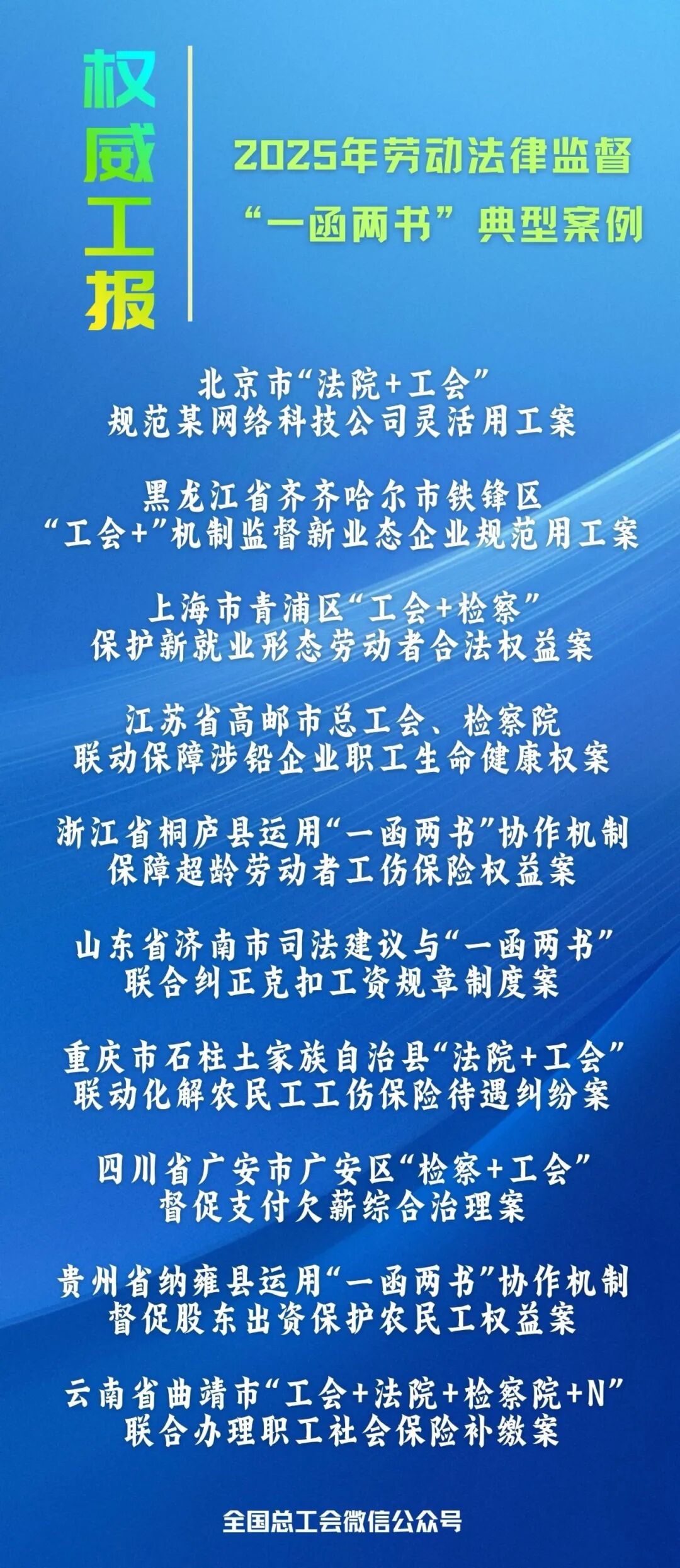
全国总工会、最高法、最高检联合发布2025年劳动法律监督“一函两书”典型案例
Yang Shi Wang· 2025-12-25 04:34
Core Viewpoint The article discusses the collaboration between the All-China Federation of Trade Unions, the Supreme People's Court, and the Supreme People's Procuratorate in promoting labor law supervision through ten typical cases, emphasizing the protection of workers' rights, especially in new employment forms, and the establishment of a multi-faceted cooperative mechanism for labor rights protection. Group 1: Key Characteristics of the Cases - The cases highlight the protection of the legitimate rights and interests of workers in new employment forms, ensuring timely and efficient handling of cases involving labor remuneration, rest, safety, and insurance [3][4] - The multi-faceted collaborative mechanism is emphasized, showcasing the systematic integration of social and judicial supervision to address labor disputes effectively [3][4] - The cases demonstrate the preventive and protective effects of governance through similar case management, aiming to resolve conflicts at the grassroots level [3][4] Group 2: Case Summaries - Case 1 involves a network technology company where the court ruled that the company was liable for unpaid wages due to improper outsourcing practices, highlighting issues in flexible employment [5][6] - Case 2 focuses on a new employment form in Heilongjiang, where the union and the procuratorate worked together to ensure the rights of delivery workers were protected, addressing issues like lack of insurance and inadequate working conditions [9][10] - Case 3 discusses the algorithmic issues in the express delivery industry in Shanghai, where the court and union collaborated to rectify unfair practices affecting workers' rights [13][14] - Case 4 addresses the health rights of workers in lead-related industries, where the union and procuratorate worked to ensure compliance with social insurance laws [18][19] - Case 5 highlights the protection of older workers' rights to workers' compensation, showcasing the collaborative efforts of the union and procuratorate in addressing legal ambiguities [22][23] - Case 6 illustrates the judicial recommendations and union supervision in correcting wage deduction practices in a car company, emphasizing the importance of fair labor practices [27][28] - Case 7 demonstrates the resolution of a workers' compensation dispute through the collaboration of the court and union, showcasing effective dispute resolution mechanisms [32][33] - Case 8 involves a construction company where the union and procuratorate worked together to ensure payment of owed wages to migrant workers, highlighting the importance of legal compliance [35][36] - Case 9 discusses the enforcement of shareholder contributions to protect migrant workers' rights in a company that failed to pay wages, showcasing the collaborative efforts of various authorities [39][40] - Case 10 illustrates a multi-department collaboration to address social insurance payment issues in companies, emphasizing the need for coordinated efforts to protect workers' rights [43][44]
中金公司:建筑存量出清与增量转型
Di Yi Cai Jing· 2025-12-25 00:13
Core Viewpoint - The report from CICC indicates a relatively optimistic outlook for fiscal policy in 2026, with a focus on stabilizing investment and supporting growth through infrastructure investment, particularly in the context of the real estate sector bottoming out [1] Group 1: Infrastructure Investment - Infrastructure investment is expected to be a key method for stabilizing growth, with a projected growth rate of 4.5% in 2026 [1] - There is a strong regional investment opportunity in western infrastructure, especially in Sichuan Province, which is anticipated to have high investment activity [1] Group 2: State-Owned Enterprises and Debt Management - The report highlights the potential for valuation recovery among construction state-owned enterprises due to debt management and state-owned enterprise reforms [1] Group 3: Manufacturing Sector - Manufacturing investment is expected to stabilize and recover, with a focus on cleanroom engineering benefiting from the upturn in semiconductor capital expenditures [1] Group 4: Overseas Market Opportunities - The overseas market is seen as a potential second growth curve, with an emphasis on the accelerated realization of construction companies' overseas expansion strategies [1]

聚焦“六优”目标护航法治化营商环境建设
Xin Lang Cai Jing· 2025-12-24 18:49
Group 1 - The core viewpoint of the news is the commitment of the Guizhou judicial system to enhance the legal business environment through a special action plan, focusing on the prosecution of crimes that harm enterprises, such as embezzlement and loan fraud [1][3] - In 2023, the Guizhou judicial authorities approved the arrest of 77 individuals and prosecuted 143 individuals for crimes against enterprises [1] - The special action includes the establishment of mechanisms for reviewing the necessity of detention in criminal cases involving enterprises and enhancing supervision of law enforcement activities [1][2] Group 2 - In terms of intellectual property protection, 17 cases involving 22 individuals were arrested, and 40 cases involving 64 individuals were prosecuted [2] - The judicial system has also addressed economic disputes by correcting 3 cases of illegal enforcement and supervising the filing of 6 criminal cases while dismissing 49 cases [2] - The Guizhou judicial authorities have received and processed 849 enterprise-related petitions through the 12309 prosecution service center [2][3] Group 3 - Various local prosecutorial agencies are focusing on specific industries, such as the construction industry and the phosphorus chemical industry, to provide tailored legal support [3] - The next steps involve continuing the special action to comprehensively support the legal business environment and respond to the legal needs of the public and enterprises [3]
美国的MAGA梦能实现吗?回溯美国制造业百年变迁
虎嗅APP· 2025-12-24 10:17
Group 1 - The article discusses the historical significance of American manufacturing as a backbone of national strength and social structure, highlighting the decline of stable job opportunities for the middle class due to the loss of manufacturing jobs [4][5]. - It raises critical questions about whether the U.S. can bring back some manufacturing capabilities and if the service sector can fill the gap left by manufacturing in providing stable, middle-class jobs [5][36]. Group 2 - The formation of American manufacturing civilization was characterized by the ability of companies to integrate resources across states and industries, supported by government initiatives that set clear demand through public works and military procurement [7][8]. - The post-war period saw significant contributions from education and population structure, with the GI Bill expanding access to higher education and vocational training, while infrastructure projects like the Interstate Highway Act fueled domestic demand [11][12]. Group 3 - The decline of American manufacturing is attributed to three main forces: rising institutional friction, globalization pushing manufacturing to low-cost regions, and the concentration of wealth among high-skilled workers due to technological and financial trends [22][24][25]. - Institutional friction has led to a preference for less risky projects, making it harder for manufacturing to thrive in the U.S. as the approval processes become longer and more complex [24][26]. Group 4 - The article emphasizes that while nominal GDP share of manufacturing has decreased, the actual output has remained stable, indicating that manufacturing has not disappeared but rather shifted in its role within the economy [30][34]. - Employment in manufacturing peaked in June 1979 at 19.6 million and has since declined to approximately 12.8 million by June 2019, reflecting a significant drop in its share of total employment [35][68]. Group 5 - The service sector's ability to absorb displaced manufacturing jobs is questioned, as it struggles to provide sufficient, well-paying jobs with clear career advancement paths, particularly in a high-cost living environment [36][39]. - The article outlines that the service sector is characterized by a "dumbbell structure," where high-end jobs require significant education and skills, while low-end jobs offer low wages and instability, making it difficult to support a middle-class lifestyle [39][40]. Group 6 - The discussion on re-industrialization in the U.S. highlights the need for a dual approach: ensuring national security in critical industries while also addressing the social structure to allow ordinary people to share in economic growth [44][46]. - The article suggests that a realistic path forward involves selective return of manufacturing capabilities, focusing on key industries while also investing in infrastructure, energy transition, and skill development to create stable job opportunities [49][51]. Group 7 - The challenges of re-establishing manufacturing in the U.S. are not solely financial; they also include regulatory hurdles, skill shortages, supply chain density, and overall cost structures that complicate the return of manufacturing jobs [53][54][55]. - The article argues that simple policies like tariffs and subsidies are insufficient to address the complex structural issues facing American manufacturing and that a more nuanced approach is necessary [56][58]. Group 8 - The article concludes that if manufacturing cannot recreate a robust middle class, the U.S. must explore a combination of industries to provide dignified work for ordinary people, including infrastructure, energy transition, and restructured service sectors [60][61]. - It emphasizes that the ultimate goal is to restore a social structure where ordinary people can achieve dignity through work, rather than merely focusing on the number of manufacturing jobs [62][63].
