数字经济

Search documents
"十五五"数字经济战略建议发布,数字经济ETF(560800)盘中拉涨0.65%
Xin Lang Cai Jing· 2025-10-29 03:40
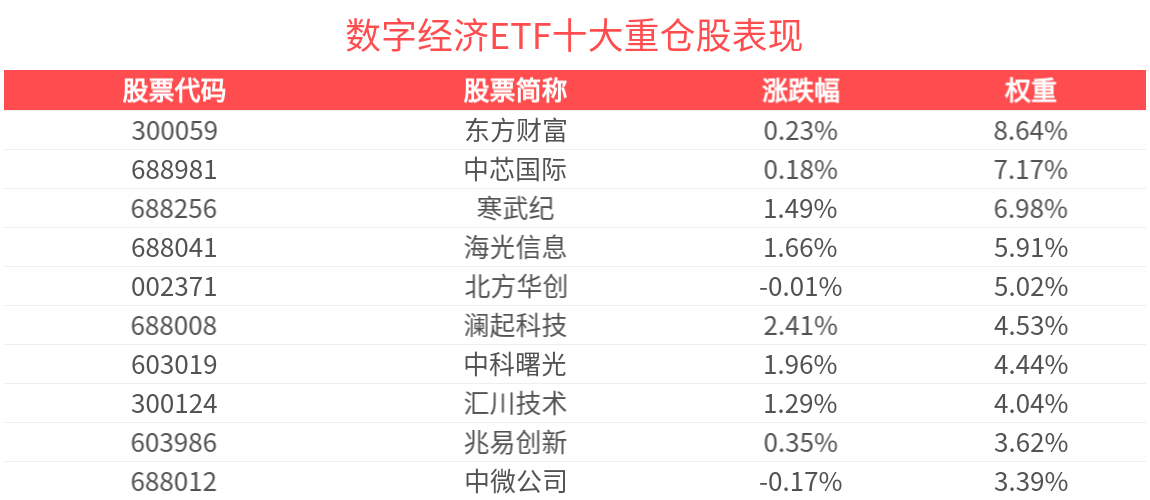
Core Insights - The digital economy is being elevated as a core national strategy under the "14th Five-Year Plan," focusing on market-oriented data reforms, industrial internet upgrades, AI integration across industries, and governance of platform economies [1][2] - The digital economy ETF has shown positive performance, with a 0.65% increase, and significant trading volume, indicating strong market interest [1][2] - The potential market size for data transactions is projected to exceed 200 billion yuan by 2025, driven by AI as a core growth engine [1][2] Industry Developments - The current policy environment is seen as a golden period for realizing the benefits of the digital economy, with substantial funding for domestic computing power projects and industrial internet transformation orders expected to generate over 1.2 trillion yuan in annual output [2] - The revaluation potential of data assets could reach up to 45% of corporate net assets, creating historic opportunities for capital market valuation [2] - The competition for AI chip resources among tech giants is intensifying, with Chinese companies increasingly seeking to reduce reliance on foreign computing power [2] Index Performance - As of September 30, 2025, the top ten weighted stocks in the CSI Digital Economy Theme Index accounted for 54.31% of the index, indicating a concentrated investment in key players [3] - The leading stocks include Dongfang Caifu, SMIC, and Cambrian, reflecting a focus on companies with significant roles in the digital economy [3][5]







影响市场重大事件:网络安全法完成修改,自2026年1月1日起施行;金融监管总局副局长周亮:正联合科技部等起草保险业支持科技创新有关文件
Mei Ri Jing Ji Xin Wen· 2025-10-28 23:18
每经记者|杨建 每经编辑|彭水萍 |2025年10月29日 星期三| NO.1 网络安全法完成修改,自2026年1月1日起施行 据新华社报道,10月28日相关会议表决通过了关于修改《网络安全法》的决定,自2026年1月1日起施 行。2016年制定的网络安全法是网络安全领域的基础性法律。此次网络安全法的修改,适应网络安全新 形势新要求,重点强化网络安全法律责任,加强与相关法律的衔接协调。回应人工智能治理和促进发展 的需要,修改后的网络安全法明确,国家支持人工智能基础理论研究和算法等关键技术研发,推进训练 数据资源、算力等基础设施建设,完善人工智能伦理规范,加强风险监测评估和安全监管,促进人工智 能健康应用和发展。 国务院新闻办公室10月28日举行新闻发布会,介绍第八届中国国际进口博览会筹备情况,并答记者问。 商务部盛秋平表示,以中国大市场的"确定性"应对全球需求的"不确定性"。进博会是近距离观察中国高 水平对外开放的"大舞台",也是沉浸式感受中国超大规模市场优势的"体验区"。 NO.5 IDC:上半年中国MaaS市场规模同比增长421.2% 10月28日,国际数据公司(IDC)最新发布的《中国模型即服务(Maa ...
培育绿色创新的亚太增长动能
Ren Min Ri Bao· 2025-10-28 22:56
"当前,经济全球化动力和阻力胶着,但动力仍然胜过阻力。新一轮科技革命和产业变革深入发展,世 界经济数字化、绿色化、智能化进程不断加快,为经济全球化再度加速蓄积了强劲动能。"2024年11月 15日,习近平主席在秘鲁利马举行的亚太经合组织工商领导人峰会上发表书面演讲,深刻洞察世界经济 发展规律,为亚太高质量发展贡献中国智慧和中国方案。 谋大势、担大义、行大道。中国作为亚太大家庭的一员,坚持科技成果造福全人类理念,深化同各方绿 色创新合作,积极推动亚太实现更高质量、更具韧性的发展。 在墨西哥前驻华大使李子文看来,中国在数字基础设施和数字技术发展等领域居于世界领先地位,有能 力也有意愿为推动全球数字经济治理贡献力量,包括墨西哥在内的亚太经合组织成员可与中国在这些领 域开展更多合作。 厚植亚太增长绿色底色 在墨西哥尤卡坦半岛北部,占地面积超过690平方千米的齐拉姆红树林保护区,拥有逾590种动植物,其 中数十种为濒危及重点保护物种。 点燃数字经济发展引擎 浩渺的太平洋之滨,南美首个智慧港口和绿色港口秘鲁钱凯港一片繁忙景象。 码头上,蓝色巨型自动化桥吊精准运作,智能驾驶集装箱卡车来回穿行;中央控制区内,码头生产操作 系 ...
先进制造业地位凸显 新兴产业和未来产业蕴藏新机遇
Zhong Guo Zheng Quan Bao· 2025-10-28 21:10
Core Insights - The "14th Five-Year Plan" emphasizes the construction of a modern industrial system, reinforcing the foundation of the real economy, with a focus on intelligent, green, and integrated development [1][2] Group 1: Advanced Manufacturing - The plan highlights the importance of maintaining a reasonable proportion of the manufacturing sector, underscoring the critical role of advanced manufacturing in economic development [1][3] - Advanced manufacturing is identified as a key focus for future development, with institutions suggesting it will drive the transformation and upgrading of the economic structure [2][3] Group 2: Traditional Industries - The plan calls for the optimization and upgrading of traditional industries, aiming to enhance the global competitiveness of sectors such as mining, metallurgy, and machinery [2][3] - It emphasizes the need for technological transformation and the promotion of smart, green, and service-oriented manufacturing [2][3] Group 3: Emerging and Future Industries - The plan aims to cultivate and expand emerging and future industries, focusing on strategic sectors like new energy, aerospace, and low-altitude economy [3][4] - It outlines initiatives for large-scale application demonstrations of new technologies and products, accelerating the development of emerging industries [3][4] Group 4: Future Industry Development - The plan encourages exploration of diverse technological routes and business models in future industries, including quantum technology and hydrogen energy [4] - It highlights the potential of sectors like energy storage and solid-state batteries, which are expected to drive growth in emerging industries [4]
粤开宏观:《“十五五”规划建议》的12大看点:科技自立与扩大内需引领新征程
Yuekai Securities· 2025-10-28 13:57
Economic Environment and Challenges - The "15th Five-Year Plan" emphasizes the coexistence of strategic opportunities and risks, highlighting increased uncertainty in the development environment[3] - External challenges are expected to intensify, with geopolitical tensions and trade barriers affecting China's economic landscape[17] - The plan identifies effective demand insufficiency and the need for new and old kinetic energy conversion as critical issues[19] Development Goals - The plan sets seven major development goals, including achieving significant high-quality development and a notable increase in the resident consumption rate[20] - Aiming for an average nominal GDP growth rate of 5% during the "15th Five-Year Plan" period to reach a per capita GDP of approximately $27,000 by 2035[21] - The target for the resident consumption rate is to increase from 40% to 43%, necessitating a 6.5% annual growth in consumption[22] Industrial and Technological Focus - The establishment of a modern industrial system is prioritized, with a focus on maintaining a reasonable proportion of manufacturing in the economy[25] - The plan emphasizes the importance of technological self-reliance and innovation as a core component of high-quality development[33] - Specific sectors such as new energy, advanced manufacturing, and digital economy are highlighted for rapid development and support[28] Domestic Demand and Investment - Expanding domestic demand is identified as a strategic foundation for modernization, with a focus on enhancing consumer confidence and increasing disposable income[35] - The plan calls for optimizing the investment structure, directing funds towards education, healthcare, and emerging technologies[36] - Reforming the income distribution system is crucial for sustainable consumption growth and fostering a robust middle-income group[38] Governance and Policy Coordination - The plan advocates for improving the macroeconomic governance system and enhancing policy effectiveness through better coordination of fiscal and monetary policies[39] - Emphasis is placed on creating a stable and predictable institutional environment to support market participants[42] - The need for a proactive fiscal policy is highlighted to address short-term fiscal challenges while ensuring long-term sustainability[43]
划重点!“十五五”规划建议里的产业利好
Zhong Guo Zheng Quan Bao - Zhong Zheng Wang· 2025-10-28 12:49
Core Viewpoint - The "Suggestions" emphasize the construction of a modern industrial system, reinforcing the foundation of the real economy, with a focus on maintaining a reasonable proportion of manufacturing and promoting advanced manufacturing as a key driver for economic development [1][2]. Group 1: Advanced Manufacturing - The "Suggestions" highlight the critical role of manufacturing in economic development, aiming to maintain its value-added within a reasonable range to support overall economic growth [2]. - Advanced manufacturing is identified as a significant focus for the future development of the real economy, with expectations for new opportunities arising from the evolving global technology landscape [2]. - The emphasis on advanced manufacturing is expected to drive the transformation and upgrading of the economic structure, with specific attention to sectors such as semiconductors, artificial intelligence, digital economy, innovative pharmaceuticals, and biotechnology [2]. Group 2: Optimization of Traditional Industries - The "Suggestions" call for the optimization and upgrading of traditional industries, aiming to enhance the global competitiveness of sectors like mining, metallurgy, chemicals, light industry, textiles, machinery, shipbuilding, and construction [3]. - There is a focus on improving the self-control level of industrial chains and promoting smart, green, and service-oriented manufacturing, which is anticipated to create a market space of approximately 10 trillion yuan over the next five years [3]. Group 3: Cultivation of Emerging and Future Industries - The "Suggestions" propose the cultivation of emerging and future industries, emphasizing the development of strategic emerging industry clusters such as new energy, new materials, aerospace, and low-altitude economy [5]. - There is a forward-looking approach to future industries, exploring diverse technological routes and typical application scenarios, with a focus on quantum technology, biomanufacturing, hydrogen energy, and sixth-generation mobile communication as new economic growth points [5]. - The establishment of mechanisms for investment growth and risk sharing in future industries is highlighted, alongside the promotion of specialized small and medium-sized enterprises and the cultivation of unicorn companies [5].
“十五五”规划建议全文发布:大力发展新型储能,加快智能电网和微电网建设
中关村储能产业技术联盟· 2025-10-28 09:09
Core Viewpoint - The article outlines the key proposals and objectives of China's 15th Five-Year Plan, emphasizing the importance of modernizing the economy, enhancing energy systems, and achieving high-quality development while addressing environmental concerns and social equity [4][5]. Energy and Environment - Accelerate the construction of a new energy system, increasing the share of renewable energy and ensuring a reliable transition from fossil fuels [3]. - Implement a dual control system for carbon emissions, focusing on peak coal and oil consumption, and develop a comprehensive carbon trading market [3]. Economic Development Goals - The 15th Five-Year Plan aims for significant achievements in high-quality development, with economic growth maintained within a reasonable range and increased domestic consumption driving growth [10][13]. - The plan emphasizes the importance of technological self-reliance and innovation, aiming to enhance the national innovation system and improve the integration of technology and industry [19][20]. Industrial and Infrastructure Development - Focus on building a modern industrial system, optimizing traditional industries, and fostering emerging industries such as new energy and advanced manufacturing [16][18]. - Strengthen infrastructure planning and development, ensuring resilience and sustainability in transportation and energy systems [18]. Social and Cultural Development - Promote cultural innovation and the development of a strong socialist culture, enhancing the influence of Chinese civilization globally [40][41]. - Address social equity by improving living standards, ensuring high-quality employment, and optimizing income distribution mechanisms [44][45]. Regional Coordination and Rural Development - Enhance regional economic coordination, promoting balanced development across different areas of the country [36][37]. - Focus on rural revitalization, improving agricultural productivity, and ensuring modern living conditions in rural areas [33][34].

中共中央关于制定国民经济和社会发展第十五个五年规划的建议
Wind万得· 2025-10-28 09:07
Core Viewpoint - The article emphasizes the importance of the 15th Five-Year Plan as a critical period for achieving socialist modernization in China, highlighting the need for strategic initiatives to address both opportunities and challenges in the domestic and international landscape [5][6][7]. Group 1: Achievements and Context - The 14th Five-Year Plan has led to significant achievements in China's development, including economic stability, technological innovation, and improved living standards, despite facing challenges such as the pandemic and international tensions [5]. - The 15th Five-Year Plan is positioned as a transitional phase that builds on past successes while addressing existing challenges to lay a solid foundation for future modernization efforts [6]. Group 2: Development Environment - The international landscape is characterized by rapid changes, including shifts in global power dynamics, technological revolutions, and rising protectionism, which pose both risks and opportunities for China's development [7]. - Domestically, China maintains a strong economic foundation but faces issues such as uneven development, insufficient demand, and demographic changes that require strategic responses [7]. Group 3: Guiding Principles and Goals - The guiding principles for the 15th Five-Year Plan include upholding the leadership of the Communist Party, prioritizing people-centered development, and focusing on high-quality growth [9][10]. - Key goals include achieving significant advancements in high-quality development, technological self-reliance, and comprehensive reforms, alongside improvements in social welfare and environmental sustainability [13][14]. Group 4: Economic Structure and Innovation - The plan emphasizes the need to strengthen the real economy, enhance traditional industries, and foster emerging sectors, with a focus on innovation and sustainability [15][16]. - A modernized industrial system is essential for supporting China's unique modernization, with an emphasis on advanced manufacturing and the integration of digital technologies [15][18]. Group 5: Domestic Market and Investment - Strengthening the domestic market is crucial for driving economic growth, with initiatives aimed at boosting consumption and effective investment [23][24]. - The plan outlines strategies to eliminate barriers to market integration and enhance the efficiency of resource allocation across various sectors [25][27]. Group 6: Social Development and Welfare - The plan prioritizes improving living standards and social welfare, with a focus on employment, income distribution, and education [41][42]. - Enhancing the social security system and ensuring equitable access to resources are key components of the strategy to achieve common prosperity [44].

数字经济板块10月28日跌0.36%,华建集团领跌,主力资金净流出44.47亿元
Sou Hu Cai Jing· 2025-10-28 09:05
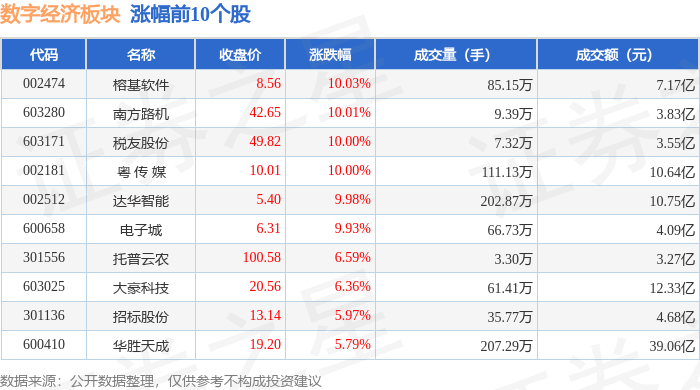
Market Overview - The digital economy sector declined by 0.36% on October 28, with Huajian Group leading the losses [1] - The Shanghai Composite Index closed at 3988.22, down 0.22%, while the Shenzhen Component Index closed at 13430.1, down 0.44% [1] Top Gainers in Digital Economy Sector - Rongji Software (002474) saw a closing price of 8.56, up 10.03% with a trading volume of 851,500 shares and a transaction value of 717 million [1] - Southern Road Machinery (603280) closed at 42.65, up 10.01% with a trading volume of 93,900 shares and a transaction value of 383 million [1] - Tax Friend Co., Ltd. (603171) closed at 49.82, up 10.00% with a trading volume of 73,200 shares and a transaction value of 355 million [1] - Ning Media (002181) closed at 10.01, up 10.00% with a trading volume of 1,111,300 shares and a transaction value of 1,064 million [1] Top Losers in Digital Economy Sector - Huajian Group (600629) experienced a significant drop, closing at 24.18, down 9.98% with a trading volume of 1,455,600 shares and a transaction value of 364 million [2] - Jiazuka Technology (301117) closed at 39.94, down 8.83% with a trading volume of 130,800 shares and a transaction value of 53.3 million [2] - Zhiou Technology (301376) closed at 18.39, down 6.98% with a trading volume of 95,500 shares and a transaction value of 17.7 million [2] Capital Flow Analysis - The digital economy sector saw a net outflow of 4.447 billion in main funds, while speculative funds had a net inflow of 352 million, and retail investors saw a net inflow of 4.095 billion [2][3] - Notable net inflows from retail investors were observed in Rongji Software (2.74 million) and other companies, while significant outflows were noted in several stocks including Huajian Group and Keda Intelligent [3]


重磅!十五五规划建议发布(全文)
第一财经· 2025-10-28 08:45
Core Viewpoint - The "15th Five-Year Plan" period is crucial for achieving basic socialist modernization, building on the significant achievements of the "14th Five-Year Plan" period, and addressing complex domestic and international challenges [2][3][4] Group 1: Achievements and Challenges - The "14th Five-Year Plan" period saw major achievements in economic stability, high-quality development, technological innovation, and social governance despite facing severe challenges such as the pandemic [2] - The "15th Five-Year Plan" period will focus on consolidating advantages, overcoming bottlenecks, and enhancing weaknesses to secure strategic initiatives in international competition [3][4] Group 2: Economic and Social Development Guidelines - The guiding ideology for the "15th Five-Year Plan" emphasizes the importance of Marxism, Xi Jinping's thoughts, and the goal of building a modern socialist country [6] - Key principles include maintaining the Party's leadership, prioritizing people’s needs, promoting high-quality development, and deepening reforms [7][8] Group 3: Economic Goals - Significant progress in high-quality development is expected, with economic growth maintained within a reasonable range and improvements in productivity and consumption rates [10] - The aim is to enhance self-reliance in technology, improve the national innovation system, and achieve breakthroughs in key technologies [10] Group 4: Modern Industrial System - The focus will be on building a modern industrial system that emphasizes the real economy, with advancements in traditional industries and the cultivation of emerging industries [12][13] - The development of a robust infrastructure system is essential for supporting economic activities and enhancing resilience [14] Group 5: Technological Self-Reliance - The plan aims to strengthen original innovation and tackle key core technologies through a comprehensive approach [15][16] - Integration of technological innovation with industrial development is crucial for enhancing productivity and competitiveness [17] Group 6: Domestic Market Development - Strengthening the domestic market is a strategic priority, with initiatives to boost consumption and investment while ensuring a reliable supply chain [20][21] - Efforts will be made to eliminate barriers to market integration and enhance the efficiency of resource allocation [22] Group 7: High-Level Socialist Market Economy - The establishment of a high-level socialist market economy is vital for ensuring sustainable high-quality development [23][24] - Enhancing the vitality of various economic entities and improving the market-oriented allocation of resources are key objectives [25][26] Group 8: Open Cooperation - Expanding high-level openness and cooperation is essential for mutual benefit and shared development [27][28] - The focus will be on trade innovation, investment cooperation, and the Belt and Road Initiative to enhance global economic integration [29] Group 9: Agricultural Modernization - Agricultural modernization is a priority, with efforts to enhance production capacity and quality while promoting rural revitalization [30][31] - Policies will be implemented to improve the effectiveness of agricultural support and ensure sustainable rural development [32][33] Group 10: Regional Economic Coordination - Promoting regional economic coordination is necessary for balanced development across different areas [34][35] - The strategy includes enhancing infrastructure connectivity and fostering collaborative development among key urban clusters [36] Group 11: Cultural and Social Development - Cultural innovation and the promotion of socialist values are essential for national cohesion and identity [37][38] - Improving public services and social welfare systems is critical for enhancing the quality of life and achieving common prosperity [40][41]