硬件设备

Search documents
开年以来近百家公司冲刺港股IPO 多家公司已在A股上市 “A+H”热潮涌动
Shang Hai Zheng Quan Bao· 2026-01-28 18:38
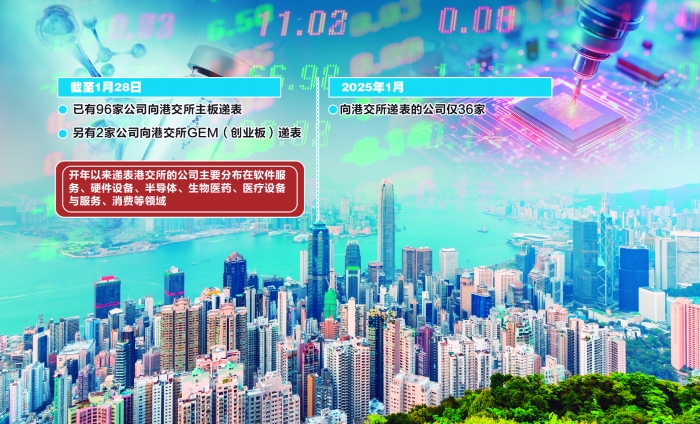
Group 1 - The IPO rush in Hong Kong continues to gain momentum, with nearly 100 companies submitting applications to the Hong Kong Stock Exchange (HKEX) since the beginning of the year, including 13 on January 26 alone [2] - As of January 28, 96 companies have applied for the main board of HKEX, with 2 additional companies applying for the GEM (Growth Enterprise Market), including nearly 20 companies that are reapplying or have applied multiple times [2] - In January 2025, only 36 companies had submitted applications to HKEX, highlighting the significant increase in activity this year [2] Group 2 - The companies applying for IPOs are primarily from sectors such as software services, hardware, semiconductors, biomedicine, medical devices and services, and consumer goods [3] - Over 10 biotech companies are pursuing IPOs under Chapter 18A of the HKEX listing rules, focusing on unmet medical needs in oncology and immunology [3] - Notable biotech firms include Bangshun Pharmaceutical, Zeling Bio, and Qinhao Pharmaceutical, which are developing innovative therapies for various diseases [3] Group 3 - In the consumer sector, over 10 well-known brands, including Junlebao Dairy and Qian Dama, have submitted IPO applications, covering various niches such as food and beverage, restaurant chains, and community retail [4] - Analysts predict that the trend of consumer companies going public in Hong Kong will continue to thrive, with strong interest from professional capital in solid consumer enterprises [4] - The "A+H" trend is ongoing, with nearly 20 companies that have applied for IPOs in 2026 already listed on A-shares, indicating a strategic move to enhance global operations and financing channels [4] Group 4 - The phenomenon of A-share companies applying for HKEX listings has been observed since the fourth quarter of 2024, driven by policy opportunities, market cycles, and globalization strategies [5] - High-profile executives, such as Goldman Sachs' CEO, anticipate a strong recovery in the HKEX IPO market in 2026, expecting significant increases in both the number of IPOs and financing scale [5] - However, the surge in IPO applications has led to concerns about the quality of submissions, with some companies submitting incomplete applications and facing scrutiny over the quality of their documentation [5][6] Group 5 - HKEX's CEO emphasized that the recent decline in IPO quality is due to the sudden increase in applications, which has put pressure on resources and collaboration [6] - Maintaining high-quality standards for IPO applications is crucial for preserving market trust, and recent warnings have been issued regarding the need for thorough due diligence [6] - The balance between speed and quality in the IPO process is essential to ensure the integrity of the market [6]

广发策略:从不买就跑输到买了就跑输——再看南下定价权
智通财经网· 2026-01-25 23:38
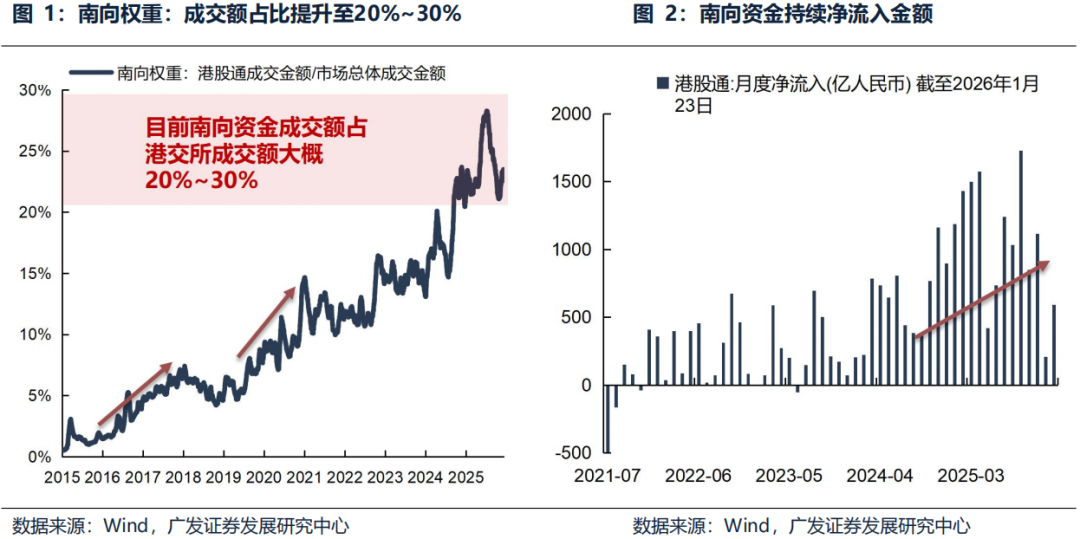
Group 1 - Since September 2024, the proportion of southbound capital transactions has rapidly increased to 20%-30%, nearly doubling compared to before 2024 [2][5] - In 2025, both active and passive foreign capital have become synchronous indicators of the Hong Kong stock market, showing no leading characteristics [2][5] - During sharp declines or corrections in the Hong Kong stock market, southbound capital tends to buy against the trend [2][5] Group 2 - Each round of pricing power competition typically begins with the optimization of the Stock Connect policy or the influx of incremental capital, which usually flows into dividend and scarce assets [5] - Net outflows of southbound capital often occur in response to adverse industry policies or external macroeconomic environments, particularly in sectors where foreign capital pricing power is increasing, such as software services, hardware equipment, consumer services, and discretionary retail [5][12] - Industries less likely to experience significant net outflows include those favored by long-term capital, such as banking, telecommunications, and public utilities, unless there are clear adverse policies affecting the sector [5][12] Group 3 - The proportion of medium to long-term capital in the current round of southbound capital inflow into Hong Kong stocks has increased, with insurance capital making 41 stakes, 35 of which are in H-shares, marking the highest record in the past decade [8] - Key industries for increased holdings include discretionary retail, finance (banking, insurance), innovative pharmaceuticals, software services, and hardware equipment [8] Group 4 - Current industries with pricing power for southbound capital and Chinese capital include semiconductors and dividend stocks, while industries lacking pricing power include internet, hardware equipment, software services, home appliances, and media [11][12] - Active management public funds have low pricing power in the Hong Kong stock market, focusing heavily on AI-related CSP giants, electronics, and innovative pharmaceuticals [16]
港股市场策略展望:从不买就跑输到买了就跑输:再看南下定价权?
GF SECURITIES· 2026-01-25 09:19
Group 1 - Since September 2024, the proportion of southbound capital in transaction volume has rapidly increased to 20%-30%, nearly doubling compared to before 2024, indicating a significant shift in market dynamics [3][8] - Historical reviews of two rounds of competition for pricing power in the Hong Kong stock market occurred in 2016-2017 and 2020-2021, typically initiated by policy optimizations and inflows of incremental capital [15][28] - The current southbound capital inflow is characterized by a higher proportion of medium to long-term funds, with insurance capital making 41 stakes in 2025, 35 of which were in H-shares, marking a record high in the past decade [3][31] Group 2 - The industries where southbound capital and Chinese capital have pricing power include semiconductors and dividend-paying sectors, while industries lacking pricing power include internet, hardware, software services, home appliances, and media [3][36] - The top five industries by southbound capital holdings include coal (41.8%), semiconductors (32.7%), environmental protection (24.5%), oil and petrochemicals (24.1%), and pharmaceutical biology (20.5%) [37] - The active management public funds have a low preference for Hong Kong stocks, with significant holdings concentrated in AI-related CSP giants, electronics, and innovative pharmaceuticals [46] Group 3 - The current sentiment in the Hong Kong stock market has fully reflected negative factors such as US-China trade friction and the high unlock peak at the end of last year, suggesting potential upward investment opportunities if liquidity pressure eases [53][54] - The spring rally in the Hong Kong stock market has a high probability of success, with southbound capital and foreign capital expected to net inflow at the beginning of the year, driven by the demand for core Chinese assets [53][54] - The pricing power of southbound capital is rapidly increasing, with expectations of a potential upward beta in the Hong Kong stock market at the beginning of the year [3][53]
2026史海钩沉亲历一次科网泡沫,我们能学到什么?
Sou Hu Cai Jing· 2026-01-25 01:07
今天分享的是:2026史海钩沉亲历一次科网泡沫,我们能学到什么? 报告共计:24页 回望科网泡沫:一场资本盛宴的启示录 每当市场对新兴技术投资热潮产生疑虑时,历史总似一面镜子,映照出相似的兴奋与暗涌。上世纪90年代那场轰轰烈烈的科网 泡沫,便是一段资本与技术交织的典型篇章。从1995年网景公司上市拉开序幕,到2000年纳斯达克指数攀上历史巅峰后骤然崩 塌,其间不仅是股价的起伏,更是一场关于创新、货币政策和人性逐利的深刻演绎。 一场由技术革命点燃的资本盛宴 科网泡沫的起点,源于互联网技术的崛起。1996年,摩根士丹利分析师玛丽·米克尔发布《互联网趋势》报告,系统描绘了互联 网经济的未来图景,为资本市场注入强心剂。同年,《电信法》出台,打破行业垄断,推动电信基建投资浪潮。技术进步叠加 政策松绑,企业IPO数量激增,尤其科技板块成为市场焦点。这一时期,劳动生产率显著提升,甚至改变了通胀与就业的传统关 系,为货币政策的宽松转向提供了宏观基础。 货币政策:从"友好宽松"到"谨慎收紧" 时任美联储的格林斯潘,在泡沫初期展现出对技术创新的包容态度。他相信生产率提升能抑制通胀,因此在经济强劲、失业率 走低时并未急于加息。这种 ...
26年港股IPO和解禁潮展望:悬头之剑?
Sou Hu Cai Jing· 2026-01-19 06:13
Group 1 - The core viewpoint of the report is that the Hong Kong IPO market is expected to maintain strong momentum in 2026, with fundraising potentially exceeding HKD 300 billion, driven by a significant number of companies in the technology and healthcare sectors waiting to go public [6][17][18]. - In 2025, the Hong Kong Stock Exchange saw 117 IPOs raising a total of HKD 285.9 billion, marking a return to the top of the global IPO rankings after four years [6][17]. - As of January 10, 2026, there are still 300 companies queued for IPOs, with a concentration in software services, biomedicine, and hardware sectors, benefiting from the HKEX's Chapter 18A and 18C listing policies [6][18]. Group 2 - The impact of IPO peaks and lock-up expirations on the Hong Kong stock market is complex; historical data shows that these events do not necessarily lead to market downturns, as seen in previous years where fundraising peaks coincided with bull markets [6][22]. - The upcoming lock-up expirations in March and September 2026 are expected to involve significant amounts, with September's expirations potentially reaching HKD 400 billion [7][36]. - The report highlights that the true impact of IPOs may be felt six months post-listing during the lock-up expiration of cornerstone investors, which historically has coincided with market downturns [7][35]. Group 3 - The report discusses the performance of stocks included in the Hong Kong Stock Connect and the Hang Seng Tech Index, noting that short-term price increases post-inclusion are not guaranteed for all companies [10][49]. - The Hang Seng Tech Index focuses on 30 representative technology companies, with a structured review and rapid inclusion mechanism, where stock prices typically react 30 days prior to index adjustments [10][52]. - Recent trends show a shift in capital flows, with northbound trading volumes decreasing and southbound trading seeing net inflows, particularly into companies like Xiaomi and Kuaishou [60][65].

北交所周观察第六十一期(20260118):北交所2025年业绩披露大幕正式拉开,关注业绩超预期和业绩改善公司
Hua Yuan Zheng Quan· 2026-01-18 07:41
Investment Rating - The report indicates a positive outlook for the industry, focusing on companies with expected performance improvements and high barriers to entry [2][3]. Core Insights - The report highlights that Lin Tai New Materials anticipates a net profit of 133.3 to 150.7 million yuan for 2025, representing a year-on-year increase of 64.48% to 85.95%, driven by stable sales in traditional automotive and rapid growth in hybrid vehicle components [3][6]. - Hai Neng Technology expects a net profit of 41 to 44 million yuan for 2025, with a significant year-on-year increase of 213.65% to 236.61%, attributed to overall market demand recovery and advancements in high-end instrument manufacturing [3][6]. - The report emphasizes the importance of focusing on companies with strong fundamentals and reasonable valuations, particularly those with expected performance improvements in 2025 [3][6]. Summary by Sections Performance Forecasts - Lin Tai New Materials projects a net profit of 133.3 to 150.7 million yuan for 2025, with growth driven by stable sales in traditional automotive and rapid growth in hybrid vehicle components [3][6]. - Hai Neng Technology forecasts a net profit of 41 to 44 million yuan for 2025, with growth driven by market demand recovery and advancements in high-end instruments [3][6]. Market Trends - The report notes that the North Exchange market is experiencing significant fluctuations, with the North Certificate 50 index declining by 3.6% [3][6]. - The overall PE ratio for North Exchange A shares has risen to 49X, indicating a recovery in market valuations [12][15]. Investment Opportunities - The report suggests focusing on three main areas for investment: companies with expected performance improvements, those related to service consumption, and companies in the new energy vehicle export chain [3][6]. - It highlights the potential for structural investment opportunities within the North Exchange, particularly in specialized and innovative enterprises [3][6].
2025年股权融资规模暴增251%!2026港股IPO热潮延续
Zheng Quan Shi Bao· 2026-01-18 02:46
Group 1 - The Hong Kong stock market experienced a significant surge in equity financing in 2025, with a total financing amount of HKD 612.2 billion, representing a year-on-year increase of 250.91% [2] - The IPO market in Hong Kong regained its position as the global leader, with 117 companies raising a total of HKD 285.8 billion, a year-on-year growth of 224.24% [2] - The outlook for 2026 remains positive, with expectations that the IPO fundraising scale will exceed HKD 300 billion, driven by favorable policies from the Hong Kong Stock Exchange and the return of Chinese concept stocks [2][3] Group 2 - As of January 15, 2026, there are 327 companies waiting to go public in Hong Kong, with nearly half being A-share listed companies, indicating strong future market activity [3] - The influx of quality IPOs is expected to attract more international capital, enhancing market liquidity rather than detracting from it [4][6] - The performance of IPOs post-listing reflects the effectiveness of the pricing mechanism in mature markets, influenced by factors such as IPO pricing and investor composition [5] Group 3 - International long-term capital has significantly returned to the Hong Kong market, with participation rates in IPO projects rising from approximately 10%-15% in early 2024 to 85%-90% by early 2026 [6] - The types of companies attracting international investors include those with clear business models, predictable profitability, and reasonable valuations, particularly in sectors like AI and consumer goods [6][7] - The biotechnology sector in Hong Kong is expected to continue its growth trajectory, with international investors likely to remain engaged due to the unique market opportunities [7]
2025,股权融资规模暴增251%!2026,港股IPO热潮延续!
券商中国· 2026-01-18 01:46
Core Viewpoint - The Hong Kong stock market experienced a significant surge in equity financing in 2025, with a 251% increase, and is expected to maintain a strong performance into 2026, albeit at a potentially lower growth rate [1][2]. Group 1: Market Performance and Projections - In 2025, the total equity financing in the Hong Kong market reached HKD 612.2 billion, marking a year-on-year increase of 250.91% [2]. - The IPO market regained its global leading position, with 117 companies raising a total of HKD 285.8 billion, reflecting a year-on-year growth of 224.24% [2]. - Projections for 2026 suggest that the IPO fundraising scale may exceed HKD 300 billion, driven by favorable policies from the Hong Kong Stock Exchange, the return of Chinese concept stocks, and increasing demand for international expansion [2][3]. Group 2: IPO Dynamics and International Capital - The influx of A-share companies into the Hong Kong IPO market was significant in 2025, but this trend may shift in 2026 towards more first-time listings [3]. - As of January 15, 2026, there are 327 companies waiting to list on the Hong Kong stock exchange, with nearly half being A-share companies [3]. - International long-term capital has significantly returned to the Hong Kong market, with participation rates in IPO projects rising from approximately 10%-15% in early 2024 to 85%-90% by early 2026 [7]. Group 3: Quality of IPOs and Market Impact - High-quality IPOs are expected to attract more international capital, enhancing market liquidity rather than detracting from it [4][5]. - The phenomenon of IPOs leading to market corrections, such as instances of new stocks breaking below their issue prices, is viewed as a normal market adjustment rather than a sign of a bearish trend [5][6]. - The performance of stocks post-IPO, particularly during the six-month lock-up period for cornerstone investors, is crucial for understanding the long-term impact on the market [5][6]. Group 4: Sector Focus and Future Trends - The Hong Kong IPO market is anticipated to see an influx of companies from the AI and related sectors, including communications, data centers, and semiconductors [3]. - The biotechnology sector is expected to maintain its high growth trajectory, with international investors likely to remain engaged due to the unique opportunities presented in the Hong Kong market [8]. - Key sectors driving the IPO market in 2026 include biotechnology, specialized technology (AI, new energy, semiconductors), traditional industry upgrades, and new consumer brands from mainland China [8].

2025,股权融资规模暴增251%!2026,港股IPO热潮延续!
Xin Lang Cai Jing· 2026-01-18 01:45
Core Viewpoint - The Hong Kong stock market experienced a significant surge in equity financing in 2025, with a total financing amount of HKD 6,122 billion, reflecting a year-on-year increase of 250.91%. The IPO market regained its global leading position, raising HKD 2,858 billion from 117 companies, a year-on-year growth of 224.24%. The outlook for 2026 remains positive, with expectations of continued high levels of IPO and refinancing activity, although growth rates may not match those of 2025 [2][10]. Group 1: Market Performance and Trends - The number of companies waiting for IPOs in Hong Kong has exceeded 300, indicating a robust market environment [1][8]. - Market consensus suggests that the active trend in Hong Kong's equity financing will persist, driven by favorable policies from the Hong Kong Stock Exchange, the return of Chinese concept stocks, and increasing demand for cross-border listings [2][10]. - As of January 15, 2026, there are 327 companies queued for listing, with nearly half being A-share companies, providing a solid foundation for market activity [3][11]. Group 2: International Capital Inflow - There has been a substantial return of international capital to the Hong Kong market, with participation rates from major international long-term funds rising to 85%-90% in IPO projects, compared to only 10%-15% at the beginning of 2024 [6][15]. - International investors are particularly interested in companies with clear business models, predictable profitability, and reasonable valuations, especially in sectors like AI and consumer goods [6][15]. Group 3: IPO Impact on Market Liquidity - The influx of quality IPOs is expected to attract more international capital, enhancing overall market activity rather than draining liquidity [4][12]. - Discussions around the potential pressure on the secondary market due to high IPO demand highlight the need to differentiate between structural issues and temporary phenomena [4][12]. - The performance of stocks post-IPO is influenced by various factors, including pricing, investor structure, and industry conditions, with a focus on the six-month period following the IPO for key investor unlocks [5][13]. Group 4: Future Outlook for IPOs - The IPO market in 2026 is anticipated to be driven by four main categories of companies: biotechnology firms, specialized technology companies (including AI and semiconductors), traditional industry upgrade representatives, and new consumer brands from mainland China [7][16]. - The biotechnology sector is expected to maintain its high growth trajectory, while other technology sectors are also poised for significant activity [7][16].
爆量第三日:巨额资金,甩卖?
Ge Long Hui A P P· 2026-01-16 09:10
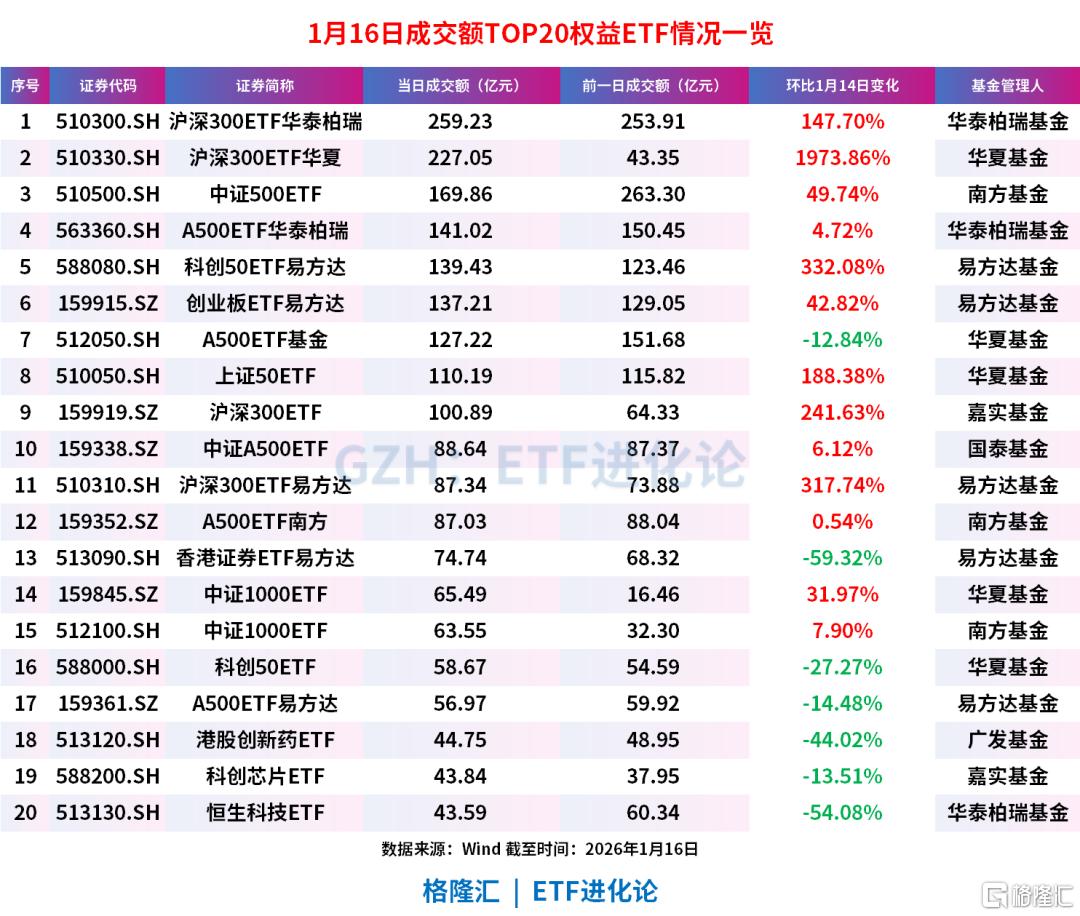
Core Viewpoint - The A-share market is experiencing an unprecedented tug-of-war between bulls and bears, highlighted by significant net outflows from major ETFs and a surge in leveraged funds [1][9][11]. Group 1: ETF Market Activity - Major broad-based ETFs saw a net outflow of 700 billion, with the total margin balance exceeding 2.7 trillion for the first time in history [1]. - The trading volume of ETFs reached a record high of 752.25 billion, marking the third consecutive day of record-breaking activity [1]. - Multiple broad-based ETFs, including the Huatai-PineBridge CSI 300 ETF and the Huaxia CSI 300 ETF, recorded transaction volumes exceeding 20 billion, with the latter seeing a nearly 20-fold increase compared to January 14 [2][4]. Group 2: Institutional Fund Flows - The top ten ETFs with the highest net outflows were all broad-based ETFs, totaling 715 billion in outflows, with the Huatai-PineBridge CSI 300 ETF alone experiencing a net outflow of 200 billion [9][10]. - Institutional funds showed a net outflow across nearly all major ETFs, indicating a trend of selling pressure despite high trading volumes [4][5]. Group 3: Leverage and Margin Trading - Leveraged funds have been aggressively buying, with net purchases of 206 billion on January 15, contributing to a total of 1.77 trillion in net purchases over the first nine trading days of the year [13][15]. - The current pace of leveraged fund inflows suggests that they could match last year's total net purchases in just over 25 trading days [15]. Group 4: Market Sentiment and Regulatory Environment - The market is showing signs of cooling, with regulatory measures aimed at tempering excessive speculation following a period of high trading volumes and bullish sentiment [11][19]. - The shift in regulatory stance is seen as a response to the rapid increase in trading activity, particularly after three consecutive days of trading volumes exceeding 3 trillion [19][20]. Group 5: Wealth Transfer and Investment Trends - A significant portion of the 160 trillion in household savings is being reallocated, which could have profound implications for the capital markets [21][30]. - The upcoming maturity of long-term deposits, estimated at 32 trillion, coincides with a bullish market environment, potentially leading to increased equity market participation [25][26].