资讯科技业

Search documents
南向资金追踪|10月净买入925亿港元 加仓金融及能源股减持医疗保健行业
Xin Lang Cai Jing· 2025-10-31 11:48
Core Viewpoint - In October, southbound funds recorded a cumulative net inflow of 92.5 billion HKD, a decrease of approximately 50% compared to September, primarily due to the suspension of Hong Kong Stock Connect trading during the National Day holiday [2][4]. Fund Flow Summary - Overall, southbound funds remained predominantly inflow-oriented in October, but the intensity of inflows weakened as the Hang Seng Index experienced volatility [4]. - The cumulative transaction volume of southbound funds reached 2,310.835 billion HKD, accounting for only 42% of the Hang Seng Index's total transaction volume, marking a low point since the beginning of the year [7]. Industry Analysis - In October, there was increased attention on the financial and energy sectors, with net inflows of 20.811 billion HKD and 9.27 billion HKD, respectively. Conversely, interest in technology and healthcare sectors declined [6]. - The inflow to the information technology sector decreased by over 40% month-on-month, while the healthcare sector saw a net outflow exceeding 5 billion HKD, likely due to the high cumulative gains in the innovative drug sector this year [6]. Stock Performance - Notable net inflows were observed in: - Xiaomi Group-W (01810.HK): 6.728 billion HKD - Meituan-W (03690.HK): 5.409 billion HKD - China National Offshore Oil Corporation (00883.HK): 4.713 billion HKD - Pop Mart (09992.HK): 4.182 billion HKD [8][9] - Significant net outflows were recorded for: - SMIC (00981.HK): 6.480 billion HKD - Alibaba-W (09988.HK): 5.750 billion HKD - Tencent Holdings (00700.HK): 1.970 billion HKD [9]. Recent Trends - Xiaomi Group-W experienced a cumulative decline of 20% in October, with short-term fund inflows slowing down [10]. - Meituan-W saw a cumulative decline of 2.39%, with a similar trend of slowing short-term fund inflows [11]. - China National Offshore Oil Corporation recorded a cumulative increase of 3.83%, with accelerated short-term fund inflows [12]. - Alibaba-W faced a cumulative decline of 6.72%, with continuous outflows of short-term funds [13].


创下7558倍认购新纪录 今年以来港股新股首日平均涨38%
Cai Jing Wang· 2025-10-20 10:52
Core Insights - The Hong Kong stock market has shown remarkable activity, with new IPOs achieving a record subscription multiple of 7558 times and an average first-day increase of 38% this year [1][2] - The Hang Seng Index has risen by 48.10% year-to-date, outperforming major global indices [2] - The IPO market in Hong Kong is vibrant, with a total fundraising amount of approximately 186.5 billion HKD in 2025, making it the largest globally [2] Market Performance - The Hong Kong stock market has outperformed global markets since 2025, with the Hang Seng Technology Index increasing by 28.92% [2] - The new IPO market has seen a low first-day failure rate of 22%, the lowest in nine years, with no IPOs breaking below their issue price since September 9 [2][5] - Major IPOs include companies like Ningde Times and Zijin Mining International, which have seen significant first-day price increases [2][6] Investment Trends - Private equity firms such as Hillhouse, Gaoyi, and Jinglin have participated as cornerstone investors in new IPOs, indicating strong institutional interest [5][6] - Investors are focusing on fundamental analysis, emphasizing business models, industry prospects, and financial health rather than initial trading hype [4][7] - The market is characterized by a structural trend driven by the high-growth AI industry, with expectations for continued performance despite macroeconomic challenges [4][8] Future Outlook - The Hong Kong market is expected to maintain upward momentum due to attractive valuations, improved liquidity, and the global trend towards AI applications [8][9] - The influx of southbound capital has exceeded 1.2 trillion HKD this year, enhancing market liquidity and supporting ongoing structural trends [9] - Key investment sectors include technology, healthcare, and high-dividend assets, which are anticipated to provide safety margins and growth potential [8][9]
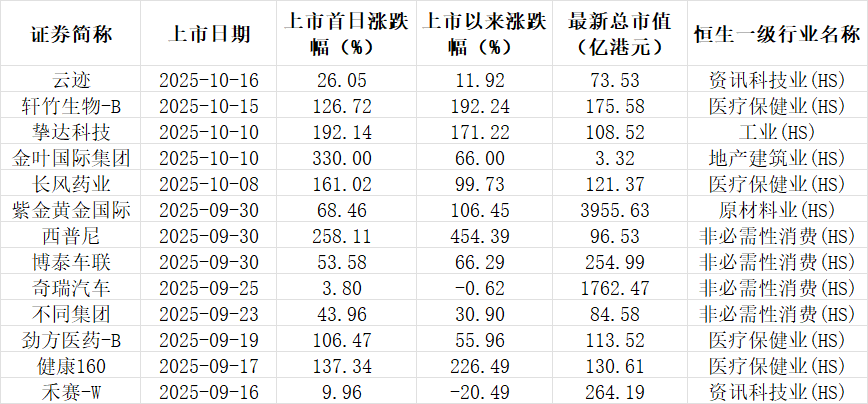
一天暴涨68%,高瓴、高毅、景林等私募“赚大了”
3 6 Ke· 2025-10-20 00:34
Core Insights - The Hong Kong stock market has been exceptionally active, with new IPOs achieving a record subscription multiple of 7558 times and an average first-day increase of 38% this year [1][2][5] - The Hang Seng Index has risen by 48.10% year-to-date, outperforming major global indices [2] - The IPO market in Hong Kong has seen a total fundraising of approximately 186.5 billion HKD, with a low first-day failure rate of 22%, the lowest in nine years [2][9] Market Performance - The Hong Kong stock market has outperformed global markets since 2025, with significant contributions from the technology and healthcare sectors [2][8] - Major IPOs this year include companies like CATL, Zijin Mining, and Hengrui Medicine, indicating strong market interest [2][6] - The recent trend shows that new stocks are not only avoiding price drops but are also frequently doubling in value [5][6] Investment Sentiment - Private equity firms such as Hillhouse, Gaofeng, and Jinglin have participated as cornerstone investors in new IPOs, indicating confidence in the market [1][5] - Investors are focusing on fundamental analysis and valuation when considering new IPOs, rather than just initial trading activity [6][7] - The market is expected to continue its upward trend due to improved liquidity and attractive valuations, particularly in technology, healthcare, and high-dividend sectors [8][9] Future Outlook - Analysts believe that the Hong Kong market has the potential for sustained recovery, supported by trends in AI and improved liquidity conditions [1][4][8] - The influx of southbound capital has exceeded 1.2 trillion HKD this year, enhancing market liquidity and supporting the ongoing structural rally [9] - The valuation of Hong Kong stocks remains relatively low compared to other global markets, suggesting further upside potential [8][9]
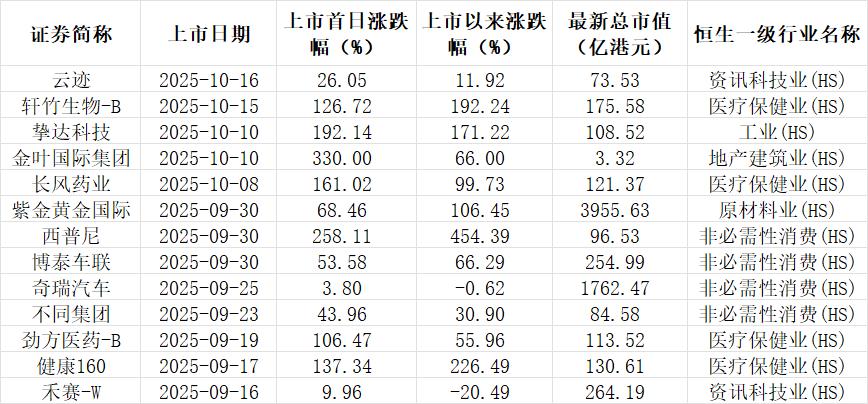
一天暴涨68%!高瓴、高毅、景林等私募“赚大了”
中国基金报· 2025-10-19 13:14
Core Viewpoint - The Hong Kong stock market is experiencing a significant surge in IPO activity, with record subscription rates and strong first-day performances, driven by favorable market conditions and institutional participation from prominent private equity firms [2][4][11]. Group 1: Market Performance - The Hong Kong IPO market has set a new record with a subscription rate of 7558 times, and the average first-day increase for new stocks this year is 38% [3][4]. - As of October 17, 2025, the Hang Seng Index has risen by 48.10% year-to-date, outperforming major global indices such as the S&P 500 and Nasdaq [4]. - The total fundraising amount from IPOs in Hong Kong has reached approximately 186.5 billion HKD, making it the highest globally [4]. Group 2: Institutional Participation - Notable private equity firms such as Hillhouse, Gao Yi, and Jinglin have participated as cornerstone investors in recent IPOs, indicating strong institutional confidence in the market [2][7][8]. - The participation of these firms reflects a focus on fundamental analysis and valuation when selecting IPOs, rather than merely market hype [9][10]. Group 3: Future Outlook - Private equity firms express optimism about the long-term performance of the Hong Kong market, citing factors such as the clear trend in the AI industry, improved liquidity, and attractive valuations [6][12]. - The market is expected to continue its upward trajectory, particularly in sectors like technology, healthcare, and high-dividend stocks, supported by structural opportunities and increased capital inflow from mainland investors [11][13].

聚焦“硬科技+新经济”,港股通科技ETF招商(159125)10月13日发行
2 1 Shi Ji Jing Ji Bao Dao· 2025-10-13 02:34
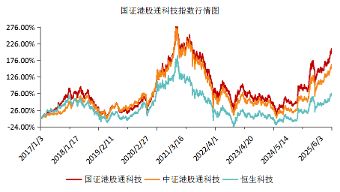
Core Viewpoint - The launch of the China Securities Hong Kong Stock Connect Technology ETF (code: 159125) aims to closely track the China Securities Hong Kong Stock Connect Technology Index, which includes leading technology companies in the Hong Kong market with core competitiveness [1] Group 1: Index Composition and Focus - The China Securities Hong Kong Stock Connect Technology Index selects 30 leading technology companies based on market capitalization, R&D investment, and revenue growth, focusing on "hard technology" and "new economy" sectors [2] - The index requires constituent stocks to have a compound revenue growth rate exceeding 10% over the past two years or an R&D expense ratio above 5%, ensuring a balance between scale and growth potential [2] - As of September 30, the index's sector weightings include 43% in consumer discretionary, 42% in information technology, and 12% in healthcare, with the top ten constituents accounting for 79% of the index [2] Group 2: Performance Metrics - The China Securities Hong Kong Stock Connect Technology Index has shown strong long-term performance, with a cumulative return of 209.77% and an annualized return of 14.03% since 2017, outperforming similar indices [3] - The index exhibits high elasticity, with an annualized volatility of 33.78%, indicating relatively high fluctuations [4] Group 3: Valuation and Market Trends - As of September 30, the index's price-to-earnings ratio stands at 26.45, positioned at the 39th percentile since inception, suggesting a favorable valuation compared to global tech indices like NASDAQ and ChiNext [6] - Hong Kong's technology companies have become significant players in stock buybacks, with a total buyback amount of 136.7 billion HKD in the first nine months of the year, indicating strong institutional confidence in long-term opportunities [8] - The influx of mainland capital into the Hong Kong market has reached a record high of 1.17 trillion HKD in net inflows this year, with technology stocks being a primary focus for investment [8]
恒指公司:恒生科指年初至今升42% 料货币宽松周期推动科技股普遍造好
智通财经网· 2025-09-25 11:46
Group 1 - The Hang Seng Tech Index has recorded a year-to-date increase of 41.8%, while the Hang Seng Composite Index has risen by 38.6% [1] - Over the past 12 months, the Tech Index has increased by 79.1%, compared to a 58.8% rise in the Composite Index, indicating higher volatility with an annualized volatility of 40.5% for the Tech Index versus 28.1% for the Composite Index [1] - The Federal Reserve lowered the federal funds rate by 25 basis points to 4% to 4.25% on September 17, marking the first rate cut of the year, which historically correlates with better performance of tech stocks during monetary easing periods [1] Group 2 - The Hang Seng Tech Index was launched in July 2020 to represent 30 of the largest Hong Kong-listed companies highly related to technology themes [2] - As of September 17, 2023, 15 of the 30 constituent stocks in the Tech Index come from the consumer discretionary sector, which holds the largest industry weight in the index [2] - The assets under management (AUM) for the ETP tracking the Tech Index reached $34.3 billion as of August 31, 2023, reflecting strong international recognition of the Hong Kong tech sector [2]
恒指公司:科指年初至今表现跑赢大市
Xin Lang Cai Jing· 2025-09-25 11:36
Group 1 - The Hang Seng Index Company reported that as of September 17, three industry indices of the Hang Seng Composite Index have increased by over 60% this year, with the Information Technology sector ranking third at a 60% increase, indicating strong market interest in digital and technology-related themes [1] - Year-to-date, the Technology Index has risen by 41.8%, while the Hang Seng Composite Index has increased by 38.6%. Over the past 12 months, the Technology Index has surged by 79.1%, compared to a 58.8% increase in the Hang Seng Composite Index [1] - The annualized volatility of the Technology Index over the past 12 months reached 40.5%, while the Hang Seng Composite Index recorded 28.1%, reflecting the typical characteristics of technology indices with higher gains and increased volatility [1] Group 2 - As of August 31, the assets under management (AUM) for exchange-traded products (ETPs) tracking the Technology Index reached $34.3 billion, the highest among its three flagship indices. From 2021 to 2025, the AUM for Technology Index ETPs is projected to increase by 362% [1] - There are currently 29 ETPs based on the Technology Index listed across 13 different exchanges in the US, Europe, and Asia. Among the 13 Hong Kong Stock Connect qualified ETFs tracking the Hang Seng Index series, 5 track the Technology Index, indicating ongoing capital inflow and international recognition of the Hong Kong technology sector [1] - The Hang Seng Index Company noted that the Federal Reserve lowered the federal funds rate by 25 basis points on September 17, marking the first rate cut of the year. Historical data shows that during the previous easing cycle (August 2023 to January 2025), the Technology Index rose by 39.6%, outperforming the 37.5% increase in the Hang Seng Composite Index [2]
宣布大消息,阿里巴巴放量大涨
Zhong Guo Ji Jin Bao· 2025-09-24 10:58
Group 1: Alibaba's Partnership with NVIDIA - Alibaba announced a partnership with NVIDIA to develop Physical AI, significantly upgrading its AI infrastructure with an additional capital expenditure of 380 billion yuan [4] - Following the announcement, Alibaba's stock surged by 9.16%, closing at 174.00 HKD per share, with a trading volume of 44.09 billion HKD, nearly four times that of the second-highest stock [4] - Alibaba's CEO emphasized the importance of large models in the evolution from AGI to ASI, stating that they will serve as the core interface for user and software interactions [4][6] Group 2: AI Infrastructure Investment - Alibaba plans to enhance its AI infrastructure, with a projected tenfold increase in energy consumption at its global data centers by 2032 compared to 2022 [6] - The company is expected to drive growth in its cloud business through significant investments in AI infrastructure, with forecasts for adjusted net profits of 140.5 billion yuan, 162.9 billion yuan, and 189.8 billion yuan from 2026 to 2028 [6][7] Group 3: Semiconductor Industry and SMIC - SMIC's stock rose by 5.72%, reaching a historical high of 76.75 HKD per share, driven by expectations of increased demand for AI chips in China [8] - Analysts project SMIC's revenue to reach 67.7 billion yuan, 77.9 billion yuan, and 89.6 billion yuan from 2025 to 2027, with net profits of 5.1 billion yuan, 6.2 billion yuan, and 7.4 billion yuan respectively [8] - The semiconductor capital expenditure is expected to grow by 14% in 2025, reaching 148 billion USD, with a 12% increase in the global equipment market size [9]

降息靴子落地!港股科技布局价值升温
Ge Long Hui· 2025-09-18 07:37
Core Viewpoint - The recent interest rate cut in China has led to an increase in the value of asset allocation, particularly in the technology sector of the Hong Kong stock market, with a focus on the top technology stocks [1]. Group 1: Fund Overview - The fund, known as the China Securities Hong Kong Technology Exchange-Traded Fund (QDII), was established on January 26, 2022, and primarily invests in overseas securities markets [3]. - The fund faces various risks, including market volatility, exchange rate risks, and specific risks associated with overseas securities markets [3]. Group 2: Market Performance - The Hong Kong Technology Index has shown a cumulative increase of nearly 125% since its base date of December 31, 2014, outperforming the Hang Seng Technology Index over the same period [6]. - Year-to-date performance of the Hong Kong Technology Index is 42.98%, compared to 36.02% for the Hang Seng Technology Index [7]. Group 3: Concentration of Top Stocks - The top five constituent stocks of the Hong Kong Technology Index account for 43% of the total weight, which is higher than that of the Hang Seng Technology Index [5]. - The leading technology stocks include Tencent Holdings (10.94%), Alibaba-W (9.36%), and Xiaomi Group-W (9.27%) [4]. Group 4: Capital Inflow - As of September 15, 2025, southbound capital has net purchased over 1 trillion HKD in the current year, with approximately 1.4 trillion HKD in net purchases over the past year, focusing on sectors such as non-essential consumer goods, healthcare, and information technology [9].

美联储降息+AI突破+业绩亮眼,机构:港股科技具备较大估值修复空间
Ge Long Hui· 2025-09-18 07:37
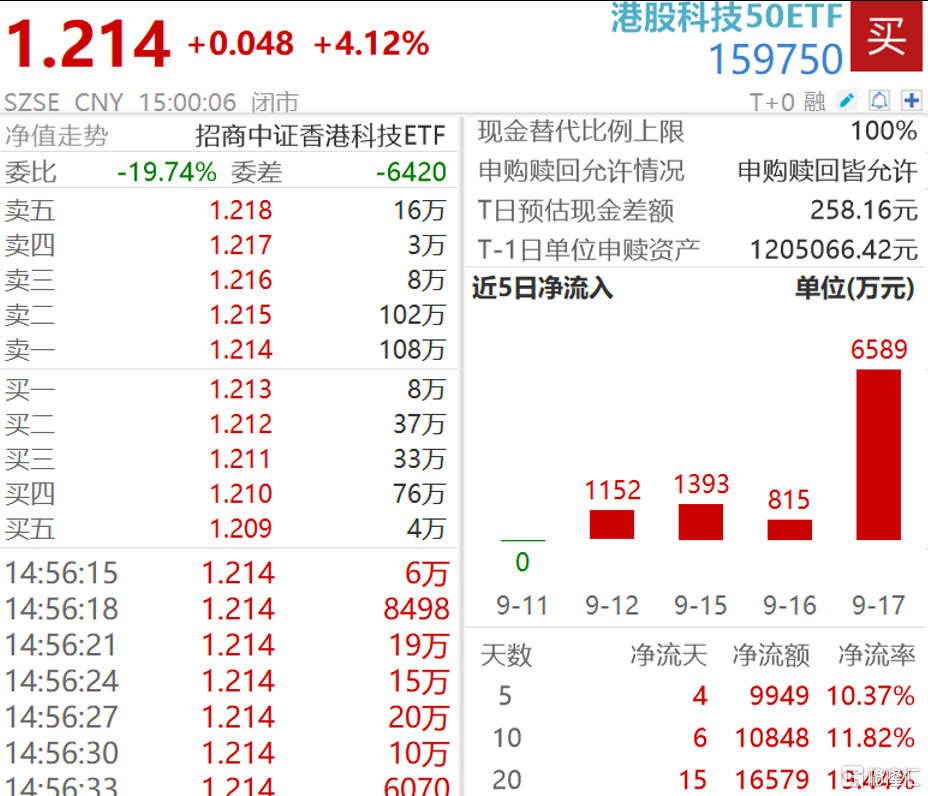
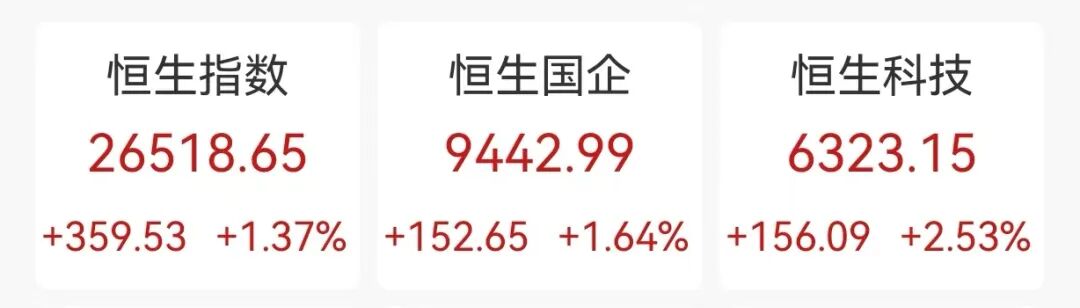
Group 1 - The Federal Reserve's decision to lower the benchmark interest rate by 25 basis points aligns with expectations, indicating potential for two more rate cuts this year, which has positively impacted the Nasdaq China Golden Dragon Index, rising by 2.85% [1] - The Hang Seng Technology Index has successfully broken through previous resistance levels, reaching 6300 points, marking a four-year high, with the Hang Seng Technology 50 ETF recording a 4.12% increase, achieving its highest closing price since inception [1][2] - The influx of foreign capital into Chinese assets is increasing, with foreign investment in the Hong Kong market currently at 66%, showing potential for further growth compared to 79% in 2022 [3] Group 2 - AI advancements are becoming a significant driving force for the market, with companies like Baidu securing substantial AI server orders, and major Chinese tech firms expected to increase capital expenditures in AI to $32 billion by 2025 [4] - The second quarter performance of Hong Kong tech stocks shows notable revenue growth, with the Hang Seng Technology Index's revenue increasing by 14.43% year-on-year, while net profit growth for the index reached 16.18% [5] - The valuation of the Hang Seng Technology Index is currently at 24.11 times PE-TTM, which is significantly lower than global peers like the Nasdaq and ChiNext indices, indicating a strong value proposition for investors [7]