
零售业

Search documents
超4300只个股下跌
第一财经· 2025-12-11 07:53
Market Overview - The A-share market experienced a decline, with the Shanghai Composite Index falling by 0.7%, the Shenzhen Component Index down by 1.27%, and the ChiNext Index decreasing by 1.41% [3][4] - The North Stock 50 Index saw a significant increase of nearly 4% [3] Sector Performance - Real estate, retail, cultural media, and communication equipment sectors faced the largest declines, while sectors such as nuclear power, wind power, newly listed stocks, and commercial aerospace concepts showed strength [3][4] - The controllable nuclear fusion concept stocks surged, with companies like Yongding Co., Xue Ren Group, and Hualing Cable seeing notable gains [5] Individual Stock Movements - Stocks such as Tianli Composite (+30%), Haheng Huaton (+15.15%), and Gao Fu Fu Fen (+12.01%) experienced significant increases [6] - Conversely, stocks like Deyi Cultural (-13.38%), China Wuyi (-10.09%), and Tianma Technology (-10.02%) faced substantial declines [7] Trading Volume and Market Sentiment - The total trading volume in the Shanghai and Shenzhen markets reached 1.86 trillion, an increase of 78.6 billion compared to the previous trading day, with over 4,300 stocks declining [9] - Main funds saw net inflows into sectors like wind power equipment, aerospace, and energy metals, while there were net outflows from semiconductors, media, and real estate sectors [11] Analyst Insights - Hu Long Securities indicated that the continuation of positive policies in 2026 could provide favorable support for the market [12] - Everbright Securities suggested that the upcoming significant meeting in December may boost market sentiment and lead to a rebound [13] - Wanlian Securities noted that the current PB valuation of the brokerage sector is at a near ten-year low, indicating potential for valuation recovery [14]





利率下行,风险上行——2025年12月美联储议息会议点评
Xin Hua Cai Jing· 2025-12-11 05:23
Group 1 - The Federal Reserve has lowered the benchmark interest rate by 25 basis points to a range of 3.50%-3.75%, aligning with market expectations, despite inflation not returning to target levels [1][2] - The labor market is showing signs of moderate deterioration, with the unemployment rate rising to 4.4%, and companies are reducing hiring due to cost and demand pressures [1][2] - A recent paper from the San Francisco Fed suggests that tariff increases may not raise inflation as traditionally expected, but rather shrink demand and suppress inflation [1][3][4] Group 2 - The U.S. economy is experiencing a dichotomy, with the Federal Reserve facing internal divisions regarding the impact of tariffs on prices and economic activity [5] - Consumer confidence is declining across various demographic groups, although the stock market's performance, driven by AI-related companies, supports spending among wealthier consumers [6] - The Fed is expected to lower interest rates by a total of 50-75 basis points by 2026 to return to a neutral level around 3%, in response to ongoing trade policy and fiscal uncertainties [1][6]
香港互联网ETF(认购代码:513723)跟踪指数有什么特点?
Sou Hu Cai Jing· 2025-12-11 01:53
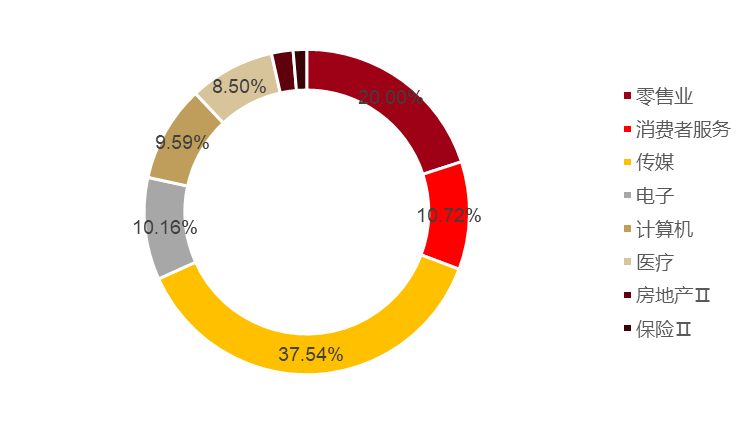
Core Insights - The Hong Kong Internet ETF (subscription code: 513723) tracks the CSI Hong Kong Stock Connect Internet Index, which selects 30 listed companies involved in internet-related businesses within the Hong Kong Stock Connect scope to reflect the overall performance of the internet theme in Hong Kong stocks [1][10] - The index focuses on companies whose main business involves internet software, internet retail, internet services, mobile internet, and even home entertainment software, thus breaking the limitations of traditional industry indices [1][10] Industry Distribution - The top three industries in the CSI secondary industry distribution are Media, Retail, and Consumer Services [1][10] - Major holdings include well-known companies such as Alibaba, Tencent, Xiaomi, Meituan, and SenseTime, with JD Health and Alibaba Health also appearing in the top ten holdings [1][3] Top Holdings - The top ten holdings by weight are as follows: - Alibaba-W (9988 HK): 18.92% in Retail - Tencent Holdings (0700.HK): 16.34% in Media - Xiaomi Group-W (1810.HK): 10.16% in Electronics - Meituan-W (3690.HK): 8.07% in Consumer Services - SenseTime-W (0020.HK): 3.91% in Computers - Bilibili-W (9626.HK): 3.76% in Media - JD Health (6618.HK): 3.58% in Healthcare - Alibaba Health (0241.HK): 3.02% in Healthcare - Kuaishou-W (1024.HK): 2.81% in Media - Meitu Inc. (1357.HK): 2.58% in Media [3] Market Capitalization Distribution - Stocks with a market capitalization of over 200 billion account for 56% of the index, indicating a significant presence of large-cap stocks [3][10] - There are 15 mid-cap stocks with market capitalizations between 20 billion and 60 billion, reflecting a balanced sample distribution [3][10] Detailed Industry Breakdown - The top three weighted industries in the CSI tertiary industry distribution are Digital Media, Internet Retail, and Electronic Terminals and Components [8] - Digital Media includes familiar areas such as interactive media and video media, while Internet Retail corresponds to online shopping needs [8] Comparison with Other Indices - The index has a higher weight in Media and Retail, exceeding 50%, compared to traditional technology indices [15] - Unlike conventional technology indices, this index focuses on internet-related companies and excludes sectors like semiconductors and passenger vehicles, which have lower correlation with internet company performance [15][16]
零售板块开盘走低 茂业商业触及跌停
2 1 Shi Ji Jing Ji Bao Dao· 2025-12-11 01:39
南方财经12月11日电,零售板块开盘走低,茂业商业触及跌停,中央商场、中百集团、三江购物跟跌。 ...

股市政策博弈情绪渐浓,债市延续暖意
Zhong Xin Qi Huo· 2025-12-11 00:52
1. Report Industry Investment Rating No investment rating for the industry is provided in the report. 2. Core Viewpoints - The sentiment of policy gaming in the domestic stock market is intensifying, but the shrinking trading volume limits its sustainability. The bond market sentiment continues to be positive [1][2]. - For stock index futures, the "Spring Rally" offensive timing still needs to wait, and in the short - term, focus on the price - increase chain and high - dividend stocks. For stock index options, continue to hold short options for defensive enhancement. For bond futures, the bond market is likely to return to a volatile state in the short - term and is expected to be volatile and bullish in the long - term [1][2]. 3. Summary by Relevant Catalogs 3.1 Market Views 3.1.1 Stock Index Futures - **Views**: The sentiment of domestic policy gaming is intensifying, but the shrinking trading volume limits its sustainability [1][6]. - **Logic**: On Wednesday, the Shanghai Composite Index rebounded after hitting the bottom, barely holding above 3900 points, with the trading volume shrinking to 1.79 trillion yuan. There were two intraday movements: Vanke's limit - up in the afternoon and the active retail sector. The PCB and photovoltaic sectors that were strong in the first half of the week adjusted. The Fed's December interest - rate decision is unlikely to bring additional benefits to A - shares. In the shrinking - volume environment, it is difficult to form a continuous main line [1][6]. - **Operation Suggestion**: Long positions in Dividend ETF + IC [6]. 3.1.2 Stock Index Options - **Views**: Use covered strategies for defensive enhancement [2][6]. - **Logic**: The equity index was weak first and then strong yesterday, with the Shanghai Composite Index down 0.23%. The trading volume of each option variety rebounded by 25.32%. The market's long - short game is more intense. Considering the possible volatile market, it is recommended to continue holding short options for defensive enhancement [2][6]. - **Operation Suggestion**: Covered options [6]. 3.1.3 Bond Futures - **Views**: The bond market sentiment continues to be positive [2][7]. - **Logic**: Bond futures rose across the board yesterday. The inter - bank market liquidity was more abundant, and the overnight repo rate decreased. The short - end pressure is not large, but the supply of long - term bonds may be weak. In the short - term, the market depends on subsequent policies, and in the long - term, the bond market is expected to be volatile and bullish [2][7][9]. - **Operation Suggestion**: Trend strategy: Volatility. Hedging strategy: Short - term short hedging, medium - term long substitution. Basis strategy: Pay attention to positive arbitrage opportunities and basis widening. Curve strategy: Pay attention to the curve steepening [9]. 3.2 Economic Calendar - On December 10, 2025, China's November CPI year - on - year was 0.7% (previous value 0.2%), and PPI year - on - year was - 2.2% (previous value - 2.1%). On December 9, 2025, the number of job openings in the US in October was 7670000 (previous value 7227000, forecast 7117000) [10]. 3.3 Important Information and News Tracking - The Ministry of Finance plans to issue the first and second phases of the 2025 maturity continued special treasury bonds on December 12, 2025, with face values of 400 billion yuan and 350 billion yuan respectively [10]. - The Shanghai Futures Exchange announced that starting from the settlement after the close on December 12, 2025, the trading margin ratio and the daily price limit range of the silver futures AG2602 contract will be adjusted [11]. 3.4 Derivatives Market Monitoring The report lists the sections for monitoring stock index futures, stock index options, and bond futures data, but no specific data content is provided.
A股延续结构性行情 海南自贸港与地产板块领涨
Shang Hai Zheng Quan Bao· 2025-12-10 17:57
◎记者 徐蔚 12月10日,A股市场呈现指数分化的结构性走势。截至收盘,上证指数微跌0.23%,报3900.50点,险守 3900点整数关口;深证成指午后翻红,逆势上涨0.29%,报13316.42点;创业板指微跌0.02%,报 3209.00点。全市场成交额为1.79万亿元,较前一个交易日缩量1260亿元,超2400只个股上涨,板块轮动 特征显著。 中银证券研报表示:基本面承压叠加"十五五"规划建议表态偏向积极,未来地产优化政策落地的空间打 开。对未来地产行业的修复有一定信心。从地产标的来看,一方面,流动性安全、重仓高能级城市、产 品力突出的房企或更具备α属性;另一方面,在新消费时代下,提前布局新业态、新模式、新场景的商 业地产公司,有望率先走出重围。 此外,零售板块延续强势表现,永辉超市、中央商场、茂业商业等多只个股涨停。消息面上,全国零售 业创新发展大会12月9日至10日在北京举行。商务部副部长盛秋平表示,"十五五"时期,要把零售业作 为培育完整内需体系、做强国内大循环的关键着力点,推动行业转向品质驱动、服务驱动,实现高质量 发展。 数据显示,"十四五"以来,零售业对促进消费和投资的贡献巨大。2024年 ...

永辉超市三连板!最新回应
Mei Ri Jing Ji Xin Wen· 2025-12-10 14:00
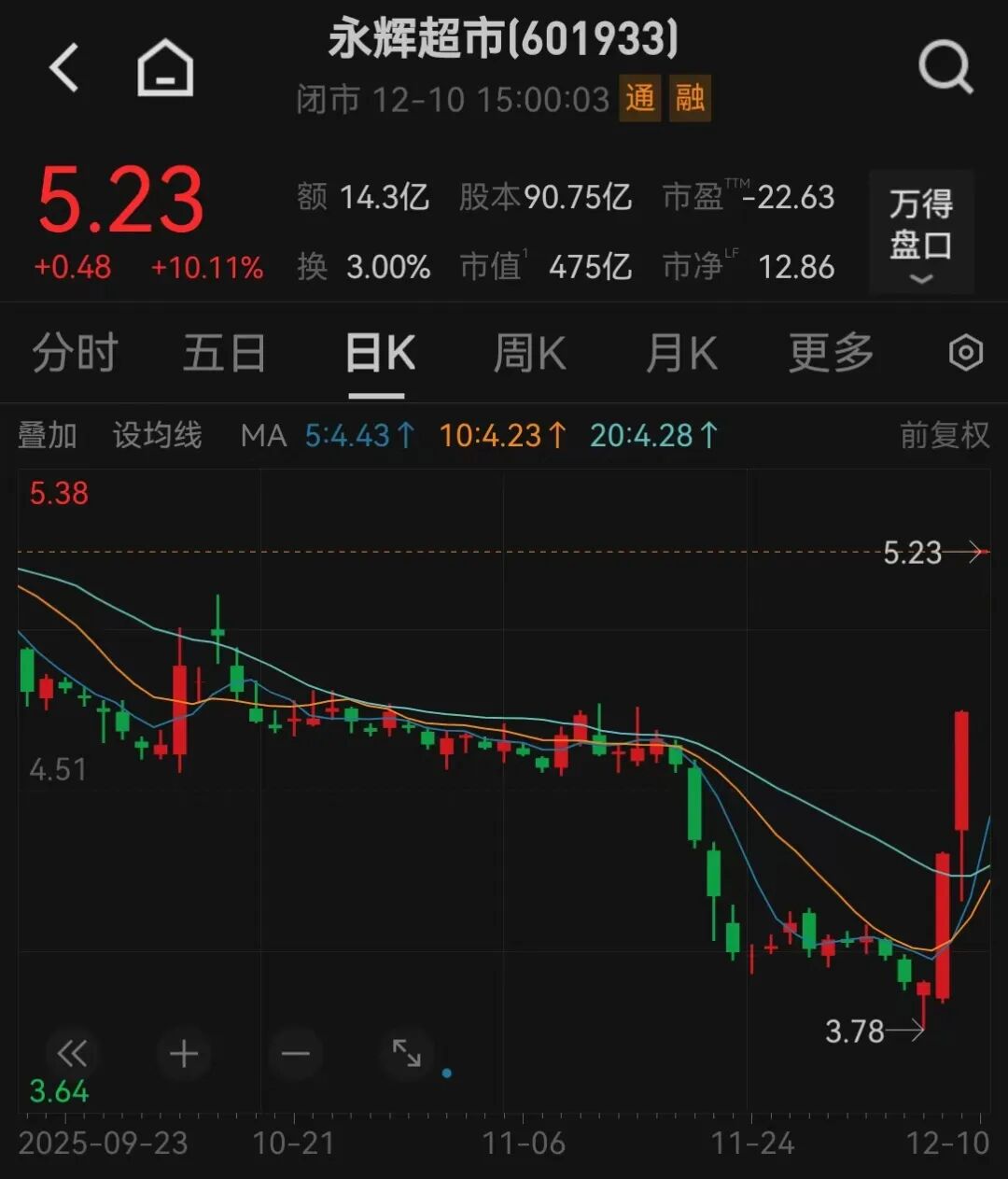
每经编辑|黄胜 12月10日,永辉超市股价再度涨停,收获三连板,截至收盘,报5.23元,总市值475亿元。 今日晚间,永辉超市发布股票交易风险提示公告称,公司股票在12月8日、9日连续两个交易日收盘价格涨幅偏离值累计达到20%。12月10日,公司股票再 次涨停,公司股票交易价格短期涨幅较大。 此外,鉴于近期公司股票交易价格涨幅较大,存在市场情绪过热情形及较高的炒作风险,可能存在短期涨幅较大后的大幅下跌风险,公司郑重提醒广大投 资者注意二级市场交易风险,理性决策,审慎投资。 12月5日,永辉超市这家零售巨头发布两则公告。 一则公告显示,永辉超市董事长张轩松及其一致行动人通过集中竞价交易方式减持公司股份450万股。 与此同时,另一则公告显示,自前次披露至今,永辉超市及下属子公司累计新增诉讼、仲裁案件涉及金额4.95亿元。 今年前三季度,永辉超市实现营业收入424.34亿元,同比下降22.21% ;归母净亏损约7.10亿元,同比下降811.60%。去年同期,其归母净亏损为7786.57万 元。 封面图片来源:图片来源:每经记者 张韵 摄 永辉超市表示,经公司自查,截至本公告日,公司目前生产经营活动正常,门店调改稳步 ...

永辉超市涨停 机构净卖出4.57亿元
Zhong Guo Jing Ji Wang· 2025-12-10 12:19
中国经济网北京12月10日讯 永辉超市(601933.SH)今日股价涨停,截至收盘,该股报5.23元,涨幅10.11%。 龙虎榜数据显示,今日,卖出永辉超市金额最大的前五名中,有3家机构专用席位。经统计,永辉超市的机构席位今日净卖出金额为45690.01万元。 | 序号 | 交易营业部名称 | | | 买入金额(万) | 占总成交比例 | 卖出金额(万) | 占总成交比例 | | --- | --- | --- | --- | --- | --- | --- | --- | | | 开源证券股份有限公司西安西大街证券营业部 | 690次 50.29% | (2) | 23995 55 | 16.82% | | | | 2 | 广发证券股份有限公司郑州农业路证券营业部 | 28次 28.57% | | 7805.06 | 5.47% | | | | 3 | 国投证券股份有限公司西安未雀大街证券营业部 | 31次 51.61% | | 5324.14 | 3.73% | | | | | 浙商证券股份有限公司宁波分公司 | 13次 46.15% | | 5230.00 | 3.67% | | | | 5 | 中信证 ...

3连板永辉超市:门店调改稳步有序进行中 内外部经营环境未发生重大变化
Ge Long Hui A P P· 2025-12-10 11:33
格隆汇12月10日|永辉超市(601933.SH)公告称,鉴于公司股票自2025年12月8日起已连续3个交易日以 涨停价收盘,存在市场情绪过热情形及较高的炒作风险,可能存在短期涨幅较大后的大幅下跌风险。敬 请广大投资者注意二级市场交易风险,理性决策,审慎投资。经公司自查,截至本公告日,公司目前生 产经营活动正常,门店调改稳步有序进行中,内外部经营环境未发生重大变化,不存在应披露而未披露 的重大事项。 ...
昆明渝裳领商贸有限公司成立 注册资本10万人民币
Sou Hu Cai Jing· 2025-12-10 11:14
Group 1 - A new company named Kunming Yushangling Trading Co., Ltd. has been established with a registered capital of 100,000 RMB [1] - The legal representative of the company is Zou Lijun [1] - The business scope includes a wide range of retail activities such as daily necessities, second-hand goods, toys, mother and baby products, office supplies, and more [1] Group 2 - The company is authorized to conduct business activities independently based on its business license, except for projects that require approval [1]