电商平台

Search documents
中金:关注双11期间即时零售和外卖进展 AI赋能平台提效
智通财经网· 2025-10-22 08:36
Core Insights - The Double 11 shopping festival is a critical period for e-commerce platforms to enhance consumer engagement, promotional efforts, and shopping experiences [1][2] - Alibaba has made significant advancements in integrating AI with e-commerce, which is expected to reduce merchant costs and improve matching efficiency [1][3] Group 1: Promotion Strategies - The duration of promotional activities has been extended, with increased investment; Alibaba announced a 50 billion yuan consumer coupon subsidy for this year's Double 11 [1] - Major platforms like JD and Douyin have also initiated their sales earlier than usual, with JD launching on October 9 and Pinduoduo starting on October 16 [1] - Various promotional strategies include discounts, consumer coupons, and live-streaming red envelopes, with Alibaba expanding its offerings compared to the previous year [1] Group 2: Instant Retail and Delivery - Instant retail and food delivery services are included in the Double 11 activities, with Alibaba integrating more dining and entertainment businesses into its promotions [2] - JD has partnered with over 3 million local dining and instant retail merchants for its Double 11 campaign, indicating a significant expansion in service offerings [2] - The performance of instant retail and delivery during Double 11 will be crucial for assessing future market dynamics [2] Group 3: AI Integration - Alibaba has implemented AI across various aspects of e-commerce, including search, recommendations, and advertising, to enhance efficiency [3] - AI tools are being utilized to assist merchants in store operations, content generation, marketing, and customer service, leading to cost reductions and efficiency improvements [3] - New AI-driven shopping features such as AI assistants and virtual try-ons are being deployed during Double 11 to enhance consumer experience [3]


双11的十七年之变:从“价格战”到“体验战”
Sou Hu Cai Jing· 2025-10-22 07:17
Core Insights - The "Double 11" shopping festival has evolved from a one-day event into a nearly two-month shopping season, reflecting changing consumer behaviors and market dynamics [2][9][29] - E-commerce platforms are adopting new strategies to rejuvenate the festival, including simplifying promotional rules, enhancing delivery efficiency through instant retail, and leveraging AI technology for better shopping experiences [12][13][22] Group 1: Changes in Consumer Behavior - Consumers are becoming more rational, focusing on essential purchases rather than impulse buying, with many stating they will not stockpile items just to meet discount thresholds [9][10] - The perception of "Double 11" has shifted, with consumers feeling that frequent promotions throughout the year reduce the urgency to wait for this specific event [11] Group 2: E-commerce Platform Strategies - Major platforms like JD.com and Tmall have started their promotions earlier, with JD.com reporting a 47.6% increase in active users and over 70% growth in orders for home appliances and electronics within just five days of launching [3][5] - Tmall's pre-sale on October 15 led to significant sales, with 80 brands achieving over 100 million yuan in sales within the first hour [5] - Douyin has extended the shopping season to 57 days, combining it with the Mid-Autumn Festival, while other platforms like Kuaishou and Xiaohongshu have also adjusted their promotional timelines [6] Group 3: Simplification of Promotion Rules - E-commerce platforms are simplifying their promotional rules to enhance consumer participation, introducing direct discounts and eliminating the need for minimum purchase requirements [11][12] - This shift aims to reduce the complexity that previously deterred consumers and increased operational costs for merchants [12] Group 4: Adoption of Instant Retail and AI Technology - Instant retail is becoming a key focus, with platforms like JD.com enhancing their delivery capabilities to meet consumer demands for speed [14][16] - AI technology is being integrated into various aspects of e-commerce, from product recommendations to customer service, improving efficiency and user experience [18][20][22] Group 5: International Expansion - As domestic growth slows, e-commerce platforms are increasingly looking to international markets, with Alibaba launching "Double 11" in 20 countries and regions simultaneously [23][24] - The company is investing 1 billion yuan in marketing subsidies to help 100,000 merchants double their overseas sales, indicating a strong commitment to global expansion [24][28] Group 6: Future of Double 11 - The festival is transitioning from a mere sales event to a platform for exploring new retail models, emphasizing speed, intelligence, and international reach [29] - The evolving nature of "Double 11" reflects a broader trend in consumer expectations and market strategies, aiming to maintain relevance in a changing retail landscape [29]



欢迎来到“理性双11”
首席商业评论· 2025-10-22 04:38
Core Insights - The article discusses the evolution of the "Double 11" shopping festival, highlighting a shift from impulsive buying to more rational consumer behavior as the event has transformed into a lengthy shopping season lasting nearly two months [5][6][13]. Group 1: Changes in Consumer Behavior - Consumers are becoming more rational, focusing on essential purchases rather than bulk buying to meet discount thresholds [13][14]. - The complexity of promotional rules has decreased, with platforms simplifying their offerings to enhance consumer participation [14][16]. Group 2: Platform Strategies - Major platforms like JD and Tmall have extended their promotional periods, with JD starting on October 9 and Tmall on October 15, leading to significant increases in user engagement and sales [7][9]. - New promotional strategies include "instant retail" and AI-driven shopping assistants, aiming to meet the demand for speed and convenience in purchasing [16][21]. Group 3: Technological Integration - AI technology is being integrated into various aspects of e-commerce, from customer service to inventory management, enhancing operational efficiency and consumer experience [22][24]. - Instant retail is emerging as a competitive edge, with platforms like Taobao and JD enhancing their delivery capabilities to meet immediate consumer needs [19][20]. Group 4: International Expansion - As domestic growth slows, platforms are increasingly focusing on international markets, with Alibaba launching initiatives in 20 countries to replicate the success of Double 11 [26][28]. - The strategies include significant marketing investments and simplified processes for merchants to facilitate overseas sales [28][31]. Group 5: Future of Double 11 - The Double 11 event is evolving from a mere sales competition to a platform for exploring new retail models, emphasizing customer understanding and timely delivery [33].
天猫双十一转身:从价格战到攻“心”战
2 1 Shi Ji Jing Ji Bao Dao· 2025-10-21 12:07
Core Insights - The 2025 Tmall Double Eleven event marks a strategic shift for Alibaba, focusing on "big consumption + AI + flash sales" and prioritizing consumer engagement over mere traffic operations [2][4] - Tmall's performance in the first hour of sales exceeded last year's figures, with 80 brands achieving over 100 million yuan in sales, indicating strong consumer demand [2][5] - The competitive landscape is evolving from price wars to efficiency battles, with AI playing a crucial role in enhancing operational effectiveness and consumer engagement [10][11] Group 1: Tmall's Strategy and Performance - Tmall's strategy has shifted to focus on high-quality consumers and younger demographics, moving away from low-price consumer subsidies [2][4] - The first hour of sales saw significant growth, with 30,516 brands doubling their sales compared to last year, and 18,919 brands surpassing last year's total sales in just the first hour [2] - Tmall's president emphasized that the decline in e-commerce net profit is due to increased investment in consumer engagement rather than operational inefficiencies [2][4] Group 2: Brand Perspectives and Market Dynamics - Brand leaders from companies like L'Oreal and MUJI highlighted the importance of Double Eleven as a platform for long-term consumer engagement and brand trust [3][6] - The competition in the beauty sector remains intense, with domestic brands struggling against international conglomerates despite multi-channel strategies [5][6] - MUJI reported a revenue increase of 18.6% year-on-year, attributing part of this growth to enhanced e-commerce efforts during the Double Eleven period [6] Group 3: AI and Technological Integration - Tmall has introduced several AI applications to enhance the shopping experience, such as "AI Universal Search" and "Photo Search," which cater to various consumer needs [7][9] - AI is being utilized to improve efficiency in coupon distribution, with a reported 15% increase in conversion rates from AI-driven decisions [10] - The integration of AI in marketing and operational strategies is seen as essential for brands to enhance their market competitiveness and consumer engagement [10][11] Group 4: Consumer Behavior and Market Trends - The Double Eleven event continues to be a significant driver of consumer behavior, with brands recognizing the need to innovate and enhance customer experiences [4][5] - Despite the success of the initial sales, concerns about promotional fatigue and complex discount structures have been raised by industry leaders [4][5] - The shift from aggressive discounting to a focus on brand value and consumer experience is becoming increasingly important in the current market landscape [10][11]
第四批江苏省县域电商产业集聚区出炉!“数商兴农庆丰收”江苏专场活动在盐城举行
Yang Zi Wan Bao Wang· 2025-10-21 10:45
Group 1 - The "2025 Digital Commerce Promotes Agriculture Harvest Celebration" event was held in Yancheng, Funing, Jiangsu Province, focusing on the theme of "Digital Commerce Promotes Agriculture" [2] - Key participants included officials from Jiangsu Provincial Department of Commerce, local government, and representatives from major e-commerce platforms and agricultural enterprises [2] - The event featured three live broadcast exhibition areas showcasing local specialties and allowed over 40 companies to present their products through live streaming, enhancing consumer engagement [2] Group 2 - The Jiangsu Provincial Department of Commerce announced the fourth batch of county-level e-commerce industrial clusters, including eight new areas focused on various industries such as electric vehicles and health products [4] - The department plans to continue implementing the "Digital Commerce Promotes Agriculture" initiative, aiming to enhance the e-commerce service system and promote digital marketing of agricultural products [4] - The initiative seeks to improve the digitalization and networking of rural e-commerce, ultimately supporting farmers' income growth and rural revitalization [4]

河北纵深推进“扩流增量促发展”活动成效显著
Zhong Guo Zhi Liang Xin Wen Wang· 2025-10-21 06:57
Core Insights - The "Expand Flow, Increase Volume, Promote Development" initiative in Hebei has successfully generated over 200 million online orders for small and medium-sized enterprises (SMEs) since its launch in February [1][4] - The initiative involves collaboration with major e-commerce platforms like Taobao, JD.com, and Kuaishou to enhance the online presence and operational capabilities of SMEs [1][4] Group 1: Initiative Overview - The Hebei Provincial Market Supervision Administration has organized 146 specialized activities, covering 22,800 SMEs, to stimulate online development [1] - A regular communication and collaboration mechanism has been established with leading platforms to create tailored cooperation models based on platform characteristics [1][2] Group 2: Training and Support - A dual-driven training system for live-streaming hosts has been developed, focusing on "nurturing and empowering" to enhance sales conversion [2] - Training activities have been conducted in various cities, improving average sales by 20% for participating companies [2] Group 3: Resource Matching and Database - A supply-demand matching database has been created to connect SMEs with necessary resources, addressing their needs in product promotion and operational technology [2] - Over 20,000 enterprises have been accurately matched with online resources to support their digital transformation [2] Group 4: Activity Highlights - The initiative has introduced an innovative service model that integrates government support, platform empowerment, host participation, and enterprise practice [4] - A tiered customization strategy has been implemented to meet the diverse needs of platform enterprises, hosts, and SMEs, promoting brand development and resource optimization [4] - A comprehensive management mechanism has been established to track the effectiveness of activities, allowing for timely adjustments and the sharing of best practices [4]
拼多多低价销售还包邮,真的不会亏钱吗?商家揭露背后真相
Sou Hu Cai Jing· 2025-10-21 05:53
Core Insights - The article explores how Pinduoduo maintains low prices while ensuring profitability, highlighting its unique business model and strategies that differentiate it from traditional e-commerce platforms [1][3][11]. Pricing Strategy - Pinduoduo's average product prices are 32.7% lower than other major e-commerce platforms, with some categories showing price differences exceeding 50% [1]. - 76.3% of consumers cite "low prices" as the primary reason for shopping on Pinduoduo [1]. Business Model - Pinduoduo's merchants often engage in direct sourcing from factories, eliminating intermediaries and reducing costs. Approximately 82% of Pinduoduo merchants use this "factory direct supply" model, which is nearly 30 percentage points higher than other platforms [3][4]. - The platform's "group buying" mechanism allows merchants to achieve economies of scale, significantly lowering costs as order volumes increase. Pinduoduo's average daily order volume per product is 2.6 times that of other platforms [4][6]. Cost Management - Merchants on Pinduoduo utilize simplified packaging and customer service, which reduces non-essential costs. Packaging costs on Pinduoduo account for only 2% of product costs, compared to 8.5% on high-end platforms [6]. - The platform's data-driven inventory management enhances efficiency, with an average inventory turnover of 18 days, nearly 40% lower than the industry average [6]. Subsidy and Support - Pinduoduo's subsidy strategies, including various promotional activities, enable merchants to offer lower prices without sacrificing profit margins. In 2024, Pinduoduo invested 27 billion yuan in merchant subsidies, a 22% increase from 2023 [7][9]. Additional Cost-Saving Measures - Merchants often choose cost-effective logistics solutions, resulting in an average logistics cost that is 27% lower than other platforms [9]. - The platform provides detailed market price analysis, helping merchants set competitive prices while maintaining profitability [9]. Consumer Insights - Pinduoduo's product quality is generally acceptable, with a quality compliance rate of 92.3%, slightly lower than some premium platforms but not significantly so [9][10]. - Consumers are advised to consider product reviews, sales volume, and store reputation to avoid low-quality purchases [10][11]. Conclusion - Pinduoduo's low-price model effectively meets consumer demand for value while allowing merchants to maintain profitability through innovative strategies and operational efficiencies. This model reflects a broader trend in the e-commerce industry towards higher efficiency and lower costs [11].

当AI全面落地双11:阿里妈妈和商家们的增长转向
3 6 Ke· 2025-10-21 01:01
Core Insights - The core message of the articles emphasizes the transformative impact of AI on the annual Double 11 shopping festival, marking it as a pivotal moment for brands to redefine their growth strategies through intelligent marketing and consumer engagement [1][19][27] Group 1: AI's Role in Marketing Strategy - AI is now central to the marketing strategy, shifting from a supportive tool to a foundational engine for growth, connecting various elements of consumer engagement [1][3] - The new strategy proposed by Alibaba's marketing arm, "全域快种快搜,AI质赢双11," reflects a shift towards a more integrated approach where interest generation and demand confirmation occur simultaneously [2][3] - The focus has shifted from achieving peak traffic to ensuring consistent and reliable conversions, allowing brands to target the right consumers more effectively [3][19] Group 2: Four Key Strategies for Brands - The four strategies identified for brands during this Double 11 are new traffic acquisition, new rhythm in marketing, new technology integration, and innovative content approaches [5][7] - Brands like Ulike have successfully utilized AI to refine their traffic strategies, achieving significant sales growth by targeting potential buyers more accurately [8][10] - Freepoint has adopted a cyclical business model, maintaining consumer engagement beyond promotional periods, resulting in sustained brand growth [11][12] - Brands like Kongke have integrated AI into their operational processes, enhancing their ability to identify and engage with target audiences effectively [12][13] - Water Mercury Home Textiles has explored a combination of subsidies and AI-driven content distribution to enhance consumer engagement and conversion rates [15][16] Group 3: Long-term Implications of AI Integration - The integration of AI signifies a broader trend in the retail industry, where growth is increasingly reliant on systematic approaches rather than mere reliance on viral products [19][24] - The shift towards intelligent operations allows brands to learn from consumer data continuously, optimizing their marketing strategies in real-time [24][26] - The role of Alibaba's marketing arm is evolving to provide a more platform-oriented perspective, helping brands navigate the complexities of consumer behavior in a data-driven environment [25][26]

跨境一周简报|亚马逊美国站2026年配送费全线上调
Sou Hu Cai Jing· 2025-10-20 09:25
Group 1 - TikTok Shop's GMV reached approximately $19 billion in Q3 2025, with the US market leading at $4-4.5 billion, a 125% quarter-over-quarter increase [2] - Thailand and Indonesia followed with GMVs of $3-3.5 billion, both showing over 110% growth [2] - The beauty and personal care category was the top-selling segment, generating around $3.5 billion in GMV, reflecting a 105% increase [2] Group 2 - Belgium plans to impose a €2 tax on packages imported from outside the EU, targeting platforms like AliExpress and Shein, expected to generate hundreds of millions in revenue [3] - The new tax will apply to packages priced at €150 or less and is anticipated to take effect next year [3] Group 3 - Chile will implement a 19% VAT on imported goods valued at $500 or less starting October 25, 2025, simplifying the tax process for low-value items [4] - Orders over $500 will incur an additional 6% import tax, while previously taxed orders in the $41-$500 range will be exempt from import tax under the new regulation [4] Group 4 - China's cross-border e-commerce import and export scale reached approximately 2.06 trillion yuan in the first three quarters of 2025, marking a 6.4% year-on-year growth [5] - Exports accounted for about 1.63 trillion yuan, growing by 6.6%, while imports were around 425.54 billion yuan, with a 5.9% increase [5] Group 5 - Meituan has simplified the onboarding process for cross-border sellers in mainland China by introducing electronic shareholder information reporting, enhancing seller experience [6] - The new process eliminates the need for paper documentation, allowing sellers to complete KYC certification online [6] Group 6 - Shopee Vietnam has updated its service fee policy to penalize sellers who request buyers to cancel orders, aiming to improve transaction experience and order completion rates [9] - Sellers will incur service fees for such violations, which will be deducted from their account balance [9] Group 7 - Amazon Business launched a "Dual Discount Program" to help B2B sellers reduce logistics and commission costs, enhancing competitiveness for bulk orders [10] - The program includes discounts on shipping fees for multi-item orders and commission reductions for large orders exceeding $1,000 [10] Group 8 - Wildberries will cease receiving goods at certain warehouses starting October 24, requiring sellers to transfer inventory to new locations [11] - Orders generated before this date will still be processed, but failure to transfer inventory will result in the platform clearing the goods [11] Group 9 - The global e-commerce market is projected to grow from $26.8 trillion in 2024 to $214.5 trillion by 2033, with a compound annual growth rate of 25.83% [12] - The growth is driven by AI-powered personalized services, increased smartphone penetration, and the development of secure digital payment systems [12] Group 10 - Amazon introduced the FBM Ship+ logistics solution for self-fulfilled orders, allowing sellers to upgrade to faster shipping without additional costs [13] - The service covers routes from China to five European countries and Japan, offering exclusive discounts and cash-back incentives [13] Group 11 - Ozon has adjusted seller fees, increasing commissions for FBO, FBS, and realFBS sales, while maintaining lower rates for low-priced items [14] - The platform has also modified storage fees based on product type and adjusted free storage periods [14] Group 12 - eBay USA updated its cross-border return policy, requiring sellers to provide US return addresses and free return services for items shipped within the US [15] - This policy aims to streamline the return process and enhance buyer trust [15] Group 13 - Lazada Thailand will adjust commission rates starting November 1, 2025, increasing the base commission by 1.5% while reducing rates for free shipping projects [16] - The adjustments aim to balance service costs with seller competitiveness [16] Group 14 - Amazon USA will raise delivery fees across the board starting January 15, 2026, with increases varying by product price range [17] - The adjustments are part of regular fee management in response to rising logistics costs [17] Group 15 - The Russian e-commerce market is expected to reach 14.7 trillion rubles by the end of 2025, driven by a 30% growth in FMCG sales [18] - Categories such as food, furniture, and clothing are projected to see the fastest growth [18] Group 16 - Ozon has introduced a new return policy allowing FBO sellers to manage return requests independently within 24 hours [19] - If sellers do not respond in time, the system will automatically approve the return [19] Group 17 - TikTok Shop has restricted sellers from using USPS for self-fulfillment starting October 27, 2025, allowing only other third-party logistics [20] - This change is aimed at improving consumer logistics experience and addressing issues with unpaid postage and delays [20]


让生意经营开启“智驾模式”,1688成AI+电商试验田
Sou Hu Cai Jing· 2025-10-20 08:27
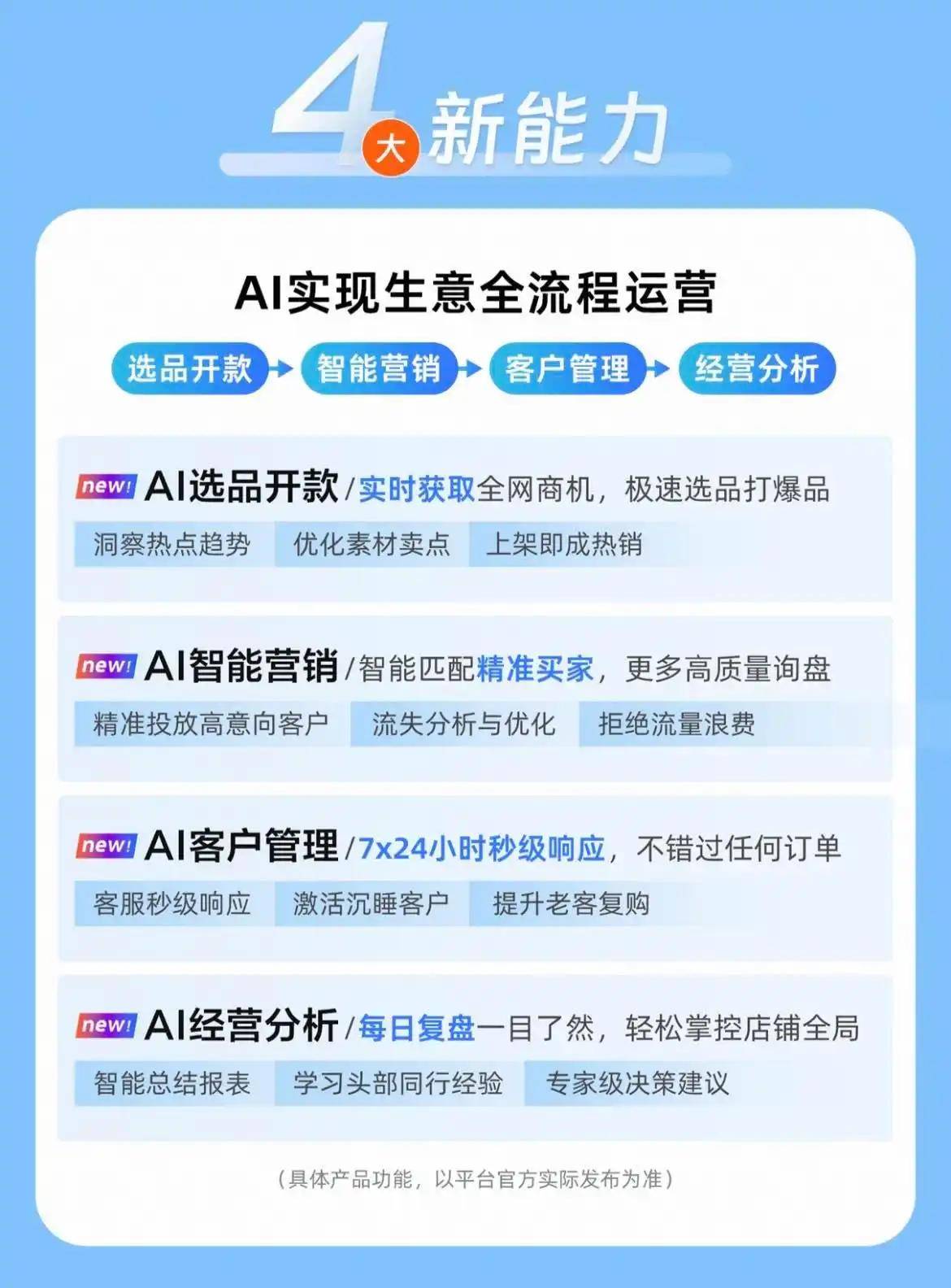
Core Insights - The article discusses the integration of AI in e-commerce, particularly highlighting Alibaba's "Integrity AI Version" on the 1688 platform, which aims to enhance operational efficiency for merchants [1][5][10] Group 1: AI Implementation in E-commerce - The year 2025 marks the end of the "Big Model War," with AI becoming a key player in e-commerce, as major companies like Amazon and Alibaba explore its applications [1] - The recent Tmall Double 11 event is noted as the first fully AI-integrated event, focusing on traffic distribution, consumer experience, and e-commerce operations [1] - The "Integrity AI Version" is designed to automate over 50% of daily operational tasks for merchants, acting as a professional "digital employee" [5][9] Group 2: Features and Benefits of "Integrity AI Version" - The platform offers capabilities in AI product selection, intelligent marketing, customer management, and operational analysis, significantly reducing operational costs and improving efficiency [5][10] - Merchants using the AI version have reported a reduction in team size from 5+ to 2, leading to a sharp decrease in operational costs [7] - Data indicates that merchants using AI for over six months experience a 30% reduction in operational costs and a 20% increase in inquiries and new buyers [9] Group 3: Market Dynamics and User Adoption - The platform has seen a 55% year-on-year growth in active buyers, with the number surpassing 100 million, making it the first ToB platform in China to reach this scale [9] - The diverse buyer base includes traditional retailers, social media influencers, and various new professional groups, enhancing the platform's attractiveness to merchants [9] - The "Integrity AI Version" lowers the entry barrier for new merchants, allowing them to compete effectively with established players [9][10]