
银行业

Search documents
时隔三年半重启工具,央行下调远期售汇风险准备金率释放了什么信号?
Di Yi Cai Jing· 2026-02-27 05:08
此次政策调整释放出支持实体经济、回归外汇政策中性的明确信号。权威市场专家认为,本次下调远期 售汇外汇风险准备金率,最直接的效果便是降低企业远期购汇成本。 远期售汇风险准备金率下调至0后,能够降低企业远期购汇成本,提高企业在购汇方向开展外汇套保的 积极性。 为进一步促进外汇市场健康发展,支持市场主体更好管理汇率风险,中国人民银行宣布,自2026年3月2 日起,将远期售汇业务的外汇风险准备金率从20%下调至0。 央行表示,下一步将继续引导金融机构优化对企业汇率避险服务,保持人民币汇率在合理均衡水平上的 基本稳定。 时隔近三年半,央行再次运用远期售汇风险准备金率工具。 上述权威专家认为,未来这两个比例有望进一步提高,也有利于保持汇率稳定。 该专家同时提醒,当前国际环境复杂多变,地缘政治冲突增多,都可能加剧全球外汇市场波动,并对人 民币汇率走势形成扰动。未来随着市场在汇率形成中发挥更大作用,人民币汇率可能有升有贬、双向浮 动。企业和金融机构不宜盲目跟风、赌汇率走势,要坚持汇率风险中性理念,做好汇率风险管理。 此前20%的准备金率要求,使得银行在开展远期售汇业务时需占用大量资金并承担相应成本,该部分成 本最终传导至企业 ...
央行大动作!外汇风险准备金率下调至0 企业远期购汇成本直降
2 1 Shi Ji Jing Ji Bao Dao· 2026-02-27 05:07
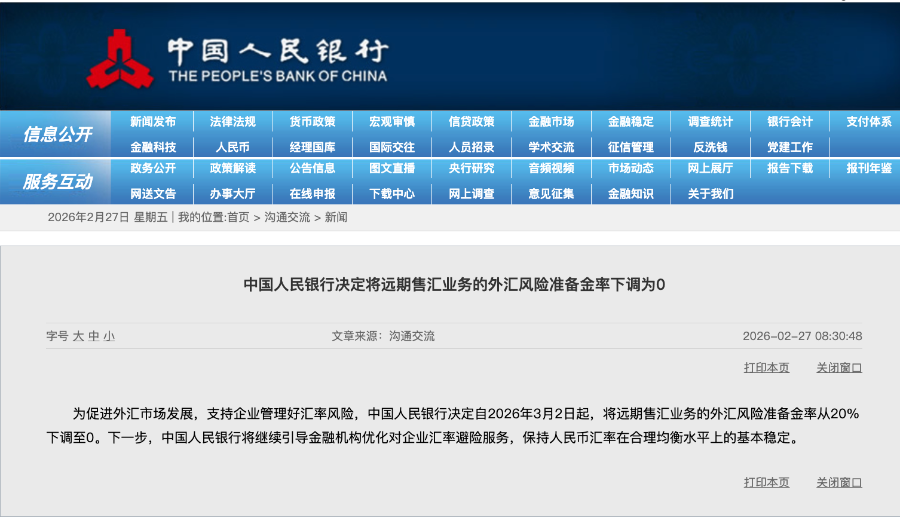
21世纪经济报道记者 唐婧 为促进外汇市场发展,支持企业管理好汇率风险,中国人民银行今日宣布,自2026年3月2日起,将远期售汇业务的外汇风险准 备金率从20%下调至0。 中国人民银行表示,下一步,将继续引导金融机构优化对企业汇率避险服务,保持人民币汇率在合理均衡水平上的基本稳定。 远期售汇业务,是银行对企业提供的一种汇率避险衍生产品。企业通过远期购汇能在一定程度上规避未来汇率风险,但由于企 业并不立刻购汇,而银行相应需要在即期市场购入外汇,这会影响即期汇率,进而又会影响企业的远期购汇行为。这种顺周期 行为易演变成"羊群效应"。 外汇风险准备金率被视为外汇市场"自动稳定器",本质上是一种价格手段,即通过影响汇率远期价格,调节远期购汇行为。一 般来说,当人民币贬值预期较强时,上调外汇风险准备金率;当人民币升值预期较强时,下调外汇风险准备金率。 分析人士告诉记者,下调远期售汇业务的外汇风险准备金率能够降低企业远期购汇成本,提高企业在购汇方向开展外汇套保的 积极性,也有利于支持企业合理运用外汇衍生产品管理好汇率风险。这是时隔近3年半央行再次使用该工具,本次下调远期售汇 风险准备金率实质上是合理退出前期措施,促进外汇 ...

节后中游持续回暖
Hua Tai Qi Huo· 2026-02-27 05:06
1. Report Industry Investment Rating - No information provided in the given content. 2. Core View of the Report - After the holiday, the mid - stream industry continued to recover. In the upstream, liquefied natural gas prices declined while international crude oil prices rose, and egg prices continued to fall. In the mid - stream, PX operating rate was at a high level, power plant coal consumption was at a high level, and road asphalt operating rate increased. In the downstream, the sales of commercial housing in first - and second - tier cities declined seasonally, and the number of domestic flights remained stable at a high level [1][3]. 3. Summary by Relevant Catalog Production Industry - Zimbabwe's Ministry of Mines announced a suspension of all exports of raw ore and lithium concentrate (including goods in transit). It is a phased measure, expected to resume within 1 to 4 weeks. Companies like Zhongkuang Resources and Yahua Group have sufficient raw material inventories, and the impact on production and operation is limited. Yahua Group is preparing to submit supplementary materials for export application, and Zhongkuang Resources estimates the ban may last less than a month, depending on the approval process [1]. Service Industry - The People's Bank of China issued a notice on RMB cross - border inter - bank financing business of banking financial institutions, supporting domestic banks to carry out RMB cross - border inter - bank financing business in line with market demand, with relevant management and risk control requirements [1]. Upstream - Energy: Liquefied natural gas prices declined, and international crude oil prices rose. - Agriculture: Egg prices continued to fall [3]. Mid - stream - Chemical: PX operating rate was at a high level. - Energy: Power plant coal consumption was at a high level. - Infrastructure: Road asphalt operating rate increased [3]. Downstream - Real Estate: The sales of commercial housing in first - and second - tier cities declined seasonally. - Service: The number of domestic flights remained stable at a high level [3]. Key Industry Price Indicators | Industry Name | Indicator Name | Frequency | Unit | Update Time | Current Value | Year - on - Year | Past 5 - day Trend | | --- | --- | --- | --- | --- | --- | --- | --- | | Agriculture | Spot price: Corn | Daily | Yuan/ton | 2/26 | 2278.6 | 0.19% | | | | Spot price: Egg | Daily | Yuan/kg | 2/26 | 6.1 | - 3.34% | | | | Spot price: Palm oil | Daily | Yuan/ton | 2/26 | 8650.0 | - 0.46% | | | | Spot price: Cotton | Daily | Yuan/ton | 2/26 | 16680.7 | 3.69% | | | | Average wholesale price: Pork | Daily | Yuan/kg | 2/26 | 17.9 | - 1.27% | | | Non - ferrous Metals | Spot price: Copper | Daily | Yuan/ton | 2/26 | 101981.7 | 0.62% | | | | Spot price: Zinc | Daily | Yuan/ton | 2/26 | 24450.0 | 0.03% | | | | Spot price: Aluminum | Daily | Yuan/ton | 2/26 | 23443.3 | 3.38% | | | | Spot price: Nickel | Daily | Yuan/ton | 2/26 | 143833.3 | - 1.01% | | | | Spot price: Aluminum | Daily | Yuan/ton | 2/26 | 16656.3 | - 0.22% | | | | Spot price: Rebar | Daily | Yuan/ton | 2/26 | 3138.7 | - 0.99% | | | Ferrous Metals | Spot price: Iron ore | Daily | Yuan/ton | 2/26 | 763.7 | - 2.27% | | | | Spot price: Wire rod | Daily | Yuan/ton | 2/26 | 3325.0 | - 1.26% | | | | Spot price: Glass | Daily | Yuan/square meter | 2/26 | 13.4 | 0.98% | | | Non - metals | Spot price: Natural rubber | Daily | Yuan/ton | 2/26 | 17000.0 | 3.61% | | | | China Plastic City Price Index | Daily | - | 2/26 | 784.4 | - 0.11% | | | | Spot price: WTI crude oil | Daily | US dollars/barrel | 2/26 | 74.4 | 4.11% | | | Energy | Spot price: Brent crude oil | Daily | US dollars/barrel | 2/26 | 70.7 | 4.69% | | | | Spot price: Liquefied natural gas | Daily | Yuan/ton | 2/26 | 2882.0 | - 12.45% | | | | Coal price: Coal | Daily | Yuan/ton | 2/26 | 798.0 | - 0.25% | | | | Spot price: PTA | Daily | Yuan/ton | 2/26 | 5319.4 | 2.06% | | | Chemical | Spot price: Polyethylene | Daily | Yuan/ton | 2/26 | 6736.7 | - 0.79% | | | | Spot price: Urea | Daily | Yuan/ton | 2/26 | 1830.0 | 2.38% | | | | Spot price: Soda ash | Daily | Yuan/ton | 2/26 | 1202.9 | 0.12% | | | | Cement price index: National | Daily | - | 2/26 | 129.5 | - 0.92% | | | Real Estate | Building materials composite index | Daily | Points | 2/26 | 113.8 | 0.03% | | | | Concrete price index: National index | Daily | Points | 2/26 | 89.8 | 0.00% | | [35]
赞比亚央行下调货币政策利率
Shang Wu Bu Wang Zhan· 2026-02-27 04:46
赞比亚国家电视台2月11日报道,赞比亚央行宣布将货币政策利率下调75 个基点至13.5%,这一决定基于2025年第四季度通胀水平持续回落、市场情绪 改善、评级上调、与国际货币基金组织达成协议以及采矿业外汇供应增加等因 素。 (原标题:赞比亚央行下调货币政策利率) ...
热搜第一!央行发公告
Nan Fang Du Shi Bao· 2026-02-27 04:30
(文章来源:南方都市报) 此消息发布后,迅速登上微博热搜第一。 2月27日,中国人民银行发布公告:为促进外汇市场发展,支持企业管理好汇率风险,中国人民银行决定自2026年3月2日起,将远期售汇业务的外汇风 险准备金率从20%下调至0。下一步,中国人民银行将继续引导金融机构优化对企业汇率避险服务,保持人民币汇率在合理均衡水平上的基本稳定。 ...
时隔三年半再次使用此工具 下调远期售汇风险准备金率有何意义?
Bei Ke Cai Jing· 2026-02-27 04:27
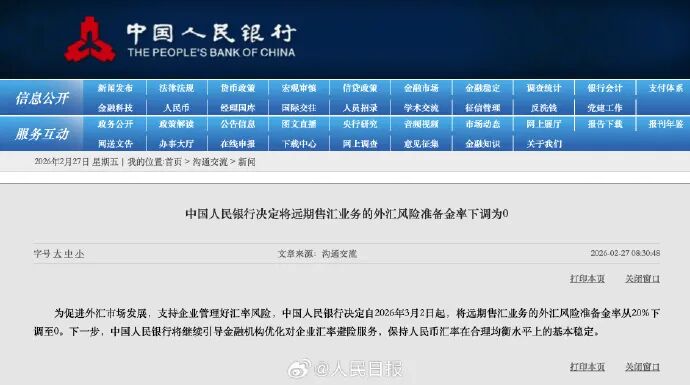
据央视新闻消息,今天(27日),中国人民银行发布公告,决定自2026年3月2日起,将远期售汇业务的 外汇风险准备金率从20%下调至0。 近期,人民币对美元汇率快速升值,在岸、离岸重返三年前高位。 那么此次调整,将会有哪些具体影响呢? 有助于降低企业远期购汇成本 央行宣布将远期售汇风险准备金率从20%下调至0,可以降低企业远期购汇成本,提高企业在购汇方向 开展外汇套保的积极性,也有利于支持企业合理运用外汇衍生产品管理好汇率风险。 当准备金率为20%时,银行每做一笔100美元的远期售汇业务,就需要向央行冻结20美元且没有利息的 资金,这会提高其远期购汇的价格。如今远期售汇业务的外汇风险准备金率从20%下调至0,意味着银 行不再需要为此冻结资金,远期购汇的成本将随之降低。 这是时隔近3年半央行再次使用该工具,本次下调远期售汇风险准备金率实质上是合理退出前期措施, 促进外汇政策回归中性。 此次下调远期售汇风险准备金率也是时隔三年半央行再次使用此工具,这一工具到底是什么?将有哪些 意义?来看解读。 什么是外汇风险准备金? 外汇风险准备金的概念可以追溯到2015年。"8·11"汇改后,人民币出现了较强的贬值预期。为稳定市 ...
高盛旗下一只私募信贷基金下调资产净值
Xin Lang Cai Jing· 2026-02-27 04:19
Core Viewpoint - Goldman Sachs' private credit fund has reduced its asset value by 0.9% in the fourth quarter due to lower expected returns from business development companies [1][2]. Group 1 - The net asset value per share of Goldman Sachs BDC has been adjusted from $12.75 to $12.64 [1][2].

36万亿美债还不起,特朗普决定弄死大债主,为此不惜“自曝家丑”调查美联储主席!美元霸权崩塌进行时
Sou Hu Cai Jing· 2026-02-27 04:11
Core Viewpoint - The article discusses the escalating tension between the Trump administration and the Federal Reserve, highlighting the political pressure exerted on the Fed regarding interest rates amidst a rapidly increasing national debt, which has significant implications for the U.S. economy and global financial stability [2][3][4][5]. Group 1: U.S. National Debt - The U.S. national debt has surged dramatically, exceeding $36 trillion by November 2025, with an average daily increase of $44.2 billion [3]. - Interest payments on the national debt reached $881 billion in the 2024 fiscal year, accounting for 3.1% of GDP, the highest since 1996 [3]. - By the first half of the 2025 fiscal year, interest payments had already reached $582.5 billion, becoming the second-largest government expenditure after Social Security [3]. Group 2: Trump's Economic Strategy - The "Big and Beautiful" strategy introduced by the Trump administration includes tax cuts, tariffs, and pressure on the Federal Reserve [4]. - The tax cuts are projected to reduce government revenue by approximately $4.5 trillion over the next decade, leading to an increase in the fiscal deficit by about $3.4 trillion [4]. - Tariffs on Chinese goods escalated significantly, with rates reaching as high as 125%, generating approximately $195 billion in tariff revenue for the fiscal year [5]. Group 3: International Response to U.S. Debt - Major foreign holders of U.S. debt, particularly China, have begun to reduce their holdings significantly, with China's holdings dropping to $683.5 billion by December 2025, a 42% decrease from its peak [6]. - Other countries, including Japan and the UK, have also reduced their U.S. debt holdings, indicating a broader trend of international investors losing confidence in U.S. debt sustainability [6]. Group 4: Shift to Gold - There has been a notable increase in global central bank gold purchases, with net purchases reaching 634 tons in the first three quarters of 2025, reflecting a strategic shift away from U.S. debt [7]. - The total value of global official gold reserves surged to $4.5 trillion, surpassing U.S. debt for the first time since 1996 [7]. Group 5: Decline of U.S. Dollar Credibility - The U.S. credit rating was downgraded by Moody's to Aa1, with all major rating agencies stripping the U.S. of its AAA rating due to excessive debt and political polarization [8]. - The "weaponization" of the dollar has raised concerns among countries about the risks of holding dollar-denominated assets, prompting a move towards using local currencies in international trade [8]. Group 6: Impact on Federal Reserve Independence - The Trump administration's public challenges to the Federal Reserve's independence, including threats against Chairman Powell, have undermined confidence in U.S. monetary policy [9]. - Following the announcement of Powell's criminal investigation, the dollar weakened while gold prices surged, indicating a flight from uncertainty [9].

符合中欧《共同分类目录》标准的中国存量绿色债券清单发布
Jing Ji Guan Cha Bao· 2026-02-27 04:00
Group 1 - The core viewpoint of the article is the release of a list of existing green bonds in China that meet the EU-China Common Classification Standards, aimed at enhancing the development of the green finance market and facilitating cross-border green capital flow [1] - A total of 9 green bonds were selected in the labeling work, with a total scale of 5.1 billion RMB, of which 6 bonds were certified as compliant with the Common Classification Standards at the time of issuance [1] - As of January 31, 2026, there are 526 green bonds in the interbank market that comply with the EU-China Common Classification Standards, with 307 of them currently active [1] Group 2 - The 307 active bonds represent 25.4% of all outstanding green bonds in the interbank market, with a total issuance scale of 347.35 billion RMB, accounting for 16.7% of the total outstanding green bonds [2] - The distribution of issuance scale by credit rating shows that AAA-rated bonds account for 93.3%, AA+ for 4.3%, AA for 0.1%, and unrated bonds for 2.2% [2] - The top three activities for which the raised funds are allocated include: D1.3 Wind Power Generation (24.4%), H1.1 Urban Public Transport System Construction and Operation (22.5%), and D1.5 Hydropower Generation (20.4%) [2]
央行下调远期售汇风险准备金率至零 助力企业汇率风险管理
Xin Lang Cai Jing· 2026-02-27 03:59
Group 1 - The People's Bank of China announced a reduction in the foreign exchange risk reserve ratio for forward foreign exchange sales from 20% to 0%, effective March 2 [1] - This is the first use of this tool by the central bank in nearly three and a half years, aimed at promoting a neutral return of foreign exchange policies [1] - Experts indicate that this move will lower the forward purchase costs for enterprises and enhance their willingness to engage in foreign exchange hedging [1] Group 2 - The reduction in the risk reserve ratio is expected to support enterprises in better managing exchange rate risks and utilizing foreign exchange derivatives [1] - The central bank's recent policies encourage financial institutions to improve their exchange rate hedging services for enterprises [1] - By 2025, it is anticipated that the hedging ratio for enterprises will increase to 30%, with nearly 30% of goods trade settled in RMB, reflecting an enhanced awareness and capability in exchange rate risk management [1] Group 3 - The current international environment is complex, with increasing geopolitical conflicts that may exacerbate fluctuations in the global foreign exchange market and impact the RMB exchange rate [1] - Future RMB exchange rates may experience both appreciation and depreciation, with a dual-directional floating mechanism [2] - The People's Bank of China will continue to guide financial institutions in optimizing exchange rate hedging services for enterprises, aiming to maintain the RMB exchange rate at a reasonable and balanced level [2]