
软件

Search documents
喜力拟裁员6000人,股价大涨4% 欧洲股市普遍走低
Xin Lang Cai Jing· 2026-02-11 12:54
Core Insights - The article focuses on the recent corporate earnings reports from various companies, highlighting significant financial updates and market reactions [1][11]. Group 1: Corporate Earnings Reports - Heineken announced plans to lay off 5,000 to 6,000 employees over the next two years due to a challenging market environment, while aiming for accelerated growth by 2030. The company reported a 1.2% decline in production for 2025 but a 4.4% increase in operating profit year-on-year, with a projected operating profit growth rate of 2% to 6% for 2026. Following this news, Heineken's stock rose by 4% in early trading [5][14]. - Dassault Systèmes experienced a significant stock drop of 19.6% after reporting flat annual revenue of €6.24 billion (approximately $7.43 billion), which fell short of market expectations. The software business revenue also showed weak growth at €5.64 billion [7][15]. - Siemens Energy reported a nearly threefold increase in net profit to €746 million (approximately $889 million) for the first quarter of fiscal year 2026, driven by strong demand from data center expansions, resulting in a 6% stock increase [8][16]. - Deutsche Bank announced record operating profit of €4.5 billion, with net profit reaching €2.6 billion, exceeding the target of €2.5 billion. However, the stock price fell by 4.2% despite the positive earnings report [9][17]. - Lufthansa's stock fell by 3.3% due to an impending 24-hour strike called by pilots over pension disputes [9][17]. Group 2: Market Reactions - European stock markets saw a slight decline, with the STOXX Europe 600 index down approximately 0.2%. However, the London FTSE 100 index rose by 0.3% as investors shifted towards mining and energy stocks amid risk-averse sentiment [4][13]. - Global investors are closely monitoring the upcoming U.S. non-farm payroll data, with U.S. stock futures rising as they await the report [10][18].



美国银行家称:软件股暴跌正扰乱部分并购与IPO交易
Xin Lang Cai Jing· 2026-02-11 11:46
Core Viewpoint - The significant sell-off in software stocks is causing a slowdown in M&A and IPO activities, with market volatility making valuations unreliable and potential buyers becoming more cautious [1][2][10]. Group 1: Market Conditions - Software stocks have experienced a substantial decline, with the S&P 500 Software and Services Index recording its worst three-month performance since May 2002 [1][2]. - Despite some recovery, the software sector is down approximately 25% from its historical peak on October 28, 2025, while the S&P 500 index has increased by 1% during the same period [1][2]. Group 2: Reasons for Slowdown - The sharp drop in software stocks has led to rapid fluctuations in valuation benchmarks, making it difficult for both buyers and sellers to agree on prices [2][10]. - Buyers are concerned about overpaying for assets that may depreciate further, while sellers are reluctant to sell at low prices [2][10]. Group 3: Impact on Transactions - The volatility has resulted in a challenging negotiation environment, with many transactions likely to be canceled or repriced in the coming weeks [11][12]. - Financial technology company Brex was valued at over $12 billion during a funding round in October but was acquired for approximately $5.15 billion, highlighting the impact of valuation reassessment [2][11]. Group 4: Broader Market Effects - The downturn in software stocks has extended to Europe, with companies like RELX and Wolters Kluwer seeing stock price declines of around 20% [12]. - The IPO market is particularly affected, with companies like Liftoff Mobile postponing their listing plans due to the current market environment [12]. Group 5: Emotional vs. Fundamental Drivers - Market volatility is perceived to be driven more by emotional responses and uncertainty rather than fundamental performance [13][14]. - Some industry leaders suggest that AI will empower rather than replace software, indicating a potential for recovery [13][14]. Group 6: Investor Sentiment - Certain investors are beginning to see buying opportunities, with private equity firms expressing interest in acquiring software companies [15][16]. - The message from these investors is clear: they are looking for the best acquisition targets in the current market [16].
美股下一个“AI受害者”已经出现,市场正在提前定价!
美股研究社· 2026-02-11 11:06
Core Viewpoint - The article discusses the recent internal rotation in the U.S. stock market, highlighting a shift from a few large-cap stocks leading the market to a broader participation across various sectors, while also addressing the impact of AI on traditional business models and the resulting market volatility [5][7][8]. Market Performance - On Tuesday, the S&P 500 fell by approximately 0.3%, while the Dow Jones Industrial Average rose by about 0.1%, reaching a new historical high [5]. - The equal-weighted S&P index also reached a record high, indicating a shift in market dynamics with around 300 stocks in the S&P 500 rising [7]. Retail Sales Data - The U.S. Commerce Department reported that December retail sales were flat month-over-month, significantly below the expected 0.4% growth, indicating a slowdown in consumer spending [9]. - Core retail sales, excluding autos and gas, even showed a decline, reflecting weakened consumer spending momentum during the holiday season [9]. Interest Rate Expectations - The weak retail data led to a rise in U.S. Treasury prices and a decline in yields, with the futures market increasing the probability of three rate cuts within the year, with two already priced in [9]. - Historical trends suggest that rate cut expectations typically support risk assets, but the current market shows a divergence where rates are falling but stocks are not rising, particularly in the tech sector [11]. AI Impact on Market Sentiment - Market participants are shifting their interpretation of AI's impact from a growth narrative to concerns about short-term disruptions, leading to a "sell first, think later" mentality [12]. - Investors are moving from an "AI is a panacea" mindset to a more pragmatic "performance realization" phase, anticipating greater differentiation between winners and losers in the market [12]. Institutional Perspectives - There is a noticeable divergence in institutional views on the tech sector, with Goldman Sachs warning about the risks of overestimating AI's growth potential and emphasizing the need for actual earnings and cash flow improvements to support tech valuations [13]. - UBS downgraded its rating on the U.S. tech sector from "overweight" to "neutral," citing key risks while still acknowledging the long-term potential of AI [14]. Wealth Management Sector - The wealth management sector has come under scrutiny following the launch of an AI tool by Altruist Corp., which automates tasks traditionally reliant on human expertise, raising concerns about the core revenue models of wealth management firms [17][18]. - The market reacted sharply, with significant declines in stocks of major wealth management firms, indicating fears about the long-term competitive structure of the industry under AI pressure [19][21]. Broader Market Reactions - The sell-off in the market has been attributed to fears that AI tools could undermine the intermediary value of insurance brokers, leading to a significant drop in the insurance brokerage sector [22]. - The recent downturn in the software sector has seen substantial market capitalization losses, with estimates indicating a combined loss of approximately $611 billion across software, financial services, and asset management sectors [26]. Conclusion - The current market environment reflects a transition from viewing AI as a beneficiary narrative to recognizing potential victims, with traditional software companies facing heightened scrutiny and volatility [27]. - The article suggests that this phase serves as a valuation and business model stress test, prompting a reevaluation of which revenue models are based on irreplaceable value versus those reliant on information asymmetry [34].






美国失业者看着账单崩溃:GDP创新高,我却连一份工作都找不到
Sou Hu Cai Jing· 2026-02-11 10:45
Economic Growth and Employment Disparity - The U.S. economy in 2026 is expected to experience high growth with low employment, characterized by a K-shaped recovery where growth benefits only a small segment of the population [1][7] - GDP growth is projected at approximately 2.8%, significantly higher than the market consensus of 2.0%, while the unemployment rate is expected to stabilize around 4.5% [1][4] Drivers of Economic Growth - The primary driver of growth is the surge in productivity driven by AI, which is expected to contribute nearly half of the GDP growth, contrasting with traditional labor expansion models [3][6] - Tax cuts from the "Inflation Reduction Act" are incentivizing companies to invest in technology and automation rather than hiring more employees, further enhancing the "machine replaces human" effect [3][6] Labor Market Dynamics - The labor supply is constrained due to immigration policy tightening and an aging population, leading to a significant decline in available workforce [5][6] - The demand side is also weak, as companies prioritize AI and automation over hiring, resulting in a low recruitment willingness and a potential "no job growth" phase [6][10] Sectoral and Regional Disparities - High-growth sectors such as AI, semiconductors, and renewable energy are thriving, while traditional industries like manufacturing and retail are struggling, leading to a concentration of high-skill jobs and a decline in low-skill positions [7][12] - The economic divide is further exacerbated by regional disparities, with tech and finance hubs on the coasts growing faster than traditional industrial areas [12] Long-term Economic Implications - The structural changes in the economy signify a shift towards a model where growth is driven by technology and capital, while employment opportunities are increasingly dependent on skills and luck [12] - The disconnect between economic growth and personal income is expected to persist, with the potential for a prolonged period of "no job growth" [10][12]

科技股疑虑盘旋,AI会否成为软件股的“屠龙刀”
2 1 Shi Ji Jing Ji Bao Dao· 2026-02-11 10:00
Core Viewpoint - The recent sell-off in US software stocks has ended, but concerns about the impact of AI on the software industry remain, leading to a divided market perspective on future valuations and investment opportunities [1][2]. Group 1: Market Performance and Reactions - After a significant decline, software stocks experienced a strong rebound, with the S&P 500 Information Technology Index down 0.58% and notable movements in individual stocks like Microsoft down 0.08% and Oracle up 2.11% [1]. - Year-to-date, Oracle's stock has dropped 18.3%, and Salesforce has retreated 23.72%, while the iShares North American Software ETF (IGV) has fallen 15% in January, marking its worst monthly performance since 2008 [1]. - The market has seen a net outflow of approximately $4.2 billion from the IGV over the past year, with Microsoft’s stock down 29.5% from its peak in October [1]. Group 2: Diverging Opinions on Software Stocks - UBS downgraded the rating of US IT stocks due to ongoing uncertainties in the software sector and increased capital expenditures, while Citigroup warned that software stocks have not yet fully bottomed out [2]. - Conversely, some analysts, like those from Wedbush, argue that the "software apocalypse" narrative is overly pessimistic, suggesting that AI will not broadly replace software applications [2]. - Experts believe that AI will not end the software industry but will reshape it, with companies closer to AI likely to thrive while others may struggle [2]. Group 3: AI's Impact on Software Valuation - The launch of AI tools by companies like Anthropic has raised fears that subscription software may become obsolete, leading to a significant market sell-off that saw software stocks lose $830 billion in value within a week [3]. - The forward P/E ratio for European software and IT service companies is currently around 16.8 times, reflecting a mere 9% premium over the broader market, nearing levels seen during the 2009 financial crisis [3]. Group 4: Future Outlook and Structural Changes - Analysts predict a structural divide in the software industry, where subscription-based companies may face pressure, while usage-based companies could benefit from increased demand driven by AI [7][8]. - Companies that successfully adapt to AI and leverage data effectively are expected to continue growing, while those unable to adjust may face significant challenges [8]. - The current P/E ratio for software stocks has dropped from over 50 to around 30, leading some analysts to suggest that certain stocks, like Microsoft and Palantir, are now attractive buying opportunities [8].
华尔街新交易逻辑:抛售处于AI冲击范围内的股票
Xin Lang Cai Jing· 2026-02-11 09:52
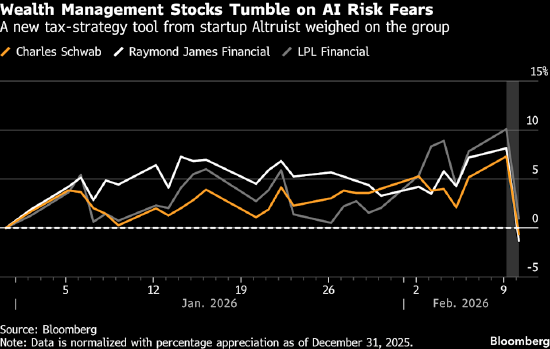
Core Viewpoint - Concerns about artificial intelligence (AI) are escalating on Wall Street, leading to significant sell-offs across various sectors, particularly in companies perceived to be at risk of disruption by AI technologies [1][14]. Group 1: Market Reactions - A recent sell-off was triggered by the launch of a tax strategy tool by Altruist Corp, resulting in stock price declines of over 7% for major financial firms like Charles Schwab and Raymond James [1][14]. - The sell-off extended to European wealth management firms, with companies like AJ Bell and St. James's Place experiencing simultaneous declines [1][14]. - This downturn is noted as one of the most significant since the market turmoil in April, reflecting a "sell first, ask questions later" mentality among investors [1][14]. Group 2: Investor Sentiment - Investors are shifting focus from identifying potential winners to avoiding any companies that exhibit even a slight risk of being replaced by AI [4][17]. - The narrative around AI has evolved from skepticism about its practical applications to a recognition of its disruptive potential, as evidenced by the rapid deployment of powerful AI tools [6][20]. - The market's reaction indicates a heightened sensitivity to negative news, with stock prices plummeting by 10% on minor adverse signals, a phenomenon unlikely to occur in markets with lower valuations [27]. Group 3: Industry Implications - The software industry has been particularly affected by AI-related anxieties, with fears spreading to other sectors such as finance, insurance, and legal services following the introduction of new AI tools [8][21]. - Altruist's CEO noted the unexpected market reaction, which resulted in the evaporation of billions in market value for several investment firms, highlighting the competitive threat posed by their new product [22][21]. - The architecture used to develop Altruist's tool is perceived as capable of replacing roles within the wealth management industry, suggesting a significant shift in operational dynamics [10][24]. Group 4: Future Outlook - Experts express uncertainty about the future impact of AI, with some suggesting that the actual disruption may occur more slowly than anticipated [25][26]. - The current market environment reflects a broader anxiety about the sustainability of high valuations driven by AI investments and the resilience of the U.S. economy [27][12]. - The ongoing developments in AI are still in their infancy, and making definitive predictions about their long-term effects remains challenging [13][12].
科技股疑虑盘旋 AI会否成为软件股的“屠龙刀”|美股一线
2 1 Shi Ji Jing Ji Bao Dao· 2026-02-11 09:51
Core Viewpoint - The recent sell-off in U.S. software stocks has ended, with a mixed performance observed in the sector, raising questions about the impact of AI on software companies and their long-term revenue potential [1][2][4]. Group 1: Market Performance - Software stocks experienced a significant decline, with the S&P 500 Information Technology Index falling by 0.58% and notable individual stock movements, such as Microsoft down 0.08% and Oracle up 2.11% [1]. - Year-to-date, Oracle's stock has dropped by 18.3%, and Salesforce has retreated by 23.72%, while the iShares North American Software ETF (IGV) has seen a cumulative decline of 15% in January, marking its worst monthly performance since 2008 [1]. - The market capitalization of U.S. software stocks plummeted by $830 billion within a week due to fears surrounding AI's impact on traditional software subscriptions [3]. Group 2: Analyst Opinions - UBS downgraded the rating of U.S. IT stocks, citing ongoing uncertainty in the software industry and increased capital expenditures, while Citigroup warned that software stocks have not yet fully bottomed out [2]. - Contrarily, some analysts, like those from Wedbush, argue that the "software apocalypse" narrative is overly pessimistic, suggesting that AI will not broadly replace software applications [2]. - Experts believe that AI will not end the software industry but will reshape it, with companies closer to AI potentially thriving while others may struggle [2][6]. Group 3: AI Impact on Software Industry - The introduction of AI tools, such as Anthropic's Claude Cowork, has raised concerns that traditional software subscriptions may become obsolete, leading to a reevaluation of software companies' revenue models [3][4]. - Analysts predict a structural division within the software industry, where subscription-based companies may face challenges, while usage-based companies could benefit from increased demand driven by AI [7][8]. - The market is witnessing a potential bifurcation, with companies that successfully adapt to AI and leverage data advantages likely to continue growing, while those unable to do so may face obsolescence [8][9]. Group 4: Future Outlook - Despite the recent downturn, some analysts believe that software stocks may now present attractive buying opportunities, with the IGV's price-to-earnings ratio dropping from over 50 to around 30 [8]. - Companies like Microsoft and Oracle, supported by diverse business units beyond software, may still find a place in the AI era, although overall valuations in the software sector remain high [9]. - There is a cautionary note regarding industries with high standardization, such as basic programming and low-barrier SaaS tools, which may face significant efficiency challenges and profit compression due to AI advancements [9].
AI淘金热变成AI恐慌潮!华尔街新共识:躲开一切可能被颠覆的公司
华尔街见闻· 2026-02-11 09:15
Core Viewpoint - The investment logic on Wall Street is undergoing a significant transformation, with investors rapidly selling stocks of companies that may be disrupted by AI, rather than focusing on identifying AI winners [3][4]. Group 1: Market Reactions - A recent sell-off was triggered by the launch of Altruist Corp.'s tax strategy tool, Hazel, which caused major wealth management companies like Charles Schwab and Raymond James Financial to see stock declines of over 7%, marking the largest drop since the market crash in April [4]. - The panic began when Anthropic introduced a new tool, leading to a deep correction across software, financial services, asset management, and legal services sectors [5][7]. - The insurance brokerage industry was also affected, with stocks plummeting after Insurify launched a ChatGPT-based application for comparing auto insurance rates [7]. Group 2: Industry Impact - Altruist's Hazel tool highlights the market's deep anxiety regarding AI's potential to disrupt traditional financial services, as it can perform tasks that typically require an entire team for just $100 a month [6][7]. - The fear of AI disruption has spread from the software industry to broader sectors, indicating a significant shift in market sentiment [5][7]. Group 3: Diverging Opinions - Despite the prevailing panic, some market participants question the speed and extent of AI disruption, suggesting that technological upheaval often takes longer than anticipated [10][11]. - Concerns about AI's impact on various industries may be premature, as the market is still in the early stages of understanding AI's long-term implications [12]. Group 4: Market Sensitivity - The current sell-off reflects a general anxiety over high valuations in the market, which have been driven by a surge in AI spending and unexpected economic resilience [13]. - In a highly sensitive market environment, even minor negative signals can lead to significant stock declines, as investors prefer to err on the side of caution regarding potential AI disruptions [13].


华尔街新交易策略:抛售处于AI冲击范围内的股票
Xin Lang Cai Jing· 2026-02-11 09:08
Core Viewpoint - Concerns about artificial intelligence (AI) are escalating on Wall Street, leading to significant stock sell-offs across various companies, from small software firms to large wealth management firms [1][3][9]. Group 1: Market Reactions - A recent sell-off was triggered by the launch of a tax planning tool by the startup Altruist, causing stocks of companies like Charles Schwab, Raymond James Financial, and LPL Financial Holdings to drop by 7% or more [1][4]. - The sell-off extended to Europe, impacting wealth management companies such as AJ Bell, Brewin Dolphin, and St. James's Place [1][3]. - This decline is noted as one of the most severe since the market downturn in April due to trade tensions, reflecting a "sell first, ask questions later" mentality among investors [1][7]. Group 2: Industry Impact - The software industry has been particularly affected, with companies like Dassault Systemes experiencing a 20% drop in stock price following disappointing earnings reports [3][9]. - The introduction of AI tools by companies like Anthropic has led to widespread declines in stocks across software, financial services, asset management, and legal services sectors [3][9]. - The insurance sector also faced significant stock declines after Insurify launched a new application utilizing ChatGPT for comparing auto insurance rates [4][10]. Group 3: Investor Sentiment - Investors are shifting from selecting potential winners in the AI space to avoiding any companies perceived to be at risk of being replaced by AI technologies [3][9]. - The CEO of Graniteshares expressed uncertainty about future developments, indicating a shift in sentiment from optimism about AI to fear of its disruptive potential [3][9]. - Concerns about the sustainability of stock valuations have intensified, with market participants reacting sharply to any negative signals [11].
法国软件股达索系统一度大跌20% 公司Q4业绩及展望均不及预期
Mei Ri Jing Ji Xin Wen· 2026-02-11 08:53
每经AI快讯,2月11日,法国软件股达索系统(Dassault Systemes SE)在巴黎一度暴跌20%至17.92欧 元,这是该股2002年9月25日以来最大的盘中跌幅。该公司周三表示,第四季度营收为16.8亿欧元(约 合20亿美元),同比下降4.1%,低于分析师平均预期的17.4亿欧元。该公司预计2026年非国际财务报告 准则收入将增长3%至5%,同样低于预期。 ...