
地产

Search documents
A股早评:沪指微跌0.02%,半导体板块回调,寒武纪低开6.8%
Ge Long Hui· 2025-08-29 01:41
盘面上,部分脑机接口概念股高开,麒盛科技、汉威科技涨超4%,我国完成全球首个脑机接口肿瘤定 位临床试验;地产股普涨,张江高科、万通发展涨超4%;建筑材料板块高开,国际复材高开超6%创新 高,中国巨石涨停,上半年净利润同比增长75.51%;半导体板块回调,寒武纪低开6.8%,预计2025年 全年实现营业收入50亿元至70亿元。(格隆汇) A股开盘,三大指数涨跌不一,沪指低开0.02%,深证成指低开0.02%,创业板指高开0.03%。 ...

A股大牛市:波动与应对
Guotou Securities· 2025-08-28 12:33
Core Insights - The report discusses the historical patterns of A-share bull markets, highlighting that each bull market typically experiences two significant waves of volatility, with an average duration of 20-40 trading days and a pullback range of 10%-20% [1][7] - The adjustments during these bull markets are primarily influenced by liquidity and sentiment rather than fundamentals, with concerns over market overheating, regulatory tightening, and external risks temporarily interrupting the bull market progression [1][7] - The report categorizes bull market volatility into four types based on their driving factors: institutional dividend and profit-driven bull, policy-driven recovery bull, liquidity and leverage bull, and liquidity-driven bull transitioning to fundamental bull [1][11][25][39] Group 1: Institutional Dividend and Profit-Driven Bull (2005-2007) - This bull market was characterized by stock reform and macroeconomic prosperity, leading to a "Davis Double Play" effect, with volatility primarily stemming from concerns over market bubbles and monetary tightening [11][19] - The first wave of volatility was triggered by fears of excessive "hot money" and rising inflation, leading to a rotation from large-cap value stocks to small-cap growth stocks [11][19] - The second wave of volatility, known as the "530 Stock Disaster," resulted in a shift towards defensive sectors and large-cap stocks after a significant tax increase on stock transactions [19][20] Group 2: Policy-Driven Recovery Bull (2008-2009) - This bull market was fueled by a massive stimulus plan, with volatility arising from skepticism about policy effectiveness and external economic factors [25][29] - The first wave of volatility was marked by doubts regarding the impact of the "Four Trillion" plan and the ongoing global financial crisis, yet there was no significant style rotation during this period [25][29] - The second wave of volatility was influenced by a downturn in overseas markets, but the dominant sectors remained cyclical and manufacturing without major style shifts [29][35] Group 3: Liquidity and Leverage Bull (2014-2015) - This bull market lacked fundamental support, relying heavily on leverage and reform expectations, with volatility driven by regulatory actions on margin trading [39][43] - The first wave of volatility was initiated by the China Securities Regulatory Commission's crackdown on margin trading, leading to a shift from large financial stocks to growth sectors [39][43] - The second wave of volatility saw renewed regulatory focus on curbing excessive leverage, prompting a rotation back to growth stocks from value stocks [39][51] Group 4: Liquidity-Driven Bull Transitioning to Fundamental Bull (1999-2001) - This period began with a technology-driven bull market fueled by internet speculation and increased liquidity, followed by a transition to a fundamental bull market supported by rising energy prices [55][60] - The initial liquidity-driven phase faced economic slowdowns and deflationary pressures, leading to concerns about growth sustainability [55][60] - The transition to a fundamental bull market was marked by a gradual recovery in economic indicators and a shift in market focus towards cyclical sectors as the economy stabilized [60][62]
大金融集体回撤,白酒、地产哎呢调整,AI芯片逆势爆发
Ge Long Hui· 2025-08-28 10:51
Market Performance - The Shanghai Composite Index rose by 0.33%, the Shenzhen Component Index increased by 1.34%, and the ChiNext Index surged by 2.41% by midday [1] - Over 3000 stocks declined across both markets, with a total trading volume of 1.73 trillion yuan [1] Sector Highlights - AI chip stocks experienced a strong surge, with an increase of 4.71% by midday, including nearly 10 stocks hitting the daily limit [3] - CPO and other computing hardware stocks collectively rose, with several stocks like Xinyisheng reaching historical highs [3] - Rare earth permanent magnet stocks were active, with Beikang Technology hitting the daily limit [3] - Real estate stocks underwent adjustments, with Shen Shen Fang A hitting the daily limit down [3] - The liquor sector opened lower and fell by 1.29% by midday, with stocks like Luzhou Laojiao and Shanxi Fenjiu declining over 3% [3] - Major financial sectors retreated, with banks and insurance leading the declines, followed by coal and poultry sectors [3] Economic Indicators - In July, the total electricity consumption reached 10,226 billion kilowatt-hours, marking an 8.6% year-on-year increase [3] - The State Council issued opinions on the deep implementation of the "AI+" initiative, aiming for over 70% penetration of new intelligent terminals and intelligent bodies by 2027 [3] - Northern Rare Earth achieved operating revenue of 18.866 billion yuan in the first half of the year, reflecting a year-on-year growth of 45.24% [3]


广发证券:后市布局看好四大方向
Zhong Guo Zheng Quan Bao· 2025-08-27 20:18
Core Viewpoint - The recent market trend is characterized by a "high growth narrative," where industries or sectors with high growth potential are performing exceptionally well [1][2]. Group 1: Macroeconomic Analysis - The recent rally in A-shares is driven by factors such as narrow liquidity easing and the appreciation of the RMB against the USD [1]. - Since September 2024, the central bank has implemented two reserve requirement ratio cuts, contributing to a relatively loose narrow liquidity environment [1]. - The depreciation of the USD since April has led to a favorable performance of emerging market currencies, with the RMB showing a one-sided upward trend against the USD [1][2]. Group 2: Market Trends and Asset Performance - As of August 27, the Wind micro-index has surged over 56% this year, outperforming major indices like the Shanghai Composite Index and Shenzhen Component Index [2]. - The trend of small-cap stocks outperforming continues, reflecting a diverse industrial landscape [2][3]. Group 3: Investment Opportunities - The market is expected to have limited downside risk, supported by the central bank's commitment to provide sufficient re-lending support when necessary [3]. - Key investment directions include: 1. Non-bank financial sectors, including financial IT, brokerage, and insurance [3]. 2. A-share real estate chain and Hong Kong real estate sectors from a low-position perspective [3]. 3. Overseas computing power chains and innovative pharmaceuticals [3]. 4. Domestic AI infrastructure and applications, which are still in the process of industrial expectation recovery [3].

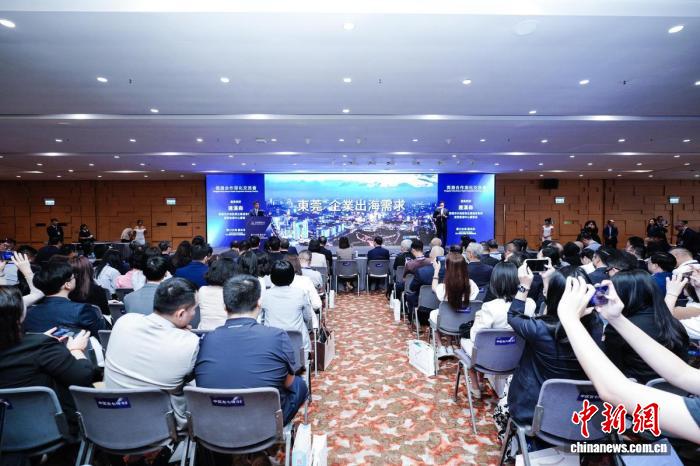
莞港合作深化交流会在港举行 助力企业出海迎新机遇
Zhong Guo Xin Wen Wang· 2025-08-27 14:11
Group 1 - The "Dongguan-Hong Kong Cooperation Deepening Exchange Conference" was held in Hong Kong, focusing on new opportunities for enterprises to go global [1][3] - The conference highlighted the long-standing cooperation between Hong Kong and Dongguan, exemplified by the Hong Kong International Airport Dongguan Air Cargo Center, which enhances logistics efficiency [2] - Dongguan has over 220,000 manufacturing enterprises, with more than 1,000 expressing a clear intention to expand internationally, targeting Southeast Asia, the Middle East, and Europe [2] Group 2 - A key event of the conference was the "Together Going Global" strategic signing ceremony, where various organizations signed agreements to establish a joint service platform for enterprises [3] - Institutions such as Standard Chartered Bank, CBRE, KPMG, and others committed to providing comprehensive professional support in finance, real estate, taxation, and legal services [3]
A股后市怎么看?券商秋季策略会来了
Zhong Guo Zheng Quan Bao· 2025-08-27 12:32
Group 1 - The recent market shows a distinct "high growth narrative" characteristic, with industries or sectors that exhibit high growth performing notably better [2][3] - The A-share market's main line remains focused on growth-oriented assets, with a positive outlook on non-bank financials, A-share real estate chain, Hong Kong real estate sector, overseas computing power chain, innovative pharmaceuticals, domestic computing power, AI infrastructure, and AI edge applications [2][3] Group 2 - Since early April, the A-share market has experienced a significant upward trend, driven by factors such as narrow liquidity easing and the appreciation of the RMB [2] - As of August 27, the micro-cap stock index has surged over 56% this year, outperforming major indices like the Shanghai Composite Index, Shenzhen Component Index, and ChiNext Index [3] - The trend of small-cap style dominance continues, supported by the diverse performance of industries, with limited downside risks in the A-share market [3]
两个3万亿,气质大不同!
Di Yi Cai Jing· 2025-08-27 08:00
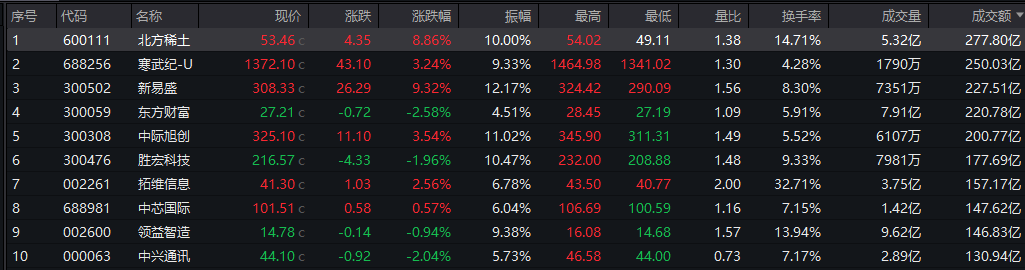
Group 1 - The A-share market experienced a record trading volume of 3.2 trillion yuan on August 27, marking the first time in history that the market saw two trading days with over 3 trillion yuan in volume within a week [1] - Major indices faced significant volatility, with the Shanghai Composite Index closing down 1.76% at 3800.35 points, the largest single-day drop since April 7 [1] - Technology stocks led the market rally, with notable performances from companies like Cambricon (688256.SH), which saw its stock price surge to 1464 yuan before closing at 1372 yuan, a 3.24% increase [1] Group 2 - On August 25, the market saw a broad-based rally with over 3300 stocks rising, driven by technology, non-ferrous metals, liquor, satellite internet, and rare earth sectors [2] - In contrast, on August 27, only 600 stocks closed in the green, with a significant increase in trading volume during the afternoon session, highlighting a shift in market dynamics [2] - The technology sector remained strong despite market fluctuations, with NewEase (300502.SZ) closing up over 9%, surpassing a total market capitalization of 300 billion yuan [2]


A股收评:沪指冲高回落跌1.76% 超4700股下跌
2 1 Shi Ji Jing Ji Bao Dao· 2025-08-27 07:50
市场午后跳水回落,沪指、深成指双双跌超1%。截至收盘,沪指跌1.76%,深成指涨1.43%,创业板指跌0.69%。 稀土永磁概念股表现活跃,北矿科技涨停。 从板块来看,CPO等算力硬件股维持强势,新易盛等多股再创历史新高。 芯片股一度冲高,瑞芯微涨停。 | 序号 | 代码 | 名称 | 现价 | 涨跌 | | 振幅 | 最高 | 最低 | 量比 | 换手率 | 成交量 | 成交额 ▼ | | --- | --- | --- | --- | --- | --- | --- | --- | --- | --- | --- | --- | --- | | 1 | 600111 | 北方稀土 | 53.46 c | 4.35 | 8.86% | 10.00% | 54.02 | 49.11 | 1.38 | 14.71% | 5.32亿 | 277.80亿 | | 2 | 688256 | 寒武纪-U | 1372.10 c | 43.10 | 3.24% | 9.33% | 1464.98 | 1341.02 | 1.30 | 4.28% | 1790万 | 250.03亿 | | 3 | 300502 | 新易監 ...


超级主线迎来重要消息
Mei Ri Jing Ji Xin Wen· 2025-08-27 04:28
Market Overview - The A-share market showed mixed performance with the Shanghai Composite Index and ChiNext Index down by 0.39% and 0.75% respectively, while the Shenzhen Component Index rose by 0.26% [1] - The total trading volume in the Shanghai and Shenzhen markets reached 26,790 billion, a significant decrease of 4,621 billion compared to the previous day [1] - A total of 2,804 stocks rose while 2,470 stocks fell, with a median increase of 0.11% for individual stocks [1] Market Trends - Recent market adjustments were anticipated, with historical analysis indicating minor fluctuations before significant breakthroughs at key resistance levels [1][2] - Defensive sectors such as liquor and real estate have started to strengthen, potentially curbing speculative market sentiment [2] - A shift in speculative focus from stocks with 20% daily limits to those with 10% limits suggests a possible change in market style [2][3] AI Sector Insights - Major AI stocks have experienced corrections, with several companies like Cambricon and Industrial Fulian seeing declines exceeding 4% [5] - The recent downturn in AI stocks is viewed as a normal adjustment after significant gains, with the sector still considered a key focus for future growth [6] - The State Council's recent policy document outlines ambitious goals for AI integration across various sectors by 2027, with expectations for substantial growth in the smart economy [6][7] Investment Strategy - The current bull market is widely accepted, but the rapid rise of small-cap stocks necessitates a controlled pace to sustain the market's upward trajectory [2][4] - Investors are advised to make minor adjustments to their portfolio structures rather than drastic changes in overall positions, focusing on sector-specific movements [4][7] - The military trade sector is experiencing declines, but stocks with commercial space logic may still present opportunities for further research [7]
市场震荡分化,创业板指半日涨2.41%,芯片股再度爆发
Feng Huang Wang Cai Jing· 2025-08-27 03:45
Market Overview - The market experienced fluctuations with the ChiNext leading gains, and the STAR 50 Index rising over 4% [1] - As of the midday close, the Shanghai Composite Index increased by 0.33%, the Shenzhen Component Index rose by 1.34%, and the ChiNext Index gained 2.41% [1] - The total trading volume in the Shanghai and Shenzhen markets reached 1.73 trillion yuan, an increase of 48.3 billion yuan compared to the previous trading day [1] Sector Performance - Key sectors showing strong performance included semiconductor, CPO, AI glasses, and rare earth permanent magnet stocks, while sectors like liquor, coal, insurance, and poultry farming saw declines [3] - Notable stocks in the computing power hardware sector surged, with companies like New Yi Sheng reaching historical highs [2] - Chip stocks also saw a resurgence, with Longchuan Technology hitting the daily limit [2] Market Sentiment - The market sentiment indicated a high level of activity, with over 3,000 stocks declining, while the number of stocks hitting the daily limit was 53 [5] - The limit-up rate was recorded at 68%, with a profit rate of 59% [4]

