
电子

Search documents
段永平、李录1500亿持仓曝光:段永平大笔加码AI,谷歌占李录近半组合
Ge Long Hui· 2026-02-25 05:57
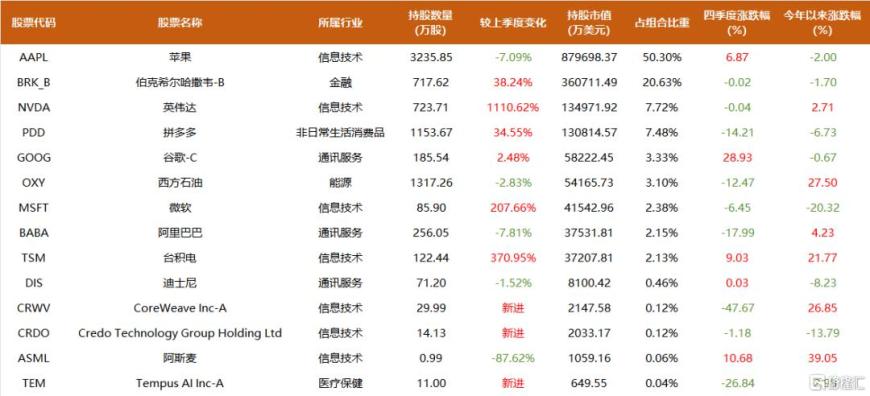
Core Insights - The 13F reports for Q4 2025 from renowned investors Duan Yongping and Li Lu reveal their latest investment strategies, highlighting a shift towards AI and technology sectors [1][3]. Group 1: Duan Yongping's Investment Strategy - Duan Yongping's H&H International Investment has a total market value of approximately $17.49 billion, equivalent to over 120.4 billion RMB [2][8]. - In Q4, Duan reduced his stake in Apple by about 247 million shares, a decrease of approximately 7.1%, yet Apple remains his largest holding, constituting 50.3% of the portfolio [10][12]. - Significant increases were noted in his holdings of Nvidia, with an addition of 6.64 million shares, representing a staggering 1110% increase, making it the third-largest position at 7.72% of the portfolio [15][20]. - Duan also increased his positions in Berkshire Hathaway and Google, indicating a strategic pivot towards AI capabilities and applications [13][20]. - New investments in AI-related companies such as CoreWeave, Credo, and Tempus reflect a proactive approach to capitalize on the AI-driven future [18][20]. Group 2: Li Lu's Investment Strategy - Li Lu's Himalaya Capital Management has a total market value of approximately $3.57 billion, equivalent to 246 billion RMB, with a highly concentrated portfolio of 9 stocks [3][21]. - His primary holding remains Alphabet (Google), which accounts for over 43% of his total portfolio, showcasing a strong belief in the company's growth potential [23][27]. - Li made a notable entry into Crocs, acquiring 628,000 shares, which aligns with his focus on brands with strong market presence and cash flow [24][25]. - The portfolio also includes significant positions in traditional financial stocks, reflecting a value investment approach focused on stable cash flows [30]. Group 3: Comparative Analysis - Both investors exhibit a shared interest in Pinduoduo, with Duan increasing his stake and Li maintaining a significant position, indicating a consensus on the company's potential [28][29]. - While Duan emphasizes a more aggressive strategy in AI investments, Li appears to favor a more conservative approach, focusing on established companies like Google for AI exposure [27].




特朗普对华失去重要筹码,日本却被坑惨,高市将登门送上大礼
Sou Hu Cai Jing· 2026-02-25 04:28
Core Viewpoint - The recent U.S. Supreme Court ruling has significantly impacted U.S. trade policy, particularly undermining the legal basis for the Trump administration's tariffs against China, which were deemed unlawful [1][3]. Group 1: U.S. Trade Policy Changes - The Supreme Court's decision restricts the President's ability to impose tariffs without Congressional approval, marking a critical institutional constraint on Trump's trade practices [3]. - Following the ruling, the Trump administration quickly reinstated a global uniform tariff of 15% under the Trade Act of 1974, indicating a shift in strategy despite the legal setback [1][10]. Group 2: China's Response and Position - China has demonstrated resilience and a mature response to U.S. tariff threats, maintaining a principle of rationality and countermeasures to protect its national interests [5][6]. - The Supreme Court ruling has alleviated the tariff pressure on China, allowing it to transition from a reactive to a proactive stance in the U.S.-China trade negotiations [8]. Group 3: Impact on Global Trade Dynamics - The new tariff measures have uneven impacts on global economies, with the EU managing to mitigate losses through retaliatory tariffs and legal actions, while Japan faces significant economic damage due to its previous concessions to the U.S. [10]. - Japan's reliance on the U.S. has been highlighted as a critical vulnerability, as the recent tariff changes have rendered its prior concessions ineffective, leading to substantial economic repercussions [10]. Group 4: Broader Implications for Global Trade - The U.S. trade policy reflects a broader instability in the post-Cold War global trade order, with unilateral actions undermining multilateral trade systems and global supply chains [10][11]. - China's commitment to multilateralism and free trade is positioned as a counter to U.S. unilateralism, emphasizing the importance of strategic autonomy and fair cooperation in the evolving international landscape [11].

春节假期消费观察|消费旺、出游火、年味足 亮眼数据彰显新年“开门红”
Yang Shi Wang· 2026-02-25 04:18
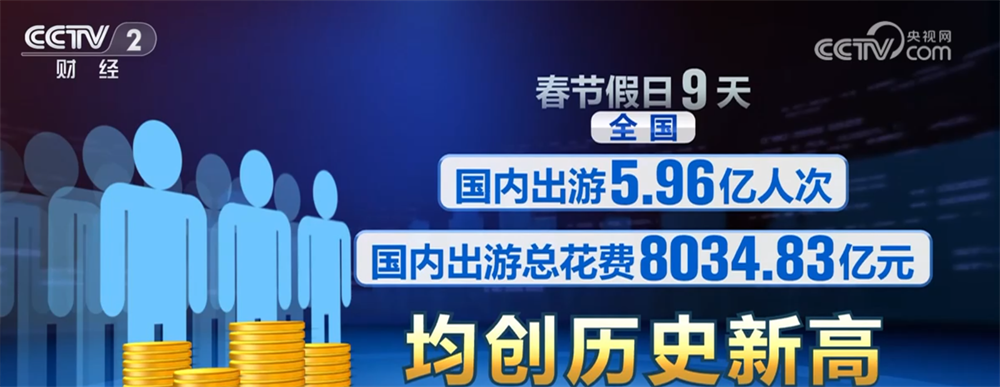
Group 1: Travel and Tourism Data - During the Spring Festival holiday, a total of 596 million domestic trips were made in China, with total spending reaching 803.48 billion yuan, both figures marking historical highs [1] - The average daily number of trips during the Spring Festival increased by 3.5% compared to the previous year, with significant growth in cultural and traditional tourism [16] - In Shenzhen, over 10.54 million tourists were received, a 17.9% increase from the previous year, generating tourism revenue of 11.845 billion yuan, up 19.8% [8][10] Group 2: Payment and Consumption Trends - During the 2026 Spring Festival, UnionPay and Wanglian processed 39.302 billion transactions amounting to 13.12 trillion yuan, with daily transaction volume and amount increasing by 37.45% and 19.26% respectively compared to 2025 [3] - WeChat Pay reported over 20% year-on-year growth in offline transactions for travel and entertainment during the Spring Festival [5] - Alipay noted a nearly 90% increase in transaction volume from foreign tourists in China, with spending up over 80% compared to the previous year [7] Group 3: Regional Highlights - In Hubei, over 22.8 million tourists visited 600+ A-level tourist attractions, a 28.27% increase from 2025, with popular sites like Yellow Crane Tower and Wudang Mountain seeing significant visitor numbers [22] - Shanghai received 21.67 million tourists, a year-on-year increase of 8.36%, with total tourism consumption reaching 25.614 billion yuan, up 20.9% [18] - In Chongqing, over 2,000 promotional consumption activities were organized, leading to a 7.8% increase in total consumption, with retail sales and nighttime consumption also showing growth [20] Group 4: Emerging Consumer Trends - The trend of "reverse reunion" saw a significant increase, with young adults bringing their parents to major cities for the holiday, particularly in first-tier cities like Beijing and Shanghai [21] - County-level hotels experienced a surge in bookings, with occupancy rates increasing over 60% in non-tourist areas, driven by returning young people [24] - New consumption habits emerged, with a notable interest in purchasing technology products and gold jewelry during the Spring Festival [10][14]
成长的力量-TMT中小盘每周观点电话会议
2026-02-25 04:13
Summary of Conference Call Records Industry and Company Involved - The conference call primarily discusses the semiconductor industry, specifically focusing on storage, PCB (Printed Circuit Board), and AI-related sectors. - Key companies mentioned include C1 Technology, Su Ning International, and various passive component manufacturers. Core Points and Arguments 1. **Investment Recommendations in Storage and PCB Sectors** - The company recommends focusing on the storage sector and upstream PCB components, including copper foil and related equipment, which are expected to see price increases in Q1 2023 [1][2]. - C1 Technology has raised prices in Q4 2022, indicating a positive price trend for the PCB upstream sector [2]. 2. **Focus on Autonomous and Controllable Technologies** - Emphasis on investing in semiconductor equipment, materials, and domestic computing chips, which are seen as critical for future growth [1][3]. - The demand for domestic chips is expected to rise due to increased capital expenditure in the sector [4]. 3. **Opportunities in AI and Testing Sectors** - The second half of 2023 and 2024 presents opportunities in AI testing, with expectations of new product launches from companies like OpenAI [5]. - The performance of Apple and its ecosystem is anticipated to improve, benefiting from the AI advancements [5]. 4. **Passive Components and Market Dynamics** - The rise in prices of high-end products from overseas competitors is expected to create a ripple effect, leading to price increases for A-share companies in the passive components sector [3]. 5. **Cloud Services and Pricing Trends** - The cloud services sector is experiencing price increases driven by demand, with major players like AWS and Google raising prices significantly [16][17]. - The introduction of AI agents is democratizing access to cloud services, allowing non-programmers to utilize these technologies [17]. 6. **Growth in Capex and Network Connectivity** - Continuous growth in capital expenditure (capex) is noted, particularly in network connectivity, with a shift towards optical solutions due to their superior long-term performance [11][12]. 7. **Upcoming Industry Events** - The North American OFC event in March is expected to showcase advancements in NPU and optical module technologies, which could influence market dynamics [15]. Other Important but Overlooked Content - The conference highlights the importance of monitoring market trends and the performance of specific companies within the semiconductor and cloud service sectors, suggesting that investors should remain vigilant for emerging opportunities [4][19]. - The discussion also touches on the competitive landscape of the gaming industry, indicating that companies with strong product pipelines are likely to perform well in upcoming quarters [10]. This summary encapsulates the key insights and recommendations from the conference call, providing a comprehensive overview of the current state and future outlook of the semiconductor and cloud service industries.
多数保险机构对2026年A股市场持较乐观态度,计划小幅增配A股
Jin Rong Jie· 2026-02-25 03:58
Group 1 - The core viewpoint of the articles indicates that insurance institutions are optimistic about domestic investments in stocks and securities investment funds for 2026, with a tendency to slightly increase stock investments [1] - Most insurance institutions plan to maintain their allocation ratios for bank deposits, bonds, securities investment funds, and other financial assets similar to 2025, with some intending to moderately increase stock investments [1] - In the bond market, insurance institutions hold a neutral outlook for 2026, favoring high-grade corporate bonds, perpetual bonds, subordinated debt, and convertible bonds, primarily focusing on bonds with maturities between 10 to 30 years [1] Group 2 - Regarding the A-share market, insurance institutions are generally optimistic for 2026, favoring indices such as the Sci-Tech Innovation 50, CSI 300, and ChiNext, and industries like electronics, non-ferrous metals, and pharmaceuticals [1] - The main factors influencing the A-share market are expected to be corporate profit recovery and liquidity conditions, with most insurance institutions planning to slightly increase their allocation to A-shares [1] - In terms of fund investments, insurance asset management institutions prefer equity funds, secondary bond funds, and mixed equity funds, with nearly half planning to slightly increase their allocation to public funds [2] Group 3 - For overseas investments, Hong Kong stocks are the most favored by insurance institutions for 2026, with gold and US stocks also receiving attention [2] - About half of the insurance asset management institutions plan to slightly increase their allocation to Hong Kong stocks, while 40% of insurance companies intend to maintain their current allocation levels [2]
卢玉珊的投资哲学:在波动中追寻长期价值
Zhong Guo Jing Ji Wang· 2026-02-25 02:17
Core Viewpoint - The investment approach of Southern Fund's Lu Yushan emphasizes a balanced and sustainable style, focusing on building a system that adapts to various scenarios to address future uncertainties, with a core emphasis on identifying trends, selecting companies, and diversifying risks [1] Group 1: Investment Strategy - Lu Yushan seeks to identify "main channels" in the market, focusing on sectors with long-term trends driven by economic structure changes, technological evolution, and social development, rather than short-term hotspots [2] - In the Q3 2025 report of the Southern Core Competitive Mixed Securities Investment Fund, Lu noted that the growth style had become extreme and adjusted the strategy to favor balanced allocation, focusing on undervalued cyclical industries for potential absolute returns [2] - In the Q4 2025 report, she continued this balanced approach, highlighting opportunities in AI computing power, commercial aerospace, energy storage, and sectors related to external demand, while adjusting the fund's allocations accordingly [2] Group 2: Company Selection - Lu Yushan employs frameworks to assess companies, placing importance on the actual impact of innovation, such as whether it improves user experience or optimizes costs, and emphasizes buying at reasonable prices [3] - She tends to focus on solid fundamental manufacturing companies that are not yet fully recognized by the market, rather than overvalued popular stocks [3] Group 3: Risk Management - The investment method includes a strong focus on risk management alongside the pursuit of returns, characterized by a "balanced growth" style [4] - Maintaining industry diversification is crucial, as high concentration in a single industry is avoided to reduce dependency on any one sector [4] - Lu Yushan dynamically assesses the cost-effectiveness of stocks and bonds, adjusting positions based on market conditions [5] - A key goal of her approach is to control drawdowns, aiming for smoother net value fluctuations during market adjustments [6] Group 4: Overall Investment Philosophy - Overall, Lu Yushan's investment method can be viewed as a framework for building long-term stability, relying on understanding trend directions, focusing on corporate value, and effective risk management to create a sustainable value growth strategy [7]
两融余额较上一日增加346.32亿元 电子行业获融资净买入额居首
Sou Hu Cai Jing· 2026-02-25 01:48
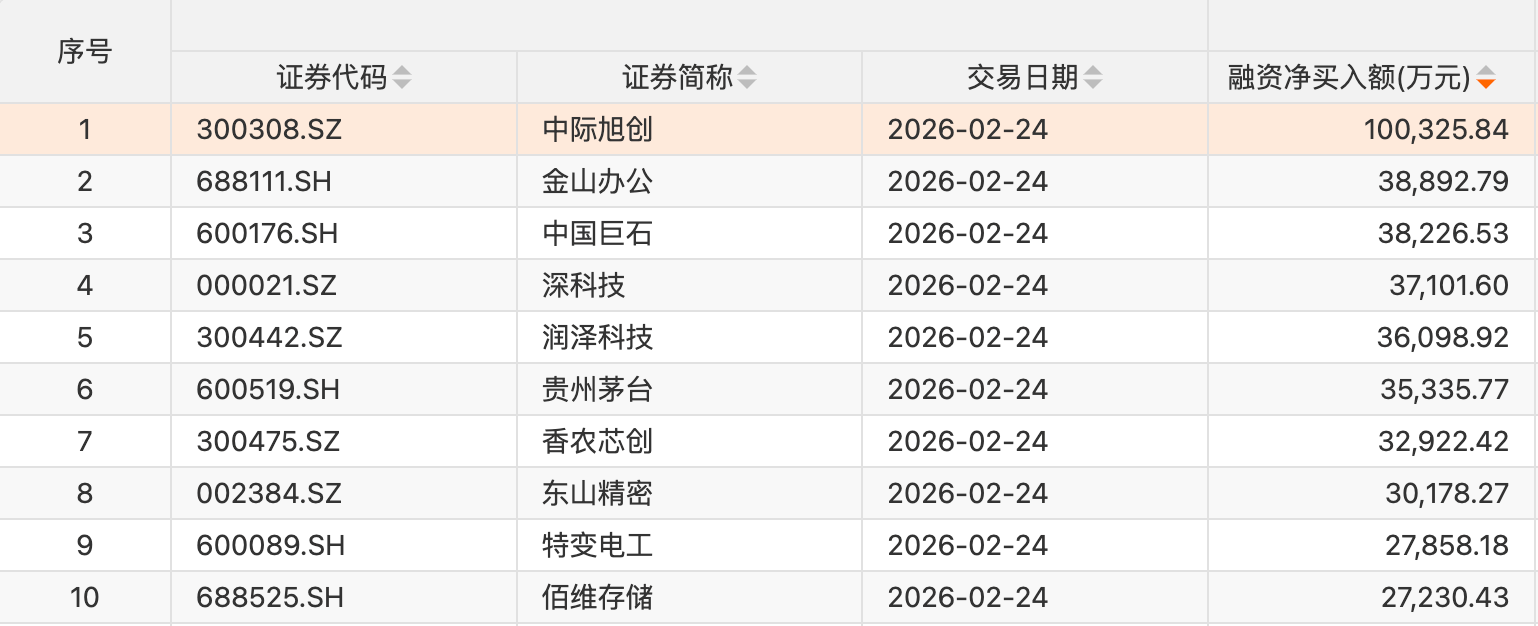
Group 1 - As of February 24, the margin trading balance in A-shares reached 26,227.57 billion yuan, an increase of 346.32 billion yuan from the previous trading day, accounting for 2.52% of the A-share circulating market value [1] - The trading volume of margin financing on the same day was 2,281.23 billion yuan, which is an increase of 482.89 billion yuan from the previous trading day, representing 10.28% of the total A-share trading volume [1] - Among the 31 primary industries in the Shenwan index, 26 industries experienced net financing inflows, with the electronics industry leading at a net inflow of 6.539 billion yuan [1] Group 2 - A total of 84 individual stocks had net financing inflows exceeding 100 million yuan, with Zhongji Xuchuang leading at a net inflow of 1.003 billion yuan [1] - Other notable stocks with significant net financing inflows include Kingsoft Office, China Jushi, Deep Technology, Runze Technology, Kweichow Moutai, Shannon Semiconductor, Dongshan Precision, TBEA, and Baiwei Storage [1][2] - The current storage super cycle is driven by explosive demand and supply lag, particularly in high-end storage chips due to AI demand, leading to significant price increases [2]
资金风向标 | 两融余额较上一日增加346.32亿元 电子行业获融资净买入额居首
Sou Hu Cai Jing· 2026-02-25 01:48
Group 1 - As of February 24, the margin trading balance in A-shares reached 26,227.57 billion yuan, an increase of 346.32 billion yuan from the previous trading day, accounting for 2.52% of the A-share circulating market value [1] - The trading volume of margin financing on the same day was 2,281.23 billion yuan, which is an increase of 482.89 billion yuan from the previous trading day, representing 10.28% of the total A-share trading volume [1] - Among the 31 primary industries, 26 experienced net financing inflows, with the electronics industry leading at a net inflow of 6.539 billion yuan [1] Group 2 - A total of 84 individual stocks had net financing inflows exceeding 1 billion yuan, with Zhongji Xuchuang leading at a net inflow of 1.003 billion yuan [1] - Other notable stocks with significant net financing inflows include Kingsoft Office, China Jushi, Deep Technology, Runze Technology, Kweichow Moutai, Shannon Semiconductor, Dongshan Precision, TBEA, and Baiwei Storage [2] - The current storage super cycle is driven by explosive demand and supply lag, particularly in high-end chips due to AI demand, leading to significant price increases in the storage market [2]



财闻早知道|刘强东宣布投资50亿进入游艇行业 减肥药司美格鲁肽将降价50%
Sou Hu Cai Jing· 2026-02-25 00:46
Market Overview - The U.S. stock market saw all three major indices rise, with the Dow Jones up 0.76% at 49,174.5 points, the S&P 500 up 0.77% at 6,890.07 points, and the Nasdaq up 1.04% at 22,863.68 points. Notable gainers included AMD, which rose over 8%, and Intel, which increased by over 5% [2] - International precious metals futures closed mixed, with COMEX gold futures down 1.25% at $5,160.50 per ounce, while COMEX silver futures rose 0.57% to $87.07 per ounce. The decline in gold prices was attributed to a stronger dollar and reduced demand for gold as a safe haven [3][4] Economic Policies - The State Council of China emphasized the potential of the silver-haired economy, aiming to enhance support measures and promote the development of the elderly care industry to address population aging. The focus is on boosting consumption capacity and creating new consumption scenarios for the elderly [5] - The People's Bank of China announced a 6,000 billion yuan MLF operation with a one-year term to maintain ample liquidity in the banking system [6] Trade and Tariffs - The Chinese Ministry of Commerce responded to recent U.S. tariff adjustments, noting that the U.S. has imposed a 20% effective tariff on Chinese goods. The ministry is closely monitoring these developments and may consider countermeasures [7] - The Ministry of Commerce of China has placed 20 Japanese entities on an export control list, prohibiting the export of dual-use items to these entities [8] Industry Developments - The Chinese solar industry is experiencing inventory accumulation, with a decrease in silicon wafer production by over 3% in February. The market anticipates a recovery in demand post-holiday [21] - The automotive sector saw a strong performance in January, with pickup truck sales reaching 49,000 units, a year-on-year increase of 22.5% [24] Company News - Liu Qiangdong announced a personal investment of 5 billion yuan into the yacht industry, aiming to create an independent yacht brand [26] - Xiaomi plans to focus on core technologies such as chips and AI over the next five years [27][28] - Huawei reported that the number of devices using its HarmonyOS has surpassed 40 million, with over 7.5 million applications available [29] - AMD has agreed to sell AI chips worth up to $60 billion to Meta, marking a significant partnership in the AI sector [30] - DJI has filed an appeal against the FCC's decision to list its products on a restricted list, aiming to protect its interests and those of its consumers [33]
新春开工,全省各地以奋进姿态夺取“开门红”以“满格状态”拼开局抢春时
Xin Hua Ri Bao· 2026-02-25 00:28
Group 1: Economic Development and Project Construction - Jiangsu province is actively promoting project construction as a key driver for economic growth, with significant projects underway across the region [2] - The Suzhou North Station comprehensive hub project is in a critical construction phase, with over 200 workers on-site, aiming for completion by the end of 2027 to enhance Suzhou's position in the Yangtze River Delta [2] - The Rosenberg smart factory in Changzhou, with an investment exceeding $100 million, is on track for completion by mid-2026, aiming to produce 170 million connectors and 60 million cable assemblies annually [3] Group 2: Workforce and Employment Services - A dedicated transportation service for workers returning to jobs has been implemented in Kunshan, with over 200 workers receiving support upon arrival [4] - Kunshan has identified over 3,000 job vacancies and is actively recruiting engineers and technicians to meet the growing demand for skilled labor [4] - The Jiangsu Taichang Hongxin Materials Technology Co., Ltd. is set to begin full production by April, with a projected annual output of 200,000 ceramic substrates for integrated circuits [5] Group 3: Government Support and Service Improvement - The government is enhancing support for enterprises, exemplified by the proactive approach of service specialists who provide project application guidance and facilitate connections with upstream and downstream companies [5] - Nanjing has launched a new action plan to optimize the business environment, focusing on practical measures to address enterprise development challenges [7] - The "换位跑一次" initiative in Wuxi aims to improve service quality by having officials experience processes from the perspective of businesses, promoting a culture of responsiveness and efficiency [8]