保险业

Search documents
2025年信用债违约事件盘点:行业分化下的信用风险边界重构
Hua Yuan Zheng Quan· 2026-03-05 06:08
1. Report's Industry Investment Rating No information provided in the content. 2. Report's Core View - In 2025, credit bond default events showed a significant feature of overall mitigation of stock risks, but the structural differentiation of default events continued to intensify. The number of new defaulting entities decreased, but the impact of individual default events became more profound [1][7]. - Company bonds were the main type of defaulting credit bonds in 2025. Private enterprises were the hardest - hit area, and the real - estate industry had the highest default or extension scale in the past five years [1][12][17]. - By analyzing typical default cases in 2025, it aimed to provide references for investors to identify credit risks [31]. 3. Summary by Relevant Catalogs 3.1 2025 Credit Bond Default Panoramic Analysis - **Overall situation**: In 2025, 13 new bond - issuing entities had substantial defaults, the second - lowest level since 2018. A total of 123 bonds defaulted or were extended, involving a total scale of 117.8 billion yuan. The default of Tianan Property Insurance's 7.516 billion - yuan capital supplementary bond broke the "zero - default" record of the insurance industry [1][7]. - **By bond type**: Company bonds were the main type of defaulting bonds in 2025. In 2025, the number of defaulted or extended company bonds was 97, with a total amount of 94.7 billion yuan, accounting for 80.4% of the total default or extension scale of credit bonds in 2025. Short - term financing bonds and enterprise bonds had no defaults or extensions in 2025 [12]. - **By enterprise nature**: Private enterprises were the hardest - hit area of credit bond defaults or extensions in 2025. In 2025, private enterprises had 94 defaulted or extended bonds, with a total amount of 92.2 billion yuan, accounting for 78.3%. Local state - owned enterprises had relatively strong credit endorsements, with 3.4 billion yuan in default or extension amount, accounting for 2.9% [17]. - **By industry distribution**: The real - estate industry had the highest default or extension scale in the past five years. In 2025, the real - estate industry had 75 defaulted or extended bonds, with a total amount of 78.3 billion yuan, accounting for 66.5%. The non - bank financial industry was the second - largest industry with a default or extension amount of 15.6 billion yuan, accounting for 13.3% [19][22][23]. - **By regional distribution**: In 2025, Guangdong, Beijing, Shanghai, Fujian, and Hubei ranked in the top five in terms of credit bond default or extension scale, with 39.1 billion, 21.2 billion, 17.4 billion, 10.2 billion, and 8.4 billion yuan respectively [30]. 3.2 2025 Credit Bond Default Typical Case Inventory - **Tianqian Asset Management & Tianying Investment**: Tianqian Asset Management's bond default was due to a rapid decline in profitability and a continuous deterioration of the debt structure. Its debt pressure had been increasing in the past five years. Tianying Investment's bond default was mainly affected by Tianqian Asset Management's poor performance. Tianying Investment's asset - liability ratio and interest - bearing liability ratio increased significantly, and it had a huge net loss in 2024 [2][32][36]. - **Tianan Property Insurance & Tianan Life Insurance**: Their bond defaults were the first in the history of the Chinese insurance industry. The reasons included illegal related - party transactions, a continuous contraction of business scale under the low - interest - rate environment, and the loss of continuous operation ability after the license was revoked in 2025 [2][44][49]. - **R&F Properties**: Its debt default was due to an imbalanced debt structure caused by aggressive expansion, a continuous decline in profitability, and blocked financing channels combined with increasing short - term debt repayment pressure [3][50][55]. - **Guanghui Automobile**: It was the first bond default of an automobile dealer in the past five years. The root cause was a decline in self - hematopoietic ability and weakened debt - repayment ability. The "high - leverage + large - scale mergers and acquisitions" expansion strategy in the industry's upward period was an important catalyst [3][60][65].

霍尔木兹遭封锁,特朗普抛出“解决”方案
财联社· 2026-03-04 12:57
Core Viewpoint - The article discusses the escalating tensions in the Persian Gulf following Iran's blockade of the Strait of Hormuz, highlighting the U.S. government's response to ensure the safety of energy transportation in the region through insurance guarantees and naval escorts [1]. Group 1: Shipping Industry Response - The shipping industry views the U.S. response as a "partial solution" to a historical crisis, with the Strait of Hormuz effectively closed due to attacks on vessels, severely impacting global oil and gas trade [2]. - Khalid Hashim, CEO of Precious Shipping Pcl, emphasizes the urgent need for a comprehensive solution, as the safety of lives, cargo, and vessels is at risk, and the company struggles to obtain war risk insurance for its ships in the region [2]. - The withdrawal of war risk insurance by major mutual insurance associations has led to skyrocketing supertanker freight rates, with oil storage facilities in several Gulf refineries nearing full capacity [2]. Group 2: Oil Production Impact - Iraq, the second-largest oil producer in the Middle East, has begun significant production cuts and faces further pressure, indicating the strain on oil suppliers in the region [3]. - RBC Capital Markets analysts express skepticism about the adequacy of the proposed insurance and escort plans, questioning the feasibility of implementing such measures in the short term [3]. Group 3: U.S. Government Initiatives - The U.S. International Development Finance Corporation (DFC) may assist shipowners and key marine insurance companies, similar to its previous support for war risk reinsurance [4]. - However, the scale of U.S. involvement in providing security for oil, gas, and fuel transportation in the Gulf would be much larger and more complex than past arrangements [4]. Group 4: Market Reactions and Concerns - Despite President Trump's statements leading to a temporary dip in oil prices, the market quickly rebounded due to limited details on insurance arrangements, causing shipowners to remain cautious [6]. - Industry insiders note that U.S. naval escorts alone may not quickly restore market confidence, especially since many tankers are neither U.S.-owned nor registered [6]. - The ongoing attacks by Houthi forces in the Red Sea further complicate the situation, raising concerns about the effectiveness of U.S. military interventions [7]. Group 5: Naval Resource Challenges - RBC highlights the critical issue of whether the U.S. has sufficient naval resources to conduct military operations against Iran while also providing escort services for commercial vessels [8]. - The deployment of any plan to restore shipping flow will require time, which may not be available for oil-producing and consuming nations [8]. - ING's commodity strategy head notes that while naval escorts could be a positive signal, they will not yield immediate results, and escort fleets themselves could become targets for Iranian attacks [8].


早报 | 王毅同以色列外长萨尔通电话;伊朗新任最高领袖选举进入最后阶段;国际油价大涨5%,白银跌近8%;马云新年现身谈AI
虎嗅APP· 2026-03-04 00:10
Group 1 - International oil prices surged significantly, with WTI crude oil rising by 4.86% to $74.69 per barrel and Brent crude oil increasing by 5.04% to $81.66 per barrel [3] - The A-share oil and gas sector experienced a rare surge, with the "three barrels of oil" (China National Petroleum, Sinopec, and CNOOC) achieving consecutive price increases for two trading days, marking a historical first [12] - The Korean stock market faced a significant drop, with the Kospi index declining over 7%, attributed to rising oil prices and a decrease in global risk appetite [15][16] Group 2 - Apple officially launched a new line of MacBook products featuring the M5 series chips, with AI computing performance as a core selling point [17] - The new MacBook Pro models show up to an 8-fold improvement in AI performance compared to the M1 models, while the MacBook Air has doubled its starting storage capacity to 512GB [18] - Google introduced the Gemini 3.1 Flash-Lite model, which offers significant improvements in response time and output speed, making it suitable for high-frequency workloads [19][20] Group 3 - Longsheng Life Insurance reported a decline in solvency ratios, with the core solvency ratio at 64.8% and the comprehensive solvency ratio at 79.7% as of the end of Q4 2025 [28] - Beijing Bank faced scrutiny after a pricing error in gold accumulation products led to significant discrepancies, prompting the bank to suspend operations and revoke orders [25][26]







每日债市速递 | 伊朗危机引发全球通胀担忧
Wind万得· 2026-03-03 23:35
Group 1: Open Market Operations - The central bank announced a fixed-rate reverse repurchase operation of 34.3 billion yuan for 7 days at an interest rate of 1.40%, with a total bid and awarded amount of 34.3 billion yuan. On the same day, 526 billion yuan in reverse repos matured, resulting in a net withdrawal of 491.7 billion yuan [3]. Group 2: Funding Conditions - The central bank's open market shifted to a net withdrawal, but the interbank market remained loose at the beginning of the month, with the DR001 weighted average rate falling over 4 basis points to around 1.26%. Overnight rates on the anonymous click system (X-repo) were reported at 1.25%, with funding supply exceeding 100 billion yuan. In the overseas market, the US overnight financing rate was at 3.68% [5]. Group 3: Interbank Certificates of Deposit - The latest transaction for one-year interbank certificates of deposit among major national and joint-stock banks was at 1.565%, down 1 basis point from the previous day [9]. Group 4: Bond Yield Rates - The yields on major interbank bonds showed various changes, with specific rates reflecting slight declines or stability across different maturities [10]. Group 5: Recent City Investment Bonds - The article discusses the trends and data regarding the yield spreads of AAA-rated city investment bonds across different maturities [11]. Group 6: Government Bond Futures - The closing prices for government bond futures indicated a slight increase for the 30-year contract by 0.09%, while the 10-year contract decreased by 0.01%, and the 5-year contract remained unchanged [13]. Group 7: Key News and Information - The upcoming National People's Congress and Chinese People's Political Consultative Conference will take place from March 4 to March 11, with significant agendas including discussions on the national economic and social development plan [14]. - Shenzhen has issued new regulations for urban renewal projects, effective from March 16, 2026, which will impact the construction of affordable housing [15]. - The Ministry of Industry and Information Technology and other departments have released guidelines to promote the comprehensive utilization of photovoltaic components, aiming to establish a green circular development system for the solar industry [15]. Group 8: Bond Market Events - The Ministry of Finance plans to issue 30 billion yuan in 63-day discount treasury bonds on March 4, and Agricultural Development Bank will auction up to 26 billion yuan in financial bonds on the same day [19].

每日债市速递 | 关闭霍尔木兹海峡有何影响?外交部回应
Wind万得· 2026-03-02 23:15
Group 1: Monetary Policy and Market Operations - The central bank conducted a 190 billion yuan reverse repurchase operation with a fixed rate of 1.40% on March 2, resulting in a net injection of 190 billion yuan for the day [3]. - The interbank market has returned to a loose liquidity state, with the DR001 weighted average rate slightly declining to around 1.31% [5]. - The latest one-year interbank certificates of deposit (CD) transactions are at 1.575%, showing a slight decrease from the previous day [9]. Group 2: Bond Market Performance - The closing prices for government bond futures showed increases: 30-year contracts rose by 0.55%, 10-year by 0.13%, 5-year by 0.09%, and 2-year by 0.02% [12]. - Recent trends in urban investment bonds (AAA) indicate varying yield spreads across different maturities [10]. Group 3: Key News and Developments - Iran announced the closure of the Strait of Hormuz, prompting calls for de-escalation to prevent further economic impacts [12]. - The Sichuan provincial government issued opinions to enhance financial support for rural revitalization, aiming for sustained growth in agricultural loans [13]. - The pilot program for local government special bonds has shown strong progress, with the ten trial provinces completing an average of 94% of their annual quota by the third quarter of 2025, exceeding non-trial provinces by 25 percentage points [13]. Group 4: Bond Issuance and Events - Agricultural Development Bank plans to issue up to 110 billion yuan in financial bonds and 80 billion yuan in 5-year fixed-rate bonds on March 3 [17]. - The Inner Mongolia Autonomous Region will issue 212.4204 billion yuan in 10-year refinancing general bonds on March 9 [17]. - There has been a notable widening of the spread for high-rated Asian dollar bonds, increasing by 4 basis points, marking the largest rise in seven months [17].


行业研究|行业周报|投资银行业与经纪业:政策引导行业规范发展,建议重视板块绩优个股-20260302
Changjiang Securities· 2026-03-02 11:45
Investment Rating - The report maintains a "Positive" investment rating for the industry [7] Core Insights - The non-bank financial sector has shown weak overall performance this week. The China Securities Regulatory Commission (CSRC) has released the "Measures for the Supervision and Management of Information Disclosure of Private Investment Funds," which aims to enhance transparency in private fund operations and protect investors' rights. Market trading has seen a slight recovery, remaining at historically high levels, and the report suggests focusing on high-performing stocks within the sector. In the insurance sector, the third-quarter reports have confirmed the logic of deposit migration, increased equity allocation, and improved new policy costs, leading to a further increase in the certainty of ROE improvement and potential acceleration in valuation recovery. The report recommends actively increasing allocation to insurance stocks under a healthy slow bull market [2][4] Summary by Sections Market Performance - The non-bank financial index decreased by 1.2% this week, with an excess return of -2.3% relative to the CSI 300, ranking 28th out of 31 sectors. Year-to-date, the non-bank financial index is down 3.8%, with an excess return of -5.6% compared to the CSI 300, ranking 30th out of 31 sectors. The market has seen a recovery in trading activity, with an average daily turnover of 24,402.93 billion yuan, up 15.59% week-on-week, and an average turnover rate of 2.32%, up 26.30 basis points [5][15] Insurance Sector Insights - In December 2025, the cumulative premium income reached 61,194 billion yuan, a year-on-year increase of 7.43%. The report highlights that property insurance income was 17,570 billion yuan (up 3.92%), while life insurance income was 43,624 billion yuan (up 8.91%). The report indicates a stable allocation of insurance assets, with bonds and equity funds seeing an increase in proportion [19][21][24] Brokerage and Investment Business - The report notes a recovery in the equity market, with the CSI 300 index rising by 1.08% and the ChiNext index by 1.05%. The average daily turnover in the two markets has increased, indicating a gradual recovery in brokerage business profitability. The report also mentions that the margin financing balance has increased to 2.67 trillion yuan, up 0.81% week-on-week, and that the stock pledge business is expected to perform better in terms of income despite a contraction in scale [33][40][43] Regulatory Developments - The CSRC's new measures for private investment fund information disclosure are set to take effect on September 1, 2026. These measures aim to clarify the disclosure responsibilities of fund managers and custodians, enhance investor protection, and establish a framework for the supervision of private fund activities [52]

海外宏观周报:地缘冲突骤然升级,避险情绪升温-20260302
Dong Fang Jin Cheng· 2026-03-02 08:50
Market Overview - Global assets experienced significant volatility due to rising risk aversion, with gold and silver prices increasing by 3.35% and 11.76% respectively last week[3] - The 10-year U.S. Treasury yield fell by 11 basis points to 3.97%, while European bond yields also declined significantly[3] - U.S. stock markets saw a collective drop in major indices, contrasting with gains in Japanese and European markets[3] U.S. Economic Indicators - The U.S. January PPI rose by 2.9% year-on-year, exceeding expectations of 2.6%, driven primarily by rising service prices[13] - Fed Governor Milan reiterated the need for a 100 basis point rate cut in 2026, complicating the monetary policy outlook due to inflationary pressures[7] Japanese Economic Outlook - The Bank of Japan's Governor indicated a careful review of data in March and April to decide on potential interest rate hikes, with February's core CPI at 1.8%[8] - The Nikkei 225 index surged by 3.56%, leading global stock market performance[3] Bond Market Trends - The 10-year U.S. Treasury yield decreased by 11 basis points to 3.97%, with foreign holdings of U.S. debt dropping by $88.4 billion to $9.27 trillion[33] - The 10-year UK bond yield fell by 23 basis points to 4.24%, while German and French yields also saw declines of 5 basis points and 8.4 basis points respectively[40] Commodity Prices - Spot gold prices reached $5,222, marking a 3.35% increase, while silver prices rose to $90, up 11.76%[5] - WTI crude oil prices increased by 1.22% to $67, reflecting a year-to-date rise of 17.39%[5]
政策半月观:各部门各地“新春第一会”的看点
GOLDEN SUN SECURITIES· 2026-03-02 01:33
Policy Focus - The recent policies emphasize the urgency of implementing government work post-Spring Festival, with a focus on enhancing responsibility and aiming for annual targets[2] - The People's Bank of China (PBOC) has lowered the foreign exchange risk reserve ratio for forward foreign exchange sales from 20% to 0%, marking the first use of this tool in nearly three and a half years[2] - Various regions, including Guangdong, Zhejiang, and Jiangsu, have held "New Year First Meetings" to set the tone for the 14th Five-Year Plan, focusing on new productivity, private economy, and high-quality development[2] Real Estate and Economic Measures - Shanghai's "Seven Measures" include easing purchase restrictions and increasing public housing loan limits (up to 3.24 million yuan), aimed at stabilizing the real estate market[2] - The emphasis on establishing a correct view of performance has been reiterated in multiple meetings, including the State Council and the Central Party's construction work meeting[2] - The government is promoting the silver economy and elderly care services, enhancing consumption capabilities through subsidies and new consumption scenarios[4] Industry Development - Multiple departments are focusing on strengthening industries, particularly in low-altitude and "AI+" sectors, with initiatives to support low-altitude industry development and establish a comprehensive low-altitude insurance system[9] - The PBOC's recent policy aims to stabilize the RMB exchange rate and promote a neutral foreign exchange policy, indicating a shift towards supporting enterprises in managing currency risks[6] Upcoming Events and Expectations - Attention is drawn to the upcoming National People's Congress (NPC) sessions, where GDP growth targets are expected to be set between 4.5% and 5% for 2026, with a CPI target around 2%[2] - Key indicators to watch include whether the PMI can return to expansion territory and if credit can achieve a strong start in the first quarter[2]
混沌AI院3期重磅发布:90天手把手落地AI试点,为企业锻造实战型AI团队
混沌学园· 2026-02-28 12:21
Core Insights - The article emphasizes that AI technology is transitioning from experimental stages to becoming a core organizational capability, fundamentally reshaping global business competition [3] - By 2026, AI is expected to be widely adopted across various industries, making it essential for companies to find effective AI implementation strategies to ensure survival and growth [5][7] - The article introduces the "Chaos AI Institute Phase 3" program, which aims to provide a comprehensive solution for enterprises to overcome AI implementation challenges through hands-on guidance [21][22] Group 1: AI Adoption and Impact - The year 2026 is highlighted as a pivotal moment for AI, marking a significant acceleration in its integration into everyday life and various industries, making AI adoption a necessity for businesses [4][5] - AI's rapid integration into consumer life during the 2026 Spring Festival is compared to the mobile payment revolution initiated by WeChat in 2014, indicating a strong foundation for AI penetration into industries [5] - Traditional enterprises are adopting AI to enhance core competitiveness, focusing on practical applications that address real industry pain points rather than merely showcasing technology [7] Group 2: Challenges in AI Implementation - Companies face three main challenges in AI implementation: unclear entry points, lack of practical methods for execution, and a shortage of skilled personnel [10][13][16] - Many enterprises struggle with identifying precise AI application areas, often leading to ineffective resource allocation and stalled progress in AI transformation [13][14] - The lack of systematic methods and hands-on guidance results in difficulties in translating business needs into actionable AI solutions, hindering the establishment of effective AI pilot projects [14][18] Group 3: Solutions Offered by Chaos AI Institute - The Chaos AI Institute's Phase 3 program focuses on hands-on support to help enterprises identify high-value AI entry points, develop actionable AI pilot projects, and cultivate skilled personnel [22][23] - The program promises to deliver a complete AI application plan, a demonstrable AI application prototype, and a team capable of executing AI initiatives independently [24][25][26] - The approach emphasizes collaboration among a core team of three members—strategic decision-makers, business experts, and technical implementers—to ensure effective AI project execution [30][31] Group 4: Practical Applications and Case Studies - The article provides examples of successful AI pilot projects across various industries, demonstrating significant improvements in efficiency and cost reduction [49][66] - Specific case studies illustrate how companies have leveraged AI to enhance marketing effectiveness, streamline operations, and drive product innovation, achieving measurable business outcomes [50][52][54][56] - These real-world applications underscore the potential of AI to transform business processes and create sustainable competitive advantages [66]

3亿美元买一张保单?揭秘吉尼斯纪录天价保单背后的财富密码
Sou Hu Cai Jing· 2026-02-28 03:36
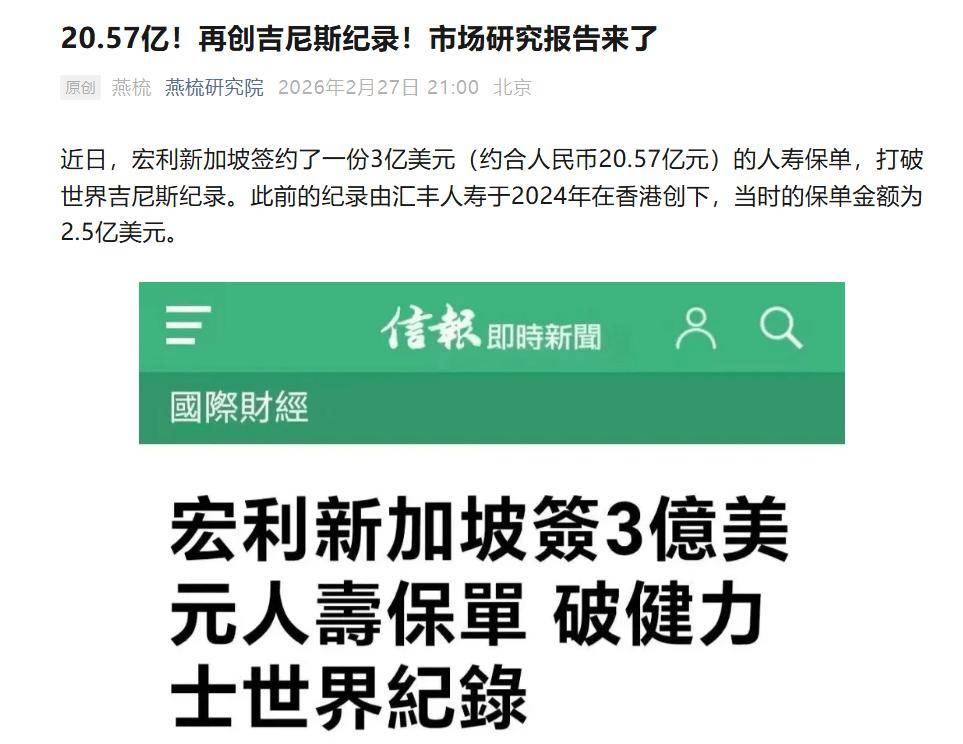
Group 1 - Manulife Singapore recently signed a life insurance policy worth $300 million, setting a Guinness World Record, surpassing HSBC Life's previous record of $250 million in Hong Kong in 2024 [2][16] - The policy allows for a much lower upfront payment compared to the total coverage amount, exemplifying the leverage effect of insurance [4] - The policy is an Indexed Universal Life (IUL) insurance, which allows the cash value to grow linked to stock market indices while providing downside protection [6][7] Group 2 - High-net-worth individuals purchase such policies to address unique concerns, such as estate distribution, business liabilities, liquidity issues, and privacy [10][11][14][15] - Singapore's advantages over Hong Kong include political stability, favorable policies for family offices, and mature professional services that integrate insurance with trust and tax planning [17][18][19] - The future of wealth management in the Asia-Pacific region may evolve into a "dual-center" model, with Singapore focusing on global cross-border services and Hong Kong serving as a bridge to mainland China [21] Group 3 - The high-value policy reflects a broader trend in wealth management, shifting from prioritizing growth to ensuring value preservation and certainty in uncertain times [34][35] - The insurance and wealth management sectors in China can learn from this trend by moving from product sales to providing comprehensive solutions that integrate various financial services [31] - There is a need for professionals in the wealth management industry to possess a diverse skill set, including knowledge of finance, law, and tax, to effectively serve high-net-worth clients [32]