公用事业

Search documents
震惊!长期利率首次低于日本!意味着什么?
Xin Lang Cai Jing· 2025-12-12 02:54
Core Insights - The inversion of the 10-year government bond yields between China and Japan suggests that the Chinese economy may be facing a "Japanification" scenario, indicating potential deflationary pressures [1][20][22] - Investors are advised to shift towards "defensive and arbitrage" strategies, focusing on high-dividend assets, global diversification, and hard currencies to safeguard capital and outperform inflation [1][20][22] Group 1: Macro Economic Implications - The inversion signifies a macroeconomic cycle misalignment, with China in a recession/recovery early stage facing deflationary pressures, necessitating low interest rates to stimulate borrowing and consumption [5][23] - In contrast, Japan is in a recovery/overheating early stage, emerging from deflation with rising wages and normalizing monetary policy, allowing interest rates to rise [5][23] Group 2: Currency and Capital Flow Pressures - There is a depreciation pressure on the Renminbi, as global capital tends to favor higher-yielding assets, leading to a preference for Japanese yen or US dollar assets over Renminbi assets [6][24] Group 3: Asset Pricing Logic Changes - The previous high yield in China supported high valuations in real estate and stocks; now, in a "low interest rate era," all assets need to be repriced according to the new risk-free rate, which is around 1.8% or lower [8][26] Group 4: Specific Asset Allocation Strategies - The strategy for A-shares and Hong Kong stocks should shift from "growth speculation" to "yield spread capture," focusing on stable assets with a dividend yield of 3%-5%, which are now seen as "quasi-bonds" [9][27] - Caution is advised against high-debt and pseudo-growth stocks, as corporate earnings are unlikely to experience explosive growth in a deflationary environment [10][28] Group 5: Cross-Border Asset Allocation - The inversion of the China-Japan yield spread signals the need to hold non-Renminbi assets for risk hedging, such as Japanese equities, which may benefit from rising interest rates [12][30] - Holding US Treasury bonds and dollar deposits is recommended, as US dollar rates remain significantly higher than Renminbi rates, providing a hedge against potential Renminbi depreciation [14][32] Group 6: Gold as a Safe Haven - In a scenario where actual interest rates are extremely low or negative, and the economy faces "Japanification" risks, gold is positioned as a counter asset to Renminbi, likely to appreciate in value [16][34] Group 7: Real Estate Market Dynamics - The logic surrounding real estate has fundamentally reversed; low long-term interest rates do not guarantee rising property prices, as low rates often correlate with reduced demand and lending [17][35]


美联储“鹰派降息”落地
British Securities· 2025-12-12 02:47
Group 1 - The Federal Reserve announced a rate cut of 25 basis points, bringing the federal funds rate target range to 3.50%-3.75%, aligning with market expectations for a "hawkish rate cut" [2][7][9] - This marks the third consecutive rate cut by the Federal Reserve, totaling a cumulative reduction of 75 basis points for the year [2][7][9] - Despite the rate cut, the dot plot indicates a conservative outlook for future rate cuts, with expectations of only one cut in 2026, which dampens market optimism for a prolonged easing cycle [2][7][9] Group 2 - The A-share market's core drivers remain focused on domestic economic fundamentals and corporate earnings expectations, despite external monetary policy changes [3][7] - The domestic economy is in a recovery phase, but there are still issues such as insufficient total demand that need to be addressed, and signals of sustained improvement in corporate profitability require further confirmation [3][7] - Investors are advised to focus on low-entry opportunities and align with sector rotation trends, selecting stocks with earnings support while avoiding high-valuation stocks lacking performance backing [3][8] Group 3 - On the trading day, the three major indices in the A-share market experienced collective declines, with the Shanghai Composite Index closing at 3873.32 points, down 0.70% [5] - The trading volume for the day was 18,571 billion, indicating a general lack of market enthusiasm and profitability [5] - Specific sectors such as wind power equipment and non-metallic materials saw gains, while real estate and commercial retail sectors faced declines [4][5] Group 4 - The controlled nuclear fusion concept stocks were notably active, driven by ongoing international cooperation in nuclear energy, highlighting its potential as a significant future energy source [6] - The commercial aerospace sector also showed resilience, benefiting from recent policy clarifications and the establishment of dedicated regulatory bodies, which provide a more stable development environment for the industry [6]
中央经济工作会议如何指引A股?机构研判来了
Sou Hu Cai Jing· 2025-12-11 15:30
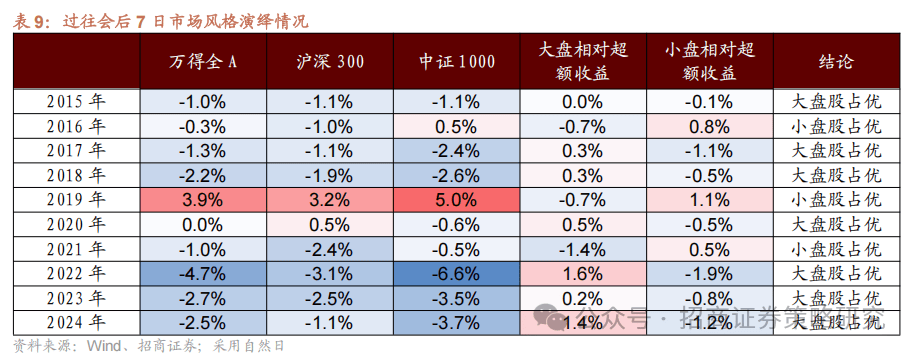
Group 1 - The central economic work conference indicates a relatively positive policy tone for the capital market in 2024, with a fiscal deficit rate potentially maintained at 4% and a focus on promoting economic stability and reasonable price recovery in monetary policy [1][2] - The conference emphasizes the need to address the decline in investment growth, with major projects expected to be a key focus for investment in 2024, particularly as it marks the beginning of the 14th Five-Year Plan [1][2] - The conference highlights the importance of consumer demand, with plans to implement a rural resident income increase plan, although there may be limited expansion in funding support for new policies [1][2] Group 2 - Historical market performance shows that large-cap stocks tend to outperform in the week following the conference, with a consistent trend observed over the past five years [3][4] - Specific industries such as oil and petrochemicals, telecommunications, and electronics have a higher probability of rising in the week after the conference, while sectors like social services, public utilities, coal, and media have shown higher average excess returns over the past five years [6][11] - The focus on key industries mentioned in the conference often translates into increased policy support in the following year, with past examples including the emphasis on low-altitude economy in 2023 leading to significant policy developments in 2024 [11][12]
中央经济工作会议点评:2025年中央经济工作会议如何指引A股?
CMS· 2025-12-11 13:32
证券研究报告 | 策略专题报告 2025 年 12 月 11 日 2025 年中央经济工作会议如何指引 A 股? ——中央经济工作会议点评 中央经济工作会议 12 月 10 日至 11 日在北京举行。会议整体延续政治局会议 相对积极的表态。短期来看,过去 10 年间,会后 7 天大盘风格往往相对占优。 行业表现上,从平均超额收益水平来看,近 5 年,社会服务、公用事业、煤炭、 传媒这五个行业会后 7 天平均超额水平相对更高。中长期来看,建议重点关注 会议"推动投资止跌回稳"下,明年重大项目的安排。 专题报告 相关报告 1、《如何理解 12 月政治局会 议?对资本市场意味着什么? ———政策专题》2025-12-08 2、《今年以来服务消费政策部 署梳理,美政府结束停摆——国 内外产业政策周报(1116)》 2、《黄金税收政策调整,美国 与亚洲多国达成合作——国内 外产业政策周报(1103)》 3、《发布会召开介绍和解读四 中全会精神,有哪些增量信息? — — 国 内 外 产 业 政 策 周 报 (1025)》 4、《整治内卷聚焦价格治理, 特朗普威胁对华大幅加征关税 — — 国 内 外 产 业 政 策 周 报 ...
谨慎加仓?
第一财经· 2025-12-11 12:31
Core Viewpoint - The market is experiencing significant differentiation, with strong performance in sectors like commercial aerospace and wind power equipment, while traditional consumption and real estate sectors are facing notable adjustments [4][6][7]. Market Performance - The Shanghai Composite Index failed to maintain the 3900-point threshold, influenced by declines in technology and consumer stocks, while the Shenzhen Composite Index and ChiNext Index saw the largest adjustments due to pressure from sectors like new energy and biomedicine [4][6]. - The trading volume in both markets increased, driven by divergent policy expectations, accelerated thematic rotations, and intensified capital discrepancies [7]. Sector Analysis - New energy and high-end manufacturing sectors emerged as the core strength against the market downturn, supported by policy backing, technological breakthroughs, and growing demand [6]. - Commercial aerospace, nuclear fusion, and wind power equipment sectors showed strong performance, while real estate, retail, and large consumption sectors became focal points for capital outflows [7][9]. Capital Flow - Institutional investors are adjusting their portfolios defensively, increasing positions in policy-driven sectors like commercial aerospace and wind power equipment, while reducing exposure to semiconductor equipment and consumer electronics [9]. - Retail investors are exhibiting a mix of risk aversion and speculative behavior, with funds flowing into banking and public utilities, while some are actively participating in short-term trading in commercial aerospace and nuclear fusion [9].

滨海投资(02886)12月11日斥资2.25万港元回购2万股
智通财经网· 2025-12-11 09:35
Group 1 - The company Binhai Investment (02886) announced a share buyback plan, intending to repurchase 20,000 shares at a total cost of HKD 22,500 [1] - The buyback price is set between HKD 1.12 and HKD 1.13 per share [1]
英大证券晨会纪要-20251211
British Securities· 2025-12-11 03:22
Market Overview - The A-share market experienced volatility with a "V-shaped" reversal on Wednesday, driven by a surge in a leading real estate company's stock, which boosted market sentiment [2][10] - The current market is characterized by technical resistance above and policy support below, indicating a likely path of repeated fluctuations and potential upward movement [2][10] - Recent data from the National Bureau of Statistics shows a 0.7% year-on-year increase in CPI for November, suggesting marginal improvement in domestic demand [2][10] Sector Analysis Precious Metals - The precious metals sector saw significant gains, attributed to factors such as the onset of a Fed rate cut cycle, increased geopolitical tensions, and strong demand from global central banks [6] - The weakening dollar and inflation concerns have led investors to view gold as a hedge against inflation, with rising demand for gold in technology applications further supporting this trend [6] Hainan Free Trade Zone - Stocks related to the Hainan Free Trade Zone were notably active, with multiple stocks hitting the daily limit up. The upcoming full island closure operation on December 18 is expected to enhance market activity [7] - The new policies will allow for freer movement of goods within Hainan while maintaining controlled access from the mainland, which is anticipated to benefit related stocks [7] Real Estate - The real estate sector experienced a rebound, driven by the upcoming discussion on debt restructuring for a leading real estate company and ongoing supportive policies from the government [8] - The industry is expected to see a gradual alleviation of risks, with a focus on high-quality companies that have strong land reserves and are returning to stable growth [8] Investment Strategy - Investors are advised to focus on low-entry opportunities across various sectors, including technology growth (semiconductors, AI themes, robotics), cyclical industries (solar, batteries, chemicals), and dividend stocks (banks, utilities) [3][10] - It is recommended to select stocks with strong earnings support while avoiding high-valuation stocks lacking performance backing [3][10]
南京公用:控股股东及其一致行动人协议转让公司7.61%股份获批复
Xin Lang Cai Jing· 2025-12-10 09:19
Core Viewpoint - The controlling shareholder, Nanjing Public Holding (Group) Co., Ltd., along with its concerted party, Nanjing Urban Construction Investment Holding (Group) Co., Ltd., plans to transfer a total of 43.731 million unrestricted circulating shares to Nanjing Innovation Investment Group Co., Ltd. for a total consideration of 300 million yuan [1] Summary by Relevant Categories Share Transfer Details - The total shares being transferred amount to 43.731 million, representing 7.61% of the company's total share capital [1] - Nanjing Public Holding intends to transfer 16.8001 million shares, which is 2.92% of the total share capital [1] - Nanjing Urban Construction Investment Holding plans to transfer 26.9309 million shares, accounting for 4.69% of the total share capital [1]

关注红利港股ETF(159331)投资机会,市场关注高股息资产防御属性
Mei Ri Jing Ji Xin Wen· 2025-12-10 04:24
Group 1 - The core viewpoint is that the Hong Kong stock market has performed well in the first 11 months of 2025, supported by ample liquidity, with a focus on undervalued high-dividend central state-owned enterprises for medium to long-term investment value [1] - The Hong Kong Stock Connect high dividend sector is highlighted, particularly the defensive and stable dividend characteristics of central state-owned enterprises, which are gaining attention amid a complex external environment [1] - The macro policy continues to strengthen, and the inflow of southbound funds is expected to sustain the advantages of high dividend strategies in a volatile market, suggesting a focus on quality stocks with stable earnings and dividend capabilities [1] Group 2 - The Dividend Hong Kong Stock ETF (159331) has tracked the Hong Kong Stock Connect high dividend index (930914), which selects 30 high dividend yield securities from companies meeting the Stock Connect criteria, emphasizing liquidity and consistent dividends [1] - The index components are primarily distributed across banking, transportation, coal, and public utilities sectors, exhibiting characteristics of stable returns and low volatility [1] - The Dividend Hong Kong Stock ETF has distributed dividends for 16 consecutive months, indicating its reliability [2]
早盘直击|今日行情关注
申万宏源证券上海北京西路营业部· 2025-12-10 02:31
Market Overview - After regaining the 3900-point level, the A-share market has returned to a phase of low-volume consolidation, with mixed performances across indices. The ChiNext Index continues to show upward momentum, while the Shanghai Composite Index and the Sci-Tech 50 Index have experienced slight pullbacks. Overall trading volume has decreased compared to Monday, reflecting a decline in investor enthusiasm as the year-end approaches, leading to a general trend of low-volume fluctuations [1] Future Outlook - As the year-end approaches, a cautious market sentiment prevails, with fluctuations around the 4000-point level potentially preparing the market for a new upward phase. The market has established conditions for further upward expansion following a period of sideways movement since October. A recovery in the supply-demand situation for the manufacturing sector in 2026 is likely, which could lead to a significant rebound in the earnings growth of A-share listed companies. Key focus areas for November include the impact of the 14th Five-Year Plan on industries, event-driven dynamics in the technology sector, and price increases driven by anti-involution trends, which are expected to catalyze multiple sectors and support a continued upward trend in the market [1] Sector Highlights - In December, sectors benefiting from dividends and price increases are expected to outperform, with short-term attention on banking, public utilities, coal, and non-ferrous metals. Technology will remain a key focus in 2026, with particular attention on AI, lithium batteries, military industry, and robotics. Specific areas of interest include: 1. The established trend in AI hardware, with a continued increase in token usage for major AI models, indicating a peak in AI applications by 2026, presenting opportunities for high growth in AI hardware and the transition from quantitative to qualitative changes in AI applications [2] 2. The trend of robot localization and integration into daily life is expected to continue into 2026, with robot products expanding from humanoid robots to quadrupedal and functional robots, creating recurring opportunities in sensors, controllers, and dexterous hands [2] 3. The trend towards semiconductor localization remains strong, with a focus on semiconductor equipment, wafer manufacturing, semiconductor materials, and IC design [2] 4. The military sector is expected to see a continued recovery in orders by 2026, with many sub-sectors such as ground equipment, aviation equipment, and military electronics showing signs of bottoming out as Q3 report declines narrow [2] 5. The innovative drug sector is entering a recovery phase after nearly four years of adjustment, with positive net profit growth for four consecutive quarters since Q3 2024, and an anticipated turning point in fundamentals by 2025, continuing an upward trend into 2026 [2]