
TMT

Search documents
IPO受理现小高峰 未盈利企业加速拥抱资本市场
Zheng Quan Shi Bao· 2025-07-01 19:10
Core Insights - The number of IPO applications received in June reached a record high for the year, with 150 companies applying, driven by periodic financial data updates and an improving regulatory framework under the registration system [1][2][3] Group 1: IPO Application Trends - A total of 177 companies' IPO applications were accepted in the first half of the year, a significant increase from 29 in the same period last year, with June alone accounting for over 85% of the total [2][4] - The last few days of June saw a surge in applications, with 41 new IPOs accepted on June 30, including 32 by the Beijing Stock Exchange [2][7] - The increase in IPO applications is linked to the financial reporting cycle, as companies must submit applications within six months of their financial report's validity [3][4] Group 2: Industry Distribution and Market Sentiment - Manufacturing companies dominate the IPO applications, particularly in sectors like computer, communication, and electronic equipment manufacturing [4] - The number of IPO withdrawals has decreased significantly, with only 66 withdrawals reported by June 30, compared to last year's higher figures, indicating improved market confidence among quality companies [4][6] Group 3: Support for Unprofitable Companies - The acceptance of IPO applications from unprofitable companies has increased, with four such companies applying in June, primarily in the semiconductor sector [5][6] - Notable examples include DaPuWei, which reported projected revenues of approximately 5.57 billion yuan in 2022 but incurred losses, and Zhaoxin Integrated, which focuses on high-end processors [5] Group 4: Future Outlook - The A-share market is expected to see a steady increase in IPO numbers in 2025, particularly from companies in key manufacturing and strategic emerging industries like semiconductors and new energy [8]
2025年公募基金“中考”九成正收益,“最牛”榜单出炉
2 1 Shi Ji Jing Ji Bao Dao· 2025-07-01 14:01
Core Insights - The public fund market showed significant profitability in the first half of 2025, with 87% of funds achieving positive returns, highlighting a strong market recovery [1][9][10] - The top-performing funds were dominated by innovative drug and North Exchange theme funds, indicating a trend towards specialized investment strategies [2][3][4][5] Fund Performance - The best-performing fund was Huatai-PineBridge Hong Kong Advantage Selection A, with a net value growth of 86.48%, followed closely by CITIC Securities North Exchange Selection with 82.45% and Great Wall Pharmaceutical Industry Selection A with 75.18% [3][4] - Seven out of the top ten funds were heavily invested in innovative drugs, while two were focused on North Exchange themes, showcasing the effectiveness of concentrated investment strategies [4][5] Market Trends - The first half of 2025 saw a notable performance from sectors such as innovative drugs, North Exchange, humanoid robots, and new consumption, with these themes alternating in prominence [2][3][10] - Analysts predict that the positive trends for innovative drugs and North Exchange themes are likely to continue into the second half of the year, supported by structural opportunities in these sectors [7][8] Overall Market Dynamics - A total of 12,571 funds were analyzed, with 10,949 achieving positive returns, reflecting a broad-based recovery in the public fund market [9] - The market exhibited a "barbell" characteristic, with both high-growth technology stocks and low-valuation, high-dividend stocks performing well, particularly in the banking sector [10] Sector Performance - Certain sectors, such as real estate and food and beverage, underperformed, leading to lower returns for funds heavily invested in these areas [11] - The bond market transitioned from a bull market to a more volatile environment, resulting in weaker performance for fixed-income funds [11]
股市情绪偏暖,债市延续震荡
Zhong Xin Qi Huo· 2025-07-01 03:25
1. Report Industry Investment Rating - No specific industry investment rating is provided in the report. 2. Core Views of the Report - The stock market sentiment is warm, and the bond market continues to fluctuate. For stock index futures, sentiment is positive with healthy long - short position changes; for stock index options, a covered defense strategy is recommended; for treasury bond futures, the bond market is expected to continue to fluctuate in the short term [1]. 3. Summary by Relevant Catalogs 3.1 Market Views 3.1.1 Stock Index Futures - **Market Conditions**: IF, IH, IC, and IM's current - month basis, inter - period spreads, and positions changed. The Shanghai Composite Index fluctuated higher on Monday, with small - cap sentiment remaining active. Large - cap stocks retreated after capital congestion, and funds flowed to small - cap stocks. IM saw healthy long - short position changes, with a significant decrease in positions and wider intraday discounts [7]. - **Logic**: Geopolitical risks eased, the tariff deadline was postponed, and the market shifted its focus to internal profit improvement as the interim report announcements approached. - **Operation Suggestion**: Continue to allocate long IM contracts [7]. - **Outlook**: Oscillating upward 3.1.2 Stock Index Options - **Market Conditions**: The equity market oscillated upward with sectoral divergence. Although sentiment indicators rose with the underlying assets, the trading volume in the options market declined significantly, and trading liquidity was lower than expected [7]. - **Logic**: In a low - liquidity derivatives market, sentiment indicators showed synchronicity but no guiding effect. Implied volatility only corresponded to daily market fluctuations, and all varieties showed a decline in volatility in the morning. - **Operation Suggestion**: Adopt a covered defense strategy [7]. - **Outlook**: Oscillating 3.1.3 Treasury Bond Futures - **Market Conditions**: Treasury bond futures closed down across the board. T, TF, TS, and TL's main contracts changed by - 0.16%, - 0.10%, - 0.05%, and - 0.43% respectively. Trading volume, positions, inter - period spreads, cross - variety spreads, and basis all had corresponding changes [3][8][9]. - **Logic**: The central bank's second - quarter policy statement was positive, the end - of - month capital tightened, the June PMI was better than expected, and the stock - bond seesaw effect was evident. At the beginning of the month, the capital may seasonally loosen, but the central bank may be cautious in liquidity injection, and the supply of new local bonds in July may remain high [3][9][10]. - **Operation Suggestion**: For trend strategies, maintain an oscillating view; for hedging strategies, focus on short - hedging at low basis levels; for basis strategies, appropriately focus on basis widening; for curve strategies, steepening the curve in the medium term has higher odds [10]. - **Outlook**: Oscillating 3.2 Economic Calendar - The official manufacturing PMI in China in June was 49.7, better than the previous value of 49.5. The US will release the June ISM manufacturing index on July 1st, the June unemployment rate and non - farm payrolls change on July 3rd [11]. 3.3 Important Information and News Tracking - **Domestic Bond Market**: As of the end of May, overseas institutions' custodial balance in the Chinese bond market was 4.4 trillion yuan, accounting for 2.3% of the total. In the inter - bank bond market, the balance was 4.3 trillion yuan. Overseas institutions held 2.1 trillion yuan of treasury bonds, 1.2 trillion yuan of negotiable certificates of deposit, and 0.8 trillion yuan of policy - bank bonds [11]. - **Overseas Macroeconomy**: The US Senate procedurally voted to pass the "Great Beauty" tax and spending bill pushed by President Trump. The bill is estimated to increase the US federal government's debt by about $3.8 trillion in the next 10 years [12]. 3.4 Derivatives Market Monitoring - The report mentions data on stock index futures, stock index options, and treasury bond futures, but specific data details are not fully presented in the provided text.
早盘直击|今日行情关注
申万宏源证券上海北京西路营业部· 2025-07-01 03:02
Group 1 - The external environment is marginally improving, with a rebound in domestic market risk appetite. Recent international situations have shown improvement, leading to an increase in expectations for interest rate cuts by the Federal Reserve, which has driven a general rebound in global capital markets. The domestic market has also seen a notable recovery in risk appetite, with the Shanghai Composite Index reaching a new high for the year and the Shenzhen Component Index rebounding as well [1] - The two markets experienced fluctuations with a slight decrease in trading volume. On Monday, both markets opened slightly lower but gradually rebounded, with the Shanghai Composite Index closing near its daily high and recovering its five-day moving average. The Shenzhen Component Index continued to rebound, outperforming the Shanghai market recently. The trading volume was around 1.4 trillion yuan, a decrease from the previous Friday. On a microstructural level, there were more gainers than losers, with a significant number of stocks hitting the daily limit up. The main market hotspots were concentrated in the defense, military, and TMT sectors, with small-cap and technology styles leading in gains [1] - The market rhythm indicates that the Shanghai Composite Index has broken through the small trading range from May and June, moving to a higher level. The index has surpassed the previous trading range and achieved a new high for the year. However, there remains strong technical resistance in the dense trading area from the fourth quarter of last year, and without substantial positive information, it is expected to be challenging to break through upward in one go [1]


早盘直击 | 今日行情关注
申万宏源证券上海北京西路营业部· 2025-06-30 01:37
Group 1 - The easing of geopolitical tensions in the Middle East has led to a recovery in market risk appetite, with the Israeli-Iranian military conflict showing signs of de-escalation and a ceasefire agreement in place [1] - The overall global capital markets have shown a rebound, with the domestic market's risk appetite significantly improving, as evidenced by the Shanghai Composite Index reaching a new high for the year [1] - Expectations for a Federal Reserve interest rate cut have strengthened, contributing to the positive market momentum [1] Group 2 - Last week, both stock exchanges experienced a volatile rebound, with average daily trading volume significantly increasing, surpassing 1.4 trillion yuan, indicating heightened market activity [1] - The Shanghai Composite Index broke through the previous resistance levels from May and June, achieving a new yearly high, although it faced resistance near last year's fourth-quarter high [1] - Market hotspots last week were primarily concentrated in the military, TMT (Technology, Media, and Telecommunications), and non-bank financial sectors, with small-cap and technology stocks showing greater gains [1]

头部私募仓位高企 中期策略研判更趋积极
Zhong Guo Zheng Quan Bao· 2025-06-29 20:22
□本报记者王辉 头部私募仓位高企 顺时投资权益投资总监易小斌认为,近期,部分外部因素的积极变化为A股运行提供了有利环境,但起 决定性作用的仍然是内部因素。这些因素包括:市场自2024年10月高点以来的累计调整时间已超8个 月,技术面面临突破;国内政策密集出台,直接刺激了券商、金融科技等板块爆发;市场资金面充裕, 核聚变、稳定币、固态电池等热点不断涌现,有效维系了市场人气。易小斌判断,这些内外部积极因素 的中期延续性较强,有利因素不断积聚,预计将推动行情持续发展。 融智投资基金经理夏风光从宏观周期角度分析称,下半年全球主要经济体货币政策的"潜在共振"是关键 变量,美联储重启降息进程的可能性正在增大,这将为国内货币和财政政策打开空间。夏风光表 示:"流动性环境的进一步改善叠加经济回暖,有望进一步推升本轮A股的阶段性趋势行情。" 来自第三方机构私募排排网的最新监测数据显示,截至6月20日,全市场股票私募机构的平均仓位水平 为74.62%,较前一周小幅上升0.37个百分点,这一数值处于今年以来的中等偏高水平。在具体仓位上, 54.31%股票私募机构仓位处于重仓或满仓(仓位大于八成)水平,24.41%股票私募仓位处于中 ...
2025年7月宏观及大类资产月报:关注7月政治局会议,结构性政策依然可期-20250629
Chengtong Securities· 2025-06-29 08:14
Group 1: Market Overview and Asset Allocation - The A-share market showed a mixed performance in June, with the Shanghai Composite Index, CSI 300, and ChiNext Index rising by 2.3%, 2.1%, and 6.6% respectively [1][13] - The bond market strengthened, with an overall increase of 0.3%, and government bond yields for 1-year, 5-year, and 10-year bonds decreasing by 11.0bp, 5.5bp, and 2.9bp respectively [1][13] - The market is expected to maintain a weak oscillation in July, influenced by the gradual implementation of fiscal policies and the upcoming Politburo meeting [2][36] Group 2: Economic Fundamentals - The domestic economy remains resilient, with a projected GDP growth rate of approximately 5.2% year-on-year for Q2 and 5.3% for the first half of the year [4][53] - The export sector is experiencing a gradual decline, with the impact of tariffs expected to deepen, while domestic demand continues to support industrial production [2][53] - The upcoming Politburo meeting is anticipated to focus on implementing previous policies rather than introducing new stimulus measures [4][53] Group 3: Sector Strategies - Investment strategies suggest focusing on low-position, rebound sectors, particularly in technology, real estate, and supply-side reform, which are expected to benefit from policy support [2][44] - The AI industry chain has shown performance, with domestic PCB and CPO sectors leading gains, although caution is advised due to potential adjustments in overseas markets [44][47] - Consumer sectors, particularly those benefiting from the "old-for-new" subsidy policies, are expected to see positive impacts, including white goods and baby products [47][48] Group 4: Bond Market Strategy - The upcoming Politburo meeting in July is viewed as a critical window for potential interest rate cuts, with expectations of a reduction of 10-15bp [3][48] - The yield on 10-year government bonds has shown a downward trend, with a recent peak of 1.7% and a subsequent decline to around 1.63% [3][48] - The bond yield movements are closely aligned with macroeconomic fundamentals, indicating a potential rebound following any interest rate cuts [3][48]
下半年A股市场指数有望震荡上行,A500ETF基金(512050)成交额超33亿元
Xin Lang Cai Jing· 2025-06-27 05:48
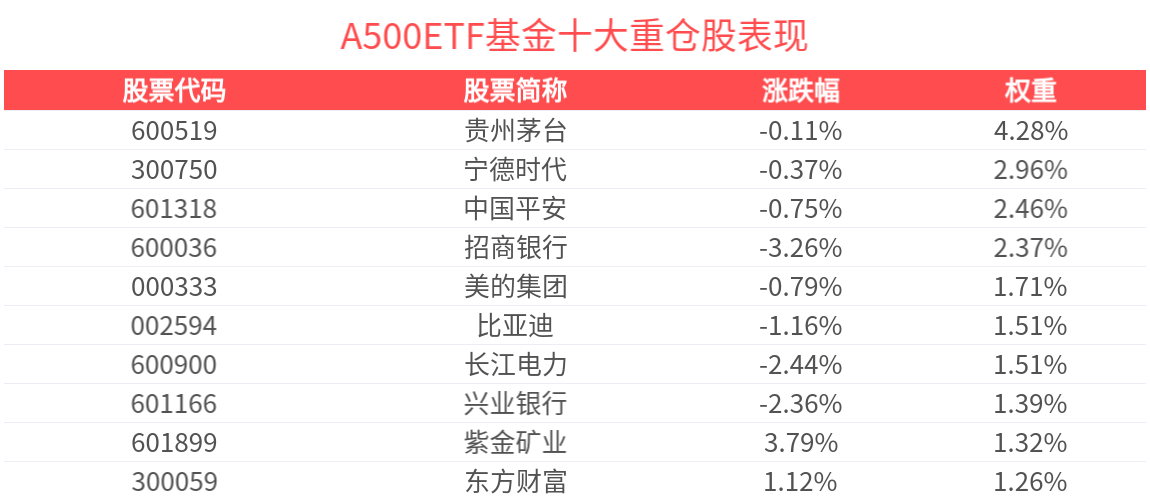
Market Overview - The CSI A500 Index (000510) rose by 0.08% as of June 27, 2025, with notable increases in stocks such as Longxin Technology (688047) up 15.19%, Huatian Technology (002185) up 10.06%, and Weining Health (300253) up 9.03% [1] - The A500 ETF Fund (512050) showed a trading volume of 33.51 billion yuan with a turnover rate of 20.12%, indicating active market participation [1] - Over the past year, the A500 ETF Fund has averaged a daily trading volume of 35.70 billion yuan, ranking first among comparable funds [1] Industry Insights - Investment opportunities in the second half of the year include: 1. Pharmaceutical and defense industries driven by overseas expansion logic 2. TMT sector benefiting from sustained high demand and reduced trading congestion 3. Banking sector opportunities supported by regulatory measures encouraging insurance capital entry and a low-interest-rate environment [2] - The A500 ETF Fund has seen net inflows in 4 out of the last 5 trading days, totaling 9.02 billion yuan, with an average daily net inflow of 1.80 billion yuan [2] Top Holdings - As of May 30, 2025, the top ten weighted stocks in the CSI A500 Index are: 1. Kweichow Moutai (600519) - 4.28% 2. CATL (300750) - 2.96% 3. Ping An Insurance (601318) - 2.46% 4. China Merchants Bank (600036) - 2.37% 5. Midea Group (000333) - 1.71% 6. Yangtze Power (600900) - 1.51% 7. Industrial Bank (601166) - 1.39% 8. Zijin Mining (601899) - 1.32% 9. Eastmoney Information (300059) - 1.26% 10. BYD (002594) - 1.51% - The top ten stocks account for a total of 21.21% of the index [2][4]
渤海证券研究所晨会纪要(2025.06.27)-20250627
BOHAI SECURITIES· 2025-06-27 01:52
Macro and Strategy Research - The overall economic operation is stable, with certain resilience shown under policy support. However, the export sector faces downward pressure and high base effects, while consumption is also under pressure due to reduced national subsidies and demand front-loading. Investment in infrastructure is expected to play a stabilizing role, and manufacturing is likely to maintain relatively high growth due to policy support [2][3] - Domestic monetary policy will focus on stabilizing growth and combating deflation, with expectations of continued liquidity easing. Interest rate cuts and reserve requirement ratio reductions are anticipated to be implemented as external conditions change [2][3] A-Share Market - The A-share market has maintained stable trading under the management's policy to "sustain stability and activate the capital market." The liquidity environment is gradually expanding, with a balanced investment and financing backdrop expected to yield better results in mergers, acquisitions, and the growth of the Sci-Tech Innovation Board [3] - The performance of the A-share market is expected to remain stable, supported by strong liquidity expectations. The market is likely to experience structural opportunities, with indices having conditions for a rebound as external risks are mitigated and trading becomes more active [3] - Investment opportunities in the second half of the year include sectors such as pharmaceuticals and defense driven by overseas expansion, TMT sectors benefiting from AI trends, and banking sectors supported by low interest rates and insurance capital market entry [3] Fund Research - As of June 18, 2025, the major indices in the A-share market showed mixed performance, with the Shanghai Composite Index rising by 1.11% and the ChiNext Index declining by 4.06%. The first half of 2025 saw frequent sector rotations, with technology and dividend themes alternating in performance [4][5] - Active equity funds outperformed indices, with ordinary stock funds and equity-mixed funds averaging over 5% gains. Bond funds showed slower growth, while QDII funds continued their strong performance from 2024, averaging a 10.44% increase [5][6] - By the end of Q1 2025, active equity fund positions increased compared to Q4 2024, with the highest over-allocated sectors being electronics, power equipment, food and beverage, and pharmaceuticals [6] Industry Research - The light industry and textile sectors outperformed the CSI 300 index as of June 24, 2025. The light industry saw a revenue decline of 0.78% year-on-year, while the textile sector experienced a 13.33% revenue drop [11][12] - The home appliance and electric two-wheeler sectors are expected to benefit from the deepening of the old-for-new policy, with significant growth in furniture retail sales [11][12] - The new consumption perspective highlights the emotional value and rise of domestic brands, particularly in the pet food market, which is projected to grow significantly by 2027 [12][13] - The investment strategy maintains a neutral rating for the light industry and textile sectors, with specific stocks recommended for "overweight" ratings, including Oppein Home (603833) and Sophia (002572) [13]
上半年广州甲级办公楼租赁市场净吸纳量约8万平方米
Zhong Guo Xin Wen Wang· 2025-06-26 10:26
Group 1 - The core viewpoint of the articles highlights the evolving demand structure in Guangzhou's Grade A office leasing market, driven by brand upgrades and overseas service needs, with a net absorption of approximately 80,000 square meters expected in the first half of 2025 [1][2] - The TMT (Technology, Media, and Telecommunications) sector continues to lead the office leasing market in Guangzhou, accounting for about 30% of the new leasing area, with significant contributions from e-commerce service providers such as enterprise management software companies and data analysis software firms [1] - Emerging business districts like Pazhou and Guangzhou International Financial City are maturing commercially and attracting TMT and professional service industries due to lower rental thresholds [1] Group 2 - The transformation and upgrading of Guangzhou's manufacturing sector are creating a new wave of demand for office space, driven by three types of enterprises: leading companies in niche markets, local gaming firms, and cross-border e-commerce leaders seeking iconic office spaces [2] - Six new Grade A office projects were launched in the first half of the year, primarily in Pazhou and Guangzhou International Financial City, with an expectation of over 400,000 square meters of new supply in the second half of 2025 [2]