
稀土

Search documents
稀土价格|镨钕价格持续上涨
Xin Lang Cai Jing· 2026-01-14 03:58
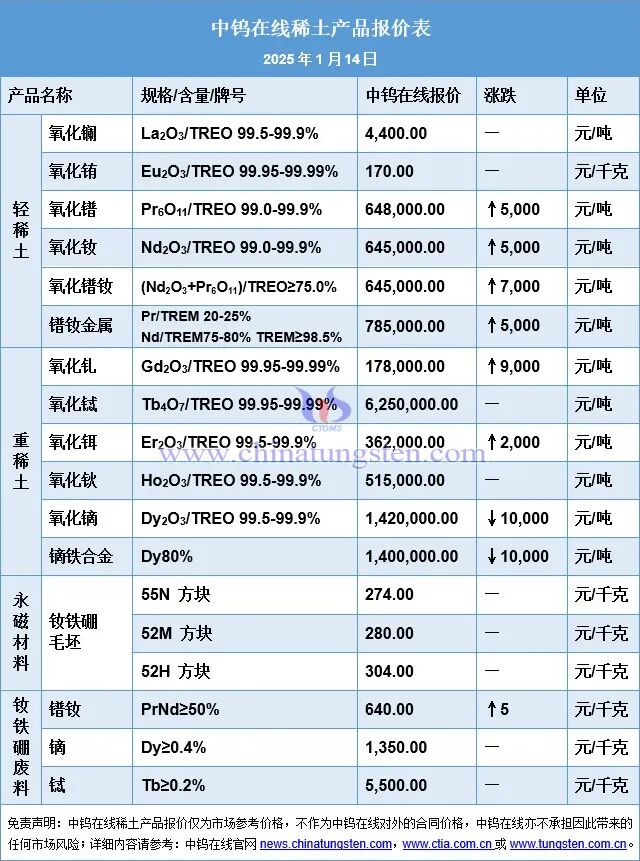
Core Viewpoint - The rare earth market is experiencing a strong performance with most product prices showing varying degrees of increase, particularly in praseodymium-neodymium oxide, praseodymium-neodymium metal, and gadolinium oxide, which have risen by approximately 7,000 yuan/ton, 5,000 yuan/ton, and 9,000 yuan/ton respectively [5][6]. Group 1: Light Rare Earth Market - The light rare earth market is seeing price increases due to tightening supply and rising trading prices for rare earth concentrates in northern regions, although the extent of price hikes has narrowed, prompting cautious operations among traders [2][6]. Group 2: Medium and Heavy Rare Earth Market - The medium and heavy rare earth market is showing a mixed trend with prices fluctuating; dysprosium and terbium prices are weak due to low downstream demand and limited supportive factors, while prices for gadolinium and holmium have increased due to rising praseodymium-neodymium prices [3][7]. Group 3: Industrial Producer Prices - According to the National Bureau of Statistics, in December 2025, the national industrial producer price index decreased by 1.9% year-on-year, with a narrowing decline compared to the previous month, while the month-on-month increase was 0.2%, showing an expanded growth rate [7].

稀土产品价格分化上涨,稀土ETF嘉实(516150)一键布局稀土产业链机遇
Xin Lang Cai Jing· 2026-01-14 02:56
Group 1 - The core viewpoint of the news highlights a significant increase in rare earth product prices, with the China Rare Earth Industry Index rising by 1.07% on January 14, 2026, driven by strong performances from key stocks such as Antai Technology and Xiamen Tungsten [1] - The average price of praseodymium and neodymium oxide increased by 11,200 yuan per ton to 636,100 yuan per ton, while the average price of praseodymium and neodymium metal rose by 11,700 yuan per ton to 772,400 yuan per ton [1] - The strategic importance of tungsten and rare earths in high-end manufacturing, new energy, and defense technology is emphasized, with China's management of mining quotas and export controls underscoring their value [1] Group 2 - As of December 31, 2025, the top ten weighted stocks in the China Rare Earth Industry Index accounted for 60.4% of the index, including Northern Rare Earth, Goldwind Technology, and Xiamen Tungsten [2] - The Jiashi Rare Earth ETF (516150) closely tracks the China Rare Earth Industry Index, providing a convenient tool for investors to access the domestic rare earth industry chain [2] - The formation of a MACD golden cross signal indicates a positive trend for these stocks, suggesting potential investment opportunities [2]
渤海证券研究所晨会纪要(2026.01.14)-20260114
BOHAI SECURITIES· 2026-01-14 02:37
Fixed Income Research - The issuance rates for credit bonds have generally increased, with changes ranging from 0 BP to 8 BP, leading to a significant increase in credit bond issuance volume due to a low base effect [2] - The net financing amount for credit bonds has increased, while the net financing for targeted tools has decreased; corporate bonds have a negative net financing amount, while other types have positive net financing [2] - The secondary market saw an increase in transaction amounts for credit bonds, with most types experiencing growth [2] - Credit spreads have narrowed for most mid-term notes, corporate bonds, and urban investment bonds, as credit bonds continue to perform better than interest rate bonds [2] - The overall conditions for a bear market in credit bonds are insufficient, with a long-term downward trend in yields expected [2] Company Research: WuXi AppTec (药明康德) - WuXi AppTec expects to achieve a revenue of approximately 45.456 billion yuan in 2025, representing a year-on-year growth of about 15.84%, with continuous operating business revenue expected to grow by approximately 21.40% [6][7] - The adjusted non-IFRS net profit is projected to be around 14.957 billion yuan, a year-on-year increase of about 41.33%, while the net profit attributable to shareholders is expected to reach approximately 19.151 billion yuan, reflecting a growth of about 102.65% [6][7] - The strong growth is attributed to the advantages of the CRDMO model, with a focus on integrated services and continuous optimization of production processes [7] - The company plans to focus on its CRDMO business model and has sold parts of its equity in joint ventures, contributing to its profit growth [7] Industry Research: Metal Industry - The steel industry is expected to maintain production levels due to acceptable profit margins, although demand is in a seasonal decline [13] - Copper prices are influenced by market sentiment and resource competition, with potential for high volatility [13] - Aluminum prices are supported by high copper prices and strategic resource concerns, while supply remains ample [13] - Gold prices are expected to remain strong due to geopolitical risks and mixed U.S. employment data [13] - The rare earth market is anticipated to strengthen due to export control measures and strategic importance [14]






中国给了你机会,你却去求日本?有冯德莱恩在,欧洲不亡天理难容
Sou Hu Cai Jing· 2026-01-13 19:41
Core Viewpoint - The European Union (EU) has shifted its focus from negotiating with China on rare earth issues to engaging with Japan, indicating a lack of optimism regarding substantial concessions from China [1][3]. Group 1: EU's Strategy and Negotiation Dynamics - EU leaders, under Ursula von der Leyen, have prioritized talks with Japan before visiting China, signaling a strategic approach to enhance their bargaining position [1][3]. - The EU's collaboration with Japan is framed as "strategic cooperation," emphasizing "economic security," "critical raw materials," and "supply chain resilience," with rare earths formally included in the political discourse [3][5]. - The EU's understanding of rare earths remains superficial, focusing on mining rather than refining, which is crucial for reducing dependency on China [5][7]. Group 2: China's Dominance in Rare Earths - China's strength lies not in resource availability but in its comprehensive industrial chain, which includes mining, refining, and downstream manufacturing, developed over decades [7][9]. - The EU's avoidance of reality regarding China's dominance is evident, as exemplified by the Caremag project in France, which has limited capacity and relies on Japanese investment [7][9]. - Japan's own rare earth projects are still in experimental stages, indicating a long path to commercialization and limited immediate impact on global supply [9][11]. Group 3: Implications for European Industry - The rising prices of rare earths will primarily impact European manufacturing sectors, particularly automotive and renewable energy, potentially leading to a loss of market share due to increased costs [15][17]. - Germany, as a major manufacturing nation, faces significant challenges due to its high dependency on rare earths, highlighting the industrial implications of the EU's political stance [15][17]. - The current global supply chain for rare earths shows no signs of "de-China-ization," with technological and efficiency advantages still concentrated in China [17][19].

厦门钨业股份有限公司关于向控股子公司金龙稀土增资暨关联交易的进展公告
Shang Hai Zheng Quan Bao· 2026-01-13 18:47
登录新浪财经APP 搜索【信披】查看更多考评等级 股票代码:600549 股票简称:厦门钨业 公告编号:临-2026-001 厦门钨业股份有限公司 关于向控股子公司金龙稀土增资 暨关联交易的进展公告 五、金龙稀土本次股票定向发行的募集资金应当用于定向发行说明书披露的用途。 本次发行系金龙稀土全体原股东同比例认购,公司持有金龙稀土的股份数增加,持股比例保持不变,仍 是金龙稀土的控股股东。公司将严格按照有关法律、法规的要求在规定期限内办理本次参与金龙稀土在 全国股转公司定向发行相关事宜,并及时履行信息披露义务。敬请广大投资者关注,并注意投资风险。 特此公告。 厦门钨业股份有限公司 2025年11月18日,厦门钨业股份有限公司(以下简称"公司")第十届董事会第二十次会议审议通过了 《关于向控股子公司金龙稀土增资暨关联交易的议案》,同意公司控股子公司福建省金龙稀土股份有限 公司(简称"金龙稀土")实施股票定向发行方案,金龙稀土全体股东均按各自的原持股比例认购本次发 行股票。同日,公司与金龙稀土签署了《附生效条件的股份认购协议》。具体详见公司2025年11月19日 于上海证券交易所网站(www.sse.com.cn)披 ...

2026年1月13日稀土主流产品价格变动:氧化镨钕均价64.27万元/吨上涨0.66万元/吨
Jin Rong Jie· 2026-01-13 10:52
Group 1 - The core viewpoint of the article indicates a significant increase in the prices of rare earth products, with specific products like praseodymium and neodymium oxide seeing a rise in average prices, while dysprosium and terbium oxides experienced slight declines [1] - Praseodymium-neodymium oxide averaged 642,700 CNY per ton, up by 6,600 CNY per ton, and praseodymium-neodymium metal averaged 780,000 CNY per ton, up by 7,600 CNY per ton [1] - The market sentiment for rare earths is warming, with downstream raw material procurement demand expected to be released, indicating potential for continued price strength in the near term [1] Group 2 - The A-share market shows positive performance for certain rare earth permanent magnet concept stocks, with Zhongmin Resources (002738) rising by 5.09% and achieving a transaction volume of 3.313 billion CNY [1] - Yahua Group (002497) increased by 3.66% with a transaction volume of 2.505 billion CNY, while Antai Technology (000969) rose by 2.09% with a transaction volume of 610.8 million CNY [1] - The overall trading activity in the rare earth sector reflects a mixed performance, with some stocks showing significant gains while others remain relatively stable [1]


G7财长就降低对中国稀土的依赖达成一致
日经中文网· 2026-01-13 07:53
Core Viewpoint - The G7 and resource-rich countries have reached a consensus to rapidly reduce dependence on China for critical minerals, emphasizing the need for collaboration among like-minded nations to enhance supply chains [2][4]. Group 1: Meeting Outcomes - The meeting included finance ministers from G7 countries and other nations such as Australia, India, South Korea, and Mexico, representing 60% of global demand for critical minerals [4]. - Japan's Finance Minister, Shunichi Suzuki, stated that there is an agreement among countries to swiftly lower reliance on China for important minerals [4]. - A roadmap to eliminate dependence on Chinese products by 2025 has been established, focusing on creating stable supply chains and setting procurement standards that protect labor rights [4]. Group 2: Proposed Measures - Discussions are ongoing regarding the establishment of "minimum prices" for critical minerals produced by G7 countries to protect markets from low-priced Chinese products [4]. - The U.S. Department of Defense has signed an agreement with MP Materials to cover the price difference if the market price of certain rare earths falls below the established minimum price [4]. - Participating countries will also explore joint efforts in developing mines that require significant funding and time, as well as identifying stable procurement partners [4].

美牵头10多国,要打响对华稀土反击?日本高兴早了,德国开出条件
Sou Hu Cai Jing· 2026-01-13 05:41
尝过了被中国卡脖子的滋味后,美国扬言要摆脱对华稀土依赖,并拉上10多个盟友准备打响反击战,但这一目标能否如愿实现呢? 1月12日,美国财长贝森特主持了七国集团(G7)财长会议,会议一开始便明确了主题——稀土!根据美国高级官员透露,贝森特计划在会议上敦促G7国家 及其他民主伙伴,必须正视眼前的危机,加大力度减少对中国的关键矿产依赖。除了G7成员国,印度、韩国、墨西哥、澳大利亚以及欧盟的财政部长和高 级官员也参与了此次会议。这些国家对稀土的需求占全球需求的60%,稀土对他们来说是不可或缺的资源。而中国恰恰是这些国家稀土及相关产品的最大供 应国,一旦中国收紧稀土出口,G7和欧盟的日子可想而知会有多艰难。 所以,美国抓住这个时机召开G7财长会议,意图商讨反击大计,联合盟友们在中国面前夺回一局。美国显然是有所准备的,除了邀请G7盟友外,还特别拉 上了印度和澳大利亚等国家。每个国家都有自己的独特优势,比如澳大利亚,虽然其他资源不多,但矿产丰富。去年中美稀土战激烈时,澳大利亚主动向美 国伸出了援手,签署了《美澳关键矿产框架协议》,动用85亿美元的稀土和锂矿储备,帮助美国度过供应链危机。因此,这一次会议,美国特别为澳大利亚 ...

稀土观点更新-涨价或提前加速
2026-01-13 05:39
Summary of Rare Earth Industry Conference Call Industry Overview - The conference call focused on the rare earth industry, particularly the impact of geopolitical tensions on pricing and supply dynamics [1][2]. Key Points and Arguments - **Price Surge Expectations**: Anticipation of a price increase for rare earth elements due to China's sanctions against Japan, which may lead to a price spike similar to historical events caused by supply shortages. A minimum price increase of 600,000 to 900,000 RMB is expected in the first half of 2026, with potential for prices to exceed 1 million RMB due to excess inventory [1][2]. - **Geopolitical Tensions**: Ongoing U.S.-China sanctions and China's retaliatory measures against Japan contribute to market uncertainty, supporting the case for rising rare earth prices. Historical precedents indicate that sanctions have previously led to significant price increases [2]. - **Supply Constraints**: Domestic supply is tightly controlled due to policy restrictions, with an increase in the proportion of recycled materials. The growth potential of imported ores is limited due to various challenges, including political instability and resource depletion [1][4][5]. - **Demand Growth**: Strong structural growth in demand for rare earths is noted in the electric vehicle and industrial robotics sectors, with 47% of downstream demand expected to come from electric vehicles in 2024. The industry is experiencing a significant increase in stocking demand, with price acceptance levels rising [6][7]. Investment Recommendations - Recommended companies for investment include: - Guangsheng Youse (now known as Zhongxi Youse) - Life Resources - Pure North-side companies such as Beixi, Baogang, and Zhongxi - In the resource and deep processing sectors, a focus on resources with some emphasis on deep processing is advised [3]. Supply-Side Considerations - **Domestic Quotas**: The distribution of domestic quotas for 2026 is expected to be broad, but overall growth will be slow due to tightened supply conditions [4]. - **Recycling Capacity**: There has been a notable increase in recycling capacity, with the proportion of recycled oxides rising from 25% to approximately 30% [4]. - **Import Limitations**: The potential for increased imports from Myanmar is limited due to various issues, while U.S. exports to China have effectively ceased [4]. Demand-Side Considerations - **Inventory Levels**: Current industry inventory is at a moderately low level, not exceeding two to three months of consumption, with expectations for stocking demand around the Lunar New Year and the second quarter [6]. - **Export Fluctuations**: Export volumes have shown significant volatility, with a recovery noted after regulatory impacts in the Middle East [7]. Price Forecasts - Expectations for neodymium oxide prices to reach 700,000 RMB by the end of the first quarter, with recent price increases observed [8]. - The price of dysprosium has decreased due to reduced downstream demand, particularly in the electric vehicle and wind power sectors [9]. Commercial Aerospace Demand - The commercial aerospace sector's demand for rare earth elements is primarily focused on high-grade materials for gyroscopes and flywheels, as well as structural components for satellites [10]. Overseas Industry Developments - Despite holding 70% of global reserves, overseas mining and refining progress is slow, with China maintaining a dominant position in production [11][12]. China's Competitive Advantages - China leads in rare earth production, accounting for 90% of global output, with a focus on recycling and established mining operations compared to overseas projects [12]. This summary encapsulates the critical insights from the conference call regarding the rare earth industry, highlighting the interplay of geopolitical factors, supply-demand dynamics, and investment opportunities.
金属|从商品到战略资产
2026-01-13 05:39
Summary of Key Points from Conference Call Records Industry Overview - **Metals Sector**: The focus is on precious metals, industrial metals, and energy metals, with a positive outlook for 2026, particularly for gold, silver, copper, aluminum, and lithium [1][2][3][4]. Core Insights and Arguments - **Precious Metals Demand**: Expectations of interest rate cuts and geopolitical risks are driving demand for precious metals, particularly gold. Central banks are increasing gold reserves, and ETF purchases are expected to be a significant source of demand in 2026. Recommended stocks include Zhaojin Mining, Shandong Gold, and others [1][7]. - **Silver Price Volatility**: Silver prices are expected to rise but with greater volatility compared to gold. The potential impact of U.S. tariffs may increase hoarding demand for silver [7][8]. - **Industrial and Energy Metals Outlook**: The outlook for industrial metals like copper and aluminum is positive due to expected recovery in traditional demand and macroeconomic support from interest rate cuts. Recommended stocks include Yun Aluminum and Wanfang [3][4][19][20]. - **Supply Challenges**: The supply side for industrial and energy minerals faces challenges such as declining resource grades, rising extraction costs, and geopolitical instability. These factors are expected to support prices [5][9]. - **Lithium Demand Dynamics**: The cancellation of export tax rebates is leading to a surge in short-term demand for lithium batteries, with prices expected to rise significantly. Long-term impacts are anticipated to stabilize as foreign buyers absorb costs [10][11][12]. - **Nickel Market Dynamics**: Nickel prices are under pressure due to quota adjustments by the Indonesian government, which may limit price increases. However, the market remains worth monitoring [13]. - **Copper Price Trends**: Recent copper prices have shown strength, influenced by U.S. economic data and supply disruptions in South America. Long-term expectations are for price increases driven by macroeconomic conditions [14][15]. - **Tin Price Surge**: Tin prices have risen significantly due to supply constraints and strong demand in AI and PVD applications. Recommended stocks include Xie Co., Huaxi Co., and Xingye Silver Tin [16]. - **Tungsten Price Trends**: Tungsten prices are expected to remain high due to tight supply and increasing demand in strategic sectors. Recommended stocks include Xiamen Property and Jiaxing International Resources [17][18]. - **Aluminum Market Performance**: Aluminum prices have reached new highs, supported by macroeconomic policies and geopolitical risks. The market is expected to remain tight in 2026, with recommended stocks including Yun Aluminum and Tianshan Aluminum [19][20]. - **Rare Earth Market Dynamics**: Rare earth prices have increased due to policy impacts and basic demand recovery. The simplification of export licenses is expected to enhance export efficiency and support demand [21][22][23][24]. Additional Important Insights - **Steel Industry Trends**: The steel industry is experiencing a rise in inventory and production levels, with profitability slightly declining but still above historical lows. The focus is on companies with strong cash flow and dividend yields [25][26][27][28]. - **Geopolitical Impacts**: Recent geopolitical tensions and trade policies are influencing metal prices and demand dynamics, particularly in the context of U.S.-China relations [2][6][8]. This summary encapsulates the key insights and trends discussed in the conference call records, providing a comprehensive overview of the current state and future outlook of the metals industry.