自动驾驶

Search documents
自动驾驶,利好来了!上海发布行动计划
Zheng Quan Shi Bao· 2026-01-14 14:50
Core Insights - Shanghai aims to establish itself as a global leader in high-level autonomous driving by 2027, with significant advancements in technology and industry competitiveness [1][4]. Group 1: Action Plan Overview - The "Mosu Zhixing" action plan outlines a strategy for accelerating the transformation of autonomous driving technology into industrial competitiveness, focusing on model-driven leadership and policy support [1]. - By 2027, the plan targets the large-scale application of L4 autonomous driving in public transport and logistics, with over 600 million passenger trips and 80,000 TEU in cargo transport [1]. Group 2: Expansion of Testing Areas - The plan includes the gradual expansion of autonomous driving testing areas, with a focus on the full opening of the Pudong New Area and other regions like Fengxian and Minhang [2]. - As of December last year, Shanghai has opened approximately one-third of its urban area for autonomous driving testing, with a new platform for real-time traffic signal data to support development [2]. Group 3: Infrastructure and Application Scenarios - By December 2025, Shanghai aims to have 3,173 open testing roads covering 5,238.82 kilometers, facilitating a comprehensive testing environment for autonomous vehicles [3]. - The action plan encourages the organization of smart taxi operations and the trial of L3 autonomous passenger vehicles, as well as the transition of intelligent heavy trucks from semi-autonomous to fully autonomous operations [3]. Group 4: Automotive Industry Development - The plan emphasizes the creation of a world-class automotive industry cluster, focusing on regions like Pudong, Jiading, and Lingang, and promoting the development of key components and software for smart connected vehicles [4]. - It aims to foster innovation in automotive technology, including high-performance chips and operating systems, while supporting the growth of specialized and competitive enterprises [4]. Group 5: Financial Support and Market Growth - The action plan encourages investment in smart connected vehicles and key component startups, promoting diverse financing channels for enterprise development [5]. - By 2024, Shanghai's automotive industry is projected to reach a production value of 703.5 billion yuan, with a cumulative promotion of 1.645 million new energy vehicles, maintaining its position as a global leader [5].


2.9亿吞下吉利系两资产,曹操出行回避了正面战场?
3 6 Ke· 2026-01-14 11:13
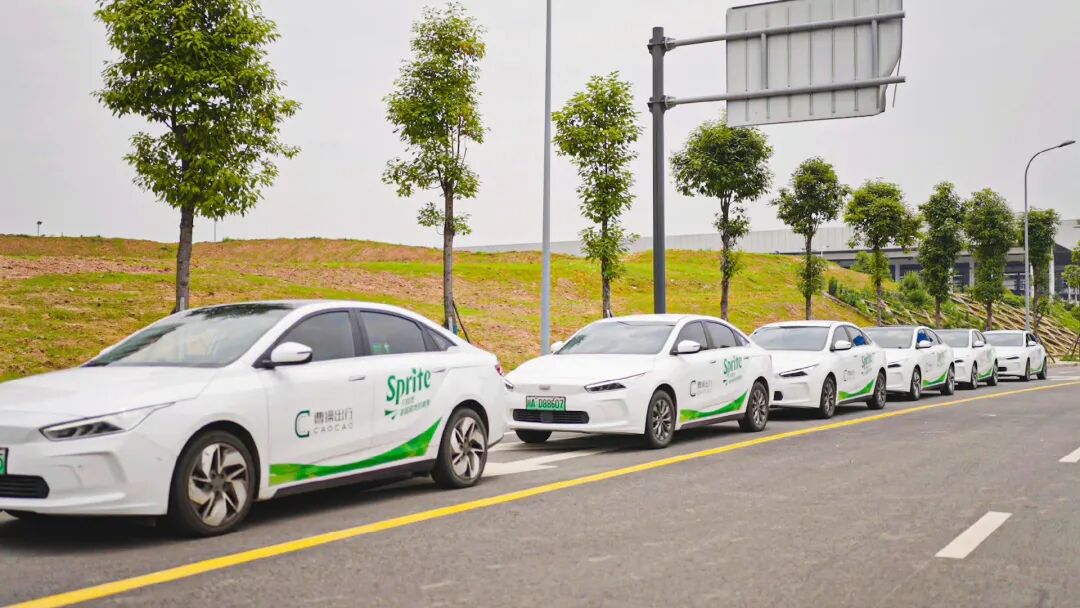
Core Viewpoint - Caocao Travel (02643.HK) has announced its first major acquisition post-IPO, acquiring Geely's Yao Travel and Zhejiang Geely Business Services for a total of 290 million RMB in cash [1][2]. Group 1: Acquisition Details - The acquisition includes 100% of Yao Travel for 225 million RMB and all shares of Geely Business Services for 65 million RMB [6]. - Yao Travel focuses on high-end business travel and is a luxury travel brand launched by Mercedes-Benz and Geely, while Geely Business Services provides corporate travel management solutions [2][6]. - Following the acquisition, Mercedes-Benz will completely exit its equity structure in Yao Travel [2]. Group 2: Financial Performance - Caocao Travel reported a revenue of 9.456 billion RMB for the first half of 2025, a year-on-year increase of 53.5%, but incurred a loss of 495 million RMB, although the loss is narrowing [4]. - Yao Travel is projected to incur a cumulative after-tax loss of over 115 million RMB for 2023 and 2024 [6]. - Geely Business Services is expected to see a significant profit decline of 47.87% in 2024 compared to 2023, with an estimated after-tax profit of 23.3 million RMB [8]. Group 3: Strategic Direction - The acquisition signals Caocao Travel's commitment to expanding its B2B business travel segment, aiming to create a comprehensive "one-stop technology travel platform" [4]. - The company aims to achieve threefold synergy through the integration of the two acquired entities, enhancing product offerings and client conversion [8]. - The business travel market in China is projected to exceed 3.5 trillion RMB in 2025, with a compound annual growth rate of over 11% [9]. Group 4: Market Position and Challenges - Despite being among the top three ride-hailing platforms in China, Caocao Travel holds only 5-6% of the market share, with over 50% controlled by Didi [11]. - The company faces significant reliance on external aggregation platforms for traffic, with commission payments to these platforms rising from 3.2 billion RMB in 2022 to 10.4 billion RMB in 2024 [12]. - The increasing commission fees paid to aggregation platforms have raised concerns about the company's bargaining power and profitability [13]. Group 5: Future Prospects in Autonomous Driving - Caocao Travel is positioning autonomous driving as a long-term strategic focus, with plans to establish five operational centers globally and achieve a transaction volume of 100 billion RMB over the next decade [15][16]. - The global autonomous vehicle market is expected to grow significantly, with a projected market size of 15.23 billion USD by 2026 [15]. - The company is leveraging Geely's comprehensive support across various dimensions, including vehicle costs and technology, to build a competitive edge in the autonomous driving sector [17].
光环褪去,理性回归,自动驾驶驶入“务实”新阶段
3 6 Ke· 2026-01-14 10:43
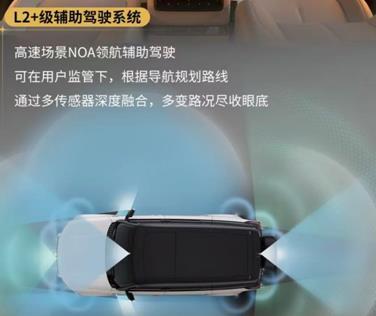
Core Insights - The global autonomous driving industry is transitioning from technical feasibility to building a profitable, safe, and widely accepted ecosystem, as evidenced by recent developments in L3-level conditional autonomous vehicles in China, Tesla's plans for production of vehicles without steering wheels or pedals, and Waymo's expansion of its autonomous taxi service network [1] Group 1: Commercialization Timeline - The expectation for the commercialization timeline of autonomous driving has been significantly pushed back, with most applications now projected to be delayed by 1-2 years compared to previous forecasts [2] - Global large-scale commercialization is now expected to be delayed from 2029 to 2030, with L4-level pilot programs for private passenger cars pushed from 2030 to 2032 [2] Group 2: Regional Disparities - The development of autonomous driving is showing regional differences, with China and the U.S. leading due to faster development cycles, active capital and startup ecosystems, and favorable regulatory environments [3] - Experts predict that widespread commercialization of autonomous taxis globally will take an additional 3 to 7 years, with China and the U.S. expected to significantly lead in most application scenarios [3] Group 3: Market Focus Shift - The focus of the private passenger car market is shifting from L3 systems to L2+ (enhanced advanced driver-assistance systems), with 49% of experts believing L2+ will be the core of the market by 2035 [4] - This shift is attributed to slower-than-expected cost reductions for L3 systems and high development and validation costs [4] Group 4: Cost Expectations - Cost expectations for achieving L4 and above autonomous driving have been significantly raised, particularly in the area of autonomous trucks, with cost estimates increasing by 50%-60% [5] - The cost of software development for lower-level autonomous driving is estimated to be 4 to 7 times lower than for higher-level systems, with the investment for fully autonomous driving potentially exceeding $3 billion [5] Group 5: Industry Challenges - High costs have emerged as the primary challenge in the development process of advanced driver-assistance systems (ADAS), surpassing technical issues and liability concerns [6] - The need for a clear industry responsibility framework is becoming increasingly urgent, as product liability and regulatory uncertainties rank as medium-level pain points [6] Group 6: Technological Pathways - There is a consensus among experts that China is likely to develop an independent technology stack for ADAS, driven by local consumer interest and a complete domestic supply chain [8] - A mixed architecture approach, combining "end-to-end" AI models with traditional algorithms, is seen as the pragmatic choice for future development, with 78% of experts favoring this model [9] Group 7: Strategic Recommendations - Industry participants are advised to maintain agility in response to rapid changes in technology, regulations, and costs [10] - Focusing on core competencies and fostering open collaboration is essential during the industry consolidation phase [11] - Emphasizing customer value and addressing real user pain points is crucial for future success [12] - Collaboration with regulatory bodies to establish clear safety standards and responsibility frameworks is necessary for scaling [13]
打开微信叫一辆Robotaxi “文远出行”小程序上线
Zheng Quan Ri Bao Wang· 2026-01-14 10:13
Core Viewpoint - The launch of the "Wenyan Travel" mini-program marks a significant step for Robotaxi service provider, Wenyan Zhixing, in making autonomous driving more accessible to users through WeChat integration [1] Group 1: Service Launch - On January 14, the "Wenyan Travel" mini-program was officially launched, allowing users to call Wenyan Zhixing's Robotaxi service without downloading a separate app [1] - The service is currently available in operational areas such as Guangzhou and Beijing, enhancing user convenience [1] Group 2: User Experience - The transition from a standalone app to a WeChat mini-program aims to provide a more flexible and convenient way for users to experience autonomous driving services [1] - By leveraging WeChat's large user base and frequent usage, the mini-program is expected to lower the barriers for users to experience Robotaxi services [1] Group 3: Technology Trust - The "Wenyan Travel" mini-program is designed to improve user awareness and trust in Wenyan Zhixing's autonomous driving technology [1]
中国智能驾驶国际化加速 轻舟智航海外多个市场落地
Zhong Guo Jing Ji Wang· 2026-01-14 09:55
Group 1 - Qizhou Zhihang is a leading provider of advanced driver-assistance systems (ADAS) in China, with nearly one million units deployed, maintaining a strong market share in the NOA segment of the passenger car market [1] - The ADAMAS product from Jishi is set to launch in China by the end of 2025, having already been introduced in five Middle Eastern countries, with a price exceeding $80,000 and monthly orders surpassing 2,000 units [3] - The collaboration between Jishi and Qizhou Zhihang allows for significant reductions in R&D costs and deployment timelines for overseas models, leveraging proven technology validated by nearly one million domestic users [4] Group 2 - The ADAMAS model features L2+ level intelligent driving capabilities as standard, covering essential driving scenarios such as highways, urban areas, and parking, marking a significant advancement in smart mobility technology [3] - Jishi has successfully entered over 40 international markets, establishing a sales network across key regions including the Middle East, Central Asia, and North Africa, with a consistent sales growth over the past 12 months [3] - The partnership is a strategic win-win for both companies, enabling rapid adaptation to local consumer demands for advanced driving features in overseas markets [4]
美股异动丨文远出行盘前涨超1% 微信小程序正式上线 机构看好ROBOX商业化落地
Ge Long Hui· 2026-01-14 09:37
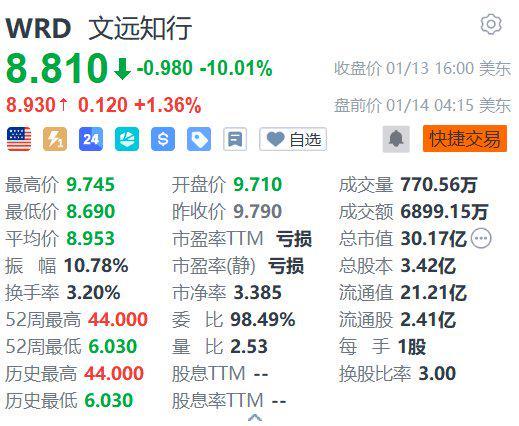
Group 1 - The core viewpoint of the article highlights that the Robotaxi service "Wen Yuan Travel" has officially launched, allowing users to access the service through WeChat without needing to download a separate app [1] - The stock price of Wen Yuan Zhi Xing (WRD.US) increased by 1.36% to $8.93 in pre-market trading, indicating positive market sentiment following the service launch [1] - Dongwu Securities has released a report suggesting that the Robotaxi sector is accelerating towards a commercial turning point, with a clear path to profitability for leading companies like Wen Yuan Zhi Xing [1] Group 2 - The company is positioned as a leader in Robotaxi technology and is expected to benefit from gradual policy openings, continuous breakthroughs in autonomous driving technology, and cost reductions in the supply chain [1] - The report indicates that once the unit economic model turns positive, the company could rapidly scale up and achieve profitability [1] - The stock's trading data shows a market capitalization of $3.017 billion, with a trading volume of 7.7056 million shares and a price fluctuation of 10.78% [1]

特斯拉(TSLA.US)FSD大转向:从“买断”全面改为订阅 拟于2月14日后生效
Zhi Tong Cai Jing· 2026-01-14 09:21
不过,值得注意的是,虽然市场对于特斯拉估值与基本面前景的展望已经全面转向基于特斯拉独家AI 超算体系打造的FSD全自动驾驶、Robotaxi(完全无人自动驾驶出租车),以及名为"擎天柱"的特斯拉AI 人形机器人,特斯拉电动车销量与汽车业务基本面并未被削弱到无足轻重,它仍是当前现金流与资产负 债表的支柱,也是FSD数据闭环与车队规模的基础(Robotaxi最终也要落到可规模化的车辆产能与运 营)。 此举将取消FSD高达约8000美元的一次性买断费用,大幅降低用户体验该技术的初始门槛。尽管命名 为"全自动驾驶",该技术目前仍需驾驶员持续监控并随时准备接管。 在面临销售增长乏力的背景下,特斯拉正将其战略重心转向以科技为核心的增长点,如FSD、无人驾驶 出租车和机器人业务。去年,特斯拉已将全球最大电动汽车制造商的头衔让位于中国的比亚迪 (002594)。 特斯拉公司(TSLA.US)宣布将彻底改变其高级驾驶辅助系统"全自动驾驶"(FSD)的销售模式,全面转向 月度订阅服务。首席执行官埃隆·马斯克在社交媒体平台X上公布了这一转变,计划于2月14日后生效。 马斯克未具体说明决策原因,该服务目前月度费用为99美元。 ...

图森未来智驾方案解析:感知、定位、规划和数据闭环
自动驾驶之心· 2026-01-14 09:00
Core Insights - The article emphasizes the importance of probabilistic perception and control in autonomous driving, advocating for a tight coupling between perception and control systems to enhance safety and decision-making [10][11][12]. Technical Approach - The core idea is to output a probability distribution rather than a single deterministic result, allowing the system to quantify its uncertainty and make informed decisions based on that uncertainty [10][11]. - The system should output key features of obstacles, including position, speed, size, and category, along with their uncertainties, which are crucial for safety decisions [11]. Challenges - Major challenges include algorithm limitations, sensor noise, and the inherent ambiguity of the environment, which can lead to uncertainty in perception [15]. - Developing algorithms that can naturally output probability distributions and optimizing planning and control algorithms to utilize uncertainty information effectively are critical [15]. Case Study - A case study illustrates the difference between traditional deterministic approaches and probabilistic outputs in handling a stationary vehicle potentially encroaching into the lane, highlighting the advantages of probabilistic decision-making [14][16]. Sensor Fusion and Localization - The article discusses the significance of multi-sensor fusion for precise localization, combining data from LiDAR, cameras, RTK GNSS, IMU, and wheel speed sensors to achieve robust positioning [46][47]. - The proposed solution includes a self-developed RTK GNSS tightly coupled localization scheme that enhances robustness against GNSS signal loss [49][53]. Prediction and Planning - The article outlines two main prediction methodologies: rasterized representation and vectorized representation, each with its strengths and weaknesses in modeling traffic interactions [60][65]. - A hybrid approach is suggested, utilizing both methods to adapt to different driving environments, ensuring effective modeling of structured and unstructured roads [75][77]. Control Strategies - The article introduces a closed-loop control system that adapts to real-time vehicle dynamics, enhancing robustness compared to traditional open-loop control methods [91][92]. - The system incorporates adaptive feedback control and online learning to continuously optimize control strategies based on vehicle performance and environmental conditions [99][100]. Simulation and Testing - End-to-end simulation is emphasized as a crucial component for testing the entire algorithm system, allowing for comprehensive evaluation and refinement of the autonomous driving framework [106][108].

关于2026年科技行业的12个关键问答:AI、自动驾驶、机器人、世界模型、美股......
Tai Mei Ti A P P· 2026-01-14 08:08
Group 1 - The core discussion revolves around the technological landscape of AI and autonomous driving, focusing on the anticipated developments in 2026 and the implications for investment opportunities [1][2][3] - The transition from theoretical discussions about AI, such as Scaling Law, to practical applications is highlighted, with industry leaders emphasizing the need for localized and practical AI solutions [2][5] - The concept of "DeepSeek Moment" signifies a shift away from the dominance of major tech companies in AI model development, suggesting that innovation may increasingly occur outside these established firms [3][4] Group 2 - The debate on whether Meta should focus on model development or application capabilities reflects broader strategic challenges faced by tech giants in the evolving AI landscape [6][7][8] - The performance of Google's Gemini and its integration with TPU showcases the importance of efficient computing solutions in the AI sector, indicating a potential shift in market dynamics [29][30] - The discussion on the operational costs of autonomous driving technologies, particularly comparing Tesla and Waymo, underscores the significance of long-term operational efficiency and maintenance in evaluating investment potential [24][25][26] Group 3 - The potential for AI applications to emerge as "killer apps" in 2026 is debated, with emphasis on the need for applications that integrate seamlessly into workflows rather than merely enhancing existing functionalities [10][11] - The financial landscape for AI investments is characterized by a belief in the ongoing growth of AI capabilities, with concerns about potential market corrections if expectations are not met [32][34] - The macroeconomic risks, including geopolitical factors and monetary policy changes, are identified as critical elements that could impact the tech sector's performance in 2026 [34][35]

打开微信叫一辆Robotaxi,「文远出行」小程序上线
Ge Long Hui· 2026-01-14 05:45
Core Insights - The launch of the "Wen Yuan Travel" mini-program for Robotaxi services allows users to easily access autonomous driving services through WeChat without needing to download a separate app [1][24]. Group 1: Service Overview - Users can search for "Wen Yuan Travel" in WeChat to access the mini-program and call Robotaxi services in cities like Guangzhou and Beijing [1][6]. - The mini-program features a five-step process for booking a ride, including searching for the service, smart ride-hailing, real-time tracking, safe boarding, and convenient payment [1][9][12][20][24]. Group 2: User Engagement and Promotions - To encourage user engagement, Wen Yuan Travel has launched several promotional activities, including a New Year experience event where users can earn JD.com gift cards by sharing their Robotaxi experiences on social media [24][32]. - The "Invite a Friend" campaign allows users to invite new friends to register, offering them a special 1 yuan ride experience while the inviter receives a 50 yuan ride coupon [32][34]. - New users can receive multiple ride coupons upon registration, enhancing the incentive to try the Robotaxi service [34].