新能源

Search documents
「碳访」朗玛峰创投董本京:绿色金融要从“政策输血”走向“市场造血”
Hua Xia Shi Bao· 2026-02-13 09:52
Core Insights - The low-carbon sector is transitioning from policy-driven initiatives to a new model for venture capital investment, with a focus on long-term returns and high-growth opportunities [2][3] - The main pain point in green finance is the short-term unprofitability of early-stage low-carbon projects, which affects market participation and overall investment efficiency [2][3] Investment Landscape - The current investment trend is heavily focused on mature assets, particularly in wind and solar energy, leading to suboptimal investment outcomes [3] - The two key pathways to achieving carbon neutrality are electrification in applicable sectors and hydrogen adoption in sectors where electrification is challenging [4][5] - By 2050, it is projected that China's electrification rate will exceed 60%, driving electricity prices towards parity, while hydrogen energy will gradually replace gray hydrogen [4][5] Challenges in Hydrogen Sector - The hydrogen industry faces significant challenges, primarily due to high production costs and a lack of robust market demand for green hydrogen applications [5][6] - Current policies encourage hydrogen use, but there is a lack of legally mandated markets, which hampers investment in downstream applications [5][6] Investment Strategy - Investors should focus on high-value applications within the hydrogen market and prioritize sectors with strong policy backing to ensure stable demand [5][6] - The investment approach should involve a comprehensive understanding of the entire industry chain, comparing technologies and market positions of potential investment targets [6][7] Future Outlook - The "14th Five-Year Plan" period presents opportunities for investment in low-carbon projects, but the focus should be on identifying high-growth, high-barrier sectors rather than following consensus-driven opportunities [8][9] - The long-term vision for China's energy landscape suggests a shift towards becoming a global leader in green energy production and standards, with a focus on sustainable returns for investors [8][9]


中国企业家首获能源界“诺贝尔奖”, 中国新能源重塑文明繁荣新底座
起点锂电· 2026-02-13 08:51
Core Viewpoint - The article highlights the recognition of Zhang Lei, Chairman of Envision Group, as the first entrepreneur to receive the President's Award from the Energy Institute, marking a significant acknowledgment of China's contributions to global energy transition [4][6]. Group 1: Award and Recognition - The President's Award, established in 2022, is the highest honor awarded by the Energy Institute, akin to a "Nobel Prize" in the energy transition field, with only one recipient selected annually [4]. - Zhang Lei's leadership in Envision Group has been pivotal in providing scalable solutions for global energy transition and addressing climate challenges [4][6]. Group 2: Energy Transition and Innovation - Envision Group has significantly reduced the costs of renewable energy, with a reported 90% decrease in wind and solar energy costs due to large-scale innovations in China, making renewable energy a competitive and accessible option [6][10]. - The company has established itself as a benchmark in the global lithium battery industry, with 14 manufacturing bases across six countries, showcasing its strong international operational capabilities [7][8]. Group 3: Technological Advancements - Envision Power has achieved notable milestones in the energy storage sector, including the production of the world's first 500+Ah and 700+Ah storage cells, and the establishment of North America's first lithium iron phosphate storage production line [8]. - The company has also led innovations in renewable energy systems, including smart wind turbines and AI power systems, contributing to the decarbonization efforts across various economies [8][10]. Group 4: Vision for the Future - Zhang Lei emphasizes the need for a sustainable, intelligent, and inclusive energy system to support the anticipated tenfold increase in global electricity demand over the next 50 years [10][14]. - The transition from fossil fuels to renewable energy is framed as a pathway to a new civilization, where abundant and affordable energy can unlock human potential and foster global collaboration [13][14].
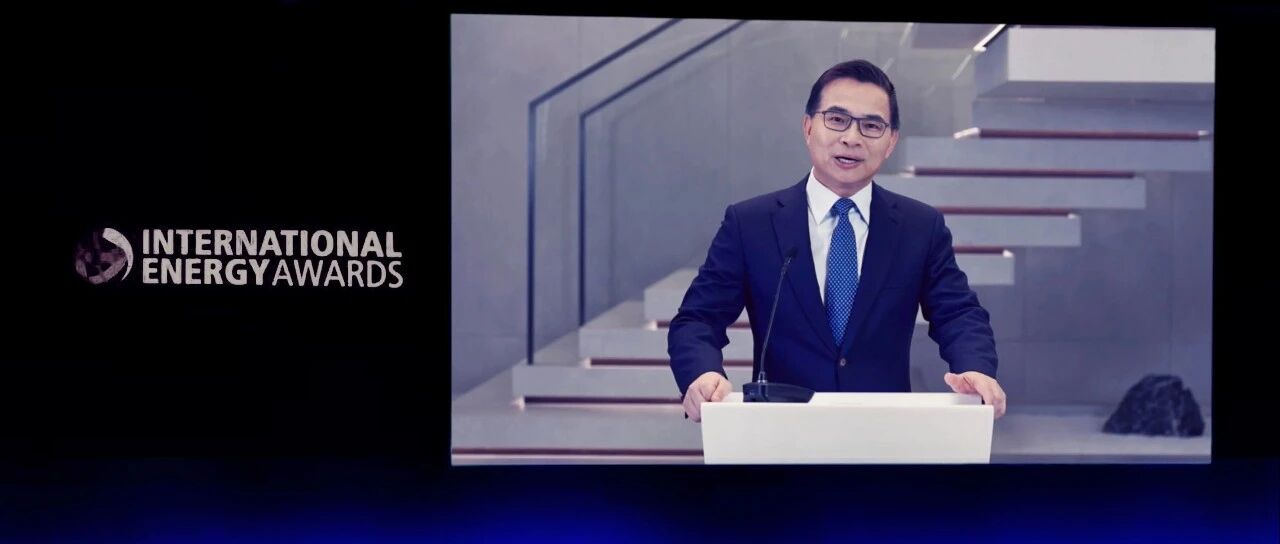
远景张雷获国际能源界奖项:为文明新繁荣,打造永续、智能、普惠的未来能源底座
Bei Ke Cai Jing· 2026-02-13 08:08
Core Viewpoint - The Energy Institute awarded the 2026 President's Award to Zhang Lei, Chairman of Envision Group, recognizing his exceptional leadership and transformative contributions to global energy transition, marking the first time an entrepreneur has received this honor [1][2]. Group 1: Award Significance - The President's Award is the highest honor given by the Energy Institute, established in 2022 to recognize key figures changing the global energy landscape, awarded annually to only one recipient [2]. - Previous recipients include John Kerry, former U.S. Secretary of State, who received the award in 2025 for his contributions to the Paris Agreement [2]. Group 2: Contributions and Innovations - During the award ceremony, the Energy Institute's Chairman, Andy Brown, highlighted Zhang Lei's vision and leadership, stating that Envision has developed a globally leading AI power system that provides scalable solutions for energy transition and addresses climate challenges [5]. - Zhang Lei emphasized the need for a renewable energy system for the future, noting that China's innovations have reduced the costs of wind and solar energy by 90%, making renewable energy the most competitive and accessible option [5]. - Envision has led several innovative renewable energy system projects, including smart wind turbines, energy storage, AI power systems, green hydrogen technology, and zero-carbon industrial parks, aiming to solve challenges for a sustainable future [8]. Group 3: Global Recognition and Impact - Nicholas Stern, known as the "father of climate economics," endorsed Zhang Lei's vision, stating that sustainable development is the only path to robust and secure growth, and that Envision's solutions represent a global opportunity [6]. - Zhang Lei drew historical parallels to clarify misconceptions about Chinese renewable energy, asserting that it is not merely "cheap and fragile" but rather "abundant and rich," contributing to a sustainable and intelligent energy system for humanity [5].
经济地理丨从地方两会看2026年经济增长发力点
Sou Hu Cai Jing· 2026-02-13 07:49
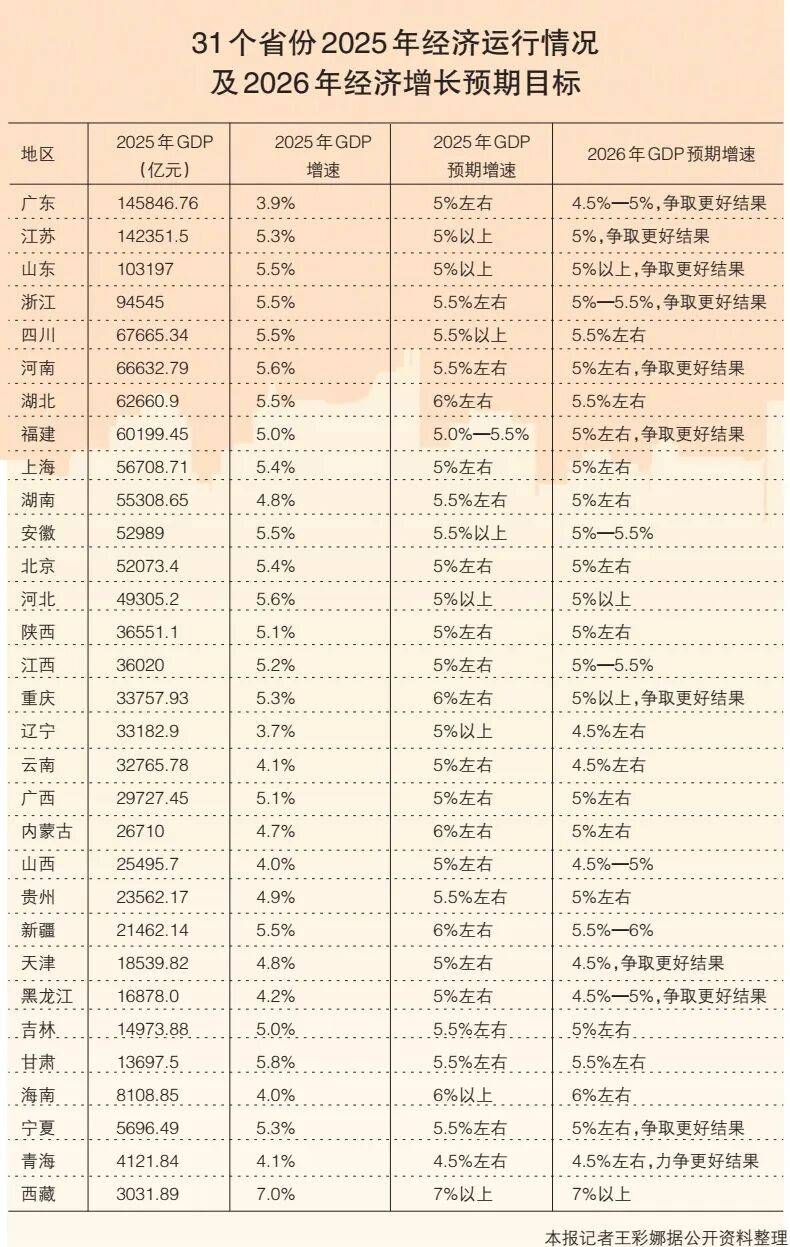
Core Viewpoint - The 2026 economic growth targets set by various provinces in China reflect a pragmatic approach, emphasizing quality over speed, with a focus on differentiated regional development strategies [1][2][3]. Group 1: Economic Growth Targets - Provinces such as Hainan and Hubei set GDP growth targets of around 6% and 5.5% respectively, while many others aim for approximately 5% [2][6]. - Only Jiangxi raised its growth target for 2026 from 5.0% to a range of 5.0%-5.5%, while 18 provinces lowered their targets or set them within a lower range [3][4]. - The overall weighted GDP growth target for all provinces is approximately 5.0%, indicating a decrease compared to 2025, with more provinces setting targets below 5% [6]. Group 2: Regional Development Strategies - A differentiated development pattern is emerging, characterized by "central regions leading, eastern regions supporting, and western regions catching up" [7]. - Central provinces are leveraging industrial transfer and domestic demand to maintain higher growth rates, while eastern provinces are focusing on high-end, intelligent, and green transformations [7]. Group 3: Innovation and Industrial Upgrading - The emphasis is on technological innovation as a core driver for economic growth, with local governments prioritizing the development of new productive forces and modern industrial systems [8][9]. - Traditional industries are being upgraded alongside the emergence of new industries, with specific targets set for technological improvements and digital transformation [8]. Group 4: Domestic Demand and Reform - The focus is on activating domestic demand through consumption and investment, with local governments implementing measures to enhance the business environment and expand high-level openness [10][11]. - Initiatives include enhancing consumer experiences and optimizing investment strategies to ensure effective and sustainable growth [10][11].
宏观经济专题:地方两会观察:内需和科技的新图景
KAIYUAN SECURITIES· 2026-02-13 07:43
Economic Growth Targets - The weighted average GDP growth target for 31 provinces in 2026 is set at 5.0%, down from 5.3% in 2025[2] - 17 provinces have lowered their targets, while 14 have kept them unchanged; 7 provinces set interval targets, indicating a likelihood of a national target range of 4.5% to 5%[2][13] - Economic powerhouses are expected to bear more responsibility for growth, with half of the top ten provinces maintaining their original targets[2][13] Investment Focus - The average fixed asset investment growth target has decreased from 6.3% to 5.1%, with all provinces either lowering or maintaining their 2025 targets[3][37] - Emphasis is placed on expanding private and livelihood investments, with many provinces encouraging private capital participation in various sectors[3][38] - Specific investment plans include a commitment of 721.46 billion yuan in Guangdong for livelihood projects[38] Consumption Trends - The weighted average target for social retail sales growth is approximately 4.8%, down from 5.4% in 2025[4] - Provinces are focusing on increasing residents' income through measures like raising basic pensions and providing subsidies[4] - New consumption models are being developed, particularly in sectors like health, culture, and entertainment, with a focus on "emotional economy"[4] Technological Development - The "Artificial Intelligence+" initiative is entering a comprehensive application phase, with local governments promoting AI in various sectors[5] - Emerging industries such as integrated circuits, aerospace, and renewable energy are prioritized, aligning with the "14th Five-Year Plan"[5] Real Estate Market - The main strategies for the real estate sector include revitalizing existing stock and improving housing quality[6] - Many provinces are initiating programs to purchase existing homes for affordable housing, marking a shift from previous strategies[6] National Conference Outlook - The national GDP growth target is likely to be set between 4.5% and 5%, with a focus on expanding domestic demand and technological breakthroughs[6] - Investment strategies will continue to support key projects and enhance livelihood investments, while the real estate sector will focus on revitalizing existing stock[6]
顺控发展:公司当前暂未涉及算力等数据服务业务
Zheng Quan Ri Bao Wang· 2026-02-13 06:52
Core Viewpoint - The company is actively responding to national dual carbon policies by exploring investments and operations in the renewable energy sector, focusing on distributed photovoltaic power generation and commercial energy storage [1] Group 1: Business Focus - The current focus of the company's renewable energy business is on distributed photovoltaic power generation and commercial energy storage [1] - The company aims to steadily achieve reasonable expansion of the photovoltaic and energy storage industry chain [1] Group 2: Strategic Development - The company is committed to diversified development and is actively exploring new opportunities in niche areas within the renewable energy sector [1] - The company has not yet ventured into computing power or data service businesses [1]

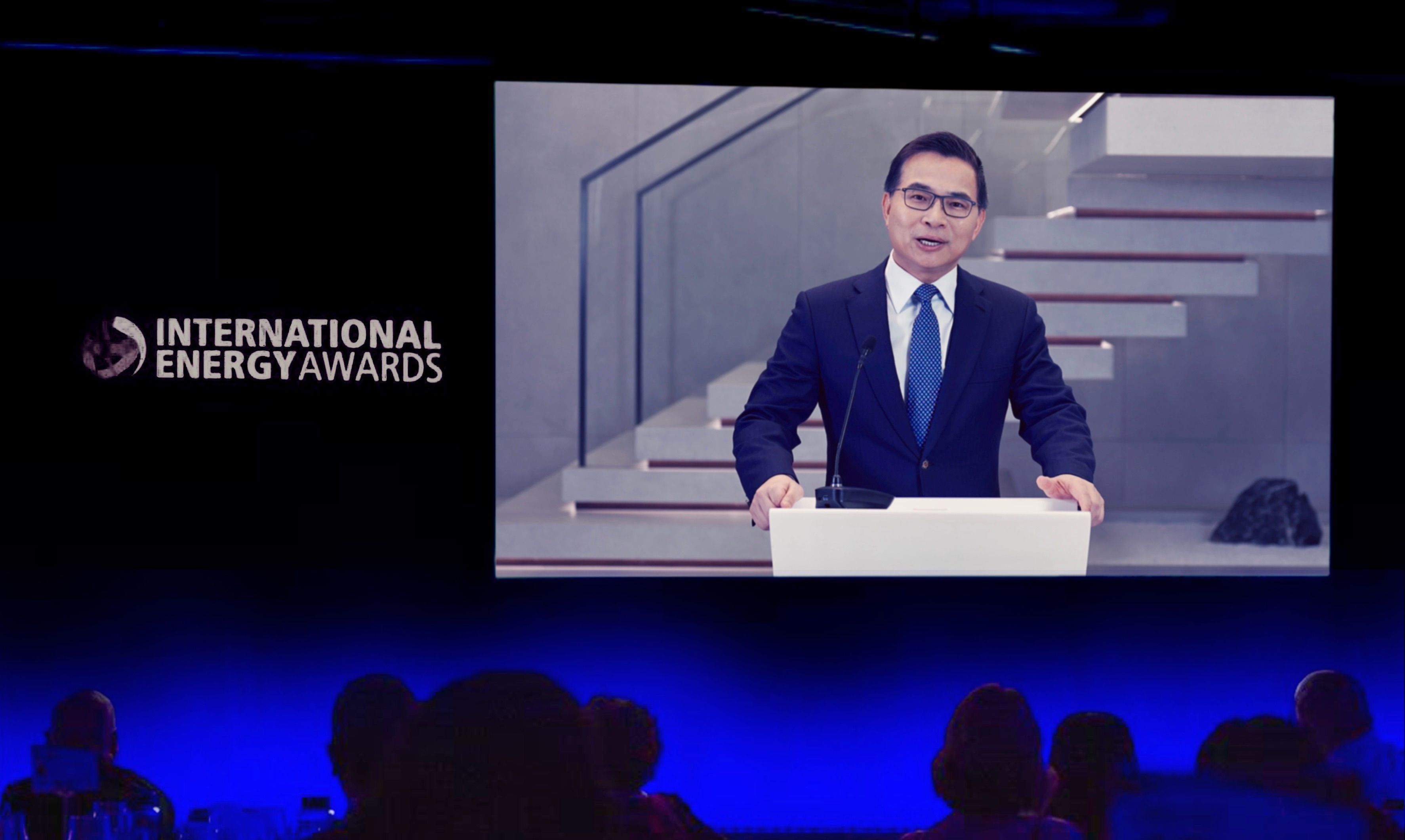
远景张雷获国际能源界顶级殊荣:为文明新繁荣,打造永续、智能、普惠的未来能源底座
中国能源报· 2026-02-13 06:36
Core Viewpoint - The article highlights the recognition of Zhang Lei, Chairman of Envision Group, as the first entrepreneur to receive the President's Award from the Energy Institute, acknowledging his leadership in global energy transition [1][3]. Group 1: Award Significance - The President's Award is the highest honor given by the Energy Institute, established in 2022 to recognize individuals who significantly alter the global energy landscape [1]. - The award is presented annually to only one recipient, making it a prestigious accolade in the energy sector [1]. Group 2: Contributions to Energy Transition - Under Zhang Lei's leadership, Envision has developed a leading AI power system that provides scalable solutions for global energy transition and addresses climate challenges [3]. - Zhang emphasized the need for a renewable energy system to support sustainable development, highlighting that China's innovations have reduced the costs of wind and solar energy by 90%, making renewable energy highly competitive [3]. Group 3: Historical Context and Misinterpretation - Zhang drew parallels between historical innovations, such as the introduction of papermaking to Europe, to clarify that China's renewable energy technology should be viewed as abundant and beneficial rather than merely cheap and surplus [3]. - He argued that the advancements in Chinese renewable energy represent a "civilizational output" that contributes to a sustainable and intelligent energy system for humanity [3]. Group 4: Global Impact and Recognition - Nicholas Stern, a prominent economist, endorsed Zhang's vision, stating that sustainable development is the only path to robust and secure growth, and that Envision's solutions offer practical examples for global energy transition [4]. - Envision is leading several innovative renewable energy systems, including smart wind turbines, energy storage, AI power systems, and green hydrogen technology, contributing to decarbonization efforts across various regions [6].
20cm速递|北美CSP大厂资本开支再加速,资金抢筹新能源机遇,创业板新能源ETF国泰(159387)近20日净流入超9亿元
Mei Ri Jing Ji Xin Wen· 2026-02-13 06:33
Core Viewpoint - North American CSP companies are accelerating capital expenditures, focusing on high-power servers, power systems, cooling, and networking equipment, indicating a significant increase in AI training and inference demand [1] Group 1: AI Industry Dynamics - The domestic AI application sector is rapidly expanding, with large-scale implementations expected to significantly increase the frequency of inference computing power usage, creating a reverse pull on upstream computing power and infrastructure [1] - The AI industry is transitioning from a "single-point computing power boom" to a collaborative expansion phase involving "computing power, infrastructure, and application ecosystem" [1] Group 2: Market Opportunities - The server, power equipment, data centers, and liquid cooling sectors, along with the domestic computing power supply chain, are positioned to benefit continuously from these trends [1] - Recent domestic AIDC tenders are beginning to emerge, with clear growth potential in the HVDC/SST industry trend, indicating a high market space and further value enhancement opportunities [1] Group 3: New Energy Sector - The Guotai New Energy ETF (159387) tracks the Innovation Energy Index (399266), which has a daily price fluctuation limit of 20%, selecting listed companies involved in clean energy, new energy vehicles, and energy storage technologies to reflect the overall performance of innovative and growth-oriented companies in the new energy sector [1]

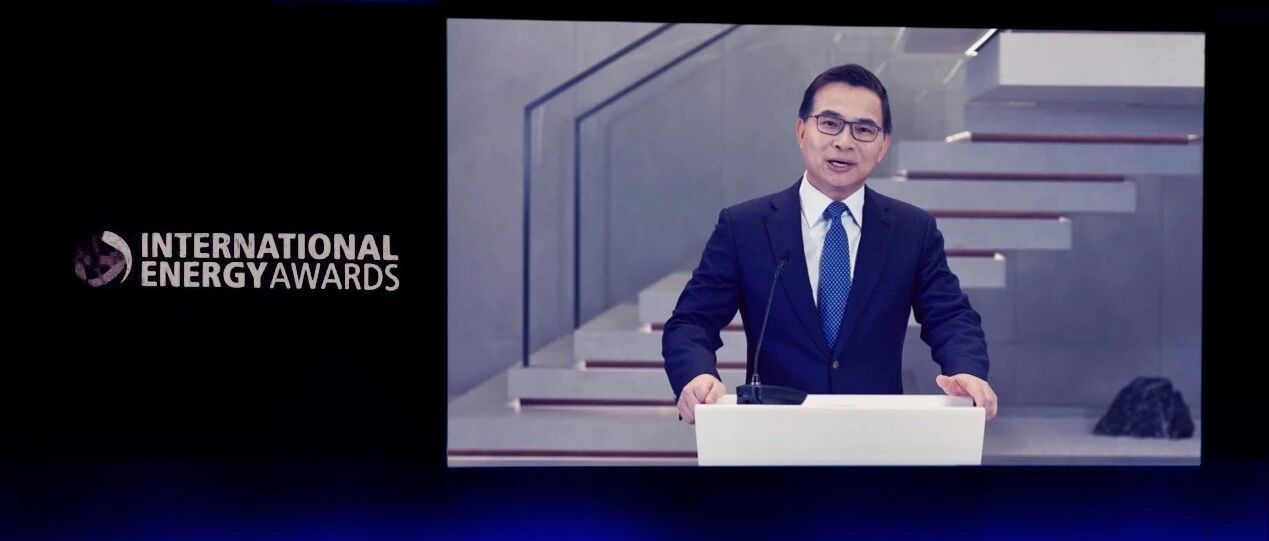
远景张雷获国际能源界卓越殊荣:为文明新繁荣,打造永续、智能、普惠的未来能源底座
Di Yi Cai Jing· 2026-02-13 05:40
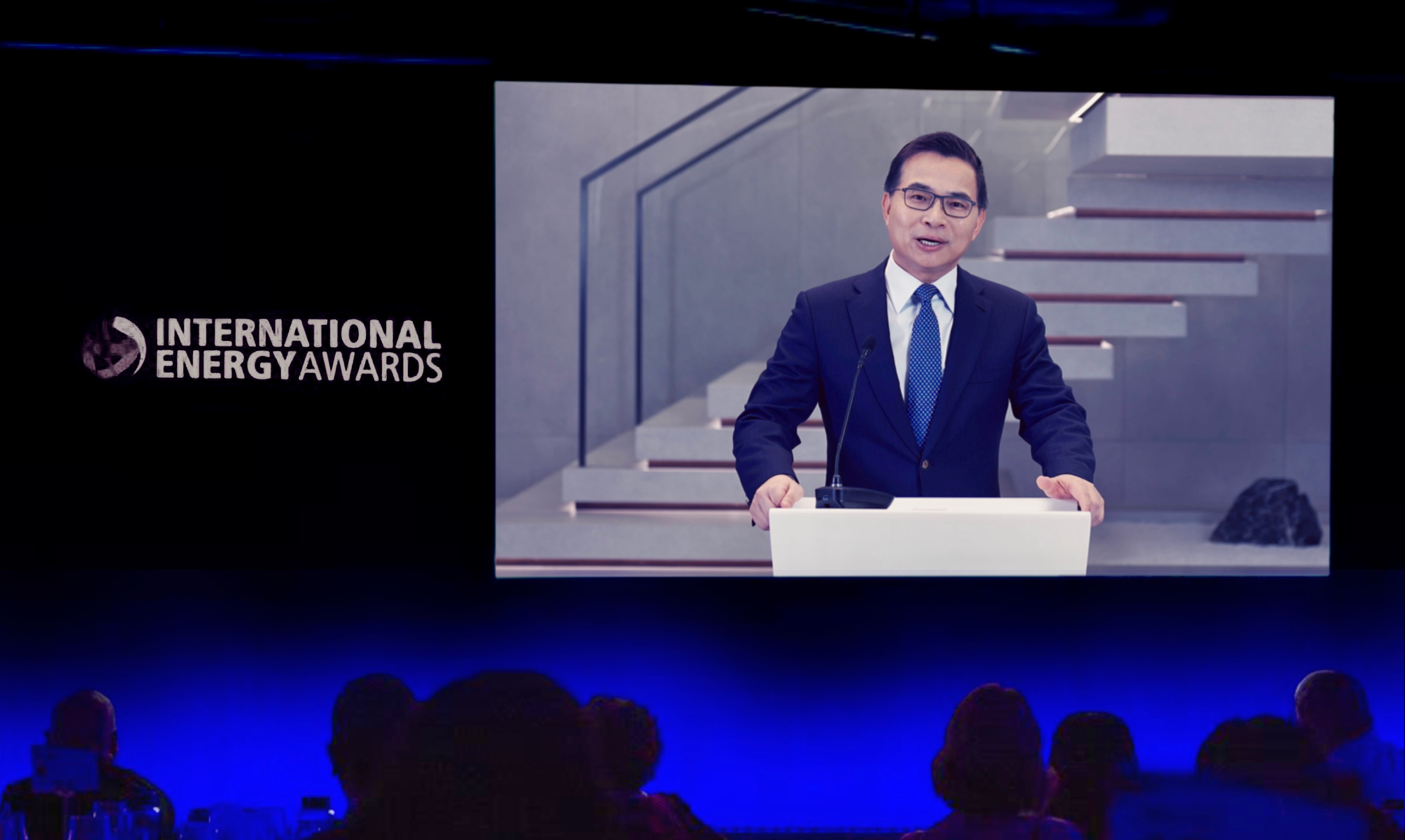
Group 1 - The President's Award for 2026 was awarded to Zhang Lei, Chairman of Envision Group, recognizing his exceptional leadership and transformative contributions to global energy transition [1] - Zhang Lei is the first entrepreneur to receive this award since its establishment in 2022, highlighting the global recognition of China's "civilization-level" output in renewable energy [1] - The award is presented annually by the Energy Institute to individuals who have significantly changed the global energy landscape, with the previous recipient being former U.S. Secretary of State John Kerry in 2025 for his role in the Paris Agreement [1] Group 2 - The award ceremony took place during the London International Energy Week, where Energy Institute Chairman Andy Brown praised Zhang Lei for his vision and leadership in creating a leading AI power system that provides scalable solutions for global energy transition [4] - Zhang Lei emphasized the need for a renewable energy system for the future, noting that China's innovations have reduced the costs of wind and solar energy by 90%, making renewable energy the most competitive and accessible option [4] - He drew historical parallels to defend China's renewable energy technology, arguing that it should be viewed as abundant and rich rather than surplus and cheap, contributing to a sustainable and intelligent energy system for humanity [4] Group 3 - Nicholas Stern, known as the "father of climate economics," endorsed Zhang Lei's vision, stating that sustainable development is the only path to robust and secure growth, and that Envision's solutions represent a global opportunity [5] - The award documentation highlighted Envision's leadership in innovative renewable energy systems, including smart wind turbines, energy storage, AI power systems, green hydrogen technology, and zero-carbon industrial parks [5] - Envision is committed to addressing challenges for a sustainable future and is actively promoting deep decarbonization across various economies in Asia, Europe, the Middle East, and the Americas [5]
再融资新规落地,量化看穿资金走向
Sou Hu Cai Jing· 2026-02-13 04:17
Core Viewpoint - The recent launch of refinancing optimization measures by the Shanghai and Shenzhen stock exchanges has triggered a positive market response, with 18 listed companies disclosing refinancing plans within three trading days, covering key areas such as AI computing power, new energy, and new materials [1] Group 1: Institutional Movements from a Funding Perspective - The core logic of the new refinancing regulations is to "precisely nourish" high-quality technology enterprises, indicating that substantial institutional funds will concentrate in these policy-supported areas [3] - Ordinary investors may struggle to discern whether institutional funds are genuinely participating or merely engaging in short-term speculation based on superficial stock price fluctuations [3] - Quantitative data on "institutional inventory" can reveal the active participation of institutional funds, providing clarity on market trends beyond mere price movements [5][6] Group 2: Behavioral Insights Beyond Price Movements - Investors often feel anxious due to their inability to understand the true reasons behind price fluctuations, such as whether a significant drop indicates risk or hidden opportunities [7] - Analyzing institutional trading behavior through quantitative data can clarify market intentions, distinguishing between genuine institutional participation and mere short-term volatility [12] - Institutional trading actions are characterized by continuity, scale, and repetition, which can be captured through quantitative data, allowing for a better understanding of market movements [12] Group 3: Core Support for Sustained Trends from a Probability Perspective - For ordinary investors, stable returns are derived from sustained trend opportunities rather than short-term price fluctuations, which are heavily influenced by emotions [13][14] - The absence of institutional funds during a price rebound suggests that such movements may be driven by sentiment rather than solid support, indicating a lack of sustainable trends [16] - Employing a probability-based approach to market analysis helps investors focus on the core factors that determine trends, moving away from emotional reactions to short-term price changes [17] Group 4: Reconstructing Investment Decision Logic with Quantitative Thinking - The market reaction following the implementation of the refinancing regulations highlights the importance of viewing investments from multiple dimensions, including funding, behavior, and probability [18] - Traditional approaches that focus solely on price movements can lead to anxiety and misjudgments, while quantitative thinking offers a multi-dimensional perspective that transforms ambiguous market information into clear, objective data [18] - Adopting a quantitative perspective enables investors to avoid pitfalls associated with guessing market tops and bottoms, fostering rational decision-making and sustainable investment capabilities [18]