家具

Search documents
今年前7个月甘肃省主要经济指标实现稳步增长
Sou Hu Cai Jing· 2025-08-21 00:20
Economic Growth - The main economic indicators in Gansu Province have shown steady growth in the first seven months of the year, with overall economic operation remaining stable [1][2] - The industrial production has increased significantly, with the added value of industrial enterprises above designated size growing by 9.5% year-on-year [1] Industrial Performance - The mining industry saw a value increase of 4.1%, while the manufacturing sector grew by 12.2%, and the electricity, heat, gas, and water production and supply industry increased by 10.2% [1] - Out of 37 major industry categories, 25 reported growth in production activities [1] Fixed Asset Investment - Fixed asset investment in the province grew by 0.8% year-on-year, with a notable increase of 4.4% when excluding real estate development investments [1] - Infrastructure investment rose by 7.4%, and manufacturing investment increased by 10.0%, while real estate development investment declined by 14.2% [1] Consumer Market - The total retail sales of consumer goods reached 2500.8 billion yuan, marking a year-on-year growth of 3.4% [2] - The "old for new" policy has positively impacted retail sales in categories such as home appliances (54.3% growth), communication equipment (37.0% growth), and furniture (20.8% growth) [2] Foreign Trade - The total import and export value reached 394.6 billion yuan, with a year-on-year increase of 24.4% [2] - Exports grew by 33.2% to 95.5 billion yuan, while imports increased by 21.9% to 299.1 billion yuan [2] - Trade with countries involved in the Belt and Road Initiative accounted for 74.4% of total trade, with a growth of 21.0% [2] Fiscal and Financial Stability - The general public budget revenue was 658.3 billion yuan, reflecting a year-on-year growth of 3.7%, while expenditures increased by 5.3% to 2848.6 billion yuan [2] - By the end of July, the balance of deposits in financial institutions reached 30383.8 billion yuan, growing by 8.1%, and the loan balance was 29981.5 billion yuan, up by 4.3% [2]
供需齐发力激活消费潜能
Jing Ji Ri Bao· 2025-08-21 00:07
Group 1 - Domestic demand contributed 68.8% to GDP growth in the first half of the year, with final consumption expenditure accounting for 52%, highlighting its role as the main driver of economic growth [1] - Retail sales of household appliances and audio-visual equipment, cultural office supplies, communication equipment, and furniture saw year-on-year growth of 30.7%, 25.4%, 24.1%, and 22.9% respectively, indicating a robust consumer market [1] - Various regions are implementing initiatives to stimulate consumption, such as Beijing's fashion consumption expansion plan and unique activities in Guangxi and Shanxi, which aim to cultivate new market dynamics [1] Group 2 - There are still barriers to fully unleashing consumption potential, particularly for the elderly demographic, who face challenges in accessing new consumption opportunities [2] - Key strategies to boost consumption include enhancing supply quality, optimizing the consumption environment, and increasing residents' income to improve consumer spending willingness [2] - Collaborative efforts from both supply and demand sides are essential to effectively implement policies that will drive consumption and contribute to high-quality economic development [2]
供需齐发力 激活消费潜能
Jing Ji Ri Bao· 2025-08-20 23:11
Group 1 - Domestic demand contributed 68.8% to GDP growth in the first half of the year, with final consumption expenditure accounting for 52%, making it the main driver of economic growth [1] - Retail sales of household appliances and audio-visual equipment, cultural office supplies, communication equipment, and furniture increased by 30.7%, 25.4%, 24.1%, and 22.9% year-on-year, respectively [1] - New consumer demands are emerging, creating new market opportunities and injecting vitality into economic development [1] Group 2 - There are barriers to fully unleashing consumption potential, particularly for the elderly, who face challenges in participating in new consumption trends [2] - Key to boosting consumption lies in enhancing supply quality and optimizing the consumption environment to encourage spending [2] - Collaborative efforts from both supply and demand sides are essential to implement policies effectively and drive high-quality economic development [2]
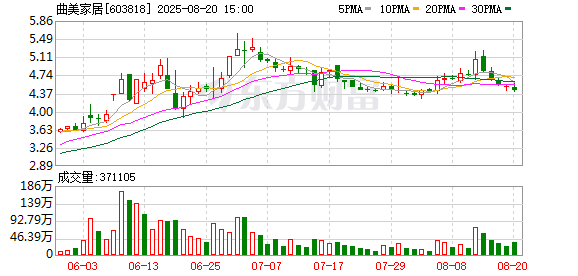
曲美家居:公司完成工商变更登记
Zheng Quan Ri Bao· 2025-08-20 13:31
证券日报网讯 8月20日晚间,曲美家居发布公告称,近日,公司完成工商登记变更手续,并取得了北京 市顺义区市场监督管理局换发的《营业执照》。 (文章来源:证券日报) ...


A股公告精选 | 牧原股份(002714.SZ)上半年盈利大增1170% 拟大手笔派现50亿元
智通财经网· 2025-08-20 12:27
Group 1: Company Performance - Muyuan Foods reported a net profit of 10.53 billion yuan for the first half of 2025, a year-on-year increase of 1169.77% [1] - Weicai Technology achieved a net profit of 101 million yuan, reflecting an increase of 831.03% year-on-year [2] - Hengrui Medicine's net profit reached 4.45 billion yuan, up 29.67% compared to the previous year [3] - Kingsoft Office's net profit was 747 million yuan, showing a growth of 3.57% year-on-year [6] - Jimin Health reported a net loss of 52.70 million yuan, compared to a profit of 25.44 million yuan in the same period last year [10] Group 2: Revenue Growth - Muyuan Foods' revenue for the first half of 2025 was 76.46 billion yuan, a 34.46% increase year-on-year [1] - Weicai Technology's revenue reached 634 million yuan, growing by 47.53% year-on-year [2] - Hengrui Medicine's revenue was 15.76 billion yuan, marking a 15.88% increase year-on-year [3] - Kingsoft Office's revenue was 2.66 billion yuan, reflecting a growth of 10.12% year-on-year [6] Group 3: Corporate Actions - Hengrui Medicine plans to repurchase shares worth between 1 billion and 2 billion yuan for an employee stock ownership plan [3] - Tianwei Foods is planning to issue H-shares and apply for listing on the Hong Kong Stock Exchange [8][9] - Oriental Zirconium's chairman plans to reduce his holdings by up to 1.315 million shares, accounting for 0.17% of the total share capital [7]





前7月安徽省“三驾马车”两增一降
Guo Ji Jin Rong Bao· 2025-08-20 12:06
Economic Overview - The overall economic operation in Anhui Province is stable in the first seven months of the year [1] - The total retail sales of consumer goods reached 1,393.21 billion yuan, with a year-on-year growth of 5.2% [1] - In July, the retail sales of consumer goods increased by 3.0% year-on-year [1] Retail Sector Performance - Retail sales of limited enterprises grew by 5.5%, with significant growth in cultural office supplies (53.7%), communication equipment (52.2%), and household appliances (21.2%) [1] - The online retail sales of limited wholesale and retail enterprises increased by 22.1% [1] Foreign Trade - The total import and export volume reached 543.41 billion yuan, with a year-on-year growth of 14.1% [1] - Exports amounted to 364.73 billion yuan, growing by 13.8%, while imports reached 178.68 billion yuan, increasing by 14.8% [1] - Trade with the EU grew by 17.3%, and trade with ASEAN increased by 35.7% [1] Investment Trends - Fixed asset investment decreased by 3.7% in the first seven months [2] - Investment in the primary industry grew by 5.5%, while the secondary and tertiary industries saw declines of 0.3% and 6.5%, respectively [2] - Infrastructure investment increased by 5.8%, with notable growth in railway (14.4%) and road transport (8.1%) [2] High-Tech and Green Energy Investment - High-tech service industry investment surged by 25.3%, with information services growing by 78.2% and R&D services by 85.7% [2] - Investment in green energy saw significant increases, with hydropower and solar energy investments growing by 113.8% and 84.6%, respectively [2]
喜临门:8月20日召开董事会会议
Mei Ri Jing Ji Xin Wen· 2025-08-20 10:07
喜临门(SH 603008,收盘价:16.47元)8月20日晚间发布公告称,公司第六届第九次董事会会议于 2025年8月20日在公司国际会议室以现场表决的方式召开。会议审议了《关于2025年度"提质增效重回 报"行动方案的半年度评估报告》等文件。 2024年1至12月份,喜临门的营业收入构成为:家具占比98.45%,其他业务占比1.55%。 (文章来源:每日经济新闻) ...


北京家具行业协会发倡议反内卷,*ST亚振高管变动
Xin Jing Bao· 2025-08-19 01:37
Group 1: Market Performance - In July, the total retail sales of furniture products in China reached 17 billion yuan, showing a year-on-year growth of 20.6% [1] - From January to July, the cumulative retail sales amounted to 115.9 billion yuan, with a year-on-year increase of 22.6%, indicating a strong market recovery [1] - In contrast, the retail sales of building and decoration materials in July were 13.5 billion yuan, reflecting a year-on-year decline of 0.5% [1] Group 2: Building Materials and Home Furnishing Sales - The sales revenue of large-scale building materials and home furnishing markets in July was 113.8 billion yuan, down 7.56% month-on-month and 12.92% year-on-year [2] - The cumulative sales from January to July were 808.3 billion yuan, showing a year-on-year decrease of 1.29% [2] - The decline in sales is attributed to seasonal factors, extreme weather, and reduced consumer demand due to market conditions [2] Group 3: Corporate Developments - Juran Smart Home appointed Wang Peng as the new vice president to enhance organizational development and management [3] - Fenglin Group reported a net loss of 46.6 million yuan in the first half of the year, with revenue declining by 19% year-on-year [4] - Oppein Home provided a guarantee of 50 million yuan for its wholly-owned subsidiary, with total guarantees amounting to 1.21 billion yuan [5] Group 4: Management Changes - *ST Yazhen announced the resignation of four executives, including the chairman, with some transitioning to other roles within the company [6] Group 5: Industry Initiatives - The Beijing Furniture Industry Association issued a proposal to resist "involution" competition and promote fair market practices, outlining four key action points [7]


持续提振消费 还有哪些举措(政策问答·回应关切)
Ren Min Ri Bao· 2025-08-18 22:12
Group 1 - The core viewpoint emphasizes the importance of increasing support for the replacement of old consumer goods to stimulate consumption, as highlighted in the recent Central Political Bureau meeting [1] - A total of 300 billion yuan has been allocated this year to support the replacement of old consumer goods, doubling the amount from last year [1] - In the first half of the year, retail sales of household appliances and audio-visual equipment increased by 30.7%, while furniture retail sales rose by 22.9%, and passenger car retail volume grew by 10.8% [1] Group 2 - The "Special Action Plan to Boost Consumption" aims to improve urban and rural consumption facilities, with a focus on enhancing the vitality of county and township markets [2] - In the first half of the year, rural online retail sales increased by 6.2%, and agricultural product online retail sales rose by 7.0% [2] - The plan includes the establishment of a commercial network centered on counties, with the goal of ensuring that every county has chain supermarkets and logistics centers, and every township has a commercial center [2]
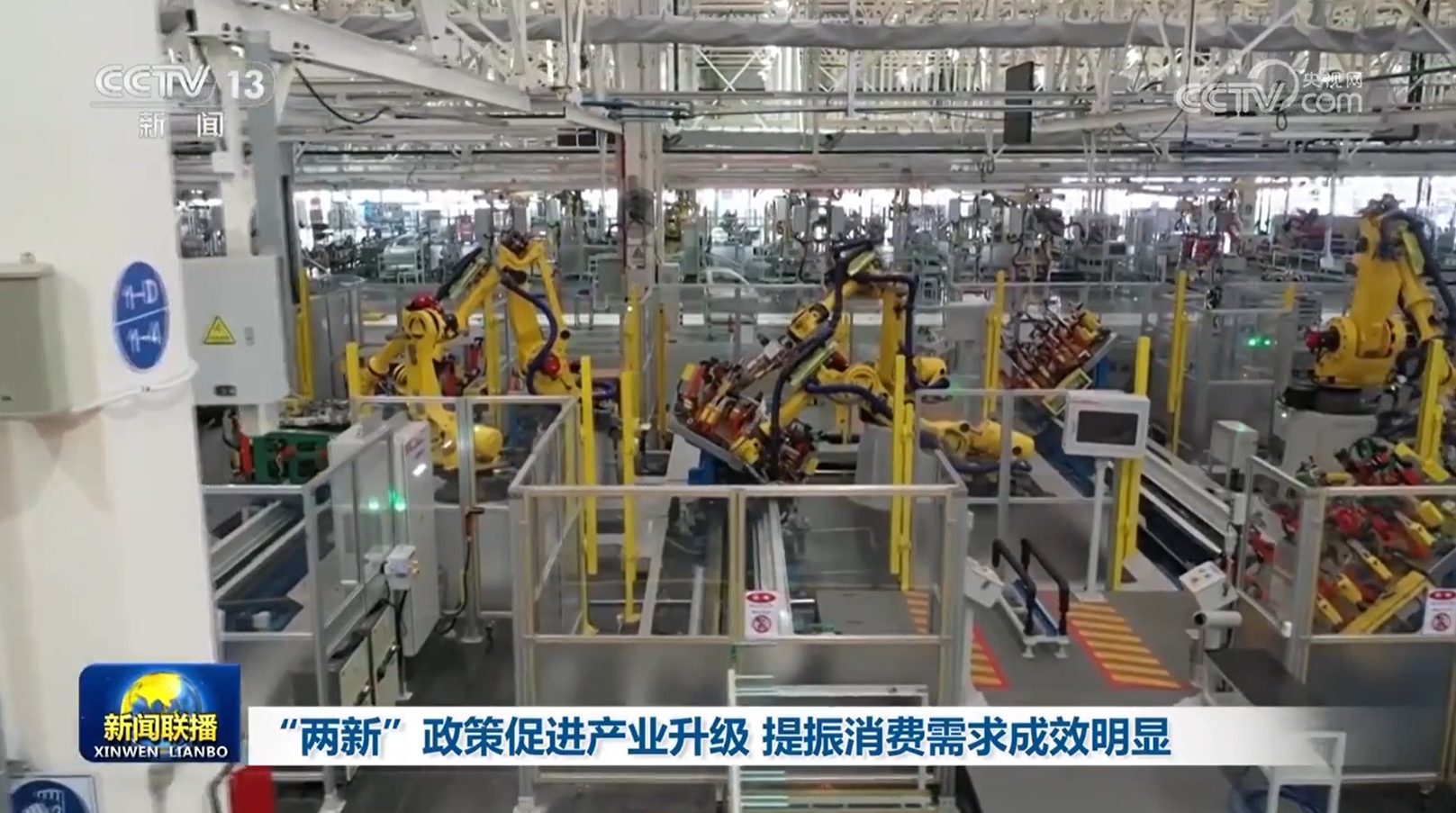
“两新”政策促进产业升级 提振消费需求成效明显
Yang Shi Wang· 2025-08-18 12:29
Group 1 - The implementation of large-scale equipment updates and the old-for-new policy for consumer goods has shown significant results over the past year [1] - From April 2024 to July 2025, the total amount of machinery and equipment purchased by enterprises nationwide increased by 7.3% year-on-year, with industrial enterprises seeing a 9.8% increase [3] - The procurement amount for equipment in the information transmission and software industry, as well as the technology service industry, has increased by nearly 30% [3] Group 2 - Consumer demand continues to be released, with daily household appliance sales increasing by 44.5% year-on-year and furniture retail sales increasing by 30.1% as of July this year [5] - The sales of service robots in the manufacturing sector have surged by over 50%, indicating a significant rise in intelligent consumption demand [5] - The sales volume of new energy vehicles has increased by 81.7% year-on-year, demonstrating a rapid growth trend [5] Group 3 - Driven by the "two new" policies, retail demand nationwide continues to grow, prompting manufacturing enterprises to accelerate equipment updates and upgrades, creating a positive interaction [6] - As of July this year, manufacturing sales revenue has increased by 5.8% year-on-year, indicating a smoother economic internal circulation [6]