
制冷剂

Search documents
2026年化工双登共振向上-再推化工板块
2026-01-07 03:05
Summary of Conference Call Records Industry Overview - The basic chemical sector is likely at the bottom of its cycle, with no need to wait for significant improvements in fundamentals before investing. Stock prices often lead the market, indicating potential investment opportunities when future fundamental changes are anticipated [2][4]. Key Investment Opportunities - Investment opportunities in 2026 are concentrated in traditional cyclical industries and technology materials, particularly in AI-related sectors such as energy storage materials (e.g., lithium carbonate) and storage materials (e.g., Yake Technology) [1][6]. - Recommended leading companies in the chemical industry include Wanhua Chemical, Hualu Hengsheng, and Juhua Co., due to their low valuations and high profit elasticity [1][8]. Company-Specific Insights Wanhua Chemical - Strongly recommended as a top investment choice due to its outlier effect and continuous growth catalysts. Expected revenue for 2026 is projected to reach 400 billion yuan, with a net profit forecast of 16 billion yuan [1][12][14]. - The company has a significant profit increase potential with every 1,000 yuan increase in MDI and TDI prices, translating to a net profit increase of 3.4 billion yuan [12][14]. Hualu Hengsheng - The company is expected to achieve annualized quarterly performance exceeding 5 billion yuan in 2026, supported by multi-category layout and technological upgrades [1][17][18]. Dongcai Technology - Notable for its advantages in new energy materials, with expectations to turn losses into profits as the overall profitability in the new energy sector improves [1][13][15]. Baofeng Energy - Expected to maintain stable annual profits between 12 billion to 13 billion yuan following the release of new capacity at its Ningxia base. The company benefits from the cyclical changes in the coal chemical industry and has diversified its product offerings [3][19][20]. Industry Trends and Signals - The potassium fertilizer industry is expected to experience tight supply and demand in 2026, maintaining high prices, while the phosphate market outlook remains stable with manageable supply increases [3][22][23]. - The tire industry is impacted by EU anti-dumping policies, prompting leading companies to expand overseas to increase market share [3][27][28]. - The spandex industry is at a cyclical bottom, with potential supply-side clearing effects anticipated due to the bankruptcy of a major player, which could improve market conditions [3][34][35]. Additional Insights - Investment in underperforming sectors is justified as they have likely reflected most negative factors in their stock prices, presenting potential for positive marginal changes [11]. - The refrigerant industry, while considered an "old story," shows strong certainty and potential for long-term investment due to ongoing price support [24]. - The organic silicon industry is expected to see price increases driven by domestic demand and external supply constraints, with companies like Dongyue showing significant elasticity [25][26]. Conclusion - The conference call highlighted a range of investment opportunities across various sectors within the chemical industry, emphasizing the importance of leading companies and emerging trends. Investors are encouraged to consider both cyclical recovery and technological advancements when making investment decisions.



制冷剂行业长期景气获支撑
Zhong Guo Hua Gong Bao· 2025-12-30 06:17
Group 1 - The core viewpoint of the articles highlights the ongoing regulatory changes in China's refrigerant industry, particularly focusing on the production, use, and import quotas for ozone-depleting substances (ODS) and hydrofluorocarbons (HFCs) for the year 2026, which are expected to support the long-term market stability of refrigerant products [1][2] - The 2026 quota plan emphasizes "total control and structural optimization," with a total production quota for second-generation refrigerants set at 151,400 tons, a decrease of 12,100 tons from 2025, indicating a continued push towards phasing out these substances [1] - The production quota for R22 is 146,100 tons, reflecting a 2.02% reduction from 2025, while R141b's quota is set to zero, showcasing the accelerated exit of second-generation refrigerants from the mainstream market [1] Group 2 - For third-generation refrigerants, the total production quota remains stable at 797,800 tons, an increase of 5,963 tons from 2025, with notable increases in quotas for key varieties such as R32 and R134a [2] - The new quota adjustment mechanism allows production companies to apply for inter-species quota adjustments under specific conditions, which is expected to benefit leading companies with diverse product lines and high quota bases, enhancing their capacity structure and profitability [2] - The downstream refrigerant market is characterized by dual support from traditional and emerging sectors, with the air conditioning industry entering a replacement cycle and the electric vehicle market driving steady demand for refrigerants [3]
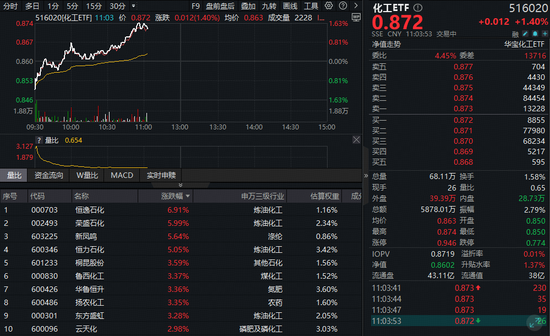
化工板块强势回归!石化、化肥股领涨,化工ETF(516020)上探1.63%!
Xin Lang Cai Jing· 2025-12-30 03:20
Group 1 - The chemical sector has regained momentum, with the chemical ETF (516020) experiencing a maximum intraday increase of 1.63% and closing up 1.4% [1][8] - Key stocks in the sector include Hengyi Petrochemical, which surged over 6%, and other companies like Rongsheng Petrochemical and New Fengming, which rose over 5% [1][8] - The recent high-quality development conference for the fertilizer industry highlighted the transition towards quality and efficiency in the sector, alongside new quota policies for refrigerants that are expected to optimize supply-demand dynamics [10][10] Group 2 - According to Huaxin Securities, the chemical industry remains weak overall, with mixed performance across sub-sectors due to past capacity expansions and weak demand, although some sectors like lubricants have exceeded expectations [3][10] - The chemical ETF (516020) has a price-to-book ratio of 2.57, indicating a relatively reasonable valuation position within the last decade [3][10] - According to Everbright Securities, the basic chemical industry is expected to see significant growth by 2025, driven by strong demand in new materials and emerging applications such as AI and OLED [4][11] Group 3 - The chemical ETF (516020) tracks the CSI sub-sector chemical industry theme index, covering various segments, with nearly 50% of its holdings in large-cap stocks like Wanhua Chemical and Salt Lake Potash [4][11] - Investors can also access the chemical sector through linked funds of the chemical ETF, providing a diversified investment approach [5][11]


光伏硅片价格回升,出光兴产、三井化学整合千叶乙烯业务 | 投研报告
Zhong Guo Neng Yuan Wang· 2025-12-30 02:02
Industry Overview - The chemical sector's overall performance ranked 7th this week (2025/12/22-2025/12/26) with a fluctuation of 4.23%, outperforming the Shanghai Composite Index by 2.35 percentage points and the ChiNext Index by 0.34 percentage points [1] - The chemical industry is expected to continue its differentiated trend in 2025, with a focus on synthetic biology, pesticides, chromatography media, sweeteners, vitamins, light hydrocarbon chemicals, COC polymers, and MDI [1] Synthetic Biology - The arrival of a pivotal moment in synthetic biology is anticipated, driven by the adjustment of energy structures, which may disrupt fossil-based materials and favor low-energy products [1] - Traditional chemical companies are expected to compete based on energy consumption and carbon tax costs, with successful firms leveraging green energy alternatives and integrated advantages to reduce costs [1] - The demand for bio-based materials is projected to surge, leading to potential profitability and valuation increases for leading companies in the synthetic biology sector, such as Kasei Bio and Huaheng Bio [1] Refrigerants - The implementation of quota policies is expected to usher in a high-growth cycle for third-generation refrigerants, with supply entering a "quota + continuous reduction" phase starting in 2024 [2] - The demand for refrigerants is anticipated to grow steadily due to the development of heat pumps, cold chain markets, and the expansion of the air conditioning market in Southeast Asia [2] - Companies with a high quota share, such as Juhua Co., Sanmei Co., Haohua Technology, and Yonghe Co., are expected to benefit significantly from this trend [2] Electronic Specialty Gases - Electronic specialty gases are critical to the electronics industry and represent a core component of domestic industrial chain localization [2] - The domestic market faces a contradiction between rapid upgrades in wafer manufacturing and insufficient high-end electronic specialty gas capacity, presenting significant domestic substitution opportunities [2] - Key players like Jinhong Gas, Huate Gas, and China Shipbuilding Gas are positioned to capitalize on the growing demand driven by integrated circuits, panels, and photovoltaics [2] Light Hydrocarbon Chemicals - The trend towards light raw materials in the global olefin industry is becoming increasingly significant, with a shift from heavy naphtha to lighter low-carbon alkanes like ethane and propane [3] - Light hydrocarbon chemicals are characterized by low carbon emissions, low energy consumption, and low water usage, aligning with global carbon neutrality goals [3] - Companies in the light hydrocarbon sector, such as Satellite Chemical, are expected to see a revaluation of their value as this trend continues [3] COC Polymers - The industrialization process of COC/COP (cyclic olefin copolymer) is accelerating in China, driven by domestic companies achieving breakthroughs and the shift of downstream industries to domestic sources [4] - COC/COP materials are increasingly used in various applications, including mobile camera lenses and medical packaging, with a focus on high-end applications [4] - Companies like Acolyte are recommended for their potential in the COC polymer production segment [4] Potash Fertilizers - Potash fertilizer prices are expected to rebound as the industry enters a destocking cycle, with supply constraints due to Canpotex withdrawing new quotes and Nutrien announcing production cuts [5] - The demand for potash fertilizers is likely to increase as farmers respond to rising grain prices, leading to a potential reversal in potash prices [5] - Leading companies in the potash sector, such as Yara International, Salt Lake Potash, and Zangge Mining, are recommended for investment [5] MDI Market - The MDI market is characterized by oligopoly, with demand steadily improving due to the expansion of polyurethane applications [6] - The global MDI production capacity is concentrated among five major chemical giants, which control approximately 90.85% of the market [6] - Companies like Wanhua Chemical are expected to benefit from the favorable supply dynamics and demand recovery in the MDI sector [6] Chemical Price Tracking - The top five price increases this week included NYMEX natural gas (9.59%), PTA (8.95%), and butadiene (6.83%) [6] - The top five price decreases included pure MDI (-4.23%) and acrylic fiber (-3.45%) [6] - A total of 170 chemical companies reported production capacity impacts this week, with 6 new repairs and 10 restarts [6]


光伏硅片价格回升,出光兴产、三井化学整合千叶乙烯业务
Huaan Securities· 2025-12-29 10:02
Investment Rating - The industry investment rating is "Overweight" [1] Core Insights - The report highlights a recovery in the price of photovoltaic silicon wafers, indicating a positive trend in the solar energy sector. Additionally, major companies such as Mitsui Chemicals are consolidating their ethylene businesses, which may enhance operational efficiencies [1][34]. Summary by Sections Industry Performance - The chemical sector ranked 7th in overall performance for the week of December 22-26, 2025, with a gain of 4.23%. This performance outpaced the Shanghai Composite Index by 2.35 percentage points [3][20]. Key Industry Trends - The report notes a continued divergence in the chemical industry’s prosperity, with recommendations to focus on synthetic biology, pesticides, chromatography media, sweeteners, vitamins, light hydrocarbon chemicals, COC polymers, and MDI [4][5]. Synthetic Biology - The report emphasizes the arrival of a pivotal moment for synthetic biology, driven by energy structure adjustments. Traditional chemical companies are expected to face competition based on energy consumption and carbon tax costs. Companies that leverage green energy and scale advantages are likely to thrive [5]. Refrigerants - The upcoming quota policy for third-generation refrigerants is expected to lead to a high-growth cycle. The supply of second-generation refrigerants is being reduced, while demand remains stable due to market expansions in heat pumps and cold chains [6]. Electronic Specialty Gases - The electronic specialty gas market is characterized by high technical barriers and value addition. The domestic market is facing a mismatch between rapid upgrades in wafer manufacturing and insufficient high-end electronic specialty gas capacity, presenting opportunities for domestic replacements [7][8]. Light Hydrocarbon Chemicals - The trend towards light raw materials in the global olefin industry is highlighted, with a shift from heavy naphtha to lighter alkanes like ethane and propane. This transition is expected to enhance production efficiency and align with global carbon neutrality goals [8]. COC Polymers - The report discusses the accelerated industrialization of COC/COP materials in China, driven by domestic companies achieving breakthroughs and the increasing demand from downstream industries [9]. Potash Fertilizers - Potash fertilizer prices are anticipated to rebound as major producers reduce output, alleviating inventory pressures. The report suggests that the market is entering a destocking phase, which could lead to price stabilization [10]. MDI Market - The MDI market is characterized by oligopolistic supply dynamics, with major players controlling over 90% of global capacity. Despite current price pressures, the long-term outlook remains positive as demand recovers [11].
化工行业估值重塑,2026投资机遇全面解析!
Sou Hu Cai Jing· 2025-12-29 08:42
Core Viewpoint - The chemical industry in China is expected to end its downward cycle in 2026, presenting structural investment opportunities due to the recovery of downstream demand, the acceleration of domestic substitution, and the ongoing implementation of anti-involution policies [1][2]. Group 1: Traditional Chemical Sector Recovery - The core opportunity in the traditional chemical sector for 2026 arises from improved supply-demand dynamics driven by anti-involution policies, leading to a rational price recovery [2][18]. - The domestic production capacity of organic silicon has peaked, with major companies leading production cuts to stabilize prices, resulting in inventory levels dropping to a three-year low [2][4]. - PTA production capacity expansion is nearing completion, with a significant reduction in inventory levels, indicating a potential recovery in the polyester chain's profitability [4]. Group 2: Agricultural Chemicals and Price Recovery - The agricultural chemical sector is poised for growth as safety incidents have disrupted global pesticide supply chains, leading to a supply contraction that catalyzes price recovery [4][8]. - The price index for raw agricultural chemicals has shown signs of bottoming out, indicating a potential rebound in prices [4]. Group 3: Acceleration of Domestic Substitution in New Materials - The domestic substitution of chemical new materials is gaining momentum, driven by government support and technological advancements, becoming a key growth engine for the industry [9][10]. - The market for lubricating oil additives has seen a decrease in imports and an increase in exports, indicating a shift towards becoming a net exporter and enhancing domestic brands' market presence [10]. - The electronic chemicals sector is benefiting from the growth of AI and semiconductor industries, with domestic manufacturers achieving technological breakthroughs and entering major supply chains [14][17]. Group 4: Demand Recovery and Policy Support - Gradual recovery in downstream demand, particularly in the real estate and automotive sectors, is expected to support the chemical industry's growth [18][19]. - Government policies aimed at stabilizing growth and stimulating consumption are expected to bolster demand for chemical products, enhancing the industry's resilience [19]. - The implementation of anti-involution policies and regulations is expected to improve market competition and guide industry profitability back to reasonable levels [19]. Group 5: Investment Recommendations - Investment in the chemical industry should focus on three core areas: capitalizing on cyclical recovery opportunities in sectors like organic silicon and PTA, investing in high-growth areas such as bio-based materials and electronic chemicals, and targeting leading chemical companies with cost and scale advantages [20]. - The industry is at a critical juncture of cyclical reversal and structural upgrade, with both cyclical and growth opportunities present [20].

化工行业估值重塑,2026投资机遇全面解析!
格隆汇APP· 2025-12-29 08:16
Core Viewpoint - The chemical industry is expected to end its downward cycle in 2026, presenting structural investment opportunities driven by anti-involution policies, accelerated domestic substitution, and gradually recovering downstream demand [4][19]. Group 1: Traditional Chemical Industry Opportunities - The core opportunity in the traditional chemical sector arises from improved supply-demand dynamics due to anti-involution policies, leading to a rational price recovery after years of capacity expansion [5][19]. - The domestic production capacity of organic silicon has peaked, with leading companies reducing output to stabilize prices, resulting in inventory levels dropping to a three-year low and prices showing signs of recovery [5][10]. - PTA production capacity expansion is nearing completion, with a significant reduction in inventory levels, indicating a potential recovery in the polyester chain's profitability [7][19]. Group 2: New Materials and Domestic Substitution - The domestic substitution of new chemical materials is accelerating, driven by government support and technological breakthroughs, becoming a core growth engine for the industry [11][12]. - The market for bio-based materials is expanding, supported by policies promoting green and low-carbon transitions, with domestic companies advancing in technology and production [12]. - The lubricating oil additive sector has seen a decrease in imports to 203,000 tons in 2023, while exports rose to 208,000 tons, indicating a shift towards becoming a net exporter [12]. Group 3: Downstream Demand Recovery - Gradual recovery in downstream demand is providing solid support for the chemical industry, with the real estate market expected to rebound, boosting demand for construction materials and coatings [19]. - The automotive sector is experiencing stable growth, with a 10.99% year-on-year increase in production in October 2025, further driving the demand for chemical materials [19]. - Policies aimed at stabilizing growth, including those targeting real estate and consumer spending, are expected to enhance downstream demand, while stricter energy and carbon emission regulations are leading to increased industry concentration [19][20]. Group 4: Investment Recommendations - Investment in the chemical industry in 2026 should focus on three core areas: capturing cyclical recovery opportunities from anti-involution, investing in high-growth sectors like bio-based materials and electronic chemicals, and identifying leading companies with cost and scale advantages [21][22]. - The industry is at a critical juncture of cyclical reversal and structural upgrade, with both cyclical and growth opportunities present [22].

周期的进攻与防守
2025-12-29 01:04
Summary of Key Points from Conference Call Records Industry Overview Chinese Companies and Global Demand - Chinese listed companies maintain higher overseas gross margins compared to domestic margins, particularly in capital and technology-intensive industries, indicating a significant competitive advantage [1] - The global demand in 2026 is expected to be favorable for Chinese outbound enterprises, benefiting from the latter half of the Federal Reserve's easing cycle, with an uptrend in global industrial and infrastructure capital expenditure [1][5] Aviation Industry - The aviation sector is viewed as a major investment opportunity, with ticket prices showing positive year-on-year growth, serving as a catalyst for the industry [1][6] - Despite fluctuations in December ticket prices, strong travel demand during the holiday season is anticipated to support price increases post-New Year [6] - Recommended stocks include China National Aviation, Juneyao Airlines, China Eastern Airlines, Southern Airlines, and Spring Airlines [6] Shipping and Oil Transportation - The oil shipping market experienced significant price fluctuations recently, with a notable drop in TCE rates for VLOCs [7] - Long-term outlook remains optimistic due to increased oil production driving demand, with a recommendation to focus on COSCO Shipping Energy, China Merchants Energy Shipping, and China Ship Leasing [8] Chemical Industry - The chemical sector, particularly the spandex segment, is performing well, with Huafeng Chemical showing significant cost advantages and benefiting from demand growth [9] - Other noteworthy areas include coal chemical companies like Hualu Hengsheng and soda ash producers like Boyuan Chemical [9] Metals Sector - The metals sector is experiencing strong performance, with gold reaching new highs and significant increases in silver, copper, aluminum, and lithium carbonate prices [11] - The supply side remains rigid, and the demand recovery driven by liquidity and AI-related factors is expected to keep prices on an upward trend [11][12] Company-Specific Insights Coal Market - Current coal prices are declining, with expectations of stabilizing around 670 RMB/ton as a bottom [3][18] - The outlook for 2026 suggests a rebound in coal demand due to a recovery in thermal power generation [21] Petrochemical Industry - The petrochemical sector is optimistic for 2026, with signs of inventory replenishment and a favorable price index for products [16] - The polyester supply chain is particularly promising, with recommendations for Tongkun Co., New Fengming, and Hengyi Petrochemical [17] New Materials - Focus areas in the new materials sector include lubricant additives, storage materials, and AI-related high-speed technologies, with specific companies recommended for investment [10] Energy Metals - The lithium carbonate market is expected to remain strong due to increasing storage demand, with recommendations for stocks in the energy metals sector [14] Steel Industry - Leading steel companies like Nanjing Steel and Baosteel are seen as good investment opportunities despite recent adjustments, with a projected decline in capital expenditure for 2026 [15] Additional Considerations - The overall sentiment for the Chinese stock market in 2026 is optimistic, driven by economic reforms and increased capital inflows [3] - The impact of monetary policy, geopolitical factors, and supply uncertainties on various sectors should be closely monitored [2]
涨价投资机遇梳理 -五大行业
2025-12-25 02:43
Summary of Key Points from Conference Call Records Industry Overview - **Chemicals Industry**: Benefiting from anti-involution policies and domestic demand recovery, with specific sectors like pesticides, refrigerants, organosilicon, and phosphate chemicals seeing improved profitability. The chemical sector index has significantly risen since July 2025, indicating a potential oil price bottom in the first half of 2026 [1][3][6]. - **New Energy Materials**: Experiencing explosive growth in downstream demand, particularly in electric vehicles and energy storage, while upstream resources are limited and midstream capacity expansion lags behind demand, leading to price increases for lithium and cobalt [1][3]. - **Electronics Industry**: Supported by AI hardware demand, semiconductor capacity expansion, and domestic policies, with increased demand for electronic chemicals and storage chips [1][4]. - **Non-ferrous Metals**: Supply constraints due to resource scarcity, rising extraction costs, and geopolitical disturbances, alongside sustained demand from photovoltaics and energy storage, have driven prices of copper, gold, and silver to historical highs, with expectations for copper prices to continue rising in the first half of 2026 [1][4][19]. Core Insights and Arguments - **Chemical Sector Performance**: The chemical sector index has risen nearly 40% since July 2025, despite marginal performance declines in Q2 to Q4. The reversal in supply-demand dynamics, particularly on the supply side, has been a key driver of stock price increases [6][12]. - **Investment Opportunities**: The polyester industry chain, particularly PTA and its derivatives, is highlighted as having significant price elasticity and potential for investment due to high concentration and recent price increases driven by global oil demand [7][9]. - **Refrigerants Market**: The refrigerants industry is expected to see price increases due to changes in supply-demand dynamics and anti-dumping measures, with applications in automotive and liquid cooling sectors [10][11]. Additional Important Insights - **PPI Recovery**: The Producer Price Index (PPI) has shown signs of recovery, with a notable decrease of 2.3% year-on-year in September, but the decline has narrowed significantly [5]. - **Weak Dollar Environment**: The overall weak dollar trend is expected to persist, providing unexpected opportunities despite changes in interest rate expectations [5]. - **Electronics Price Trends**: Significant price increases have been observed in the electronics supply chain, particularly in wafer manufacturing, storage, and analog devices, driven by increased demand and supply constraints [13]. - **Communication Sector**: The optical device sector is experiencing price increases due to rising demand for 1.6T optical modules and 800 laser modules, with expectations for continued price growth in the fiber optics market [15][16]. Future Outlook - **Chemical Industry**: The chemical sector is still in the early stages of a bull market, with expectations for significant performance improvements in 2026 [12]. - **Non-ferrous Metals**: Continued price increases are anticipated for major metals like copper and aluminum, with a focus on demand-side changes in the latter half of 2026 [22]. - **Lithium Battery Materials**: Prices for lithium and its derivatives are expected to rise due to strong demand growth outpacing supply, with projections for lithium carbonate prices to reach 150,000 to 200,000 yuan [24][25]. - **Copper Foil and Membrane Materials**: The copper foil industry is expected to see significant elasticity due to potential supply-demand gaps, while the membrane industry is facing challenges due to long expansion cycles [27][28].
印度叫停对华钛白粉反倾销税,西湖集团关停在美4家工厂 | 投研报告
Zhong Guo Neng Yuan Wang· 2025-12-23 03:02
Industry Overview - The chemical sector showed a weekly performance ranking of 5th with a change of 2.58% from December 15 to December 19, 2025, outperforming the Shanghai Composite Index by 2.55 percentage points and the ChiNext Index by 4.83 percentage points [1] Key Insights - The chemical industry is expected to continue its differentiated trend in 2025, with a focus on synthetic biology, pesticides, chromatography media, sugar substitutes, vitamins, light hydrocarbon chemicals, COC polymers, and MDI [1] Synthetic Biology - The arrival of a pivotal moment in synthetic biology is anticipated, driven by energy structure adjustments. Traditional chemical companies will face competition based on energy consumption and carbon tax costs, with a shift towards green energy solutions and integrated advantages to reduce costs [2] - Companies like Kasei Bio and Huaheng Bio are highlighted as leaders in the synthetic biology sector [1] Refrigerants - The third-generation refrigerants are expected to enter a high prosperity cycle starting in 2024, with supply entering a "quota + continuous reduction" phase. The demand for refrigerants is projected to grow due to the development of heat pumps and the cold chain market [2] - Companies such as Juhua Co., Sanmei Co., Haohua Technology, and Yonghe Co. are positioned to benefit from this trend [2] Electronic Specialty Gases - Electronic specialty gases are critical for the electronics industry, with high technical barriers and added value. The domestic market is facing a mismatch between rapid upgrades in wafer manufacturing and insufficient high-end electronic specialty gas capacity [2] - Companies like Jinhong Gas, Huate Gas, and China Shipbuilding Gas are expected to capitalize on the domestic substitution opportunities [2] Light Hydrocarbon Chemicals - The trend towards light raw materials in the olefin industry is becoming global, with a shift from heavy naphtha to lighter low-carbon alkanes like ethane and propane. This shift is characterized by lower carbon emissions and energy consumption [3] - Satellite Chemical is recommended for investment in the light hydrocarbon chemical sector [3] COC Polymers - The industrialization of COC/COP (cyclic olefin copolymer) is accelerating in China, driven by domestic companies achieving breakthroughs and the shift of downstream industries to domestic sources [4] - Akolai is identified as a key player in the COC polymer production segment [4] Potash Fertilizers - Potash fertilizer prices are expected to rebound as the industry enters a destocking cycle, with supply constraints due to Canpotex withdrawing new quotes and Nutrien announcing production cuts [5] - Companies like Yara International, Salt Lake Potash, and Cangge Mining are noted as leading firms in the potash sector [5] MDI Market - The MDI market is characterized by oligopoly, with demand steadily increasing due to the expansion of polyurethane applications. The supply structure is expected to improve as major producers like Wanhua Chemical and BASF maintain significant market shares [6] - Wanhua Chemical is highlighted as a key company to watch in the polyurethane sector [6] Price Tracking - The top five price increases this week included SBS (4.52%), PTA (3.04%), and others, while the largest decreases were seen in nitric acid (-14.29%) and sulfur (-5.06%) [6] Supply Side Tracking - A total of 168 chemical enterprises had their production capacities affected this week, with 6 new repairs and 3 restarts reported [7]