半导体等

Search documents
【长江策略戴清团队】0915港股日评:南向流入,迎头赶上
Sou Hu Cai Jing· 2025-09-15 15:04
Market Overview - The Hang Seng Index rose by 0.22% to 26,446.56, while the Hang Seng Tech Index increased by 0.91% to 6,043.61, and the Hang Seng China Enterprises Index climbed by 0.21% to 9,384.76. The Hang Seng High Dividend Yield Index saw a slight decline of 0.16% [3] - In the A-share market, the Shanghai Composite Index decreased by 0.26%, while the CSI 300 Index rose by 0.24%, and the Wind All A Index increased by 0.09%. The Dividend Index fell by 0.42% [3] Sector Performance - Among the primary sectors in the Hong Kong Stock Connect, the top gainers were Comprehensive (+7.69%), Coal (+2.45%), and Electric Equipment & New Energy (+2.24%). The sectors that declined included Steel (-1.58%), Light Industry Manufacturing (-1.47%), and Non-ferrous Metals (-1.18%) [3] - In terms of concepts, the Unprofitable Biotechnology Index surged by 15.63%, the Lithium Battery Index rose by 5.62%, and the Anti-tumor Index increased by 5.08%. Conversely, the CGN Index fell by 4.35%, the Baby and Child Index dropped by 4.13%, and the Film and Television Media Index decreased by 3.38% [3] Capital Flow and Economic Factors - On September 15, 2025, the total trading volume in the Hong Kong market reached HKD 290.19 billion, with net inflows from southbound funds amounting to HKD 14.473 billion. The rise in the three major Hong Kong stock indices was attributed to a recent economic discussion between China and the U.S. in Madrid, which raised market expectations for positive outcomes [4] - The market anticipates a 100% probability of a rate cut by the Federal Reserve in September, with a 94.2% chance of a 25 basis point reduction, which is expected to enhance global liquidity and benefit the Hong Kong market [4] Policy Developments - The China Automobile Industry Association released a proposal for payment norms for automotive suppliers, which aims to stabilize cash flow for small and medium-sized enterprises and maintain supply chain stability. This policy is expected to positively impact the automotive sector [4] - The Ministry of Commerce announced an anti-dumping investigation into imported related simulation chips from the U.S., further strengthening the logic of domestic substitution and boosting the semiconductor sector [4] Future Outlook - The future growth of the Hong Kong market is expected to be driven by three core directions: 1) AI technology and new consumption, which are anticipated to have significant growth potential; 2) Continuous inflow of southbound funds, which will enhance pricing power; 3) The transmission from broad monetary policy to broad credit, alongside potential further rate cuts in the U.S. that could improve global liquidity [5] - The "anti-involution" policy is expected to accelerate supply-side clearing, with related industries likely to rebound from their bottoms, gradually addressing the shortcomings of the bull market [5]


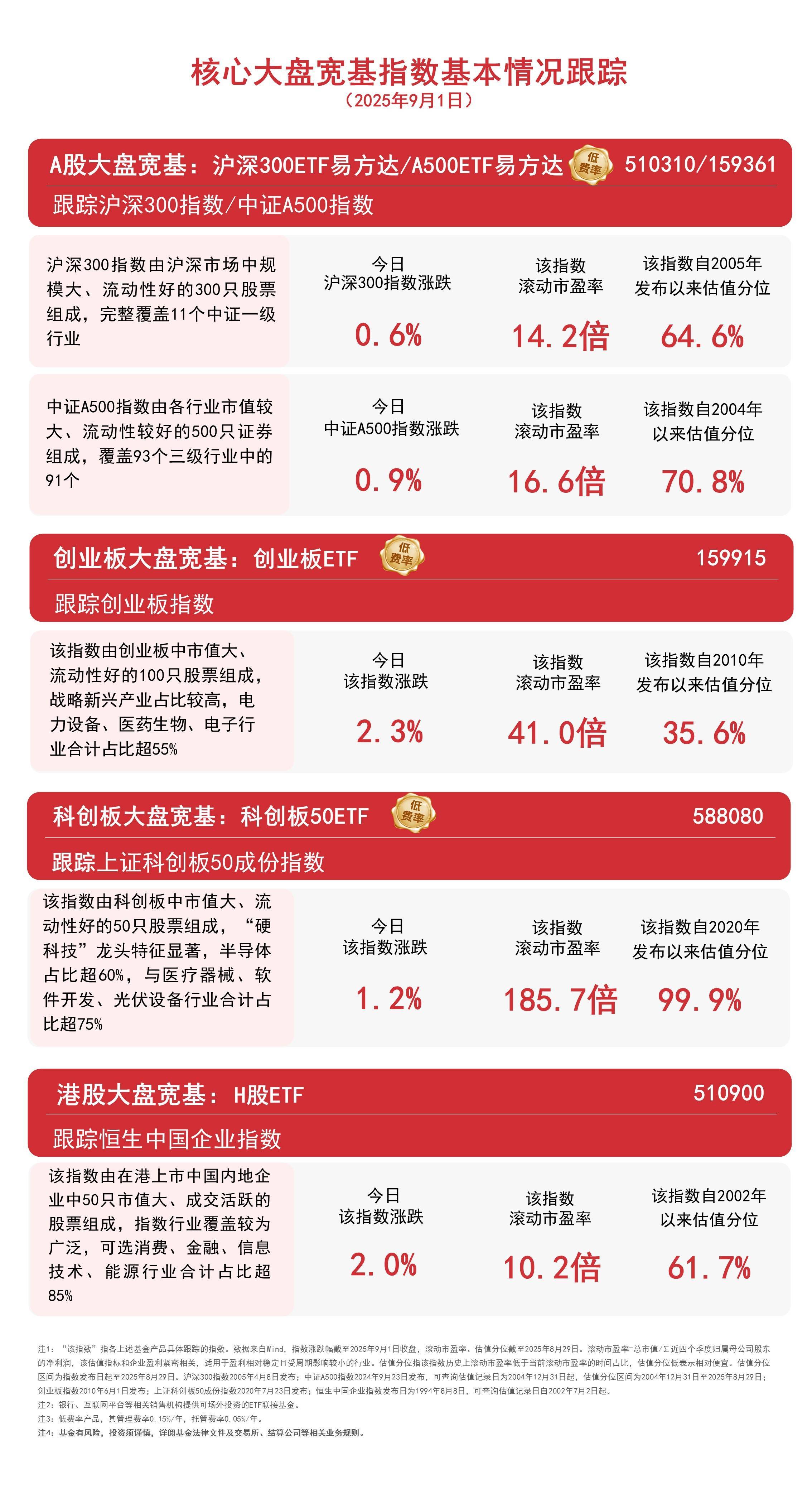
市场继续上攻,A500ETF易方达(159361)、沪深300ETF易方达(510310)等助力布局核心资产
Sou Hu Cai Jing· 2025-09-01 13:19
Market Performance - The A-share market saw all three major indices strengthen, with a total market turnover of 2.78 trillion yuan [1] - The CSI A500 index rose by 0.9%, the CSI 300 index increased by 0.6%, the ChiNext index surged by 2.3%, and the STAR Market 50 index climbed by 1.2% [1] - The Hang Seng China Enterprises Index also experienced a rise of 2% [1] Sector Performance - The leading sectors in terms of gains included precious metals, non-ferrous metals, innovative pharmaceuticals, CPO, and storage chips [1] - Conversely, sectors that faced declines included insurance, airport and shipping, securities, military equipment, banking, and gaming [1] Index Composition - The ChiNext index consists of 100 stocks with high market capitalization and liquidity, with a significant proportion in strategic emerging industries, particularly in electric equipment, pharmaceuticals, and electronics, which together account for over 55% [3] - The STAR Market 50 index is composed of 50 stocks from the STAR Market, showcasing prominent technology leaders, with semiconductors making up over 60% and medical devices, software development, and photovoltaic equipment industries collectively accounting for over 75% [3]
午评:创业板指涨超2%,保险、白酒等板块走强
Zheng Quan Shi Bao Wang· 2025-08-29 05:52
Market Overview - The Shanghai Composite Index experienced slight fluctuations, while the Shenzhen Component Index and the ChiNext Index reached new highs during the session. As of the midday close, the Shanghai Composite Index rose by 0.16% to 3849.76 points, the Shenzhen Component Index increased by 0.93%, and the ChiNext Index surged by 2.34%. The STAR 50 Index fell by 2.51%. The total trading volume in the Shanghai and Shenzhen markets reached 18,754 billion yuan [1]. Sector Performance - Strong sectors included insurance, liquor, tourism services, small metals, gold, daily chemicals, copper, supermarket chains, chemical pharmaceuticals, and textile machinery. Conversely, sectors such as semiconductors, IT equipment, communication devices, software services, components, forestry, and diversified finance showed weakness [1]. Concept Stocks - Concept stocks related to sodium batteries, lithium mines, solid-state batteries, and battery recycling saw significant gains [1]. Market Sentiment - Financial analysts noted a clear market structure differentiation, with technology stocks, particularly in computing hardware and semiconductor chips, leading the market. Other sectors are experiencing rapid rotation, indicating the need for careful market timing. Mid-term factors influencing the A-share market include anti-involution policies and demand-side policies. The influx of household savings into the market is expected to support the strengthening of market indices. The outlook remains for a strong oscillation in indices, with an increased tolerance for investment risks and a recommendation for active participation in the A-share market [1].

上证180ETF指数(510040)涨超2%,机构称国内半导体材料迎来投资窗口期
Xin Lang Cai Jing· 2025-08-22 07:00
Group 1 - The Shanghai 180 Index (000010) has seen a strong increase of 2.13%, with notable gains from stocks such as Haiguang Information (688041) up 20.00%, Cambrian (688256) up 19.79%, and SMIC (688981) up 13.12% [1] - The surge in the semiconductor industry is attributed to Nvidia's suspension of H20 chip production and the official release of DeepSeek-V3.1, leading to a broad rally in the chip supply chain [1] - Investment in high-purity electronic specialty gases, crucial for wafer manufacturing, reflects ongoing breakthroughs by domestic companies in key segments of the semiconductor materials supply chain, with these two focus areas accounting for nearly 50% of total investment [1] Group 2 - The Shanghai 180 Index consists of 180 securities selected from the Shanghai market based on market capitalization and liquidity, representing the overall performance of core listed companies [1] - As of July 31, 2025, the top ten weighted stocks in the Shanghai 180 Index account for 25.4% of the index, including major companies like Kweichow Moutai (600519) and China Ping An (601318) [2]



声通科技(02495.HK)盘中涨逾11% 拟2亿元参设合伙企业布局AI、机器人等未来产业
Jin Rong Jie· 2025-08-21 03:58
Group 1 - The core point of the article is that Soundon Technology (02495.HK) has approved an investment in a partnership managed by Guoyi Investment Management to enhance its strategic investment layout and competitiveness in future industries [1] - The partnership will be established with Guoyi Shuzhi as the general partner, and Soundon Technology, along with Changjiang Industrial Investment Fund and Humanoid Robot Industry Investment Fund, as limited partners, with a total scale expected to be RMB 500 million [1] - Soundon Technology plans to contribute RMB 200 million, accounting for 40% of the total committed capital of the partnership [1] Group 2 - The investment focus of the partnership will primarily be on high-quality enterprises in future industries such as artificial intelligence, robotics, semiconductors, Beidou, and low-altitude economy [1] - The partnership is prohibited from investing in listed securities unless during the exit period of its investment portfolio [1]

港股异动 声通科技(02495)涨超10% 拟成立合伙企业 围绕AI、机器人等未来产业领域进行投资布局
Jin Rong Jie· 2025-08-21 03:24
Group 1 - The core point of the news is that Sound Technology (02495) has seen a stock price increase of over 10%, reaching 83.05 HKD, with a trading volume of 5.916 million HKD following the announcement of a strategic investment initiative [1] - On August 20, Sound Technology's board approved an investment in a partnership managed by Hubei Guoyi Investment Management Co., Ltd. to enhance the company's competitive edge through strategic investments in future industries [1] - The partnership will be established with Hubei Guoyi Smart Technology Service Co., Ltd. as the general partner, and Sound Technology, along with Hubei Yangtze River Industry Investment Fund Co., Ltd. and Hubei Humanoid Robot Industry Investment Fund Partnership (Limited Partnership) as limited partners, with an expected total scale of 500 million RMB [1] Group 2 - The purpose of the partnership is to engage in legally permitted equity investment activities in mainland China, focusing on future industries such as artificial intelligence, robotics, semiconductors, BeiDou, and low-altitude economy [2] - The partnership is expected to generate investment returns through professional investment management, and it is prohibited from investing in listed securities unless during the exit period of its investment portfolio [2]
声通科技(02495)拟成立合伙企业 投资人工智能、机器人、半导体、北斗、低空经济等未来产业领域的优质企业
智通财经网· 2025-08-20 14:08
Core Viewpoint - The company has approved an investment in a partnership managed by Hubei Guoyi Investment Management Co., Ltd. to enhance its strategic investment layout and competitive strength in future industries [1][2] Group 1: Investment Details - The partnership will be established with Hubei Guoyi Smart Technology Service Co., Ltd. as the general partner, and the company, Hubei Yangtze River Industry Investment Fund Co., Ltd., and Hubei Humanoid Robot Industry Investment Fund Partnership (Limited Partnership) as limited partners [1] - The total scale of the partnership is expected to be RMB 500 million, with the company planning to contribute RMB 200 million, accounting for 40% of the total contributions [1] Group 2: Investment Focus - The partnership aims to engage in legally permitted equity investment activities in mainland China, focusing on future industries such as artificial intelligence, robotics, semiconductors, Beidou, and low-altitude economy [1] - The partnership will not invest in listed securities unless during the exit period of its investment portfolio [1] Group 3: Strategic Rationale - The board believes that participating in the establishment of an investment fund focused on artificial intelligence will help the company leverage the expertise of its partners to identify and cultivate quality projects and technology resources [2] - This initiative is expected to further expand the company's interactive artificial intelligence industry layout and promote the achievement of its overall strategic goals [2]
21社论丨持续筑牢A股“健康牛”根基
2 1 Shi Ji Jing Ji Bao Dao· 2025-08-18 22:41
Group 1 - The A-share market's total market capitalization has surpassed 100 trillion yuan for the first time, with a daily trading volume of 2.81 trillion yuan, marking the third-highest in history [1] - The current market trend is characterized as a "systematic slow bull," which reflects a collective expectation for a gradual upward movement rather than a heated market [1] - Various sectors, including banking, energy, public utilities, and technology, are experiencing alternating rotations, contributing to a stable "slow bull" market without overheating [1] Group 2 - The ongoing exit of low-end production capacity due to the rectification of low-price competition is expected to enhance industry concentration and improve pricing power in globally competitive sectors, thereby boosting company performance and profits [2] - The influx of medium to long-term funds from state-owned commercial insurance companies and pension funds into the market has been a significant driver of the current market rally [2] - As of June 30, northbound capital holdings reached 2.29 trillion yuan, an increase of 2.38% from the previous quarter, indicating growing foreign interest in A-shares [2] Group 3 - There is an expectation for further liquidity release in the market, with predictions that the Federal Reserve may enter a rate-cutting cycle, which would enhance global liquidity [3] - Positive factors such as liquidity, technological innovation, and improved market confidence are collectively driving the stock market upward, although maintaining low volatility remains a challenge [3] - It is crucial for market participants to avoid excessive promotion of a "bull market" and to be cautious of speculative activities, ensuring a stable market environment [3]
午评:科创50指数大涨近2%,半导体板块拉升,数字货币概念等活跃
Zheng Quan Shi Bao Wang· 2025-08-14 04:37
Market Overview - The Shanghai Composite Index rose to a new high, surpassing 3700 points during intraday trading, with the ChiNext Index and the STAR Market Index also showing positive movements [1] - As of the midday close, the Shanghai Composite Index increased by 0.2% to 3690.88 points, while the Shenzhen Component Index and the ChiNext Index fell by 0.15% and 0.23% respectively [1] - The total trading volume across the Shanghai and Shenzhen markets reached 1.4314 trillion yuan [1] Sector Performance - Sectors such as military, automotive, steel, coal, oil, and chemicals experienced declines, while insurance and brokerage sectors saw gains [1] - The semiconductor sector showed an upward trend, and concepts related to digital currency and brain engineering were active [1] Investment Sentiment - Dongguan Securities noted that the Shanghai Composite Index has broken through the previous high of 3674 points from 2024, indicating a strong overall market trend [1] - The current market rally has been characterized by low volatility and low drawdowns, reflecting the characteristics of a mature market [1] - The continuous increase in margin financing indicates a recovery in market confidence, suggesting that the market may maintain a strong trend in the short term [1] Future Outlook - The market is expected to continue its upward trend supported by liquidity and fundamental recovery, with the index potentially rising gradually [1] - Recommended sectors for investment include large financials, machinery, technology, media, telecommunications (TMT), and consumer goods [1]
螺丝钉指数地图来啦:指数到底如何分类|2025年8月
银行螺丝钉· 2025-08-12 04:01
Core Viewpoint - The article introduces a comprehensive index map that includes various commonly used stock indices, their codes, selection rules, industry distribution, average and median market capitalization of constituent stocks, and the number of constituent stocks, which will be regularly updated for easy reference [1][2]. Group 1: Types of Indices - The index map includes several categories of stock indices: broad-based indices, strategy indices, industry indices, thematic indices, and overseas indices [4][2]. Group 2: Broad-based Indices - Examples of broad-based indices include: - CSI 300 (000300.SH): Comprises 300 large-cap stocks with an average market cap of 1,929.37 billion and a median of 955.29 billion [5]. - CSI 500 (000905.SH): Comprises 500 mid-cap stocks with an average market cap of 295.98 billion and a median of 271.81 billion [5]. - CSI 800 (000906.SH): Comprises 800 stocks with an average market cap of 908.50 billion and a median of 358.74 billion [5]. Group 3: Strategy Indices - Strategy indices focus on specific investment strategies, such as: - CSI Dividend (000922.CSI): Selects 100 stocks with high dividend yields and stable dividends, with an average market cap of 1,963.17 billion [6]. - Shanghai Stock Exchange Dividend (000015.SH): Comprises 50 stocks with high dividend yields from the Shanghai Stock Exchange, with an average market cap of 2,809.85 billion [6]. Group 4: Industry Indices - Industry indices reflect the performance of specific sectors, such as: - Financial Sector Index: Represents the performance of up to 50 banking stocks with an average market cap of 3,507.12 billion [7]. - Real Estate Sector Index: Comprises 50 stocks from the real estate industry with an average market cap of 195.47 billion [7]. Group 5: Thematic Indices - Thematic indices focus on specific investment themes or trends, providing insights into particular market segments [8].