对冲基金

Search documents
机构:非洲信用市场回报或难以为继 美元走势成关键风险
Xin Lang Cai Jing· 2026-01-07 08:59
Group 1 - The core viewpoint of the article is that the African credit market may disappoint investors expecting to replicate last year's impressive returns, as highlighted by Enko Capital Management LLP [1] - Enko Capital Management, managing $1.4 billion in assets, is actively seeking trading opportunities to mitigate potential setbacks in Africa's best-performing assets [1] - The Chief Investment Officer of Enko, Alain Nkontchou, emphasizes that a key risk for Africa is the reversal of the dollar's weakening trend since 2026 and the potential end of interest rate cuts by central banks, including the Federal Reserve [1] Group 2 - Enko's performance has been notable, delivering a 32% return for investors in the first 11 months of 2025, which is three times the average return of 11% for emerging market debt hedge funds during the same period [1] - This performance positions Enko to potentially achieve its best year since its establishment in 2016, with the annualized return rising to 17.2% [1]
桥水全天候策略一年涨20%!创50年最高年度收益率!普通投资者如何复制?
雪球· 2026-01-06 13:00
Core Viewpoint - The article highlights the impressive performance of top hedge funds in 2025, particularly Bridgewater Associates, which achieved its highest annual return in 50 years, showcasing the effectiveness of diversified investment strategies in a volatile market [3][4]. Group 1: Bridgewater Fund Performance - Three Bridgewater funds ranked in the top five for annual returns, with the Bridgewater Asia Fund achieving a 37% return, the Bridgewater Pure Alpha II Macro Fund and Bridgewater China Fund both at 34%, significantly outperforming the Nasdaq 100 index, which rose about 20% during the same period [4][5]. - The Bridgewater All Weather Fund, utilizing a risk parity strategy, recorded a return of approximately 20%, also surpassing the S&P 500 index, which had a return of about 16%, ranking it 10th overall [4][5]. Group 2: Multi-Asset Multi-Strategy Investment - Despite the strong performance of U.S. stocks, many top financial institutions are increasingly favoring a multi-asset multi-strategy investment approach, which allows for flexible allocation across various assets and strategies to enhance returns [6]. - Funds employing this strategy, such as Exploration Capital and Oculus Fund, have also performed well, with Oculus Fund achieving a net return of 28.2% in 2025, maintaining positive returns for over 20 years [6]. Group 3: High Net-Worth Client Preferences - High net-worth clients are also gravitating towards multi-asset multi-strategy funds, leading to a continuous growth in this type of fund's scale [7]. - In 2025, the performance of various indices showed that the Hang Seng Index outperformed the S&P 500, and technology growth indices in A and Hong Kong markets significantly outperformed the Nasdaq 100 [7]. Group 4: Market Volatility and Risk Management - The S&P 500 experienced a maximum drawdown of nearly 19% in 2025, indicating increased volatility in the market, where each gain comes with higher risks [9]. - In contrast, A and Hong Kong stocks are seen as having improved risk-reward ratios, suggesting that diversifying investments can mitigate risks associated with single asset classes [10]. Group 5: Investment Accessibility - Hedge funds typically have high entry barriers, with minimum investments often set at 1 million, and in many cases, higher thresholds are required to access Bridgewater products [15]. - To democratize access to these investment strategies, platforms like Xueqiu have introduced tools like the "Three-Part Method," which allows ordinary investors to participate in diversified investment strategies with lower thresholds [16][17].


达利欧警示AI泡沫初现,桥水基金2025年业绩创纪录
Jin Rong Jie· 2026-01-06 05:08
Group 1 - The core viewpoint of the article is that Ray Dalio warns about the current investment frenzy in the artificial intelligence sector, suggesting it has entered the early stages of a bubble [1] - Dalio highlights that the performance of the U.S. stock market is expected to lag behind non-U.S. stocks and asset classes like gold by 2025, with gold prices having increased over 60% last year [1] - He notes that investors are increasingly favoring non-U.S. assets over U.S. stocks, as well as non-U.S. bonds over U.S. bonds and cash [1] Group 2 - Dalio mentions that the global stock market experienced turbulence last autumn, with growing concerns about a potential bubble in AI-related stocks, which suppressed market sentiment and increased selling risks [1] - He points out that geopolitical tensions in the Middle East and uncertainties regarding the Federal Reserve's future interest rate policies have further heightened investor anxiety [1] - Dalio expresses that there is significant uncertainty regarding the Federal Reserve's policy direction and productivity growth outlook, indicating that the new Fed Chair and the Federal Open Market Committee are likely to lean towards lowering nominal and real interest rates [1]
多策略对冲基金去年斩获丰厚,Point72等回报率高达两位数
Sou Hu Cai Jing· 2026-01-05 23:15
Core Insights - Point72 Asset Management, led by Steve Cohen, achieved a 17.5% annual return in 2025, marking its fourth consecutive year of double-digit returns [1] - The hedge fund industry, with a total size of approximately $5 trillion, is expected to record its best annual performance in at least five years in 2025, driven by significant gains in the stock market and precious metals, along with volatility in the bond and foreign exchange markets [1] Company Summary - Point72 Asset Management has an asset management scale of $41.4 billion [1] - The firm has consistently delivered double-digit returns for four years [1] Industry Summary - The hedge fund industry is projected to achieve its best annual performance in five years in 2025 [1] - Key factors contributing to this performance include substantial increases in the stock market and precious metals, as well as fluctuations in the bond and foreign exchange markets [1]
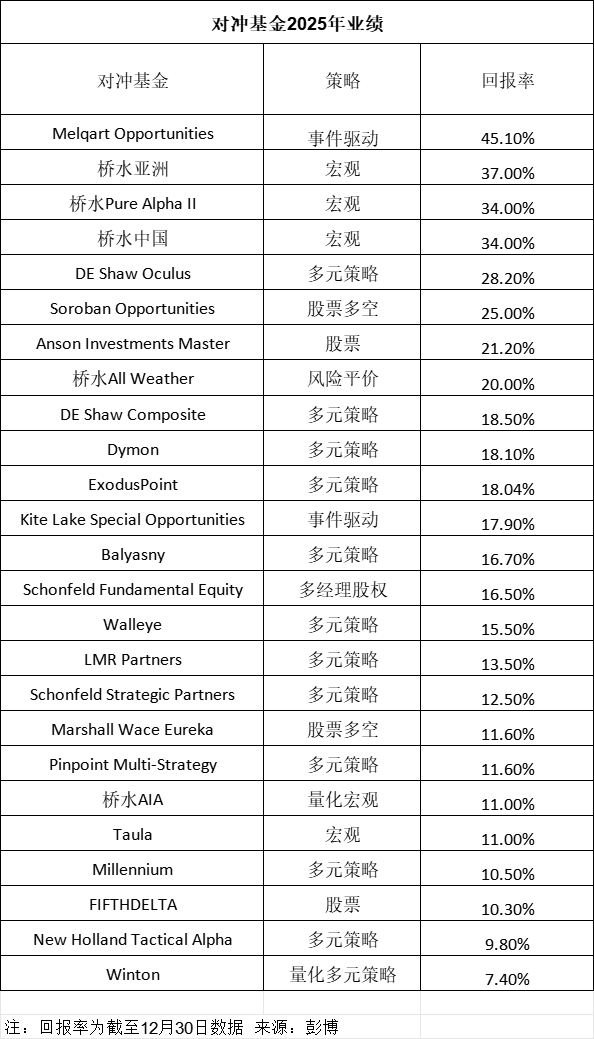
对冲基金2025龙虎榜:桥水旗舰基金回报34%创纪录,桥水中国排名第三超德邵
华尔街见闻· 2026-01-03 10:24
Core Viewpoint - Hedge funds achieved their highest overall returns in at least five years in 2025, driven by significant gains in the U.S. stock market, particularly in the AI sector, and volatility in the bond and currency markets due to trade tensions [1][3]. Performance Highlights - Bridgewater's flagship fund, Pure Alpha II, recorded a historic return of 34%, marking a significant recovery from annual returns below 3% from 2012 to 2024 [1][2]. - The Melqart Opportunities Fund led the performance with a return of 45.1%, while other notable funds included Bridgewater's Asian Macro Fund at 37% and the All Weather Fund at 20% [4][6]. - D.E. Shaw's flagship multi-strategy fund, D.E. Shaw Composite, achieved an 18.5% return, and its Oculus fund reached 28.2% [2][10]. Strategy Analysis - The strong performance of hedge funds is attributed to the flexibility of event-driven strategies, which capitalize on corporate mergers and restructurings amid increasing trade policy uncertainties [7]. - Multi-strategy funds showed varied performance, with Dymon achieving 18.1% and ExodusPoint at 18.04%, while industry giant Millennium only managed a 10.5% return [12]. - In the long/short equity strategy category, Soroban Opportunities delivered a robust 25% return, significantly outperforming the market [13]. Market Context - The U.S. stock indices recorded double-digit annual gains for the third consecutive year, a trend not seen since 2019-2021, with 14 out of 25 major hedge funds outperforming the S&P 500's 16.7% increase [3][5]. - Bridgewater's assets under management reached approximately $92 billion, reflecting its strategic shift towards AI-driven investment decisions [6][11].

量化宏观为什么突然爆火?
私募排排网· 2026-01-03 10:00
Core Viewpoint - The rise of quantitative macro strategies in the private equity industry has become a focal point, with these strategies gaining significant traction compared to traditional subjective macro strategies [2][3]. Group 1: Growth of Quantitative Macro Strategies - Since 2020, hedge funds employing quantitative macro strategies have seen an average annual growth rate of over 15%, significantly outpacing traditional subjective macro strategies [2]. - As of November, the average return for 195 macro strategy products was 25.50%, with subjective macro strategies yielding 26.42% and quantitative macro strategies at 21.42% [2]. - The Sharpe ratio for quantitative macro strategies reached 2.11, compared to 1.57 for subjective macro strategies, indicating better risk-adjusted performance [2]. Group 2: Reasons for Popularity - The global macro environment has become increasingly complex, with challenges such as the COVID-19 pandemic, high inflation, and geopolitical conflicts, making traditional decision-making methods less effective [3]. - Quantitative macro strategies have successfully avoided severe losses by utilizing real-time market liquidity monitoring and stress testing models, prompting a reevaluation of investment methodologies [3]. Group 3: Characteristics of Quantitative Macro Strategies - Quantitative macro strategies utilize systematic, data-driven models to analyze relationships between macroeconomic variables and financial asset prices, enabling automated or semi-automated asset allocation and trading [7]. - Key features include data-driven decision-making, systematic investment processes, multi-dimensional analysis, and a strong focus on risk management [8]. Group 4: Types of Quantitative Macro Strategies - Strategies can be categorized into five types: 1. Fundamental Quantitative Strategies: Based on economic indicators like GDP and inflation [10]. 2. Systematic Trend Following: Identifying momentum factors through price trends [11]. 3. Cross-Asset Relative Value: Arbitraging pricing discrepancies across different markets [12]. 4. Machine Learning Macro Forecasting: Using advanced algorithms to predict economic cycles [13]. 5. Macro Factor Investing: Capturing risk premiums based on growth, inflation, and liquidity factors [10]. Group 5: Differences Between Quantitative and Subjective Macro Strategies - Subjective macro strategies rely on the personal insights and intuition of fund managers, while quantitative macro strategies are based on data, models, and statistical patterns [14]. - Quantitative macro strategies offer greater scalability and consistency in performance, while subjective strategies are more prone to volatility and depend heavily on individual managers [15][16]. Group 6: Future Outlook - The evolution of quantitative macro strategies represents a necessary advancement in macro investment methodologies in the data era, emphasizing the importance of integrating human judgment with machine capabilities [17][18].

“多策略对冲基金”两巨头Citadel和千禧年2025年回报略超10%,不及更小规模同行
Hua Er Jie Jian Wen· 2026-01-03 04:12
Core Insights - Millennium and Citadel delivered slightly over 10% returns for investors in 2025, underperforming several smaller peers in the multi-strategy hedge fund sector [1] - The performance divergence highlights a changing competitive landscape within the multi-strategy hedge fund industry, with smaller firms showing stronger returns [1][2] Performance Overview - Millennium achieved a return of 10.5%, while Citadel recorded 10.2% for the year, rebounding after a brief loss in the first half due to market volatility caused by Trump's tariff policies [1][2] - Smaller multi-strategy hedge fund ExodusPoint led with an 18% return, followed by Schonfeld's flagship fund at 12.5%, significantly outperforming the larger firms [1][2] Market Conditions - The recovery of Millennium and Citadel was supported by stable returns in the second half of the year, aided by improved market conditions as Trump rolled back aggressive tariff measures [2] - The S&P 500 and FTSE 100 indices rose by 16.5% and 21.5% respectively in 2025, creating a favorable trading environment for multi-strategy funds [2] Multi-Strategy Fund Dynamics - Multi-strategy hedge funds have risen to the top of the industry over the past decade, relying on strict central risk management and high leverage [3] - These funds typically enforce discipline by quickly exiting losing positions, which contributes to their ability to deliver consistent returns [3] Cost Structure - The multi-strategy model comes with a higher cost structure, charging investors more than traditional hedge funds and passing on expenses related to bonuses and client entertainment [4] - Despite the higher costs, this model has generally provided stable performance over the past decade, meeting the demand for steady returns from large institutional investors [4]
【对冲基金2025龙虎榜:桥水旗舰基金2025年回报34%创纪录 ,桥水中国排名第三超德邵】2025年,全球对冲基金业创至少五年来最佳表现,桥水旗舰基金一扫前十年低迷之势。媒体估算,25只主要对冲基金中14只跑赢标普,但只有七只超越涨约20.4%的纳指,其中三只来自桥水。Melqart O...
Sou Hu Cai Jing· 2026-01-03 02:19
Group 1 - The core viewpoint of the article highlights that the hedge fund industry achieved its best performance in at least five years in 2025, with Bridgewater's flagship fund making a significant comeback after a decade of underperformance [1] - Among 25 major hedge funds, 14 outperformed the S&P 500, while only seven surpassed the approximately 20.4% increase of the Nasdaq, with three of those funds being from Bridgewater [1] - Melqart Opportunities topped the list with a 45% annual return, followed by Bridgewater Asia at 37% and Bridgewater China at 34%, while De Shaw Oculus achieved a return of 28% [1] Group 2 - The article mentions that the multi-strategy Castle flagship fund reportedly returned 10.2% [1]

特斯拉跌落电车销冠王座 三星释放HBM4利好
Xin Lang Cai Jing· 2026-01-02 23:59
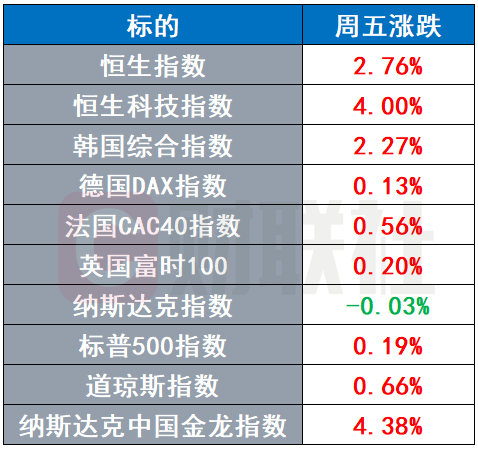
Market Performance - The MSCI Emerging Markets Index rose by 1.7% on the first trading day of 2026, marking the largest single-day gain since October of the previous year and reaching its highest closing level since February 2021 [1] - The Hang Seng Index increased by 2.76%, while the Hang Seng Tech Index surged by 4.00% [2] - The Nasdaq Index experienced a slight decline of 0.03%, influenced by major tech companies like Tesla [2] Commodity Market - Precious metals rebounded after a significant drop on the last trading day of the previous year, with silver futures rising over 5% before retracting some gains [2] - Industrial metal aluminum closed above $3,000 per ton for the first time since May 2022 [2] Company Updates - Tesla reported Q4 2025 delivery figures of 418,227 vehicles, falling short of expectations and losing its title as the global leader in electric vehicle sales to BYD, which sold 2.2567 million electric vehicles in 2025, a 27.86% increase from 2024 [4] - Bridgewater's flagship Pure Alpha II macro fund achieved a record annual return of 34% in 2025, marking its best performance in decades [4] - Warren Buffett expressed high confidence in Berkshire Hathaway's future, stating it has a greater chance of existing in 100 years than any other company [5] - Samsung Electronics' co-CEO emphasized the competitive edge of their HBM4 technology, leading to a 7.39% increase in the company's stock price [5]
对冲基金2025龙虎榜:桥水旗舰基金回报34%创纪录,桥水中国排名第三超德邵
Hua Er Jie Jian Wen· 2026-01-02 21:23
Core Insights - The hedge fund industry is expected to achieve its strongest performance in at least five years in 2025, driven by market volatility from the Trump administration's trade war, which has created lucrative opportunities for traders [1][2] - Bridgewater Associates' flagship fund, Pure Alpha II, recorded a historic return of 34%, marking a significant recovery from the previous years' returns of less than 3% [1][4] - The overall performance of hedge funds in 2025 is characterized by a mix of strategies, with event-driven funds leading the pack [5][6] Performance Summary - **Top Performing Funds**: - Melqart Opportunities Fund achieved a return of 45.1%, the highest among major hedge funds [5] - Bridgewater's Asian fund recorded a return of 37%, while both Pure Alpha II and Bridgewater China achieved 34% [4] - D.E. Shaw's Oculus fund returned 28.2%, and its Composite fund achieved 18.5% [6] - **Market Context**: - The strong performance of hedge funds is attributed to significant gains in the U.S. stock market, particularly driven by artificial intelligence themes, and the volatility in bond and currency markets due to trade tensions [2] - In 2025, the three major U.S. stock indices recorded double-digit annual gains for the third consecutive year, a trend not seen since 2019-2021 [2] Strategy Performance - **Event-Driven Funds**: - Event-driven strategies have shown flexibility and adaptability, with Melqart Opportunities leading at 45.1% and Kite Lake Special Opportunities at 17.9% [5] - **Multi-Strategy Funds**: - D.E. Shaw's flagship funds outperformed market benchmarks, with Oculus achieving a return of 28.2% and Composite at 18.5% [6] - Other multi-strategy funds displayed varied performance, with Dymon at 18.1% and Millennium at 10.5%, which did not outperform the S&P 500 [6][8] - **Equity Strategies**: - Equity long/short strategies showed significant divergence, with Soroban Opportunities at 25% and Anson Investments Master at 21.2% [7] - Other equity funds like Schonfeld's Fundamental Equity and Marshall Wace's Eureka recorded returns of 16.5% and 11.6%, respectively [7] Quantitative Strategies - **Quantitative Funds**: - Winton's multi-strategy fund had the lowest return at 7.4%, while AQR Capital Management's Apex Strategy achieved a 19.6% increase [8]