
方便食品

Search documents
麻六记酸辣粉发霉!代工商阿宽食品:涉及两批次产品,将召回
Nan Fang Du Shi Bao· 2025-07-28 01:09
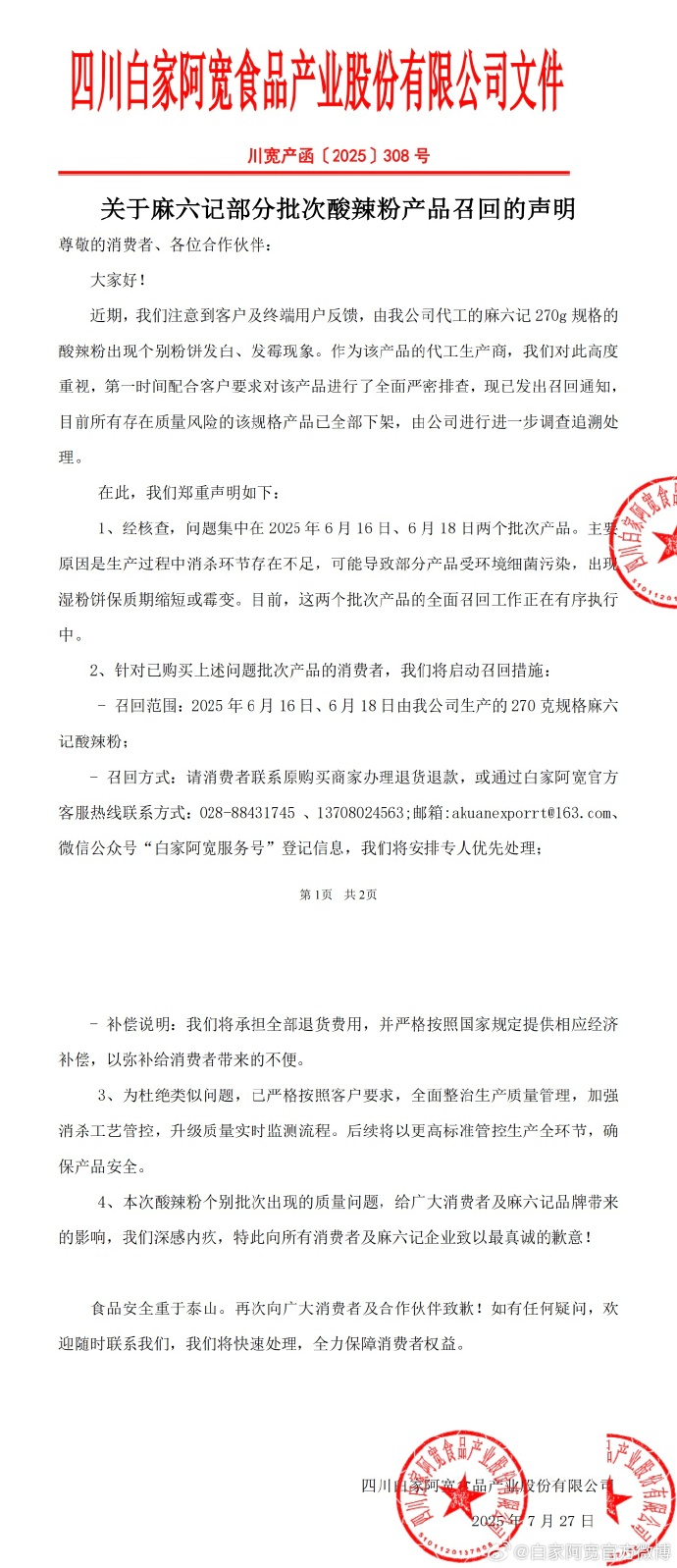
Core Viewpoint - The issue of moldy and discolored products from the brand "Ma Liu Ji" has led to a recall and removal from Costco stores, with the problem identified in two specific batches of products due to insufficient sanitation during production [1][2][5]. Group 1: Product Recall and Quality Issues - Sichuan Bai Jia A Kuan Food Industry Co., Ltd. confirmed that the quality issues were concentrated in two batches of 270g spicy sour noodles produced on June 16 and June 18, 2025, which were found to have mold and discoloration [2][5]. - The affected products have been completely removed from shelves, and a recall has been initiated to address the quality concerns [2][5][6]. - Consumers can return the products for refunds, and the company will cover all return costs and provide compensation as per national regulations [5][6]. Group 2: Impact on Sales and Business Relationships - "Ma Liu Ji" is the largest customer of A Kuan Food, with procurement amounts increasing significantly from 50.35 million yuan in 2022 to 174 million yuan in 2023, marking a year-on-year growth of 245.65% [9]. - However, the growth rate has shown signs of slowing down, with a projected increase to 201 million yuan in 2024, reflecting a growth rate of only 15.52% [9]. - The brand's sales have been influenced by external factors, including media attention related to its founder, which previously boosted sales [9]. Group 3: Company Background and Market Position - A Kuan Food was established in December 2016 in Chengdu, focusing on the development, production, and sales of new convenience foods, including instant noodles and self-heating foods [10]. - The company also provides OEM services for various brands, including "Ma Liu Ji," and has previously aimed for an A-share listing before shifting focus to the New Third Board [10]. - In 2024, A Kuan Food reported a revenue increase of 4.72% to 1.364 billion yuan, while net profit decreased by 6.79% to 47 million yuan [10].

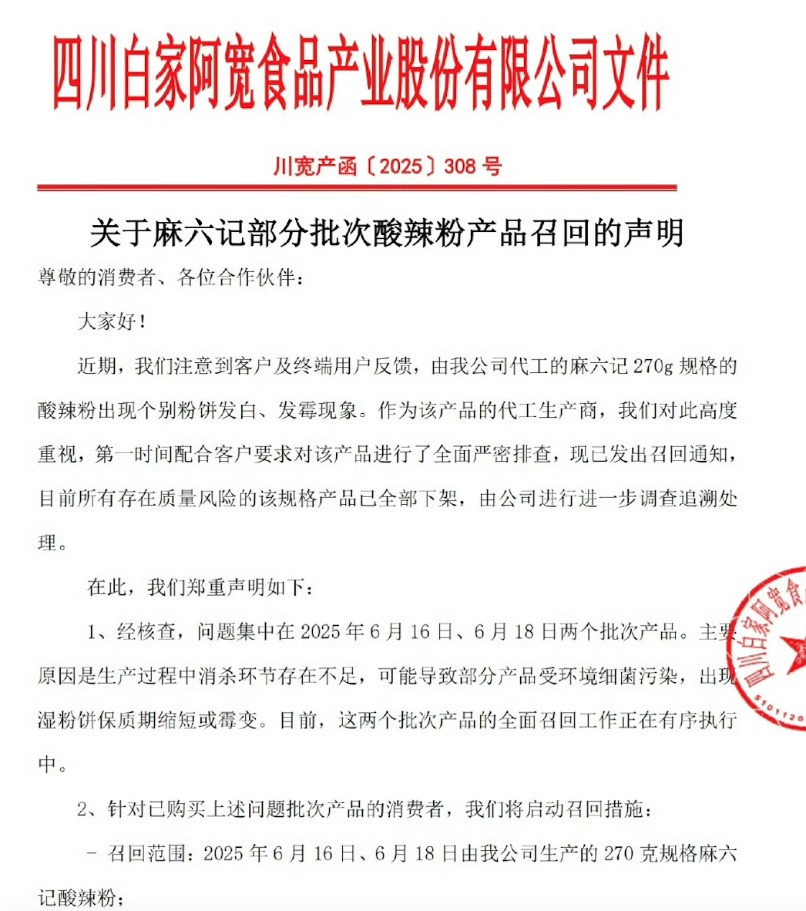
麻六记部分批次酸辣粉因质量问题被召回 白家阿宽发布声明回应:两批次产品生产环节存不足 产品受细菌污染
Xin Lang Cai Jing· 2025-07-27 14:33
Core Viewpoint - Sichuan Baijia Akwan Food Industry Co., Ltd. announced a recall of certain batches of its 麻六记 (Ma Liu Ji) 270g spicy sour noodles due to quality issues, specifically potential bacterial contamination leading to discoloration and mold [1][2][3]. Group 1: Recall Announcement - The company identified quality issues in batches produced on June 16 and June 18, 2025, due to insufficient sanitation during production, which may have led to environmental bacterial contamination [3][4]. - All affected products have been removed from shelves, and a comprehensive recall process is underway [2][3]. Group 2: Consumer Compensation - Consumers who purchased the affected batches are advised to contact the original retailer for refunds or reach out to the company's official customer service for assistance [4][5]. - The company will cover all return costs and provide compensation according to national regulations to address consumer inconvenience [4]. Group 3: Quality Management Improvements - The company has committed to enhancing its production quality management, improving sanitation processes, and upgrading real-time quality monitoring to prevent similar issues in the future [4][5]. - A sincere apology was issued to consumers and the Ma Liu Ji brand for the impact of the quality issues [5].
一生嗦粉的中国人,“嗦”出三千亿米粉产业
Zhong Guo Shi Pin Wang· 2025-07-24 11:40
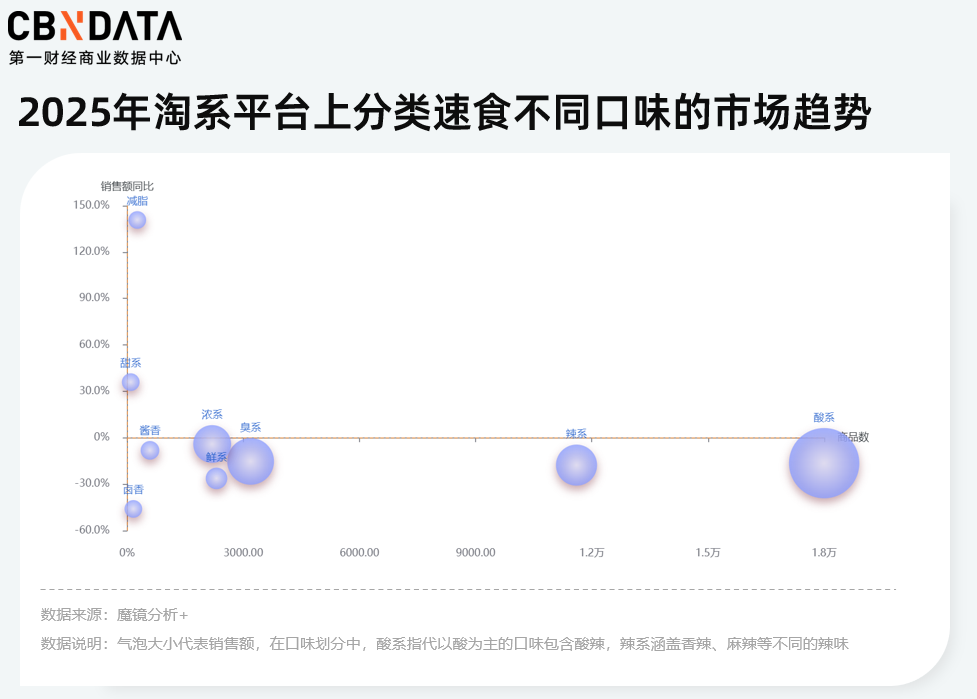
Core Insights - The Chinese rice noodle industry has reached a market scale of 300 billion yuan, with a complete industrial chain covering planting, production, processing, distribution, and sales [1] - The popularity of rice noodles is reflected in social media discussions, which have increased by over 30% year-on-year, with total online mentions exceeding 1 billion [1] - The market is rapidly expanding, with a projected terminal consumption market size of over 80 billion yuan by 2025, indicating a shift from regional specialty food to a national daily consumption [18][20] Industry Overview - The rice noodle industry has evolved from a local food history to a national phenomenon, with various regional specialties like Guangxi's snail noodles and Chongqing's spicy noodles gaining popularity [6][7][9] - The market has seen a significant increase in the number of registered companies, with over 60,000 new registrations in 2023, a 31.9% increase from 2022 [36] - The industry is characterized by a competitive landscape, with a focus on brand differentiation and innovation in flavors and product offerings [29][42] Market Dynamics - The online and offline sales channels for rice noodles are expanding, with nearly 210,000 stores nationwide by mid-2025, and over 80,000 new stores opened in the past year [20] - The online segment has seen a significant increase in demand, with online orders for rice noodles accounting for 11.2% of the snack fast food category in 2023 [20] - The rise of instant rice noodles has been driven by modern production techniques and consumer preferences for convenience, leading to a surge in online sales [20][23] Competitive Landscape - The top brands in the instant rice noodle market have established a stable market structure, with the top six brands maintaining their rankings from 2023 to 2025 [23] - The brand "Chou Bao" has consistently held the largest market share, increasing from 8.2% in 2023 to 11.5% in 2025 [24] - The offline market remains fragmented, with over 80% of brands having fewer than 50 stores, indicating a competitive environment with many small players [26] Consumer Trends - The demand for rice noodles has transcended basic sustenance, becoming a lifestyle choice among young consumers, driven by low cost and high emotional value [13][15] - Social media has played a crucial role in promoting rice noodle culture, with various discussions and trends emerging around different types of noodles and eating experiences [15][32] - Flavor trends are evolving, with sour and spicy flavors becoming dominant, and a growing interest in healthier options like konjac and buckwheat noodles [29] Supply Chain and Production - The rice noodle industry has developed a comprehensive supply chain, focusing on quality raw material sourcing, standardized production, and efficient distribution networks [38][39] - The establishment of industry standards, such as the recently approved QB/T2652-2025, is expected to enhance product quality and market trust [39] - Companies are increasingly investing in integrated supply chain systems to enhance competitiveness and operational efficiency [42][45] Future Outlook - The rice noodle market is expected to continue its growth trajectory, with increasing consumer demand and ongoing innovations in product offerings and production methods [18][50] - The integration of modern agricultural practices and branding strategies will be key to transforming traditional rice noodles into valuable consumer products [49][50] - The industry's evolution reflects a broader trend towards the establishment of a sustainable agricultural ecosystem, with rice noodles becoming a significant part of China's culinary identity [50]
兰州味道不再遥远,牛肉拉面迈入预包装时代
Zhong Guo Chan Ye Jing Ji Xin Xi Wang· 2025-07-21 22:35
Core Insights - The development of the Lanzhou beef noodle industry is being driven by policies aimed at promoting pre-packaged products, allowing traditional dishes to reach consumers nationwide [2][3] - The industry is experiencing significant growth, with a reported revenue of approximately 165 billion yuan from January to April this year, alongside the addition of 1,092 new stores [3][4] - Technological innovation is crucial for the industry's transformation, focusing on improving production efficiency and product quality through automation and data analysis [5][7] Policy and Industry Support - The Gansu provincial government has issued measures to support the development of the pre-packaged Lanzhou beef noodle industry, including project construction and product testing [2][3] - The "Lanzhou Beef Noodle Industry High-Quality Development Three-Year Action Plan (2024-2026)" aims to have over 50 pre-packaged enterprises and achieve a revenue of over 100 billion yuan by the end of 2026 [2][3] Market Expansion and Sales Channels - The pre-packaged Lanzhou beef noodles are being sold in various locations, including supermarkets, convenience stores, and transportation hubs, expanding their market reach [2][3] - Online sales have become a primary channel, with companies reporting daily sales of around 60,000 yuan and a 35% repurchase rate [4][6] Technological Advancements - Companies are investing in smart production lines and centralized kitchens to standardize the production process, ensuring consistent quality across products [6][7] - Innovations in preservation techniques and dehydration processes are enhancing the competitiveness of Lanzhou beef noodles in the market [7] Cultural Significance - Lanzhou beef noodles have evolved beyond a mere food item to become a cultural symbol of the city, reflecting its culinary heritage and history [8]
智研咨询发布:自热食品行业市场动态分析、发展方向及投资前景分析报告
Sou Hu Cai Jing· 2025-07-10 00:26
Core Insights - The self-heating food industry in China is experiencing significant growth due to increasing consumer demand for convenience and quick meal options, driven by fast-paced lifestyles and the rise of solo dining scenarios [2][4] - The market size of the self-heating food industry in China is projected to reach approximately 17.64 billion yuan by 2024, reflecting a peak during the pandemic in 2020 [2] Industry Overview - Self-heating food is defined as pre-packaged food that uses a self-heating pack for warming, without the need for electricity or fire, catering to various scenarios such as emergency supplies and outdoor activities [4] - The industry has evolved from military applications to civilian use, with significant market growth observed since 2016, particularly with the rise of self-heating hot pot products [12] Market Dynamics - The self-heating food market is influenced by several favorable factors, including increased consumer purchasing power, improved supporting industries for online sales, and favorable industry policies promoting sustainable growth [9] - However, challenges such as low brand concentration, food safety concerns, and fluctuations in raw material prices also exist [9] Business Models - The production model in the self-heating food industry includes both OEM/ODM (contract manufacturing) and self-owned production lines, with many emerging brands opting for the former to minimize initial costs [6] - Brand operation is crucial, with companies leveraging social media and KOL promotions for marketing, while also focusing on product differentiation to avoid market saturation [7] - Sales channels are diversified, utilizing both online platforms and offline retail, with a strategy of focusing on high-tier cities for online sales and penetrating lower-tier cities through physical stores [8] Regulatory Environment - The Chinese government has implemented various policies to enhance food safety and support the self-heating food industry, including stricter regulations and guidelines aimed at ensuring consumer safety [9][10] Competitive Landscape - The self-heating food industry faces several barriers to entry, including brand loyalty, sales channel establishment, supply chain management, product development capabilities, and the need for economies of scale [14][15][16][17][18] - Established brands benefit from higher recognition and consumer trust, making it challenging for new entrants to compete effectively [14] Industry Chain - The self-heating food industry chain consists of upstream raw materials (packaging, heating packs, etc.), midstream production of various self-heating food products, and downstream sales through e-commerce and retail channels [19]
三养首个海外工厂扎根中国,高标准智造保障品质
Bei Ke Cai Jing· 2025-07-03 07:29
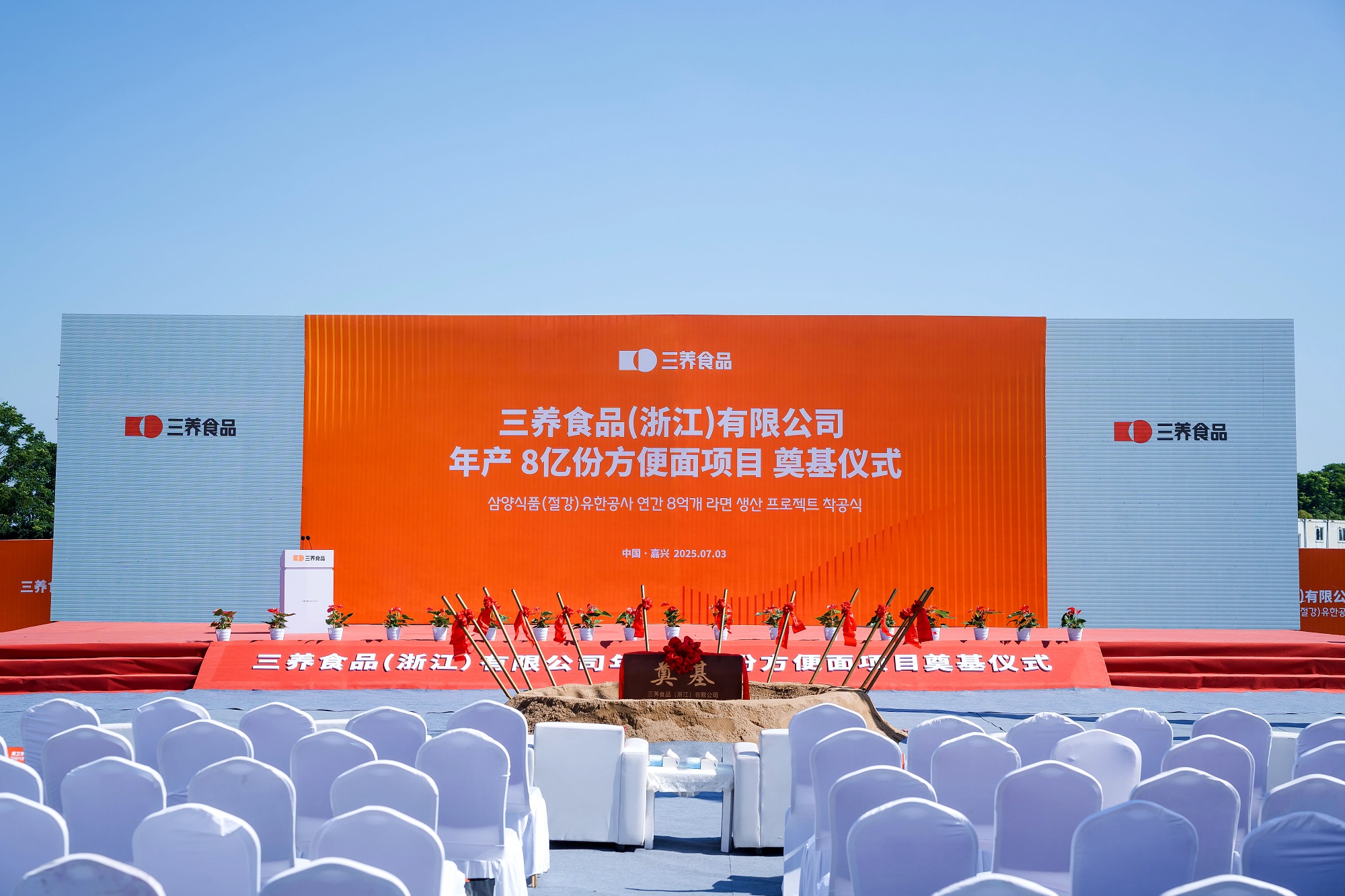
Group 1 - The core viewpoint of the article highlights the increasing market share of Korean convenience food companies in China, exemplified by Samyang Foods' establishment of its first self-built factory outside Korea in Jiaxing, which is expected to produce approximately 800 million servings of instant noodles annually [1][2] Group 2 - The Jiaxing factory has a total investment of 201.4 billion KRW (approximately 1 billion RMB) and will cover an area of about 55,000 square meters, with plans to build six production lines focused on various flavors of Samyang's signature spicy noodles, set to commence production in Q4 2026 [2][3] - The factory aims to enhance Samyang Foods' competitiveness in the Chinese market by creating a dual-base operation model with Shanghai, facilitating product innovation, manufacturing, and brand development [3][6] Group 3 - The factory will implement international advanced standards and comply with Chinese food safety regulations, establishing a systematic and transparent quality management mechanism from raw material sourcing to product delivery [4] - Samyang Foods plans to obtain certifications such as FSSC22000, ISO22000, and ISO14001, and aims to apply for "green factory" status, focusing on food safety, environmental management, and employee health [4] Group 4 - To ensure consistent taste and quality, the factory will use high-quality raw materials, standardized manufacturing processes, and direct supply of sauce packets from Korea, along with a smart oil management system to monitor oil quality [5] Group 5 - The establishment of the Jiaxing factory is expected to support the continuous development of the upstream and downstream supply chain, create more job opportunities, and enhance local economic vitality and resilience [6] - This marks a transition for Samyang Foods in the Chinese market from an "import" strategy to a "rooted" approach, expanding its long-term growth potential in the region [6]
2025年中国自热火锅市场分析:自疫情结束后市场规模萎缩,行业市场集中度高
Qian Zhan Wang· 2025-06-25 08:39
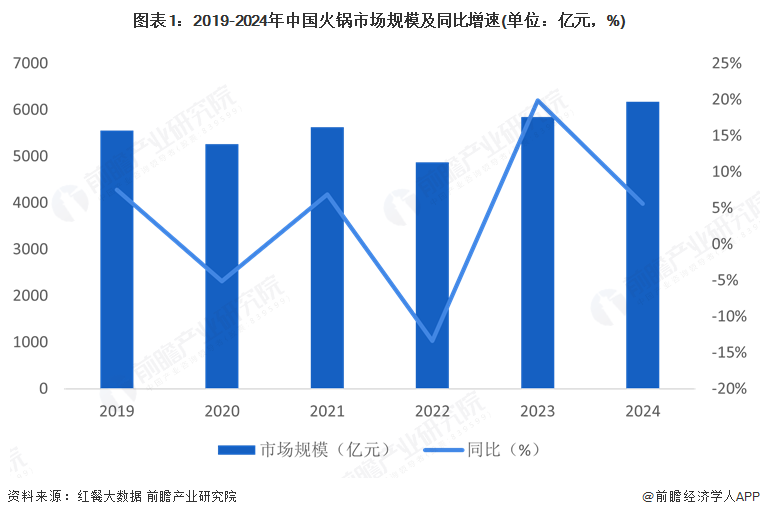
Group 1 - The core viewpoint of the article highlights the fluctuation in the domestic hot pot market and the significant decline in the self-heating hot pot market share [1][3] - The overall hot pot market in China is projected to reach a scale of 617.5 billion yuan in 2024, with a year-on-year growth of 5.6%, surpassing the overall growth rate of the catering industry [2] - The self-heating hot pot market is experiencing a severe downturn, with a year-on-year decline of approximately 20% in growth by the fourth quarter of 2024 [3][5] Group 2 - The decline in self-heating hot pot sales is attributed to changes in consumer behavior post-pandemic, product quality issues, and poor consumer experience [5][8] - The leading companies in the self-heating hot pot sector are Yihai International and Mo Xiaoxian, which together hold a significant market share of 83.73% in the fourth quarter of 2024, with Yihai International alone accounting for 50% [9][12] - The top five self-heating hot pot products in 2024 are dominated by Yihai International and Mo Xiaoxian, with their combined market share exceeding 40% [12][13]
千亿米粉赛道加速整合 微念集团日均出货超百吨成“米粉王”
Cai Fu Zai Xian· 2025-06-24 03:37
Industry Overview - The rice noodle industry is experiencing a growth phase, with over 300,000 rice noodle shops in China by April 2024 and a market size exceeding 70 billion yuan in 2023 [1][3] - The industry is characterized by a fragmented competitive market, with 77.7% of rice noodle brands having 10 or fewer stores, indicating a diverse range of standards, flavors, and quality [3] Key Players - Micro念 Group, known as the "Rice Noodle King," leads the market with an average daily shipment of over 100 tons, primarily focusing on the production of snail rice noodles [3][4] - Micro念 operates several brands, including the instant food brand Li Ziqi and the rice noodle supply chain service brand Xingnong Weinian, providing bulk raw materials to offline outlets [3] Industry Standards - The Ministry of Industry and Information Technology approved the highest industry standards for rice noodles, which will be implemented on May 1, 2026, marking a significant step towards standardization and scale in the local specialty rice noodle industry [4] - The new standards include water-boiled rice noodles, filling a gap in the industry and promoting the development of local specialty rice noodles [4] Market Dynamics - The continuous improvement of industry standards is expected to accelerate a new round of market reshuffling, with supply chain and production technology becoming key competitive factors [4][5] - The ability of leading companies like Micro念 to maintain stable product quality and robust supply chains will be crucial for building competitive advantages in the market [5]
四川省巴中市市场监督管理局关于8批次食品抽检不合格情况的通告(2025年第6号)
Zhong Guo Zhi Liang Xin Wen Wang· 2025-06-16 09:38
Summary of Key Points Core Viewpoint The Ba Zhong City Market Supervision Administration has reported that out of 100 food samples tested, 8 batches were found to be non-compliant, primarily due to the illegal use of substances such as sucralose, sweeteners, and sunset yellow. Immediate actions have been taken to investigate and recall the affected products to mitigate risks to consumers [3]. Group 1: Non-compliant Products - A total of 8 batches of food products were identified as non-compliant during the recent inspection [3]. - The main issues found included the illegal use of sucralose, sweeteners, and sunset yellow in various food items [3]. - The local market supervision authority has mandated the immediate investigation and recall of these non-compliant products [3]. Group 2: Types of Food Samples Tested - The inspection covered 11 categories of food, including edible oils, meat products, dairy products, beverages, convenience foods, frozen desserts, snacks, alcoholic beverages, pastries, honey products, and catering foods [3]. - A total of 100 food samples were collected for testing as part of the "You Choose, I Test" public service initiative [3]. Group 3: Consumer Action - Consumers are encouraged to report any instances of encountering the non-compliant products in the market by calling the complaint hotline 12315 [3].
河南方便面大王,摔了一跤
Hua Er Jie Jian Wen· 2025-06-10 04:16
Core Viewpoint - The company Bai Xiang, known for its instant noodles, has recently faced backlash over its "Duoban" trademark, which misled consumers regarding product quantity, leading to a public apology and potential brand image issues [1][2][3] Group 1: Company Overview - Bai Xiang has successfully positioned itself as the third-largest player in the instant noodle market, with a market share of 12% in 2023, trailing behind Kang Shifu and Uni-President [6][8] - The company reported a sales revenue of 9.175 billion yuan in 2023, showing double-digit growth and narrowing the revenue gap with Uni-President to less than 500 million yuan [6][8] - Bai Xiang's chairman, Yao Zhongliang, founded the company in 1997, leveraging local wheat resources and gaining popularity with its "1 yuan big bone noodle" product [8] Group 2: Recent Controversy - The controversy arose when consumers discovered that the "Duoban" label on Bai Xiang's noodle packaging was a trademark, not an indication of increased quantity, leading to public outrage and a swift apology from the company [2][3][5] - The backlash was significant, with the apology trending on social media, garnering 190 million views and 34,000 discussions within 16 hours [2][3] Group 3: Market Position and Strategy - Bai Xiang has capitalized on online sales channels, especially during the rise of live-streaming e-commerce, which has significantly boosted its visibility and sales [9][10] - The company has launched innovative products like the controversial cilantro-flavored noodles, which saw a nearly 2000% increase in online sales in August 2023 [10][11] - Bai Xiang's online presence is strong, with its Douyin flagship store amassing over 5.12 million followers, far surpassing competitors [11] Group 4: Challenges and Future Outlook - Despite its online success, Bai Xiang faces challenges in the offline market, where brand recognition varies significantly among different consumer demographics [12][13] - The company is expanding its presence in southern China, with a new production facility in Guangdong set to begin operations, aiming to enhance its market penetration [14][15] - The competitive landscape remains fierce, with established brands like Kang Shifu and Uni-President maintaining strong positions in offline retail, necessitating strategic adjustments from Bai Xiang [19][20]
