
资讯科技业

Search documents
港股科技ETF(513020)昨日净流入超0.5亿,市场关注流动性改善与行业轮动机会
Mei Ri Jing Ji Xin Wen· 2025-08-20 02:10
Group 1 - The core viewpoint is that during the US interest rate cut cycle, Hong Kong stocks may exhibit better resilience than US stocks, benefiting from improved liquidity and risk appetite, with a focus on TMT, energy, and telecommunications sectors [1] - The current trading mode is primarily characterized by stagflation trading, with a potential shift towards easing trading scenarios and recession trading scenarios [1] - Under stagflation trading, Hong Kong stocks have shown higher gains (close to those in easing trading), while US stocks have seen slight increases (similar to recovery trading), and US Treasury yields have declined (approaching recession trading declines) [1] Group 2 - The Hong Kong Technology ETF (513020) tracks the Hong Kong Stock Connect Technology Index (931573), which selects the top 30 securities by market capitalization from technology-related listed companies traded through Stock Connect, reflecting the overall performance of the technology sector in Hong Kong [1] - The index emphasizes information technology and hardware sectors, showcasing a balanced allocation across multiple tracks [1] - Investors without stock accounts can consider the Cathay CSI Hong Kong Stock Connect Technology ETF Initiated Link A (015739) and Link C (015740) [1]
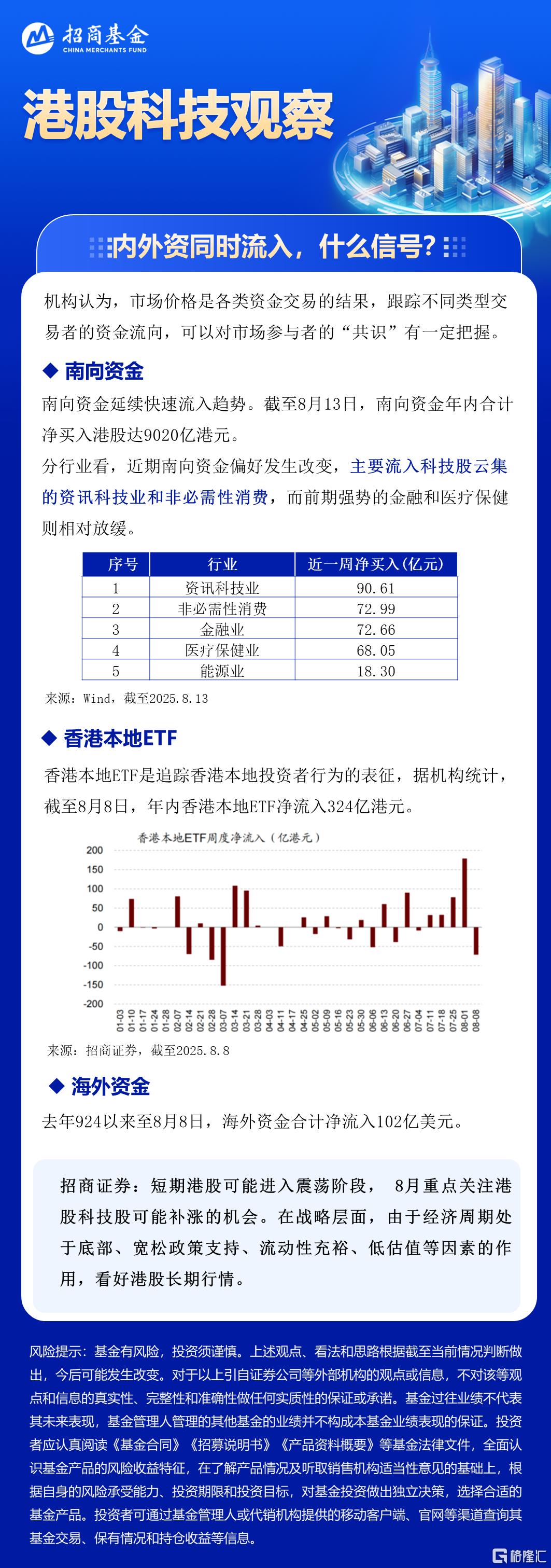
内外资同时流入,港股资金“共识度”提升?
Ge Long Hui· 2025-08-15 03:01
Group 1 - The core viewpoint is that both domestic and foreign capital are flowing into the Hong Kong stock market, leading to an increase in consensus among investors [1] - Southbound funds have net bought a total of 902 billion HKD in Hong Kong stocks this year, with technology stocks being the main focus of investment [1] - The Hong Kong local ETFs have seen a net inflow of 32.4 billion HKD as of August 8 this year [3] Group 2 - Over the past week, the information technology sector had the highest net inflow of 9.061 billion HKD, followed by non-essential consumer goods at 7.299 billion HKD and the financial sector at 7.266 billion HKD [2] - Since September 2022 until August 8, overseas funds have net flowed into Hong Kong stocks totaling 10.2 billion USD [5]

南向资金单日净流入超234亿港元创5月以来新高,恒生科技ETF(513130)多只成份股获大举加仓
Xin Lang Ji Jin· 2025-08-06 02:59
Group 1 - On August 5, 2025, southbound capital transactions reached HKD 129.701 billion, accounting for 56.54% of the total turnover of the Hang Seng Index, with a net inflow of HKD 23.426 billion, setting a new single-day net buying record since April 9, 2025 [1] - The technology and non-essential consumer sectors topped the net buying list, indicating a growing confidence and allocation enthusiasm from southbound capital towards Hong Kong's technology and new economy sectors [1] - The Hang Seng Technology Index has seen increased capital attention, with the Hang Seng Technology ETF (513130) attracting HKD 3.026 billion in the past week, averaging daily turnover of HKD 4.797 billion, making it the only product tracking the index to accumulate over HKD 2.6 billion during the same period [1] Group 2 - As of August 5, 2025, the Hang Seng Technology ETF (513130) reached a record size of HKD 30.907 billion and 4.2356 billion shares, marking historical highs and continuous growth over four trading days [2] - The ETF has a broad investor base, with over 160,000 investors holding it, making it one of the two ETFs tracking the Hang Seng Technology Index with more than 70,000 holders, reflecting strong market recognition [2] - Despite recent performance pressures due to a price war in the food delivery sector, positive signals are emerging as regulatory discussions have led to commitments from delivery platforms to standardize promotional behaviors, potentially alleviating negative impacts on the technology sector [2] Group 3 - The Hang Seng Technology ETF (513130) closely tracks the Hang Seng Technology Index, with its top five constituents being Tencent Holdings, NetEase, Xiaomi, Alibaba, and Kuaishou, representing competitive industry leaders across key sectors such as internet platforms, new energy vehicles, semiconductors, and AI [3] - With the support of southbound capital and the gradual implementation of "anti-involution" policies, adverse factors hindering the development of Hong Kong's technology sector are expected to diminish, suggesting a potential return of core investment value [3] - The current price-to-earnings ratio of the Hang Seng Technology Index is at a low of 22% over the past five years, indicating a significant investment window [3]
前7个月港股回购超1000亿港元 腾讯回购400亿港元位居榜首
Shen Zhen Shang Bao· 2025-07-31 19:05
Core Viewpoint - The Hong Kong stock market has seen a significant increase in share buybacks in 2023, indicating that companies are taking advantage of historically low valuations and improving their capital structures [1][2]. Group 1: Buyback Trends - From January 1 to July 31, 2023, 212 Hong Kong-listed companies repurchased a total of 4.611 billion shares, amounting to HKD 104.7 billion [1]. - The healthcare, consumer discretionary, and information technology sectors have the highest number of companies participating in buybacks, reflecting a broadening of market confidence [1]. - Tencent Holdings led the buyback activity with a total repurchase amount of HKD 40.043 billion, accounting for 38.25% of the total buyback value in the market [2]. Group 2: Tencent Holdings Buyback Details - Tencent has consistently increased its buyback amounts over the years, with HKD 25.99 billion in 2021, HKD 337.94 billion in 2022, and HKD 494.33 billion in 2023 [3]. - In the first seven months of 2023, Tencent repurchased 8.884 million shares, with an average daily buyback amount exceeding HKD 600 million [2][3]. - The monthly buyback amounts exceeded HKD 10 billion in five months, with the highest in June at HKD 20.834 billion [3]. Group 3: Market Outlook - The Hong Kong Stock Exchange's upcoming reform in June 2024 will allow companies to hold repurchased shares as treasury stock, which is expected to enhance buyback activity and efficiency [3]. - The total buyback amount for the second half of 2023 is projected to remain around HKD 100 billion, similar to the first half [3].
南向资金追踪|7月加仓金融及科技板块抛售消费股 单月净流入环比复苏重回千亿量级
Xin Lang Cai Jing· 2025-07-31 12:39
Core Insights - In July, southbound funds recorded a cumulative net inflow of 135.65 billion HKD, returning to a scale exceeding 100 billion after a slowdown in May and June [1][2] - Year-to-date, southbound funds have accumulated a total inflow of 866.84 billion HKD, surpassing the total inflow for the entire previous year, equivalent to 107% of the expected inflow for 2024 [2] Industry Analysis - Significant inflows were observed in the financial and healthcare sectors, with net purchases of 49.78 billion HKD and 22.25 billion HKD respectively, while consumer stocks saw substantial sell-offs [2][4] - The non-essential consumer sector experienced a net outflow of 31.54 billion HKD, indicating a decline in the "new consumption" concept [4] Market Performance - The Hang Seng Index rose by 2.91% in July, reaching new highs for the year, with total trading volume of 57.8 trillion HKD, the highest since April [5] - Southbound funds accounted for approximately 55% of the trading volume during the same period [5] Stock-Specific Movements - Major net inflows were recorded for Meituan (89.82 billion HKD), China Construction Bank (75.13 billion HKD), and SMIC (62.28 billion HKD) [6] - Significant net outflows were noted for Tencent Holdings (41.45 billion HKD), Pop Mart (26.77 billion HKD), and Xiaomi Group (18.51 billion HKD) [7] Recent Trends - Meituan saw a cumulative decline of 2.95% in July, with short-term funds primarily flowing out [8] - China Construction Bank and SMIC experienced gains of 1.64% and 14.32% respectively, with continued inflows [9][10] - China Life Insurance surged by 24%, attracting accelerated inflows [10] ETF Activity - Southbound funds significantly increased their positions in three major ETFs: the Tracker Fund of Hong Kong (24.05 billion HKD), Hang Seng China Enterprises (17.81 billion HKD), and Southern Hang Seng Technology (9.73 billion HKD) [15]






又创纪录了?港股科技下跌,南向却在疯狂“吸筹”
Jin Rong Jie· 2025-07-31 02:50
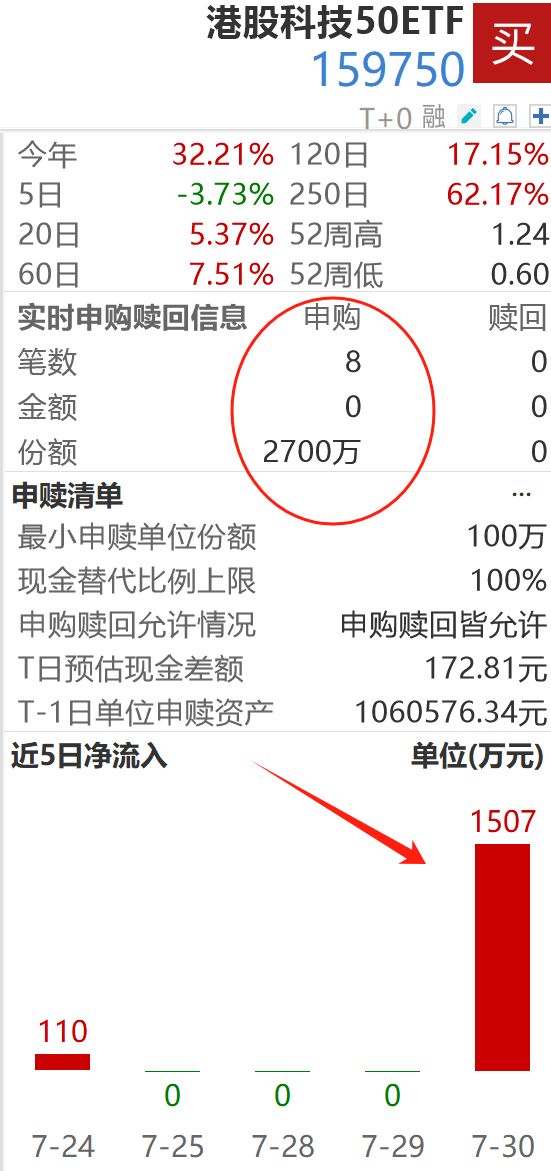
Group 1 - The core viewpoint of the articles highlights the significant inflow of capital into the Hong Kong technology sector, driven by mainland investors seeking opportunities in undervalued assets [4][6][11]. - The southbound capital has net bought approximately 840 billion HKD in Hong Kong stocks in just seven months of 2025, surpassing the total for the entire previous year and setting a historical record since the launch of the Stock Connect [4][6]. - The Hong Kong Technology Index is noted for its broader coverage of sectors, including electric vehicles and innovative pharmaceuticals, which may provide better performance potential compared to the Hang Seng Technology Index [7][9]. Group 2 - The Hong Kong Technology 50 ETF (159750) has seen significant capital inflows, with 150.7 million HKD net bought yesterday and an additional 36 million HKD today, indicating strong investor interest in low-cost entry points [1][10]. - The performance of the Hong Kong Technology Index has outpaced the Hang Seng Technology Index over various time frames, with returns of 30.94%, 57.40%, and 95.02% over the past year, two years, and ten years, respectively [9][11]. - The article suggests that the Hong Kong Technology sector is becoming an important outlet for mainland funds seeking allocation opportunities, especially given its relatively low valuations and potential for earnings recovery [6][12].
2025年下半年香港市场中国焦点策略:坚定信心,2025年下半年港股有望震荡上行
Bank of China Securities· 2025-07-28 06:44
Group 1: Market Outlook - The report maintains an optimistic outlook for the Hong Kong stock market in the second half of 2025, predicting a potential upward trend for the Hang Seng Index, which is expected to reach 27,500 points by the end of December 2025, based on a forecasted P/E ratio of 12.2 times [2][30] - The Chinese decision-makers are expected to implement incremental policies to strengthen domestic circulation, promote supply-side reforms, and expand domestic consumption demand [2][30] - The report highlights attractive valuation levels in the current Hong Kong stock market, suggesting that the market is currently in a historically lower valuation range compared to previous years [2][31] Group 2: Sector Performance - In the first half of 2025, the Hong Kong stock market outperformed other major global markets, with the Hang Seng Index rising by 20.0% and the Hang Seng Tech Index by 18.68% [3][4] - The healthcare, materials, and information technology sectors showed strong performance, with respective increases of 47.7%, 45.6%, and 29.8% [4][7] - The report notes that the premium of A-shares over H-shares has decreased, indicating a narrowing gap in valuations between the two markets [4][16] Group 3: Investment Opportunities - Key investment opportunities are identified in areas such as supply-side reform, infrastructure development, and consumer-driven companies, particularly those with low valuations and high dividend yields [2][30] - The report emphasizes the importance of focusing on leading consumer companies and domestic brands that are benefiting from accelerated domestic substitution processes [2][30] - The ongoing infrastructure projects, such as the construction of the largest hydropower station in China, are expected to benefit related sectors, including construction, machinery, and materials [2][38] Group 4: Capital Market Dynamics - The Hong Kong capital market remains liquid, with significant inflows from southbound trading, which accounted for 22.1% of total market turnover by June 30, 2025 [17][23] - The report indicates that the IPO financing amount in Hong Kong reached $141 billion in the first half of 2025, marking a 695% year-on-year increase, positioning Hong Kong as the top global IPO market [17][23] - The report also highlights the impact of geopolitical risks on market sentiment, noting that companies with mainland backgrounds dominate the Hong Kong market, comprising 80.97% of total market capitalization [24]
一键布局港股科技核心资产 华安恒生港股通科技主题ETF7月28日发行
Xin Lang Ji Jin· 2025-07-28 01:03
Group 1 - The technology sector is becoming a core driver of economic growth in China, with the launch of the Huaan Hang Seng Hong Kong Stock Connect Technology Theme ETF providing new investment tools for investors in the Hong Kong technology space [1] - The ETF closely tracks the Hang Seng Hong Kong Stock Connect Technology Theme Index, which focuses on the AI industry chain and includes major tech companies such as Xiaomi, Alibaba, Tencent, and Meituan [1] - The Hang Seng Hong Kong Stock Connect Technology Theme Index has a more concentrated weight limit of 10% per stock compared to the Hang Seng Technology Index's 8%, indicating a more focused investment strategy [1] Group 2 - The Hong Kong stock market is expected to see revenue growth of 3.4% and profit growth of 8.5% in 2024, indicating a recovery from 2023, with the technology sector benefiting significantly from the overall growth of the AI industry [2] - The Hang Seng Hong Kong Stock Connect Technology sector is projected to experience a profit growth rate of 51% in 2024, continuing the high growth trend established in 2023 [2] - As the domestic economy recovers and global asset rebalancing occurs, the investment value of Hong Kong stocks is expected to become more prominent, driven by advancements in AI technology and increased capital expenditure from tech leaders [2]
港股持有比例,创新高
Zhong Guo Ji Jin Bao· 2025-07-27 13:36
Group 1 - The core viewpoint of the articles highlights that the proportion of actively managed equity funds holding Hong Kong stocks has reached a historical high, driven by a significant increase in global interest in Chinese assets [1][3]. - As of the end of Q2, the total market value of Hong Kong stocks held by public funds reached 734.3 billion yuan, a 12.8% increase from the previous quarter, with the proportion of public fund holdings in Hong Kong stocks rising from 36.9% to 39.8% [2]. - The actively managed equity funds specifically increased their holdings in the healthcare and financial sectors while reducing exposure in information technology and discretionary consumer sectors [2]. Group 2 - The Hang Seng Index has seen a year-to-date increase of nearly 27%, making it the best-performing major index globally, with fund managers expressing optimism about the market's future [4]. - Fund managers are particularly optimistic about structural opportunities in various sectors, including new consumption, innovative pharmaceuticals, and traditional industries like "AI+", overseas expansion, and smart manufacturing [4]. - The increasing allocation of public funds to Hong Kong stocks reflects a growing attractiveness of the market, with over 50% of public funds now having the ability to invest in Hong Kong stocks as of Q2 2025 [3].


沪指重返3500点!这些方向开始领跑
Sou Hu Cai Jing· 2025-07-09 04:54
Group 1 - A-shares have shown a structural market characteristic, with strong performance in consumer sectors such as food and beverage, and retail, as well as certain technology sectors like AI applications and innovative pharmaceuticals [2][4] - The top five performing industries in A-shares include agriculture, media, food and beverage, electrical equipment, and retail, indicating a growing interest in agricultural assets and a recovery in consumer spending [2] - The bottom five performing industries in A-shares are electronics, steel, basic chemicals, non-ferrous metals, and storage chips, with the decline in non-ferrous metals linked to proposed US tariffs on copper [2] Group 2 - In the Hong Kong market, the healthcare sector has seen a rise due to active innovative drug concepts, despite potential US tariffs on pharmaceuticals [3] - The top three performing industries in Hong Kong include healthcare, industrial, and energy, while the bottom three are materials, information technology, and real estate, reflecting external pressures from US tariff policies and global tech supply-demand imbalances [3] - The current market characteristics indicate that A-shares are driven by policy and sectoral improvements, while Hong Kong stocks are more influenced by external factors such as US tariffs and global technology cycles [4] Group 3 - Short-term market hotspots are concentrated around policy-driven sectors and improving industry conditions, with a focus on performance in the upcoming earnings reports [4] - The breakthrough of the Shanghai Composite Index above 3500 points is expected to further boost market confidence, with potential policy signals from the July Politburo meeting influencing capital flows [4]