
投资银行

Search documents
华尔街抢滩沙特私人信贷 杰富瑞(JEF.US)牵头Erad融资加入战局
Zhi Tong Cai Jing· 2025-11-27 09:23
Group 1 - Jefferies Financial Group has entered the Saudi Arabian private credit market by leading a $125 million financing deal for fintech startup Erad [1] - The financing will provide an asset-backed scalable financing tool to help Erad expand its lending to local SMEs in Saudi Arabia [1] - This move positions Jefferies among major Wall Street investment banks exploring private credit opportunities in Saudi Arabia and the broader Gulf region [1] Group 2 - There is a significant demand for new funding sources in the SME sector, which often struggles to secure support from local banks [2] - SMEs are considered the backbone of the Gulf region's economic diversification, facing a financing gap of $250 billion that limits their growth potential [2] - The financing tool will enable Erad to meet the growing financing needs of SMEs in the Gulf region and expand its service offerings beyond traditional consumer sectors to include manufacturing, logistics, distribution, and real estate services [2]

英镑反弹恐近尾声!大摩警告:英国预算案行情或是“最后欢呼”
Zhi Tong Cai Jing· 2025-11-27 08:23
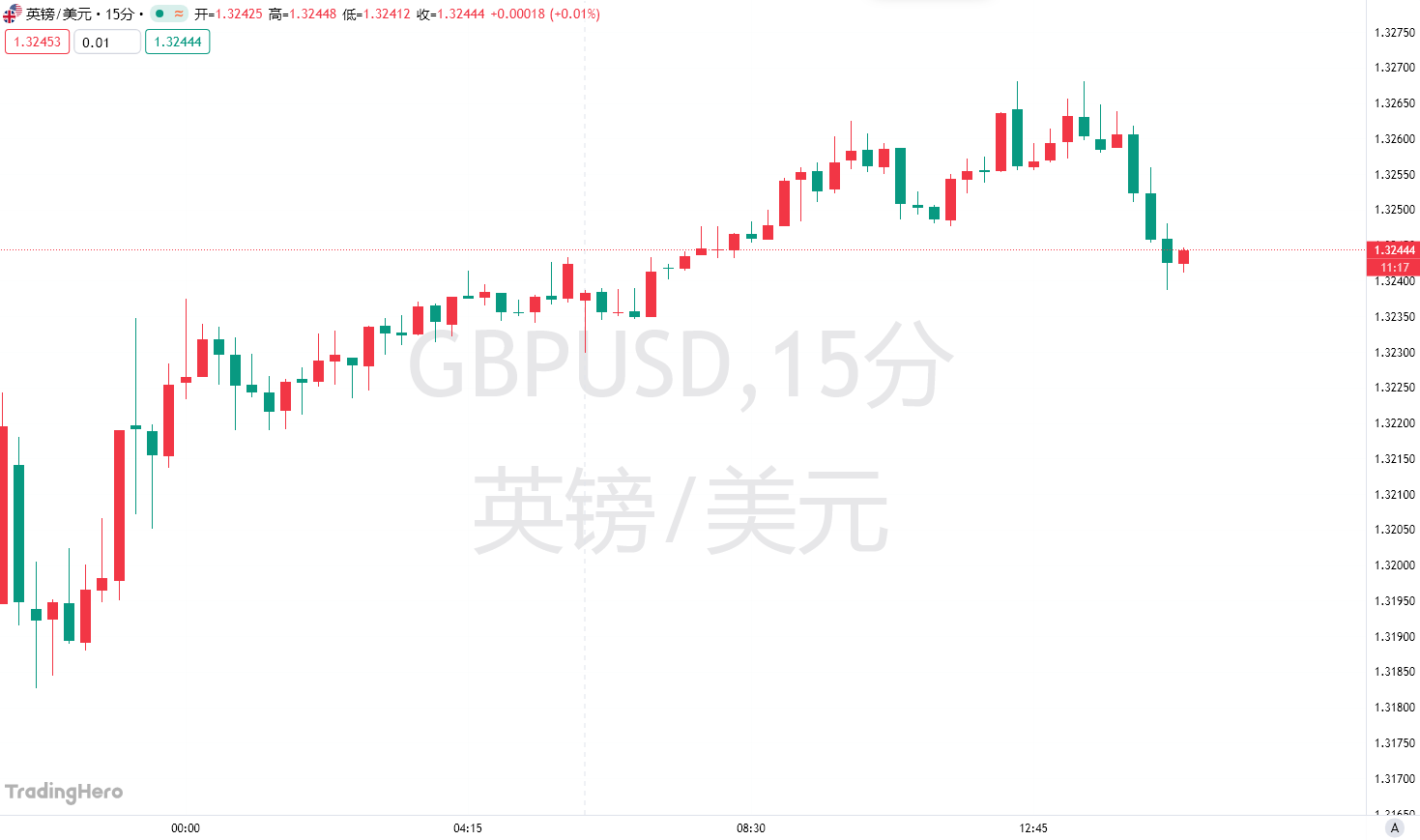
Group 1 - Morgan Stanley has closed its bullish stance on the British pound, indicating that the currency may have reached its last favorable catalyst recently [1] - Following the UK budget announcement, the pound briefly rebounded against the dollar, but this upward trend is likely to fade [1][4] - The attractiveness of the pound against the dollar has diminished, with its correlation to the stock market dropping to zero and a lack of positive local drivers in the short term [1] Group 2 - The pound rose above 1.32 against the dollar after the budget announcement, signaling a more restrained government borrowing approach [4] - Morgan Stanley suggests that if the Bank of England implements sufficient rate cuts, it could alleviate negative factors affecting the pound, potentially creating more fiscal space [4] - Jefferies also anticipates that the pound's upward momentum is unlikely to persist, citing ongoing fiscal vulnerabilities as a reason for further potential weakness [4]

金价猛涨,80倍杠杆高风险,官方紧急提示谨慎操作
Sou Hu Cai Jing· 2025-11-27 07:45
Group 1: Gold Market Dynamics - Gold prices experienced a sudden surge after initially declining, driven by new statements from key Federal Reserve officials regarding potential interest rate cuts in December [1][3] - Federal Reserve Governor Waller expressed support for a rate cut in December, citing possible downward revisions to September employment data, which increased market expectations for lower interest rates [3] - Goldman Sachs projected that the Federal Reserve would implement a third consecutive rate cut in December, reinforcing the growing consensus in the financial community regarding this expectation [3][5] Group 2: Investment Risks in Gold - The CME's "FedWatch" tool indicated an 82.9% probability of a 25 basis point rate cut in December, a significant increase from the previous day's 69.4%, leading to a shift in market sentiment towards gold and other safe-haven assets [5] - Several cases of dubious gold investment schemes were highlighted, including a dealer promoting "gold leasing" and another offering high returns on gold investments through an app with an 80x leverage, which poses significant risks to investors [7][9] - Regulatory warnings were issued to the public about the dangers of high-leverage gold investments and the importance of choosing legitimate channels to avoid illegal financial activities [9][18] Group 3: Aluminum Market Trends - Aluminum prices have shown a pattern of rising and then retreating, influenced by macroeconomic sentiment and fundamental factors, with recent declines attributed to a combination of hawkish Federal Reserve comments and mixed employment data [11][15] - Analysts noted that the oversupply of alumina and high inventory levels are likely to keep aluminum prices under pressure, with a potential for production cuts in December, although immediate impacts on supply-demand dynamics may be limited [13][15] - The aluminum market remains sensitive to macroeconomic conditions, with expectations for a potential weakening in demand and increased supply in the coming months, particularly with new capacities coming online [17][18]
摩根士丹利唱空英镑:短期利好已耗尽,反弹恐是“回光返照”!
Jin Shi Shu Ju· 2025-11-27 07:26
AI播客:换个方式听新闻 下载mp3 摩根士丹利表示,从长远来看,英国央行充分的降息可能有助于缓解对英镑的不利因素,因为政策宽松可能会创造更多的财政空间。该行补充道,此外,借 贷成本降低可以提振家庭消费和企业活动。 "也许当我们接近英国央行降息周期的尾声时,增长将取代套利交易,成为英镑的关键货币催化剂,"策略师们写道。"如果降息有助于刺激增长前景,那么 原本可能对英镑不利的市场情绪将有很大的转变空间。" 同样,杰富瑞预计英镑的涨势将是短暂的,并认为还有进一步走弱的空间。该行经济学家Modupe Adegbembo在一份报告中写道: "展望未来,我们认为持续的财政脆弱性使得收益率曲线陡峭化交易具有吸引力,因为市场继续计入财政滑坡和结构性失衡的风险。" 音频由扣子空间生成 摩根士丹利已结束其看涨英镑的建议,并指出该货币可能已经见证了短期内最后一个利好催化剂。 David Adams等策略师在周四的一份报告中写道,尽管周三英国预算案公布后英镑有快速反弹的空间,但涨势可能会消退。他们补充称,英镑兑美元的吸引 力已受到打击,因为其与股市的关联度已降至零,且眼下缺乏积极的本土驱动因素。 策略师们写道,"随着预算案已成过去 ...
香港IPO热潮,将推高香港投行家2026年薪酬
Xin Lang Cai Jing· 2025-11-27 06:13
来源:瑞恩资本RyanbenCapital 来源 | The Banker 据The Banker报道,招聘机构Robert Walters华德士表示,受香港IPO活动复苏的提振,香港的投行预计 将在明年提高员工薪酬。 该机构预测, 精品投行的加薪幅度将更为普遍,2026年精品投行的助理(associate)、副总裁(vice president)、董事 (director)和董事总经理(managing director)的薪酬范围都将有所提高。 华德士的分析,基于其年度薪资调查,该调查收集全年数据,并对2026年进行前瞻性预测。上述数字, 未包含奖金和股权激励。 根据华德士基于与客户沟通的估算(薪资不包括奖金、股权激励): 精品投行前台职位的董事总经理(managing director),2025年薪资范围在200万至280万港元之间,2026年 可能增至210万至310万港元; 从事卖方业务的董事(director),2025年薪资范围在140万至220万港元,2026年可能跃升至150万至250万 港元; 副总裁(vice president)的薪酬,则可能从86万至130万港元增至96万至150万 ...

高盛重磅预测:美股“躺赢”时代结束了?未来十年回报率恐腰斩
3 6 Ke· 2025-11-27 04:51
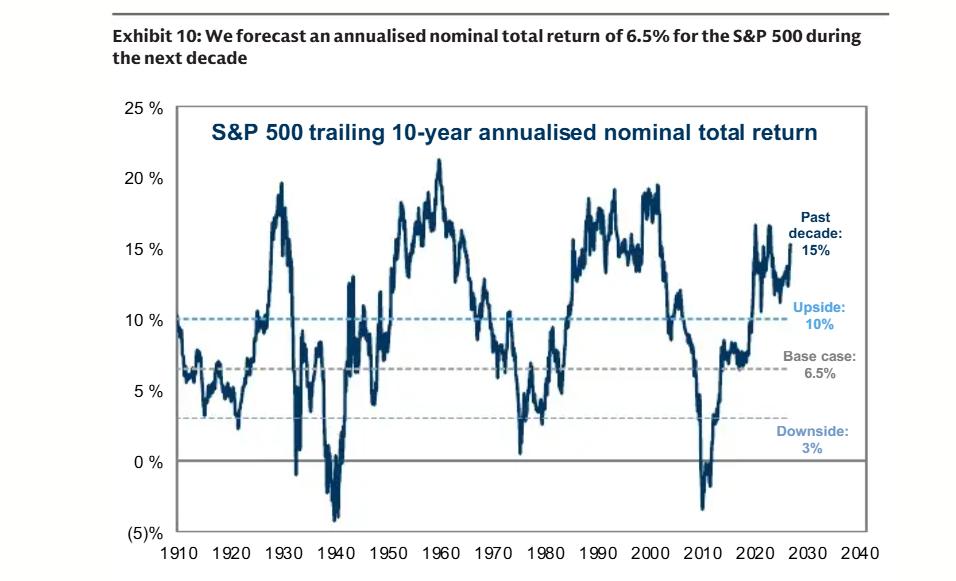
Core Insights - Goldman Sachs released a report titled "2025-2035 Global Stock Market Decadal Outlook," which emphasizes a shift from the previous decade's "U.S. stock dominance" and warns of potential corrections in asset pricing [1] - The report suggests that the S&P 500's annualized nominal total return is expected to decline to 6.5% over the next decade, a significant drop from the 15% annualized return seen in the past ten years [1][3] Return Attribution Analysis - Earnings growth is projected to contribute positively, with an expected annual compound growth rate of approximately 6%, indicating robust fundamentals for U.S. stocks [3] - Dividend returns are anticipated to contribute around 1.4% to total returns [4] - Valuation adjustments are expected to be the largest drag on returns, with the current forward P/E ratio at 23x, which is historically high. A gradual contraction in valuation multiples is predicted to negatively impact total returns by about 1% annually [4] Global Market Opportunities - As U.S. stock returns are expected to decline, relative value in global assets is becoming more apparent. Goldman Sachs forecasts a 7.7% annualized return for global equities (MSCI ACWI), surpassing U.S. stocks [6] - Non-U.S. markets, both developed and emerging, are expected to outperform U.S. stocks due to structural advantages and more attractive valuations [8] Regional Performance Expectations - Emerging markets are projected to have a 10.9% annualized return, driven by strong EPS growth in China and India [10] - Asia (excluding Japan) is expected to yield a 10.3% return, supported by approximately 9% EPS growth and a 2.7% dividend yield [10] - Japan is forecasted to achieve an 8.2% return, bolstered by EPS growth and policy-led improvements in shareholder payouts [12] - Europe is expected to deliver a 7.1% return, with half of this driven by earnings and the other half by shareholder returns [10] Strategic Recommendations - The report suggests a shift from a concentrated investment strategy focused on U.S. stocks, particularly tech giants, to a more balanced global allocation to mitigate risks associated with declining Sharpe ratios [15] - It advocates for increasing exposure to emerging markets and non-U.S. developed markets to capture potential valuation recovery and benefits from currency fluctuations [16]

高盛预言黄金将冲击4900美元:央行与散户共筑“黄金时代”
Jin Shi Shu Ju· 2025-11-27 02:15
Core Viewpoint - Goldman Sachs predicts gold prices will reach $4,900 per ounce by 2026, driven by central bank demand and ETF purchases, with a potential for significant price increases if retail investors diversify into gold [1][2] Group 1: Price Predictions - Goldman Sachs has raised its gold price forecast for 2026 from $4,300 to $4,900 per ounce, citing strong inflows into Western ETFs and ongoing central bank purchases as key drivers [1][3] - The firm expects gold prices to increase by nearly 20% by the end of 2026, although this growth rate is lower than the nearly 60% increase observed in 2023 [1] Group 2: Drivers of Demand - The primary driver of gold demand is the structural increase in central bank purchases, particularly from emerging markets, which are diversifying their reserves into gold following the freezing of Russian central bank assets [1][3] - The second key driver is the anticipated interest rate cuts by the Federal Reserve, which are expected to lead to increased investments in gold ETFs as gold is a non-yielding asset [1][2] Group 3: Market Dynamics - The current gold market is relatively small compared to the U.S. bond market, with global gold ETF holdings being only one-seventieth of the U.S. bond market, indicating that even a small shift in investment could significantly impact gold prices [1] - The ongoing trend of central banks shifting reserves from U.S. dollars to gold is expected to continue, with central bank gold purchases projected to reach 80 tons in 2025 and maintain at 70 tons in 2026 [3]
高盛再发黄金看多宣言:明年或再涨20%,目标直指4900美元
智通财经网· 2025-11-27 01:56
"自2022年俄罗斯央行储备被冻结以来,新兴市场储备管理者得到了一个重要的警示:他们需要增持黄 金以实现多元化。一旦将黄金储存在国内金库中,它就是唯一真正安全的资产,"斯特鲁文在采访中表 示。他补充说,高盛经济学家目前预测美联储还将降息75个基点。 "私营部门多元化配置可能推动金价大幅上涨的关键原因在于黄金市场的规模相对较小,"斯特鲁文指 出,黄金ETF市场的规模比美国国债市场小约70倍——"这是我们将黄金列为最推荐做多的大宗商品的 另一个原因。" 由于市场对美联储下月降息的预期日益增强,黄金期货周三连续第四个交易日上涨。 智通财经APP获悉,高盛全球大宗商品研究共同主管达安·斯特鲁文表示,在央行增购和利率下降的推 动下,明年晚些时候金价可能攀升至每盎司4900美元。但他也指出,即使零售投资者向多元化配置迈出 一小步,也可能带来更大的上行空间。 一批最新公布的延迟美国数据显示,9月零售销售小幅增长,批发价格涨幅符合预期。与此同时,三菱 日联银行分析师Soojin Kim在报告中写道:"政策转向的可能性获得了额外动力,因为被广泛视为下一 任美联储主席最热门人选的凯文·哈塞特,被认为与特朗普支持降低借贷成本的观点 ...
炒币大赚、投行收入超10亿美元!美国商业部长的“华尔街前东家”创历史最佳业绩,其儿子任董事长
Hua Er Jie Jian Wen· 2025-11-27 00:06
Core Insights - Cantor Fitzgerald is experiencing its best performance ever, with projected revenues exceeding $2.5 billion this year, driven by early investments in cryptocurrency [1] - The investment banking segment is expected to generate over $1 billion, nearly double the previous record of $650 million set in 2021 [1] Group 1: Cryptocurrency Business - The growth of Cantor Fitzgerald is primarily attributed to its deep involvement in the cryptocurrency sector, having raised over $40 billion this year, with expectations to reach $50 billion by year-end [2] - The company's cryptocurrency operations began in 2018, initially collaborating with Bitcoin miners and later expanding to exchanges and custodians [2] - Cantor Fitzgerald holds a significant portion of the reserves of the largest stablecoin, Tether, and has a convertible bond that grants it approximately 5% equity in Tether [2] - The company has also launched a lending service for Bitcoin holders and supported a SPAC to create a publicly traded Bitcoin vault in collaboration with Tether and SoftBank [2] Group 2: Leadership Transition - Following the departure of Howard Lutnick to serve as U.S. Secretary of Commerce, his sons, Brandon and Kyle Lutnick, have taken on leadership roles as Chairman and Executive Vice Chairman, respectively [3] - Although Howard Lutnick is legally separated from the company's operations, his influence remains, with his sons representing the company's cryptocurrency business at industry events [3] - The investment banking division has doubled its workforce over the past two years, with a broader vision to become the preferred bank across all sectors, as stated by Chairman Brandon Lutnick [3]
国际投行看好明年A股
Shen Zhen Shang Bao· 2025-11-26 23:37
Group 1 - Major international investment banks, including UBS, Goldman Sachs, and Morgan Stanley, have released optimistic investment outlooks for the Chinese market in 2026, highlighting the increasing attractiveness of the A-share market and the AI sector as a key investment direction [1][2] - UBS's China equity strategy head, Wang Zonghao, predicts a 14% increase in the MSCI China Index by the end of 2026, with favorable factors such as low valuations and moderate profit growth supporting the market [1] - Morgan Stanley has slightly raised its target for Chinese stock indices, emphasizing the stability of valuations and moderate profit growth, which positions China favorably in the global tech competition [1][2] Group 2 - Fidelity International's global multi-asset head anticipates a resilient global macro environment in 2026, with a focus on stock assets, particularly in emerging markets like China and South Korea [2] - Goldman Sachs notes that emerging market stocks are currently trading at a 40% discount compared to U.S. stocks, suggesting potential for outperformance in 2026 due to supportive macro conditions [2] - The AI industry is viewed as one of the most certain investment themes for 2026 by multiple foreign institutions, indicating strong confidence in this sector's growth potential [2][3] Group 3 - The technology sector remains a primary investment focus, with continued optimism for tech and internet stocks, as highlighted by Wang Zonghao [3] - Morgan Stanley's investment manager, Li Shengyao, emphasizes the long-term structural benefits of China's supply chain and the economic closed loop formed in AI, integrated circuits, biomedicine, and high-end equipment [3] - Fidelity International's global multi-asset head points out that breakthroughs in AI are expected to drive strong performance in A-share and Hong Kong tech stocks in 2025, supported by China's AI ecosystem and favorable policies [3]