
软饮料

Search documents
东鹏饮料: 东鹏饮料(集团)股份有限公司2025年半度募集资金存放与使用情况的专项报告
Zheng Quan Zhi Xing· 2025-07-25 16:49
Core Viewpoint - Dongpeng Beverage Group Co., Ltd. has provided a detailed report on the management and usage of raised funds as of June 30, 2025, highlighting the total amount raised, the amount utilized, and the remaining balance in special accounts for the raised funds [1][2]. Summary by Sections 1. Basic Information on Raised Funds - The company raised a total of RMB 1,851.26 million by issuing 40,010,000 shares at RMB 46.27 per share in May 2021 [1]. - As of June 30, 2025, the total amount utilized from the raised funds is RMB 1,658.08 million, with RMB 24.93 million used in the first half of 2025, leaving a remaining balance of RMB 73.85 million [1][2]. 2. Management and Storage of Raised Funds - The company has established a management method for the raised funds to ensure compliance with regulatory requirements and protect investor interests [1]. - Special agreements have been signed with banks and sponsors to clarify the rights and obligations of all parties involved in the management of the raised funds [1]. 3. Usage of Raised Funds - The report details the specific projects funded by the raised capital, including construction projects and marketing initiatives, with a total of RMB 173.19 million allocated across various projects [3][4]. - The company has completed the use of funds for several projects, with the remaining funds primarily in cash management products [3][4]. 4. Changes in Fund Usage - The implementation subject of the R&D center construction project has been changed from a subsidiary in South China to another subsidiary in Zengcheng, without altering the total investment amount or project content [4][5]. - The company has approved the extension of the completion date for the headquarters building project to June 2026 due to strategic investment considerations [4][5]. 5. Compliance and Disclosure - The company confirms that all disclosures related to the usage of raised funds are timely, truthful, accurate, and complete, with no violations in the management and disclosure of raised funds [3][4].

东鹏饮料: 东鹏饮料(集团)股份有限公司对外担保管理制度(2025年7月)
Zheng Quan Zhi Xing· 2025-07-25 16:49
东鹏饮料(集团)股份有限公司 对外担保管理制度 二〇二五年七月 东鹏饮料(集团)股份有限公司对外担保管理制度 东鹏饮料(集团)股份有限公司 对外担保管理制度 第一章 总则 第一条 为了维护投资者的利益,规范东鹏饮料(集团)股份有限公司(以下简称 "公司"或"本公司")的对外担保行为,有效防范公司对外担保风险,确保公司资产 安全,根据《中华人民共和国公司法》 《上海证券交易所股票上市规则》 《上市公司监管 第四条 公司对外担保实行统一管理,非经公司董事会或股东会批准、授权,任何 人无权以公司名义签署对外担保的合同、协议或其他类似的法律文件。 第五条 公司对外担保应当遵循平等、自愿、公平、诚信、互利的原则,严格控制 担保风险。 第六条 公司为他人提供担保,应当采取反担保等必要的措施防范风险,反担保的 提供方应具备实际承担能力。 第二章 对外担保的权限与审批程序 第七条 公司股东会、董事会应当根据《公司章程》中有关对外担保审批权限的规 定,行使对外担保的决策权。 第八条 对于董事会权限范围内的对外担保事项,应当经出席董事会会议的三分之 二以上董事同意并经全体独立董事三分之二以上同意。公司为关联人提供担保的,除应 东 ...
东鹏饮料: 东鹏饮料(集团)股份有限公司关于制定及修改公司本次H股发行上市后适用的内部治理制度的公告
Zheng Quan Zhi Xing· 2025-07-25 16:49
Core Viewpoint - Dongpeng Beverage Group Co., Ltd. is preparing for its H-share issuance and listing on the Hong Kong Stock Exchange, necessitating the revision and establishment of internal governance systems to comply with regulatory requirements [1][2]. Group 1: Internal Governance System Revisions - The company’s board of directors approved the proposal to revise and establish internal governance systems applicable after the H-share issuance during the 16th meeting of the third board of directors on July 25, 2025 [1]. - The revised and newly established systems include the management of shares held by directors and senior management, the work rules for the remuneration and assessment committee, and the work rules for the strategy and sustainable development committee [1]. Group 2: Submission for Shareholder Approval - The revised systems for related party transactions, independent director work, external investment management, and fundraising management are pending submission for shareholder approval [2].
华润饮料(02460):首次覆盖:产能与渠道驱动中期成长
Haitong Securities International· 2025-07-25 09:03
Investment Rating - The report initiates coverage with an OUTPERFORM rating, targeting a price of HK$18.10, representing a potential upside of 38% from the current price of HK$13.10 [2]. Core Insights - China Resources Beverage is a leading player in the packaged drinking water industry, holding the position of the second-largest packaged drinking water company and the largest in pure drinking water in China. The core brand "Yibao" has maintained a leading market share, contributing approximately 90% to the company's revenue [3][8]. - The company is transitioning from a single product focus to a multi-product platform, with significant growth expected in the beverage segment, which currently accounts for about 10% of total revenue but shows promising growth potential [3][30]. - The company has been expanding its production capacity and optimizing its supply chain, which is expected to improve gross margins. The gross profit margin is projected to increase to 47.3% in 2024, up from 44.7% in 2023 [4][36]. Revenue and Profit Forecast - Revenue is expected to grow from RMB 14.54 billion in 2025 to RMB 16.54 billion in 2027, with year-on-year growth rates of 7.5%, 6.7%, and 6.6% respectively. Net profit is projected to increase from RMB 1.99 billion in 2025 to RMB 2.52 billion in 2027, with corresponding EPS of RMB 0.83, RMB 0.95, and RMB 1.05 [2][5]. Market Position and Growth Drivers - The company has a strong channel network, covering over 2 million retail outlets across China, with a significant increase in retail coverage from 50.6% in 2021 to 77.2% in 2024. The company is also focusing on expanding its presence in lower-tier cities and e-commerce platforms [5][44]. - The growth of large-sized bottled water products has outpaced the industry, with a CAGR of 9.9% from 2021 to 2024, making it a key growth driver for the company [3][31]. Cost Management and Margin Improvement - The company has been optimizing its cost structure, with a focus on increasing self-built production capacity to reduce reliance on outsourcing. This strategy is expected to enhance cost control and product quality consistency [4][48]. - The gross margin has improved due to a decrease in raw material costs, particularly PET, which is projected to stabilize in the future [36][37]. Strategic Expansion - The company is actively expanding its production facilities in key regions, including Guangdong and Fujian, to enhance its national coverage and eliminate supply bottlenecks [4][48]. - The strategic focus on sports marketing and partnerships with major events is expected to enhance brand visibility and consumer engagement, further driving growth [46][47].
异动盘点0725|维立志博首日高开107%;港股石油、航空股普涨;美股核电走高;名创优品涨近8%
贝塔投资智库· 2025-07-25 04:02
Group 1: Hong Kong Stock Market Highlights - Valiant Bio-B (9887.HK) opened 106.86% higher on its first trading day, focusing on developing new therapies for tumors and autoimmune diseases [1] - Kintor Pharmaceutical (0148.HK) rose over 12% after announcing a projected net profit increase of over 70% for the six months ending June 30, 2025, exceeding approximately HKD 2.56 billion [1] - Lingbao Gold (3330.HK) saw an initial rise of over 8%, expecting revenue between HKD 7.492 billion and HKD 7.92 billion, a year-on-year increase of 75% to 85%, and net profit between HKD 656 million and HKD 687 million, a growth of 330% to 350% [1] - Oil stocks in Hong Kong rose, with PetroChina (0857.HK) up 1.3%, CNOOC (00883) up 1.2%, and Sinopec (00386) up 0.4%, following an increase in crude oil prices [1] Group 2: Company Performance and Forecasts - Nongfu Spring (9633.HK) rose nearly 6%, with CICC forecasting an 18% revenue growth and a 20% profit increase for the first half of the year, driven by strong performance in tea and juice segments [2] - China Southern Airlines (1055.HK) and China Eastern Airlines (0670.HK) both rose around 3%, supported by improved supply-demand dynamics in the aviation sector [2] - COSCO Shipping Ports (01199) surged over 6% amid reports of a potential acquisition of over 40 port assets, including the Panama Canal [2] - WuXi Biologics (02269) saw a nearly 7% increase, with expected revenue growth of about 16% and profit growth of approximately 54% for the first half of the year [2] Group 3: IMAX China Performance - IMAX China (01970) shares rose nearly 8% after reporting a 31.66% increase in revenue to USD 57.802 million and an 88.9% increase in net profit to USD 23.893 million for the interim period [3] Group 4: US Stock Market Highlights - Intel (INTC.US) fell 3.66%, with analysts predicting a 7% year-on-year revenue decline to USD 11.9 billion for Q2 [5] - Kohl's (KSS.US) rebounded with a 10.81% increase, driven by social media discussions boosting its stock [5] - Blackstone (BX.US) rose 3.58%, reporting a 33% year-on-year revenue increase to USD 37.1 billion, surpassing analyst expectations [5] - Deutsche Bank (DB.US) increased by 7.83%, reporting a net profit of EUR 1.485 billion (approximately USD 1.75 billion) for Q2, a significant improvement from a loss in the previous year [6]


食品饮料深度研究:破局与重构:中国软饮行业的发展新纪元
HTSC· 2025-07-24 09:56
Investment Rating - The report maintains an "Overweight" rating for the food and beverage industry [3]. Core Insights - The Chinese soft drink industry is transitioning from a growth phase characterized by new product launches to a more competitive environment focused on existing products, making it challenging to cultivate new billion-dollar brands [16][39]. - The report highlights the emergence of health and functional trends in consumer preferences, which are expected to create new market opportunities for innovative products [5][17]. - The industry is witnessing a shift in growth logic from volume-driven to structural upgrades, emphasizing the need for companies to enhance product innovation and channel management capabilities to succeed [18][19]. Summary by Sections Industry Overview - The soft drink sector in China has a vast potential for nurturing billion-dollar products, with notable examples including Red Bull (23.4 billion), Dongpeng Special Drink (17.6 billion), and Wanglaoji (13.8 billion) [4][20]. - The market size for the soft drink industry reached 691.4 billion yuan in 2024, with a compound annual growth rate (CAGR) of 4.0% from 2014 to 2024 [21]. Market Trends - The report identifies a significant trend towards health and functionality in beverages, with a growing demand for low-sugar and functional drinks [5][17]. - The Japanese soft drink market's history of sugar reduction and functionalization serves as a reference for potential developments in China [17]. Competitive Landscape - The competitive dynamics have intensified, with a notable increase in product and channel homogeneity, making it harder to develop new billion-dollar products [41]. - Major players like Nongfu Spring, Uni-President China, and Master Kong are recommended for their strong market positions and innovative capabilities [8]. Future Outlook - Short-term projections indicate that the cost advantages in the industry will continue, benefiting leading companies [18]. - Long-term success will depend on companies' abilities to innovate products and refine channel strategies to capture emerging consumer demands [19].
破局与重构:中国软饮行业的发展新纪元
HTSC· 2025-07-24 04:08
Investment Rating - The report maintains an "Overweight" rating for the food and beverage sector [7] Core Insights - The Chinese soft drink industry is transitioning from a growth phase characterized by new product launches to a more competitive landscape focused on existing products, with significant challenges in cultivating new billion-dollar products [14][15] - Emerging trends in health and functionality are reshaping consumer preferences, creating opportunities for new product categories such as sugar-free beverages and functional drinks [3][16] - The report emphasizes the importance of product innovation and channel development as key factors for companies to succeed in the evolving market [17][18] Summary by Sections Industry Investment Rating - The food and beverage sector is rated as "Overweight" [7] Industry Overview - The soft drink market in China reached a scale of 6,914 billion yuan in 2024, with a CAGR of 4.0% from 2014 to 2024 [20] - Major billion-dollar products include Red Bull (23.4 billion), Dongpeng Special Drink (17.6 billion), and Wanglaoji (13.8 billion) [15][32] Market Trends - The report identifies a shift towards health and functionality in consumer preferences, with sugar-free and functional beverages gaining traction [3][16] - The health trend began with the introduction of sugar-free drinks in China in 1997, with significant growth noted since 2018 [3][16] Competitive Landscape - The report highlights that the competition in the soft drink industry has intensified, with a focus on product differentiation beyond taste to include packaging, marketing, and functional attributes [18][37] - The market is characterized by a high degree of product and channel homogeneity, making it challenging for new billion-dollar products to emerge [15][37] Investment Recommendations - The report recommends investing in leading companies with strong comprehensive capabilities, such as Nongfu Spring, Uni-President China, and Master Kong [5][9]
食品饮料行业报告(2025.07.14-2025.07.18):白酒迎来情绪修复,大众品关注个股机会
China Post Securities· 2025-07-24 03:22
Industry Investment Rating - The investment rating for the food and beverage industry is "Outperform the Market" and is maintained [1] Core Insights - The report highlights that the liquor sector has faced challenges due to the implementation of the "Regulations on Strict Economy and Opposition to Waste" by the central government, leading to a decline in revenue and profits for most liquor companies in Q2 2025. However, recent media corrections have stabilized the sector, and a gradual recovery is expected [3][20] - The report emphasizes the importance of individual stock opportunities within the consumer goods sector, particularly in the context of the liquor market's recovery and the introduction of innovative products [4][21] Summary by Sections Industry Overview - The closing index for the food and beverage sector is 17226.07, with a 52-week high of 19809.29 [1] - The sector has shown a relative performance decline compared to the CSI 300 index, with a year-on-year retail sales growth of 4.8% in June 2025 [14] Liquor Sector Analysis - The report notes that major liquor companies like Moutai, Wuliangye, and Luzhou Laojiao have varying price-to-earnings ratios, indicating a mixed valuation landscape [20] - The introduction of new products, such as the "Jiu Gui Free Love" by Jiu Gui Jiu and its collaboration with the retail channel "Pang Dong Lai," is expected to drive sales and innovate marketing strategies [5][18] Fund Holdings and Market Sentiment - As of Q2 2025, the food and beverage sector's fund holding ratio is 6.75%, reflecting a decrease of 2.12 percentage points, indicating cautious sentiment among investors [4][20] - The liquor segment's fund holding ratio is 4.98%, also down by 2.42 percentage points, suggesting a trend of risk aversion in the market [20] Company Performance Highlights - Dongpeng Beverage reported stable revenue growth, with significant increases in electrolyte water and fruit tea segments [22] - The report mentions that companies like Youfei Foods and Guoquan are focusing on channel optimization and product innovation to drive growth [23] - The performance of companies such as Zhou Hei Ya and Jiahe Foods is noted, with both showing signs of recovery despite facing challenges [23] Market Trends and Price Movements - The food and beverage sector index increased by 0.68% in the latest week, ranking 13th among 30 sectors, while the dynamic PE ratio stands at 21.26 [24] - The report highlights that soft drinks and dairy products have shown the highest growth rates among sub-sectors [24]




Monster:手撕红牛,20年100倍“怪兽”如何练就?
3 6 Ke· 2025-07-23 23:29
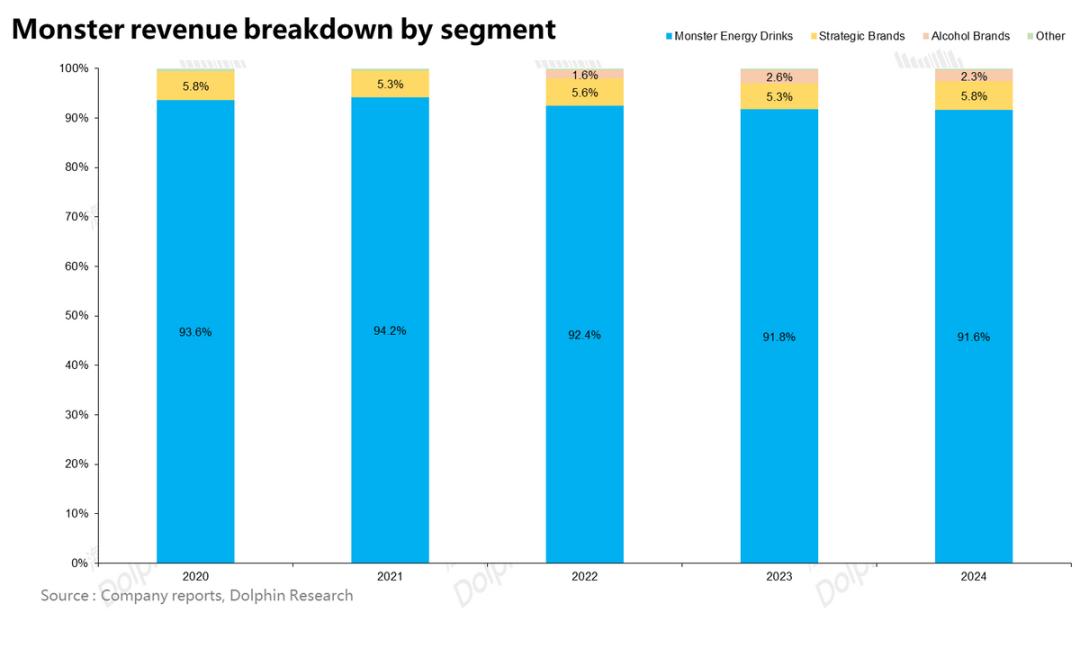
Core Insights - Monster Beverage has achieved remarkable investment returns, with a stock price increase of 100 times over 20 years and a compound annual growth rate of 25%, significantly outperforming Berkshire Hathaway's 10% during the same period [2][18]. Group 1: Company Overview - Monster Beverage originated from Hansen Natural, a company on the brink of bankruptcy, which was acquired by CEO Rodney in 1992. The initial focus was on eliminating unprofitable lines and optimizing cash flow [2][3]. - The company entered the energy drink market in 2002, capitalizing on the growing demand for energy beverages in the U.S. and forming a strategic partnership with Coca-Cola in 2015 for global distribution [3][6]. - Currently, Monster holds nearly 40% of the global energy drink market share, making it the second-largest brand after Red Bull, with over 90% of its revenue coming from its own energy drink products [3][6]. Group 2: Business Model - Monster operates a light-asset model, outsourcing production and distribution while focusing on brand management and product development, resulting in fixed assets accounting for less than 10% of total assets [9][13]. - The company maintains a low debt ratio of 23%, primarily relying on short-term liabilities, and has historically operated with no long-term debt until a recent $370 million loan for stock buybacks [13][15]. - Monster's gross margin is around 60%, positioning it among the top in the soft drink industry, benefiting from strong pricing power and high-margin product offerings [15][18]. Group 3: Growth Strategy - Monster's success is attributed to its differentiated product targeting younger consumers (ages 18-25) with larger packaging and higher caffeine content compared to Red Bull, which targets a broader demographic [21][26]. - The company employs community marketing strategies, engaging with subcultures such as extreme sports enthusiasts and gamers, fostering brand loyalty through grassroots initiatives and sponsorships [34][35]. - Strategic partnerships with major distributors like Coca-Cola have enabled Monster to expand its market presence rapidly, increasing its distribution coverage from under 40% to 90% in convenience stores [44][47].
可口可乐公司披露第二季度财报;广电总局对微短剧再发管理提示|消费早参
Mei Ri Jing Ji Xin Wen· 2025-07-23 23:13
Group 1: Coca-Cola Financial Performance - Coca-Cola reported Q2 2025 revenue of $12.535 billion, a 1% year-over-year increase [1] - Net profit for the quarter was $3.803 billion, reflecting a significant 58% year-over-year growth [1] - Strong performance in the Chinese market, particularly in flagship brand Coca-Cola and the food service channel, contributed to overall sales growth [1] Group 2: AI Adoption in Japanese Retail - Due to labor shortages, Japanese retailers are increasingly adopting AI technology to enhance order processing and inventory management [2] - FamilyMart has implemented AI in approximately 500 stores, which has halved ordering time and reduced stockout rates by about 4% [2] - The application of AI technology is expected to improve operational efficiency and procurement quality, potentially leading to a broader adoption across the retail sector [2] Group 3: Regulation of Micro Short Dramas - The National Radio and Television Administration issued management guidelines regarding micro short dramas with anti-Japanese war themes, addressing issues of exaggerated character portrayals and dramatic tension [3] - The guidelines aim to ensure that creators maintain historical accuracy and educational significance in their works [3] - This initiative is intended to purify the content ecosystem and prevent misleading representations, particularly for younger audiences [3] Group 4: Public Toilet Management in Scenic Areas - The Sai Li Mu Lake scenic area faced criticism for poor public toilet conditions, prompting an official apology and a commitment to improvements [4] - The management announced the addition of 9 temporary toilets and plans for 8 new toilets to address the shortage [4] - This response highlights the challenges of managing public services during peak tourist seasons and emphasizes the need for better resource planning in similar areas [4]
