
非银金融

Search documents
2026年可转债年度策略:节奏为先,革新求变
Guohai Securities· 2025-12-08 14:31
Overview - The report highlights that the convertible bond market experienced significant growth in 2025, with the China Convertible Bond Index rising by 17.87%, driven primarily by price parity and valuation support [2][12] - The current environment presents challenges for convertible bonds, with overall cost-effectiveness declining and valuation at historical highs, leading to increased investment difficulty [2][12] Section 1: 2025 Convertible Bond Review - The convertible bond market saw a strong performance in early 2025 due to ample liquidity and moderate economic recovery, with price parity being the main driver [12] - The market faced a pullback in March-April due to negative CPI and external disturbances, but recovered from May to September as fundamental expectations improved [12] - The overall market for convertible bonds is now in a "deep water zone," with a significant decline in supply and an increase in the median price to 132 yuan, indicating a high premium environment [2][12][27] Section 2: 2026 Stock Market Outlook - The report anticipates a turning point in the stock market, with corporate earnings expected to recover and long-term capital inflows continuing to support the equity market [41][45] - The M1 money supply has shown a significant turning point since September 2024, indicating improved liquidity conditions that are expected to benefit the stock market [46][52] Section 3: 2026 Convertible Bond Outlook and Allocation Strategy - The report suggests a dynamic adjustment of positions in convertible bonds based on market cycles, emphasizing a focus on index-based allocations [2][56] - The strategy indicates that the best accumulation window for convertible bonds is during the latter half of a market downturn and the early half of an uptrend [2][56] - The report highlights the importance of sector rotation, suggesting that constructing an equal-weighted index can effectively capture rotation opportunities [2][67]
“牛市旗手”券商股再度抬头,释放什么信号?机构最新解读
Guo Ji Jin Rong Bao· 2025-12-08 13:32
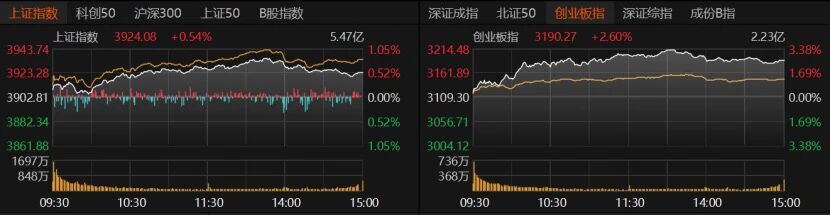
Core Viewpoint - The A-share market has shown a significant increase in both trading volume and price, with a daily turnover exceeding 2 trillion yuan, driven by strong performance in technology stocks and a rebound in the brokerage sector, indicating potential for continued upward momentum in the market [1][2][10]. Market Performance - The A-share market saw a daily turnover of 2.05 trillion yuan, up from 1.74 trillion yuan in the previous trading day, marking a recovery from a recent decline [2]. - Major indices closed higher, with the Shanghai Composite Index rising by 0.54% to 3924.08 points and the ChiNext Index increasing by 2.6% to 3190.27 points [2]. Sector Performance - The technology sector, particularly the CPO concept, experienced a surge of nearly 6%, with significant gains in semiconductor, electronic components, and optical electronics sectors [4][6]. - The communication sector led the gains, with notable stocks such as Tianfu Communication rising over 19% [5][9]. Investor Sentiment - Investor sentiment has been positively influenced by favorable macroeconomic data and liquidity conditions, with expectations of continued support for the A-share market [1][10]. - The non-bank financial sector's rise reflects market optimism regarding the recovery of the financial industry amid improving economic conditions [10][11]. Future Outlook - Analysts suggest that while the current market momentum is supported by various factors, structural differentiation is increasing, and future performance will depend on policy implementation and the sustainability of new capital inflows [1][11]. - The upcoming central economic work conference is anticipated to further influence market sentiment and activity, with expectations of continued policy support for economic recovery [12][13].





A股放量上涨!后市关注这些机会→
Xin Lang Cai Jing· 2025-12-08 13:05
Market Overview - A-shares experienced a significant increase in both volume and price, with daily trading volume surpassing 2 trillion yuan, indicating strong market momentum [1][14] - The ChiNext Index rose by 2.6%, with over 3,400 stocks closing higher, reflecting a broad-based rally in the market [1][14] Sector Performance - Technology stocks, particularly in the CPO (Chip-on-Board) sector, saw substantial gains, with the CPO concept rising nearly 6% [3][16] - Traditional sectors such as liquor, beverages, oil and gas, and white goods experienced slight declines, indicating a shift in investor preference towards technology [3][16] Key Stocks - Notable performers included Tianfu Communication, which surged over 19% to 236.9 yuan per share, and other tech stocks like Xin Yi Sheng and Zhong Ji Xu Chuang, which also saw significant price increases [6][18] - The communication sector led the gains, with a 4.79% increase, while the electronic sector rose by 2.60% [18] Market Sentiment - Investor sentiment was bolstered by favorable macroeconomic data and liquidity conditions, with expectations of continued upward momentum in A-shares [10][12] - The non-bank financial sector's rise reflects improved market confidence and expectations of better performance in the financial industry amid economic recovery [10][11] Future Outlook - Analysts suggest that while the current market momentum is supported by various factors, structural differentiation is increasing, necessitating close monitoring of policy developments and the sustainability of capital inflows [11][12] - The upcoming Central Economic Work Conference is anticipated to influence market sentiment and activity, with expectations of continued policy support for economic recovery [12]
市场成交额重回2万亿
Tebon Securities· 2025-12-08 12:55
Market Overview - The A-share market continued its upward trend, with trading volume returning to 2 trillion yuan, indicating significant inflow of new capital [2][3] - The core indices of the A-share market showed strong performance, with the Shanghai Composite Index closing at 3,924.08 points, up 0.54%, and the Shenzhen Component Index rising 1.39% to 13,329.99 points [3] Sector Performance - The technology sector led the gains, with indices for communication, electronics, and computer industries rising by 4.67%, 2.51%, and 1.92% respectively, driven by strong demand for AI hardware [5] - The financial sector remained robust, with the non-bank financial index increasing by 1.89%, supported by regulatory signals aimed at enhancing broker capital space and leverage limits [5] - The dividend index showed weakness, with declines in various indices indicating a persistent improvement in market risk appetite [5] Economic Policy Insights - The Central Political Bureau's meeting on December 8 highlighted a shift in economic work focus for 2026, emphasizing quality and efficiency over mere stability [6] - The report anticipates a more pragmatic economic growth target for 2026, with a maintained narrow deficit rate around 4% and limited expansion of debt scale [6] Bond Market Analysis - The bond market exhibited a mixed performance, with long-term futures showing significant adjustments while short to medium-term bonds remained stable [7] - The central bank's net injection of 147 billion yuan into the market indicates a continued loose monetary environment, although short-term interest rates saw slight increases [7] Commodity Market Trends - The commodity index declined, with significant drops in the black series commodities, particularly coking coal and coke, reflecting weak downstream demand [7] - The precious metals sector, however, showed strength, with silver prices rising due to ongoing central bank gold purchases and weakening U.S. economic data [9] Investment Strategy Recommendations - The report suggests a balanced investment approach across technology growth, dividend stocks, and cyclical resources, given the current market conditions and policy signals [10] - In the bond market, a focus on short to medium-term bonds is recommended, while monitoring fiscal and monetary policy developments [10] - For commodities, attention should be paid to supply-side changes and policy statements, as industrial products continue to show weak performance [10]
兴业证券:岁末年初窗口 非银异动往往是躁动行情开启的重要信号
智通财经网· 2025-12-08 12:34
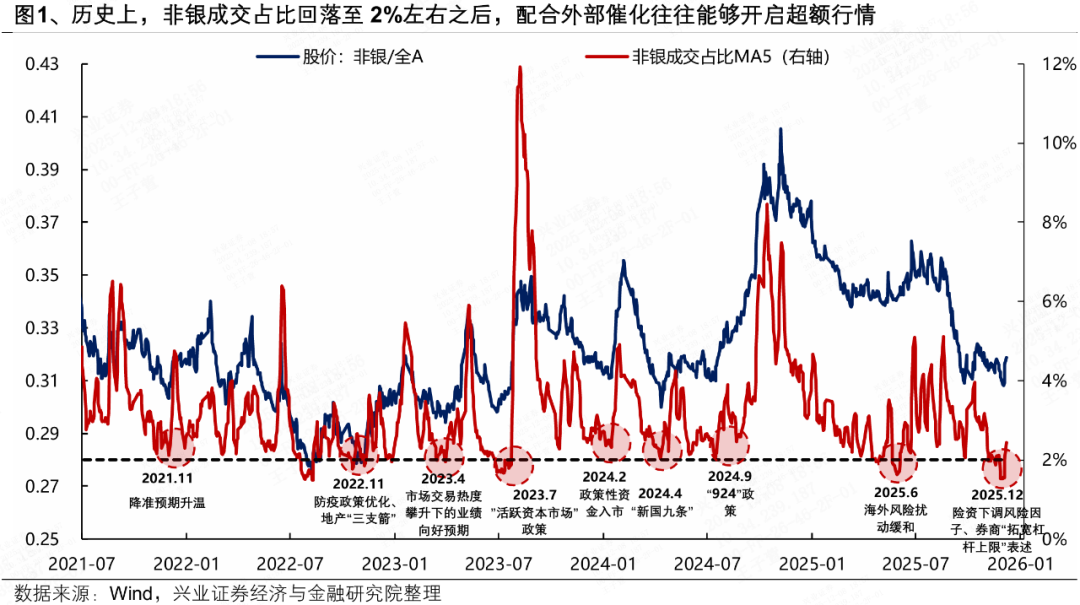
Core Viewpoint - The non-bank sector's effective timing indicator has seen a drop in trading volume share to 2%, historically indicating the potential for excess returns when combined with external catalysts [1][2]. Group 1: Non-Bank Sector Indicators - The trading volume share of the non-bank sector fell to 2%, with a previous low of 1.5% observed [2]. - External catalysts, such as the adjustment of investment risk factors by insurance funds and proposals to expand broker capital space and leverage limits, have triggered excess returns in the non-bank sector [2]. Group 2: Historical Trends and Market Behavior - Historical data shows that non-bank sector movements (daily gains over 3%) during the year-end and early-year window often signal the start of a volatile market [3]. - Since 2010, in 15 instances of year-end and early-year windows, 7 were accompanied by non-bank sector movements, indicating a correlation with the initiation of volatile market conditions [3]. Group 3: Market Performance Post Non-Bank Movements - Following non-bank sector movements, the overall market typically experiences an upward trend, with average increases of 6.8%, 9%, and 12.8% over the subsequent 10, 20, and 30 trading days, respectively [6]. - In the 20 trading days following non-bank movements, indices such as the Shanghai 50, CSI 300, and CSI 1000 have shown superior performance, with large-cap growth and value styles leading in average returns [9].

肖远企:非银风险难识别 将强化资本监管防范风险
2 1 Shi Ji Jing Ji Bao Dao· 2025-12-08 12:27
Group 1 - The core viewpoint emphasizes the increasing interconnectedness between non-bank financial assets and banking and insurance institutions, making risk identification and transmission more challenging [1] - The development of the private equity market provides insurance companies with more investment opportunities, but it also introduces higher potential risks due to the complexity, low transparency, and poor liquidity of private equity assets [1] - The current high interest rate environment poses significant challenges for the insurance industry, particularly life insurance companies, as many business models built on a low interest rate paradigm are becoming unsustainable [1] Group 2 - The sudden shift in the global interest rate environment and the severe challenges posed by climate change are creating dual challenges for the insurance industry [2] - Climate change has a multidimensional impact on the insurance industry, necessitating adjustments in actuarial assumptions, underwriting scope, and risk models [2] - Increased awareness of insurance among farmers following major disasters highlights the critical role of insurance in post-disaster recovery [2]
肖远企:非银风险难识别,将强化资本监管防范风险
2 1 Shi Ji Jing Ji Bao Dao· 2025-12-08 12:27
Group 1 - The core viewpoint of the article emphasizes the increasing interconnectedness between non-bank financial assets and banking and insurance institutions, making risk identification and transmission more challenging [1] - The development of the private equity market provides insurance companies with more investment opportunities, but it also introduces higher potential risks due to the complexity, low transparency, and poor liquidity of private equity assets [1] - From a regulatory perspective, it is crucial for non-bank financial institutions to identify risks and prevent their rapid transmission, necessitating strengthened capital regulation and the establishment of large risk exposure limits [1] Group 2 - The insurance industry, particularly life insurance companies, faces significant challenges due to the impact of a high interest rate environment, which disrupts business models built on a low interest rate paradigm [2] - The sudden shift in the global interest rate environment and the increasing severity of climate change pose dual challenges to the insurance industry, requiring companies to adjust their business models to enhance risk resilience [2] - Climate change has multifaceted impacts on the insurance industry, necessitating revisions to actuarial assumptions, adjustments in underwriting scope, and upgrades to risk models, while also creating new market demands for property protection and asset preservation insurance products [2]
兴证策略张启尧团队:岁末年初窗口,非银异动的信号
Xin Lang Cai Jing· 2025-12-08 12:19
Core Insights - The non-bank sector's effective timing indicator shows a drop in trading volume to 2%, historically leading to excess returns when combined with external catalysts [1][8] - Recent developments, including a reduction in investment risk factors by insurance funds and proposals to expand brokerage capital space and leverage limits, have catalyzed the non-bank sector [1][8] Historical Context - Historically, significant movements in the non-bank sector at the year-end and beginning of the year often signal the start of a volatile market [3][9] - Since 2010, in 15 instances of year-end and beginning of the year windows, 7 have seen the initiation of volatile markets coinciding with non-bank sector movements [3][9] Market Performance - Following non-bank sector movements, the overall market typically enters an upward phase, with average increases of 6.8%, 9%, and 12.8% over the next 10, 20, and 30 trading days respectively [4][10] - In the 20 trading days following non-bank sector movements, indices such as the Shanghai 50, CSI 300, and CSI 1000 tend to outperform, with large-cap growth and value styles showing higher average returns [5][11] Statistical Data - The historical performance data indicates that the average returns for various indices and sectors post non-bank movements are significant, with the Shanghai Composite Index showing an average return of 19.8% in certain periods [12]
为何高手不谈收益目标?揭秘投资中最重要却被忽视的“原则”
Sou Hu Cai Jing· 2025-12-08 11:33
Market Overview - On December 8, 2025, the A-share market experienced a significant surge with a trading volume exceeding 2.05 trillion yuan, marking a notable increase from the previous day. Major indices saw gains, with the Shanghai Composite Index rising by 0.54%, the Shenzhen Component Index increasing by 1.39%, and the ChiNext Index soaring by 2.6%. Over 3,400 stocks rose, indicating a clear recovery in market sentiment [1] Sector Performance - The telecommunications sector, driven by the CPO (optical module) concept, surged by 4.79%, while technology sectors such as electronics and computers also performed strongly. In contrast, traditional cyclical sectors like coal and oil & petrochemicals experienced slight pullbacks. The non-bank financial sector (brokerage) rose by 1.9%, with a significant increase in trading volume, reflecting the entry of new capital and an increase in risk appetite [1] Market Drivers - The core drivers of today's market performance were the resonance of "policy-driven" and "industry trends." Regulatory policies guided "patient capital" to support technological innovation, while the global AI computing power competition and the fundamental logic of optical module technology upgrades collectively propelled the explosion of the technology sector. The market is transitioning from liquidity recovery to a structurally driven dual-phase [1] Investment Philosophy - The article emphasizes the importance of shifting from a focus on specific annual return targets to a more robust risk management approach. It argues that setting unrealistic return expectations can lead to poor decision-making and unnecessary risks. Instead, investors should concentrate on managing risk and understanding potential losses, which is the true essence of investment [2][3] Risk Management Framework - A systematic risk management framework is essential for effective investment. Key components include: 1. **Asset Allocation**: Define risk ceilings based on personal financial cycles and risk tolerance rather than market predictions [3] 2. **Margin of Safety**: Invest only when prices are significantly below intrinsic value to account for potential errors and unforeseen events [3] 3. **In-depth Research and Diversification**: Conduct thorough research to avoid flawed companies and diversify across uncorrelated opportunities to mitigate individual company risks [3] 4. **Discipline and Position Management**: Adjust overall positions based on market valuations and adhere to pre-set investment criteria to maintain rational risk management [4] Long-term Investment Success - Long-term investment success relies on avoiding significant permanent losses, as the cost of recovering from losses is much higher than anticipated. The article highlights that the art of investing lies in systematically avoiding catastrophic downturns, which ultimately opens the door to potential gains [4][5]
两融周报|融资余额小幅增加
Xin Lang Cai Jing· 2025-12-08 11:28
Market Overview - The net financing inflow in the A-share market has ranked the top five industries as semiconductor, non-ferrous metals, hardware equipment, defense industry, and machinery [19] - Conversely, the bottom five industries in terms of net financing inflow are transportation, non-bank financials, construction, public utilities II, and chemicals [19] Financing Data - The financing balance for the top five industries includes: - Semiconductor: 346.39 billion - Electrical equipment: 182.86 billion - Software services: 182.33 billion - Hardware equipment: 179.39 billion - Non-bank financials: 150.33 billion - The weekly percentage change for these industries shows a mixed performance, with non-bank financials declining by 2.12% [13][28] Weekly Performance - The A-share market indices have shown positive movement over the past week: - Wind All A Index increased by 0.72% - Shanghai Composite Index rose by 0.37% - Shenzhen Component Index grew by 1.26% - ChiNext Index saw an increase of 1.86% - North 50 Index went up by 1.49% - Sci-Tech 50 Index slightly decreased by 0.08% [18] ETF Financing - The top ten ETFs by financing balance include: - Huaan Gold ETF: 76.05 billion - E Fund Gold ETF: 57.35 billion - Huaxia Hang Seng ETF: 38.84 billion - Huatai-PineBridge CSI 300 ETF: 37.63 billion - Guotai CSI All-Share Securities Company ETF: 37.38 billion [29] Industry Trends - Approximately 60% of the 35 Wind secondary industries have received net financing inflows, indicating a positive trend in investment across various sectors [19]
