创新药

Search documents
掘金港股 基金经理看好结构性机会
Zhong Guo Zheng Quan Bao· 2026-01-08 22:24
Core Viewpoint - The Hong Kong stock market is expected to continue its upward trend in 2026, with significant investment opportunities in sectors such as innovative pharmaceuticals, technology, and dividend assets [1][4]. Group 1: Market Performance - The Hong Kong stock market experienced a strong start in 2026, with the Hang Seng Index and Hang Seng Tech Index rising by 2.76% and 4% respectively on January 2, and maintaining gains of 2.02% and 2.94% by January 8 [2]. - In 2025, both the Hang Seng Index and Hang Seng Tech Index increased by over 20%, ranking among the top global markets [2]. - Several funds investing in Hong Kong stocks achieved impressive returns in 2025, with notable QDII products like Huatai-PineBridge Hong Kong Advantage Select yielding a return of 112.69% [2]. Group 2: Fund Inflows - Multiple cross-border ETFs focused on Hong Kong stocks saw significant net inflows in 2025, with the Hong Kong Stock Connect Internet ETF leading at a net inflow of 56.659 billion yuan [3]. - Other ETFs such as the Hong Kong Stock Connect Technology 30 ETF and the Hong Kong Stock Connect Non-Bank ETF also reported substantial net inflows of 25.544 billion yuan and 24.978 billion yuan respectively [3]. Group 3: Strategic Outlook - The overall sentiment towards the Hong Kong stock market remains optimistic, with expectations of continued capital inflows exceeding 1.3 trillion HKD in 2025, a historical high [4]. - Factors influencing the market include the Federal Reserve's monetary policy, domestic economic fundamentals, technology trends, and geopolitical situations, with a generally positive outlook [4]. Group 4: Sector Opportunities - Key investment areas identified include AI infrastructure, internet technology, new consumption, innovative pharmaceuticals, resource companies, and dividend sectors [5]. - The innovative pharmaceutical sector is highlighted for its potential, with a focus on companies that can sustain cash flow through successful product launches [5]. - Dividend assets are considered attractive due to their historical performance, lower volatility, and favorable valuation compared to A-shares [6].
掘金港股基金经理看好结构性机会
Zhong Guo Zheng Quan Bao· 2026-01-08 20:50
Core Viewpoint - The Hong Kong stock market is expected to present investment opportunities in 2026, particularly in sectors such as innovative pharmaceuticals, technology, and dividend assets, following a strong performance in 2025 [1][3]. Group 1: Market Performance - The Hong Kong stock market experienced a strong start in 2026, with the Hang Seng Index and Hang Seng Tech Index rising by 2.76% and 4% respectively on January 2, and year-to-date increases of 2.02% and 2.94% as of January 8 [1]. - In 2025, both the Hang Seng Index and Hang Seng Tech Index saw annual gains exceeding 20%, ranking among the top global markets [1]. Group 2: Fund Performance - Several funds investing in Hong Kong stocks achieved impressive returns in 2025, with the Huatai-PineBridge Hong Kong Advantage Selected Fund's A share returning 112.69% [2]. - Other notable funds, including the GF CSI Hong Kong Innovative Pharmaceuticals ETF and Southern Hong Kong Medical Industry A, reported returns over 60% [2]. - Cross-border ETFs focused on Hong Kong stocks attracted significant inflows, with the Hong Kong Stock Connect Internet ETF leading with a net inflow of 56.659 billion yuan in 2025 [2]. Group 3: Strategic Outlook - The overall sentiment towards the Hong Kong stock market remains optimistic, with expectations of continued inflows from southbound capital, which exceeded 1.3 trillion HKD in 2025 [3]. - Factors influencing the market include the Federal Reserve's monetary policy, domestic economic fundamentals, technology trends, and geopolitical situations, with a general positive outlook [4]. - The market's current valuation is considered attractive compared to global standards, providing potential investment opportunities [3][4]. Group 4: Sector Opportunities - Key sectors identified for investment include AI infrastructure, internet technology, new consumption, innovative pharmaceuticals, resource companies, and dividend-paying stocks [3]. - The non-bank financial sector and leading internet companies are viewed as having strong growth potential due to the rapid development of artificial intelligence [4]. - The innovative pharmaceutical sector is highlighted for its attractiveness, with a focus on companies with robust pipelines and cash flow improvements [4].
“南下”热情高涨 开年首周逾10家A股公司冲刺H股上市
Shang Hai Zheng Quan Bao· 2026-01-08 16:49
Core Viewpoint - The trend of A-share companies "going south" to list on H-shares is gaining momentum in early 2026, driven by a combination of policy support, financing needs, and internationalization strategies [1][2][3] Group 1: Companies Going Public - Six A-share companies, including Jucheng Co., Penghui Energy, and Zhengtai Electric, have announced plans for H-share listings from January 1 to January 8, 2026 [1] - Four additional companies, including Jingwang Electronics and Yifang Bio, have submitted prospectuses to the Hong Kong Stock Exchange [1] - The trend is primarily led by technology companies, with a focus on sectors such as semiconductor design, energy storage, and smart mobility [1] Group 2: Market Dynamics - The 2026 "southbound" trend is a continuation of the 2025 A+H listing boom, with a significant increase in active listing applications in Hong Kong [2] - In 2025, 19 A-share companies listed on the Hong Kong market, raising a total of approximately 139.99 billion HKD, nearly half of the total IPO amount for the year [2] - The average time for A+H listings in 2025 was reported to be 4 to 6 months, with the fastest taking only about 3 months [2] Group 3: Strategic Motivations - A-share companies are pursuing H-share listings to raise funds for global expansion and enhance their competitive position in international markets [3][4] - Companies like Jucheng Co. and Penghui Energy emphasize that listing in Hong Kong will help them build a diversified capital operation platform and support overseas business development [3] - The need for substantial foreign currency funding for overseas production and supply chain establishment is a key driver for these companies [4] Group 4: Regulatory Environment - The favorable regulatory environment, including cooperation measures between mainland and Hong Kong regulatory bodies, has made cross-border listings more feasible [4] - The Chinese Securities Regulatory Commission has expressed support for leading mainland companies to list in Hong Kong, facilitating a quicker approval process for qualified firms [4] - The current valuation of Hong Kong stocks is perceived to be lower than that of A-shares, prompting some companies to accept lower valuations to secure international funding and prepare for stricter overseas disclosure standards [4] Group 5: Market Expectations - The IPO market in Hong Kong is expected to perform well in 2026, with projections of over 300 billion HKD in IPO scale and 150 to 200 projects [4] - The growth in the MSCI China Index's earnings is anticipated to reach 14% or higher, driven by sectors such as high-end manufacturing and companies with global expansion capabilities [4]


坚定出海方向-把握结构性机遇-医药行业2026年策略
2026-01-08 16:02
Summary of Key Points from the Conference Call Industry Overview - The conference call focuses on the **pharmaceutical and medical device industries** in China, particularly the trends and opportunities for 2025 and beyond [1][2]. Core Insights and Arguments Pharmaceutical Industry - In 2025, the pharmaceutical industry experienced a significant recovery, with the innovation drug sector outperforming the overall market, showing a growth of approximately **60%** compared to the overall industry index increase of less than **10%** [2][3]. - The success of innovative drugs is primarily driven by breakthroughs in international markets, with **8 out of the top 10 global innovative transactions** in 2025 originating from Chinese companies, boosting market confidence [3][4]. - Despite the positive performance of innovative drugs, certain sectors like vaccines and blood disorders still reported negative returns, indicating a strong structural market [2][3]. Medical Devices - The medical device sector shows varied performance across sub-markets, with low-value consumables like nitrile gloves gaining significant market power, while high-value consumables and high-end medical devices are still in the early stages of international expansion [6][7]. - Notable achievements in the medical device sector include significant growth in exports of cardiovascular stents, artificial joints, and pacemakers, with local companies successfully entering developed markets such as the US and EU [7][8]. - High-value consumables differ from pharmaceuticals in that they possess independent intellectual property and innovation, allowing for licensing opportunities. Establishing sales networks in developed countries is expected to mitigate domestic pricing pressures [8][9]. Additional Important Insights - The financing environment for innovative drugs has improved, reversing a downward trend observed in the past two to three years, which is a positive signal for the pharmaceutical industry [10]. - The retail pharmacy sector is undergoing significant changes, with a decline in the number of single-store pharmacies and a recovery in performance for some chain pharmacies due to the closure of unprofitable locations [11]. - The implementation of traceability code policies in 2026 is expected to standardize market competition and accelerate internal consolidation among chain pharmacies [11]. - Future trends in innovation are expected to focus on unmet clinical needs and new technological directions, such as small nucleic acid technology, which has shown promise in traditional treatments [16]. Recommendations for Investment - The pharmaceutical industry is expected to remain promising in 2026, with a focus on innovative directions due to reduced uncertainty compared to previous years [15]. - In the medical device sector, attention should be given to high-value consumables, IVD products, and high-end medical equipment, which are anticipated to have significant growth potential [17]. - Continuous monitoring of CDMO order growth and potential breakthroughs in chain pharmacies and raw materials is recommended, particularly in synthetic biology and contract manufacturing [18].
创新链系列——中国创新药研发投入景气度指标2025年12月跟踪及全年总结
Changjiang Securities· 2026-01-08 13:11
Investment Rating - The industry investment rating is "Positive" and maintained [10] Core Insights - The financing ecosystem for China's biopharmaceutical industry is gradually entering a positive cycle, driven by abundant funds from A/H listings and capital increases of innovative drug companies. This is expected to improve the willingness to invest in R&D, leading to a new cycle of prosperity in the innovative drug industry [2][8][57]. Summary by Relevant Sections 2025 Prospective Indicator Trends - In December 2025, the IPO fundraising for pharmaceutical companies in Hong Kong reached 6.2 billion yuan, marking the second-highest monthly level since 2022. The A-share IPO fundraising for unprofitable companies opened up, with amounts of 4.2 billion and 2 billion yuan in October and December respectively [6][32]. - The fundraising scale for A-share pharmaceutical companies in December 2025 was 1.2 billion yuan, showing significant improvement year-on-year. The fundraising scale for Hong Kong pharmaceutical companies reached 13.9 billion HKD, the second-highest monthly level since 2022 [35]. - The total financing amount for China's biopharmaceutical sector in December 2025 was 1.23 billion USD, a new monthly high since 2022 [37]. - The upfront payment for external business development (BD) in Q4 2025 was 2.27 billion USD, with a record high of 1.5 billion USD in October [6][43]. 2025 Indicator Trends Summary - The total IPO fundraising for pharmaceutical companies in A-shares was 9.1 billion yuan in 2025, a year-on-year increase of 216.6%, while H-share IPO fundraising reached 33.6 billion yuan, up 334.7% [46]. - The fundraising scale for A-share pharmaceutical companies was 9.9 billion yuan, a year-on-year increase of 111.1%, and for H-share companies, it was 66.8 billion HKD, up 194.9% [54]. - The number of biopharmaceutical financing projects in China reached 201 in 2025, a year-on-year increase of 18.9%, with total financing amounting to 5.8 billion USD, up 28.0% [54]. - The upfront payment for external BD in 2025 was 6.9 billion USD, a year-on-year increase of 224.9%, with milestone payments reaching 125.98 billion USD, up 185.9% [54]. Overall Summary - The total amount of IPO fundraising, company capital increases, biopharmaceutical financing, and confirmed upfront payments for external BD in 2025 reached 201.5 billion yuan, a year-on-year increase of 145%. The funding levels for innovative drug companies significantly improved compared to 2024. Additionally, potential milestones for external BD reached 880.5 billion yuan, a year-on-year increase of 185.9% [8][50].
中无人机签订超1亿元无人机系统合同 天能股份拟以不超120亿元委托理财
Xin Lang Cai Jing· 2026-01-08 12:59
Group 1: Industry Insights - The Ministry of Industry and Information Technology (MIIT) has warned against irrational competition in the lithium battery industry, convening a meeting with 16 major companies to discuss regulatory measures [1] - The State Administration for Market Regulation (SAMR) has interviewed six leading photovoltaic companies regarding monopoly risks and has mandated corrective actions by January 20 [1] - Guangzhou is accelerating the construction of liquid rocket assembly and testing bases, focusing on reusable rocket technology to enhance national aerospace capabilities [2] Group 2: Company Announcements - MiniMax is set to list on the Hong Kong Stock Exchange on January 9, with a pricing result of HKD 165 per share, and its dark market performance showed a 26.8% increase [3] - Zhong UAV has signed a contract exceeding RMB 100 million for drone systems, which is expected to positively impact its financial performance [4][5] - TianNeng Co. plans to use up to RMB 12 billion of its idle funds for low-risk financial investments, which has been approved by its board [5] - Hu Silicon Industry's major shareholder, the National Integrated Circuit Industry Investment Fund, has reduced its stake by 0.2% [5] - Yongxi Electronics expects a net profit increase of 13.08% to 50.77% for 2025, driven by growth in the semiconductor industry and improved product structure [6] - BiYi Micro has set an initial transfer price of RMB 36.29 per share for its stock, with a subscription multiple of 6.99 times [7] - ZhiXiang JinTai's application for conditional approval of its GR1803 injection has been accepted by the National Medical Products Administration [8] - Zejing Pharmaceutical's injection of human thyroid-stimulating hormone beta has been approved for market entry, enhancing its product line [9] - Mengke Pharmaceutical has received a patent term extension for its core product, significantly improving its market competitiveness [9] - Chip Source Micro has reported a 30% stock price fluctuation, confirming normal business operations [9] - Jiyu Pharmaceutical has completed nearly RMB 2 billion in Series A financing, focusing on innovative drug development [10] - Yiwei Aerospace has completed a million-level angel round financing, aimed at developing space computing systems [10]


对话基金经理毛丁丁:A股创新药的投资逻辑是什么?今年医药板块还会继续涨吗?
Sou Hu Cai Jing· 2026-01-08 12:45
Core Viewpoint - The A-share market is expected to continue its recovery in 2026, particularly in the pharmaceutical sector, driven by three main factors: the ongoing trend of international expansion, stabilization of domestic demand alongside macroeconomic recovery, and overall valuations remaining below historical averages [2][3]. Group 1: Pharmaceutical Sector Performance - In 2025, the pharmaceutical sector showed a structural recovery, with the innovation drug segment being the standout performer, while other areas like medical devices and services lagged [1][3]. - The innovation drug sector experienced significant growth primarily from March to July 2025, followed by a correction starting in September due to rapid price increases and overvaluation [1][3]. - The overall performance of the pharmaceutical sector in 2025 was characterized by a 10% increase in the Shenwan Biopharmaceutical Index, which underperformed compared to the CSI 300 [1]. Group 2: Investment Logic and Trends - The investment logic for innovative drugs in A-shares, H-shares, and U.S. stocks is fundamentally similar, focusing on drug technology characteristics, global competition, and valuation factors influenced by policies and interest rates [2][8]. - The Chinese innovative drug industry is still in its early stages, with significant growth potential, and the investment focus in A-shares and H-shares is more on policy, capital market cycles, and industry mapping [2][8]. - The trend of "going global" for innovative drugs and medical devices is accelerating, which is expected to enhance the competitive edge of Chinese companies in various disease areas, especially oncology [3][4]. Group 3: Future Outlook and Risks - The pharmaceutical sector is anticipated to maintain its upward trend in 2026, supported by the deepening internationalization of the industry and improved domestic demand due to economic recovery [2][3]. - Key risks to monitor include potential unexpected tightening of medical insurance cost controls, U.S. healthcare reforms, and the pace of interest rate changes by the Federal Reserve [3][9]. - The valuation of the pharmaceutical sector remains below the historical average of the past 15 years, indicating a relative advantage for investors [3].
ETF复盘资讯|乘风商业航天涨停潮,军工ETF华宝涨超4%再创上市9年多新高!八部门发文,国产AI产业链闻风而动
Sou Hu Cai Jing· 2026-01-08 12:26
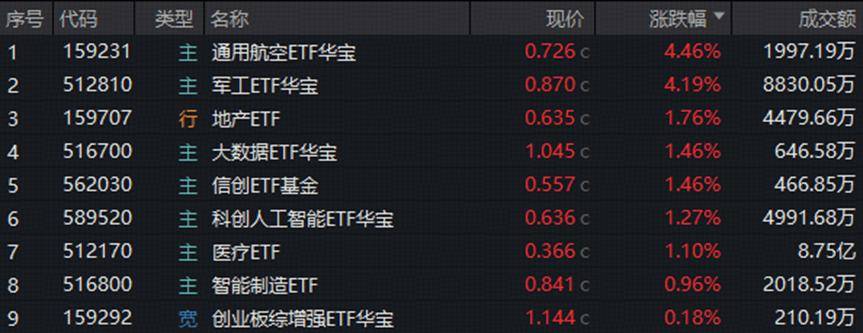
Market Overview - A-shares experienced narrow fluctuations with the Shanghai Composite Index slightly declining but recording 15 consecutive days of gains [1] - The total trading volume in the Shanghai and Shenzhen markets reached 2.8 trillion yuan, a slight decrease from the previous trading day, but has remained above 2.5 trillion yuan for four consecutive days [1] - Over 3,700 stocks in the market rose, with 111 stocks hitting the daily limit [1] Sector Performance - The commercial aerospace sector saw a surge, with stocks like Aerospace Nanhai and Hailanxin hitting the 20% limit up [1] - The military industry ETF, Huabao (512810), rose over 4%, marking its largest single-day increase in nearly six months and reaching a new high since its listing in August 2016 [1][6] - The popular general aviation ETF, Huabao (159231), also increased by over 4%, setting a new record since its listing, with a net subscription of 14 million units in a single day [1] Policy Impact - The Ministry of Industry and Information Technology and seven other departments issued the "Implementation Opinions on the Special Action of 'Artificial Intelligence + Manufacturing'," focusing on the domestic AI industry chain [1] - Following this policy announcement, the AI-related ETFs, including the Huabao Science and Technology AI ETF (589520) and the Big Data ETF (516700), saw increases of over 1% [1][12] Stock Highlights - The military ETF Huabao (512810) recorded a trading volume of 883 million yuan, with a notable increase in net inflow of funds into defense and military stocks, totaling 18.932 billion yuan [6][8] - Key stocks within the military ETF include Aerospace Nanhai, Hailanxin, and Aerospace Electronics, which have seen significant trading volumes and price increases [5][10] Future Outlook - Dongguan Securities anticipates that the market will maintain upward momentum before the Spring Festival, suggesting that any short-term adjustments could present buying opportunities [2] - The overall market sentiment is expected to remain positive, with a focus on sectors such as dividends, TMT (Technology, Media, and Telecommunications), and consumer goods [2]

喜娜AI速递:今日财经热点要闻回顾|2026年1月8日
Xin Lang Cai Jing· 2026-01-08 11:34
Group 1: Storage Market - The storage market is experiencing a "super bull market" driven by explosive AI inference demand and exponential growth in multimodal data, with prices significantly increasing [2][7] - The global DRAM market has seen prices rise rapidly since July 2025, with most categories increasing over 100%, and the price of a single 256G DDR5 server memory exceeding 40,000 yuan [2][7] - Major storage manufacturers are shifting production capacity towards HBM and DDR5, leading to limited supply of traditional memory, and cloud service providers are paying premiums far exceeding those of mobile manufacturers [2][7] - Capacity tightness is expected to last at least until the end of 2027 [2][7] Group 2: Commercial Aerospace - The commercial aerospace sector is witnessing a surge, with nearly 40 stocks hitting the daily limit up on January 8, driven by policy support and technological breakthroughs [2][7] - The construction of a large liquid rocket assembly and recovery base by Arrow Yuan Technology in Zhejiang Qiantang has commenced [2][7] - Analysts believe that the commercial aerospace industry is entering a new era, with a need for legislative and procurement support to tackle cost reduction in reusable rockets [2][7] Group 3: Trade Relations - China has initiated an anti-dumping investigation into imported dichlorodihydrosilane from Japan, effective January 7, 2026, due to a rising trend in import quantities and a 31% cumulative price drop from 2022 to 2024 [2][7] - This investigation follows China's tightening of export controls on Japan, which has led to a decline in the Japanese stock market [2][7] - Estimates suggest that if rare earth exports are restricted, Japan's economy could suffer a loss of approximately 30 billion yuan within three months [2][7] Group 4: Monetary Policy - The People's Bank of China has emphasized the continuation of a moderately loose monetary policy, focusing on promoting high-quality economic development and reasonable price recovery [8][9] - Experts anticipate that the first round of interest rate cuts and reserve requirement ratio reductions may occur before the Spring Festival, with ample room for monetary policy adjustments in 2026 [8][9] Group 5: Innovation in Pharmaceuticals - The A-share innovative drug sector is showing signs of recovery, with the Hong Kong market performing even better, as valuations have entered an attractive range [8][9] - Fund managers believe that innovative drugs will remain a key investment theme in 2026, supported by continuous positive catalysts and improved overseas liquidity [8][9] - The emergence of brain-computer interface concepts may also boost the medical device sector, with "going overseas" capabilities becoming a core criterion for selecting companies [8][9] Group 6: Nuclear Fusion Technology - The controlled nuclear fusion sector is experiencing renewed strength, with multiple stocks hitting the daily limit up following breakthroughs in China's nuclear fusion technology [10] - The EAST experiment has confirmed the existence of a density-free zone in the Tokamak, and the upcoming implementation of the Atomic Energy Law will support controlled thermonuclear fusion [10] - Global investment in the fusion industry is rapidly increasing, with the market expected to reach $496.55 billion by 2030 [10] Group 7: AI and Manufacturing Integration - Eight departments, including the Ministry of Industry and Information Technology, have issued implementation opinions for the "AI + Manufacturing" initiative, aiming for secure and reliable supply of key AI technologies by 2027 [10] - The initiative will promote breakthroughs in key technologies such as smart chips and accelerate the application of AI across various manufacturing sectors [10]
BD交易与政策红利共振 医药板块2025年强势反弹
BambooWorks· 2026-01-08 10:21
Core Insights - The core viewpoint of the article emphasizes that the surge in innovative drug licensing and BD transactions has significantly driven the stock price explosion in the pharmaceutical sector, with total transaction amounts reaching $135.655 billion in 2025, marking a 161% increase from 2024 [1][4]. Group 1: Market Performance - The Hong Kong biopharmaceutical sector has rebounded strongly in 2025, with the Hang Seng Healthcare Index (HSHCI) rising by 76%, outperforming the Hang Seng Index and the overall A-share biopharmaceutical sector, which saw a 25.64% increase [1]. - Southbound capital inflow reached a record high of HKD 1.4 trillion in 2025, with healthcare sector holdings increasing by 125.51% to HKD 540 billion, providing substantial liquidity to the market [1][3]. Group 2: Structural Differentiation - The structural differentiation within the biopharmaceutical sector is becoming more pronounced, with companies that have First-in-Class or Best-in-Class pipelines and stable BD revenue sources being favored, while those reliant on single core projects face valuation pressures [3]. - The CXO sector also performed well in 2025, benefiting from ongoing investments in innovative drugs, while the medical device and supplies sector showed solid performance due to stable cash flows [3]. Group 3: Policy and Regulatory Environment - The policy environment has been continuously optimized, with 76 innovative drugs approved for market entry by the National Medical Products Administration in 2025, significantly surpassing the 48 approvals in 2024 [5]. - The introduction of the first version of the innovative drug commercial insurance catalog marks a shift to a dual protection system of basic medical insurance and commercial health insurance, enhancing clinical medication standards and overall industry R&D returns [6]. Group 4: Future Outlook - The explosive growth in BD transactions and active IPOs is injecting strong cash flow and confidence into the biopharmaceutical industry, with expectations for leading companies like BeiGene to achieve profitability in 2026 [5]. - However, challenges remain, including potential market pressure from a wave of unlocks post-IPO lock-up periods and stricter regulatory scrutiny on IPO applications [7].