动力电池

Search documents
20GWh项目启动!国轩高科六合投资超百亿!
起点锂电· 2025-10-23 10:20
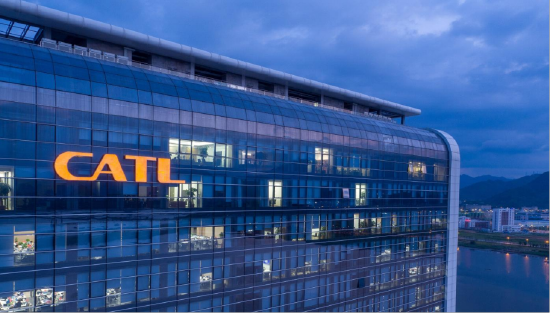
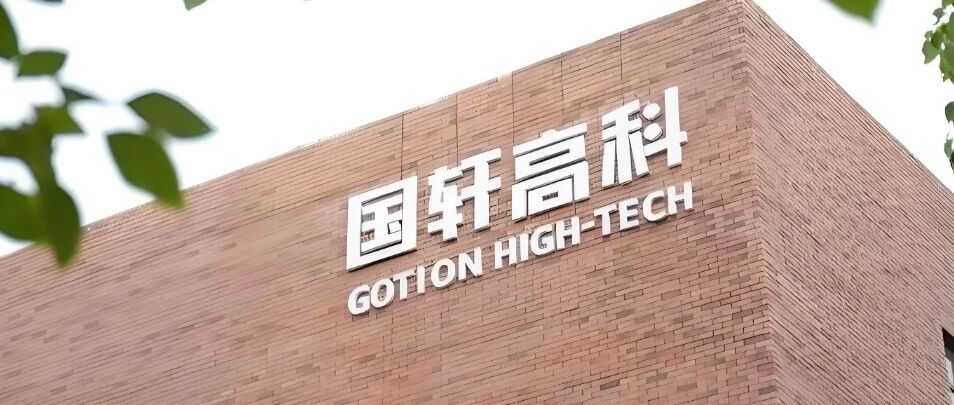
Core Viewpoint - The article highlights the significant expansion of Guoxuan High-Tech in the lithium-ion battery manufacturing sector, particularly in Nanjing, where it has established itself as the largest production base globally, with a total investment exceeding 10 billion RMB and a production capacity nearing 50GWh [4][6][8]. Group 1: Project Developments - On October 22, Guoxuan High-Tech laid the foundation for a new lithium-ion battery manufacturing base in Nanjing, with a total investment of 4 billion RMB and a construction period of no more than 24 months [2]. - The company has cumulatively invested over 10 billion RMB in Nanjing, with a total production capacity of nearly 50GWh, making it the largest base for Guoxuan globally [4][6]. - The first project in Nanjing began in 2015, with an initial investment of 1.5 billion RMB for a 2GWh production line, which has since expanded through multiple phases [7]. Group 2: Capacity Expansion and Market Position - Guoxuan High-Tech has been rapidly increasing its production capacity, with plans for additional projects that will exceed a total capacity of 100GWh, in response to the growing demand in the energy storage and power battery sectors [10][11]. - The company reported a significant year-on-year increase in shipments, with approximately 40GWh shipped in the first half of 2025, reflecting a growth of over 48% [12]. - In the commercial vehicle sector, Guoxuan has enhanced its market share to 7.4%, driven by innovative products like the "G Series Super Heavy Truck Standard Box" [12]. Group 3: Financial Performance - Guoxuan High-Tech achieved a revenue of 19.394 billion RMB in the first half of 2025, marking a year-on-year growth of 15.48%, with a net profit of 367 million RMB, up 35.22% [14]. - The company aims to reach an effective production capacity of approximately 130GWh by mid-2025, with plans to increase it to nearly 150GWh by the end of 2025 and a target of 200GWh by 2026 [14][15].


宁德的港股溢价之谜
3 6 Ke· 2025-10-23 02:29
从传统的跨市场定价角度,A+H股两地上市公司,通常遵循两条规律: 1.A股比港股溢价 2.市值越大,A、H股价格越接近 (原标题:宁德的港股溢价之谜) 2025年10月20日,宁德时代发布三季报,依旧彰显宁王本色。 财报数据显示,第三季度公司净利润185亿元,同比增长41%;扣除非经常性损益的净利润164亿元,同比增长35%。 财报公布后,宁德港股与A股双双高开。但值得注意的一点是,作为一家A+H股两地上市的公司。宁德H股相比于A股显著溢价。 时势造"溢价" 事实上,宁德时代港股发行价较A股仅折6.8%,上市首日即实现7.0%溢价。折价6.8%到溢价7%,依旧是一个合理的波动区间,相比于现在34%的 溢价,相去甚远。 这背后一个值得关注的是宁德时代港股IPO的时间点:2025年5月20日。 当时宏观层面发生了一个特殊的事件,导致了港币市场流动性的异常宽松。 5月初,亚洲货币罕见迎来集体升值。新台币创1988年以来最大升幅,人民币升破7.2关口,而港元升至7.75,触及强方兑换保证水平。 长期以来,香港金管局为维持汇率稳定而实行联系汇率制。也就是说,由于香港没有独立的货币政策,实际上政策利率参照美联储利率同步调 ...
红利和成长将并存!明世伙伴基金刘博生:将研究力量集中在最有投资价值的领域
券商中国· 2025-10-22 10:50
Core Viewpoint - The private equity industry has seen an overall improvement in performance this year, with certain subjective strategies showing remarkable results and a significant increase in institutional research enthusiasm [1][2]. Group 1: Investment Strategy - The investment goal of private equity is absolute returns, emphasizing the correctness of investments and the efficiency of capital usage, requiring a higher transformation of research results [2][5]. - Research efforts should be concentrated in the most valuable investment areas to achieve the highest win rates and optimal investment returns [2][5]. - In the current environment of consumption and cyclical recovery, it is essential to analyze the triggering factors for industry activation, identify benefiting segments, and track key data closely after market movements [5][6]. Group 2: Market Trends - The coexistence of growth and dividend styles is driven by the current economic and market environment, with growth stocks like new consumption, innovative pharmaceuticals, AI, and robotics performing well alongside dividend stocks like banks [6][7]. - The growth style is propelled by new technologies such as AI and changing consumption trends among younger demographics, while the dividend style is supported by low-risk preferences in a low-interest-rate environment [6][7]. Group 3: Impact of External Factors - The imposition of high tariffs by the U.S. is expected to raise inflation and suppress demand, negatively impacting global trade and economic growth, but the marginal impact on China is limited due to its competitive advantages [7][8]. - If the U.S. enters a rate-cutting cycle, it could enhance global market risk appetite and provide a favorable external environment for domestic markets, particularly benefiting technology and innovative pharmaceutical sectors [8].

加码动力电池!吉利“落子”湖南!
起点锂电· 2025-10-22 10:28
Group 1 - The article discusses the upcoming Solid-State Battery Industry Annual Conference and the Golden Ding Award Ceremony, scheduled for November 8, 2025, in Guangzhou, focusing on new technologies and ecosystem building [2][3] - The event will feature over 1000 participants and includes concurrent exhibitions for solid-state and sodium batteries, highlighting the growing interest in these technologies [3] - Notable participating companies include CATL, BYD, and various research institutions, indicating strong industry support and collaboration [3] Group 2 - A new company, Hunan New Energy Materials Research Institute Co., Ltd., was established in Xiangtan, Hunan, with a registered capital of 40 million yuan, marking a significant investment in new energy materials [6][4] - The company is backed by major stakeholders, including Zhejiang Remote New Energy Commercial Vehicle Group and local enterprises, which positions it as a strategic player in the energy materials sector [9][10] - The establishment of this institute is seen as a move by Geely to enhance its capabilities in new energy materials, potentially boosting its battery business in the future [11][13] Group 3 - Geely's battery business is expanding, with plans to achieve a production capacity of 70 GWh by 2027, reflecting its commitment to in-house battery production [14][18] - In the first three quarters of 2025, Geely's total sales reached 2.953 million units, with a significant increase in new energy vehicle sales, indicating a strong market presence [15][16] - Geely's strategy involves a balanced approach to battery supply, sourcing 40% from its own production and the remainder from external suppliers, ensuring flexibility and competitiveness in the market [18]


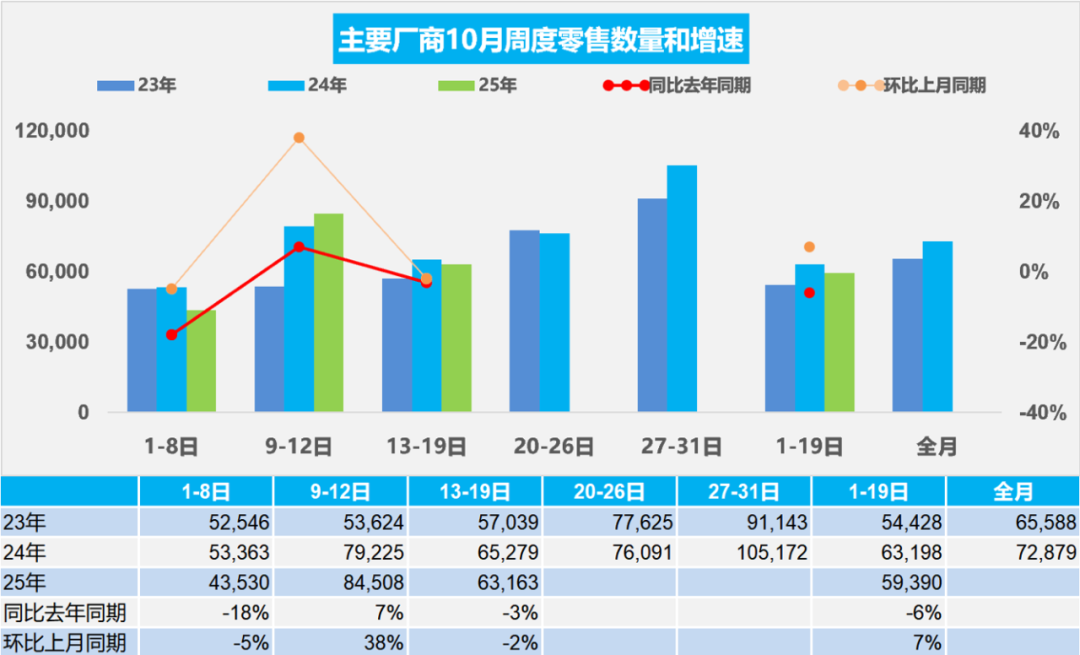
乘联分会:10月1-19日全国乘用车市场零售112.8万辆 同比下降6%
智通财经网· 2025-10-22 09:01
Core Insights - The retail sales of passenger cars in China from October 1 to 19 reached 1.128 million units, representing a year-on-year decline of 6% but a month-on-month increase of 7% [1][2] - Cumulative retail sales for the year reached 18.136 million units, showing a year-on-year growth of 8% [1][2] - The retail sales of new energy vehicles (NEVs) during the same period were 632,000 units, marking a year-on-year increase of 5% and a month-on-month increase of 2%, with a penetration rate of 56.1% [1][2] Passenger Car Market Overview - Retail sales from October 1 to 19 totaled 1.128 million units, down 6% year-on-year but up 7% month-on-month; cumulative sales for the year reached 18.136 million units, up 8% year-on-year [2][5] - Wholesale figures for the same period were 1.155 million units, down 5% year-on-year but unchanged from the previous month; cumulative wholesale for the year reached 22.002 million units, up 12% year-on-year [2][9] New Energy Vehicle (NEV) Insights - NEV retail sales from October 1 to 19 were 632,000 units, up 5% year-on-year and 2% month-on-month, with a cumulative total of 9.502 million units for the year, reflecting a 23% year-on-year increase [2][5] - NEV wholesale during the same period was 676,000 units, up 6% year-on-year and 5% month-on-month, with a cumulative total of 11.123 million units for the year, showing a 30% year-on-year growth [2][9] Market Trends and Influences - The market experienced a slow start in October due to holiday effects and a previous surge in September driven by government incentives [5] - The traditional peak season of "Golden September and Silver October" is expected to boost sales, although tightening subsidy standards and the impending expiration of tax incentives may affect consumer enthusiasm [5][11] - The export market for Chinese automobiles has shown positive growth, particularly in the NEV segment, with increasing competitiveness against international brands [9][11]
市占率创新低? 日赚1.8亿的宁德时代,被谁挖了墙脚
Xin Lang Cai Jing· 2025-10-22 06:28
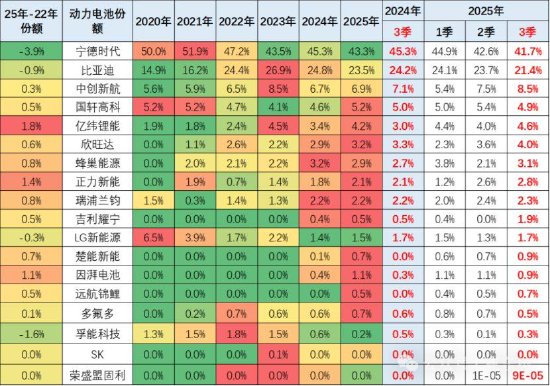
Core Insights - CATL reported a third-quarter revenue of 104.186 billion yuan, a year-on-year increase of 12.9%, and a net profit of 18.549 billion yuan, up 41.21% year-on-year [1] - For the first three quarters, CATL achieved a revenue of 283.072 billion yuan, a 9.28% increase year-on-year, and a net profit of 49.034 billion yuan, a 36.2% increase year-on-year, indicating an average daily profit of approximately 180 million yuan [1] - Despite strong financial performance, CATL's market share in the power battery sector has declined to 41.7%, the lowest in nearly six years, as competitors in the second tier are gradually increasing their shares [1][2] Market Share Dynamics - From 2020 to 2025, CATL's market share is projected to decrease from 50.0% to 43.3%, while competitors like Zhongchuang Innovation, Guoxuan High-Tech, and Yiwei Lithium Energy are steadily increasing their shares [2] - The decline in CATL's market share is attributed to the rapid development of the battery industry, particularly in lithium iron phosphate batteries, where CATL's share has diminished [1][2] - The shift from a dominant player to a more competitive landscape is characterized by second-tier manufacturers finding niches and excelling in specific areas, leading to a healthier market ecosystem [2] Supply Chain Strategies - Automakers are diversifying their battery suppliers to mitigate supply chain risks, opting to work with multiple battery manufacturers rather than relying solely on one [3] - This strategy allows automakers to enhance their bargaining power and focus on cost competitiveness, making it challenging for leading battery companies to expand their market share further [3][4] - The trend indicates a shift towards self-research and development of batteries by automakers, as they aim to create competitive products that surpass those available in the market [3][4] Collaboration and Customization - Recent collaborations, such as the joint venture between Li Auto and battery manufacturer Sunwoda, highlight a trend towards customized battery solutions, allowing automakers to have more control over battery design and production [4] - Unlike CATL, which prefers a traditional supplier relationship, second-tier manufacturers are more open to collaborative development, which can lead to tailored solutions for automakers [4] Industry Evolution - The competitive landscape is evolving, with second-tier manufacturers gradually gaining market share, reflecting a maturation of the entire electric vehicle industry [5][6] - The diversification of battery suppliers is seen as beneficial for consumers, providing more options and enhancing the overall efficiency of the supply chain [5] - As the market transitions from rapid growth to refined operations, leading companies face increased pressure to innovate and maintain competitiveness [5][6]

市占率创新低?日赚1.8亿的宁德时代,被谁挖了墙脚|能见派
Xin Lang Cai Jing· 2025-10-22 01:41
Core Insights - CATL reported a third-quarter revenue of 104.186 billion yuan, a year-on-year increase of 12.9%, and a net profit of 18.549 billion yuan, up 41.21% year-on-year [1] - Despite strong financial performance, CATL's market share in the power battery sector has declined to 41.7%, the lowest in nearly six years, indicating a potential shift in its dominant position [1][2] - The rapid development of the lithium iron phosphate battery sector has contributed to CATL's declining market share, as competitors gain ground in specific niches [1][2] Market Dynamics - The power battery industry is transitioning from a "one strong leader" model to a more fragmented competitive landscape, with second-tier manufacturers finding their strengths in specialized areas [2] - Automakers are diversifying their battery supply chains to mitigate risks, opting to collaborate with multiple battery suppliers rather than relying solely on one [2][3] - The competitive landscape among battery manufacturers remains stable in the short term, with both first and second-tier companies maintaining their positions [3] Strategic Collaborations - Automakers are increasingly interested in collaborating with battery manufacturers for research and development, seeking to enhance their understanding of battery technology [3] - A recent partnership between Li Auto and battery manufacturer Sunwoda aims to establish a joint venture for the production and sale of lithium-ion batteries, indicating a trend towards customized battery solutions [3] - The shift in focus from traditional partnerships to joint ventures reflects a desire for more tailored and stable supply chains among automakers [3] Industry Evolution - The changing dynamics in the battery market reflect the maturation of the entire electric vehicle industry, moving from rapid growth to more refined operations [2][3] - Analysts suggest that while second-tier companies are gradually increasing their market share, the competition will remain fierce, and some may still fall behind [3]
交银国际每日晨报-20251022
BOCOM International· 2025-10-22 01:35
Group 1: Chinese Economy - The Chinese economy demonstrated strong resilience in the first three quarters of 2025, with a GDP growth of 5.2% year-on-year, and a quarterly growth of 4.8% in Q3, maintaining a reasonable operational range [3][4] - Domestic demand continues to contribute steadily to economic growth, with final consumption expenditure accounting for 53.5% of GDP growth in the first three quarters, an increase of 9 percentage points compared to the entire year of 2024 [4] - The total import and export volume increased by 4.0% year-on-year in the first three quarters, with exports growing by 7.1%, highlighting the global competitive advantage of Chinese manufacturing [4] Group 2: Alibaba - Alibaba's revenue for Q2 of FY2026 is expected to grow by 3.9% year-on-year, with the overall e-commerce business projected to incur a loss of approximately 37.6 billion yuan due to significant subsidies [5][6] - The cloud business is anticipated to accelerate further, with revenue expected to exceed 30% year-on-year, while maintaining stable profit margins [5] - The target price for Alibaba is maintained at $200, reflecting a potential upside of 15.3% from the current closing price of $173.47 [5][6] Group 3: Rongchang Bio - Rongchang Bio's core product has shown excellent clinical data for a major indication, leading to an upward revision of the target price to HKD 109, indicating a potential upside of 17.8% from the current price of HKD 92.50 [9][10] - The data presented at the ESMO conference for the combination therapy of Vidisic and T demonstrated significant survival benefits compared to chemotherapy [9] - The company is expected to benefit from ongoing international multi-center studies in collaboration with Pfizer [9] Group 4: CATL (Ningde Times) - CATL reported a robust profit margin of 17.8% in Q3, with revenue reaching 104.2 billion yuan, a year-on-year increase of 12.9%, and a net profit of 18.6 billion yuan, up 41.2% year-on-year [11][12] - The demand for energy storage is projected to be the largest driver of lithium battery demand in 2025, with a 104% year-on-year increase in new bidding scale for energy storage in China [12] - The target price for CATL has been raised to 458.75 yuan, reflecting a potential upside of 25.2% from the current price of 366.50 yuan [11][12]

【财经早餐】2025.10.22星期三
Sou Hu Cai Jing· 2025-10-22 01:32
Macro Economy - The Ministry of Commerce held a video meeting discussing export controls and the EU's anti-subsidy case against Chinese electric vehicles, with both sides expressing a willingness to enhance communication on semiconductor issues [4] - China's GDP growth averaged 5.5% during the first four years of the 14th Five-Year Plan, showcasing resilience and potential despite external challenges [4] - Domestic tourism saw 4.998 billion trips in the first three quarters, a year-on-year increase of 18.0%, with total spending reaching 4.85 trillion yuan, up 11.5% [4] Real Estate Dynamics - The Guangzhou Real Estate Agency issued a statement urging real estate agents to improve service quality and resist commission-based practices that harm the industry's reputation [6] - In September, the real estate sector raised 56.1 billion yuan in bond financing, a 31% year-on-year increase, with credit bonds accounting for 57.4% of the total [6] - Shenzhen plans to launch 39 new residential projects in Q4, with a total supply area of approximately 1.6 million square meters, indicating a significant increase compared to Q3 [6] Stock Market Review - The Shanghai Composite Index rose 1.36% to 3916.33 points, with a total market turnover of 1.87 trillion yuan, reflecting a broad-based rally [7] - The Hang Seng Index increased by 0.65%, with significant gains in the insurance and technology sectors, while new consumption concepts showed signs of adjustment [7] - As of October 21, the total market capitalization of companies listed on the Beijing Stock Exchange was 863.865 billion yuan [8] Company News - Bubble Mart reported a 245%-250% year-on-year increase in overall revenue for Q3, with domestic revenue up 185%-190% and overseas revenue up 365%-370% [18] - CATL is accelerating the production of its 587Ah battery, aiming to increase its market share in the future [19] - Yushutech launched a four-legged robot training platform aimed at enhancing engineering practice capabilities for students [19]

市占率创新低? 日赚1.8亿的宁德时代,被谁挖了墙脚 | 能见派
Xin Lang Cai Jing· 2025-10-22 00:41
Core Viewpoint - CATL reported a significant increase in revenue and net profit for Q3, but its market share in the power battery sector has declined to its lowest level in nearly six years, indicating potential challenges ahead [1][2]. Financial Performance - In Q3, CATL achieved a revenue of 104.186 billion yuan, a year-on-year increase of 12.9%, and a net profit attributable to shareholders of 18.549 billion yuan, up 41.21% [1]. - For the first three quarters, CATL's total revenue reached 283.072 billion yuan, a 9.28% increase year-on-year, with a net profit of 49.034 billion yuan, reflecting a 36.2% growth [1]. Market Share Dynamics - CATL's market share in the power battery sector has decreased to 41.7%, marking a decline from previous years, with competitors like BYD and other second-tier manufacturers gaining ground [1][2]. - From 2020 to 2025, CATL's market share is projected to fluctuate, with a notable drop from 50.0% in 2020 to 41.7% in 2023 [2][4]. Competitive Landscape - The power battery market is shifting from a "one strong leader" model to a more diversified competition, with second-tier manufacturers finding success in niche markets [2][5]. - Second-tier manufacturers are adopting differentiated strategies, focusing on specific technologies such as lithium iron phosphate and cylindrical batteries, which enhances market health [2][5]. Supply Chain Strategies - Automakers are diversifying their battery suppliers to mitigate supply chain risks, opting to work with multiple battery manufacturers rather than relying solely on one [5][6]. - This trend has led to a more stable competitive landscape among first and second-tier battery companies, as automakers seek to balance cost and supply chain security [5][6]. Collaboration and Innovation - Companies like Li Auto are forming joint ventures with battery manufacturers to develop customized battery solutions, indicating a shift towards collaborative innovation in the industry [6][7]. - The establishment of joint ventures allows automakers to gain tailored components while reducing investment risks for suppliers, contrasting with CATL's preference for traditional sales models [6][7]. Industry Evolution - The evolving battery market reflects the maturation of the entire electric vehicle industry, with increased competition leading to more diverse product offerings and improved supply chain efficiencies [7][8]. - Analysts suggest that while competition will intensify, CATL's advantages may still provide it with a competitive edge in the long run [8].