家电

Search documents
国联民生证券:维持家电行业“推荐”评级 板块受益于升值助推外资流入
智通财经网· 2026-02-05 02:13
汇兑:套保对冲净资产损失 毛利率之外,汇率波动导致的外币净资产/负债头寸折算差额,是财务费用科目下汇兑损益的主要来源; 具体而言,货币性净资产在升值中产生汇兑损失,净负债则产生汇兑收益。过往三轮年度级人民币升值 周期中,家电主要公司汇兑多为损失;从最新披露25H1外币货币性项目看,主要公司中仅海尔智家及海 信家电为净负债,汇兑受益升值,其余公司均为净资产。经营角度,龙头外汇套保比例较高,有效对 冲,实际影响或集中于外销型小电公司。 智通财经APP获悉,国联民生证券发布研报称,拐点在望,维持家电行业"推荐"评级。名义汇率升值对 出口修复斜率及外销盈利虽有牵制,龙头品牌议价、海外产能、外汇套保平滑波动,影响有限;此外, 板块陆股通敞口较高,或受益于升值助推的外资流入。标的方面:①推荐高质量且高股息的白电龙 头;②推荐份额及盈利中枢提升的彩电龙头;③推荐领跑全球的扫地机龙头;④推荐份额提升、积极外拓。 国联民生证券主要观点如下: 量价:美元价汇率弹性较大 自下而上,外销量价是汇率影响的首要路径;升值阶段,出口厂商或上调美元均价维持本币出厂价稳 定,或以人民币价格消化升值影响,前者影响份额,后者影响盈利。过往汇率周期 ...

中泰国际每日晨讯-20260205
ZHONGTAI INTERNATIONAL SECURITIES· 2026-02-05 02:13
Market Overview - The Hang Seng Index closed at 26,847 points, up 0.1%, while the Hang Seng China Enterprises Index closed at 9,048 points, down 0.1%[1] - Total turnover in Hong Kong stocks was HKD 285.4 billion, a decrease of 14.9% from HKD 335.2 billion the previous day, indicating increased investor caution[1] - Energy, real estate, and materials indices rose by 3.0%, 2.1%, and 1.4% respectively, while information technology and consumer discretionary fell by 3.4% and 0.4%[1] Stock Performance - Xinyi Glass (868 HK) and China Shenhua (1088 HK) led the blue-chip gainers, rising by 5.9% and 5.7% respectively[1] - Ctrip Group (9961 HK) and Tencent Holdings (700 HK) were the biggest losers, falling by 6.1% and 4.0% respectively[1] - Major property stocks like China Resources Land (1109 HK) and China Overseas Land (688 HK) saw increases between 3.9% and 6.2% due to expectations of more proactive real estate policies from the government[1] Economic Indicators - The EU's January CPI rose by 1.7%, matching market expectations and down from 2.0% in December[3] - The US ISM Services PMI for January was 53.8, unchanged from December and above the market forecast of 53.5[3] Industry Developments - The Chinese government is encouraging increased consumer spending during the Spring Festival, which has positively impacted appliance stocks like Haier (6690 HK) and Midea Group (300 HK), which rose by 2.5% and 1.4% respectively[4] - The healthcare sector saw a 0.5% increase in the Hang Seng Healthcare Index, with companies like Rongchang Biopharma (9995 HK) expected to maintain rapid revenue growth[5] Renewable Energy Sector - The renewable energy and utilities sector generally rose, with significant gains in the photovoltaic sector, where stocks like Xinyi Solar (968 HK) and Flat Glass Group (6865 HK) increased by 1.3% to 2.9%[6] - However, Goldwind Technology (2208 HK) fell by 6.8% due to an EU investigation regarding state subsidies affecting competition[6]
“新国补”实施首月销售汽车、家电、数码和智能产品925.6亿元
Zhong Guo Xin Wen Wang· 2026-02-05 01:19
据央视新闻,记者从商务部了解到,随着2026年消费品以旧换新加力实施,各地掀起了焕新潮。"新国 补"实施首月,消费品以旧换新惠及1613万人次,销售汽车、家电、数码和智能产品925.6亿元。 资讯编辑:陈群 021-26096771 资讯监督:乐卫扬 021-26093827 资讯投诉:陈跃进 021-26093100 免责声明:Mysteel发布的原创及转载内容,仅供客户参考,不作为决策建议。原创内容版权归Mysteel所有,转载需取得Mysteel书面授 权,且Mysteel保留对任何侵权行为和有悖原创内容原意的引用行为进行追究的权利。转载内容来源于网络,目的在于传递更多信息,方 便学习与交流,并不代表Mysteel赞同其观点及对其真实性、完整性负责。 ...
钉钉大楼换LOGO硬刚飞书,网友:商战总是朴实无华;马斯克团队摸底中国光伏产业链,A股巨头回应;断友商后路?元宝回应被微信「封了」
雷峰网· 2026-02-05 01:08
Group 1 - Tesla's team is exploring the Chinese photovoltaic industry chain and has signed orders with a leading heterojunction equipment manufacturer [4][5] - JinkoSolar confirmed contact with Tesla's team regarding their technology and production capabilities, leading to a surge in stock prices [5] - The photovoltaic sector saw a collective rise in stock prices following the news of Tesla's interest [5] Group 2 - DingTalk changed its logo in a competitive move against Feishu, reflecting a playful approach to brand rivalry [7][8] - The logo change was inspired by a perceived height advantage of Feishu's logo, leading to humorous online reactions [8] Group 3 - The CEO of RT-Mart's parent company, Gao Xin Retail, has been unreachable after only two months in the position, raising concerns about his status [10][11] - The company reported a significant decline in revenue and profit prior to the CEO's disappearance, indicating potential operational challenges [11] Group 4 - WeChat blocked the sharing links for the Yuanbao app, leading to a rapid adjustment in its sharing mechanism to maintain user experience [12][13] - The incident highlights the competitive tensions within Tencent's ecosystem, as other apps also faced similar restrictions [12][13] Group 5 - Vivo has confirmed the development of a Vlog camera aimed at competing with DJI's Pocket series, with a planned release in 2026 [15][16] - The new product is part of Vivo's strategy to expand its offerings in the camera technology sector [16] Group 6 - Xiaohongshu's valuation has reportedly increased to 350 billion RMB after a recent sale of shares, reflecting strong investor interest [23][24] - The platform experienced a surge in monthly active users, surpassing 350 million, contributing to its rising valuation [24] Group 7 - Panasonic announced plans to expand its layoffs to 12,000 employees due to challenges in its AI business and a decline in sales [45] - The company is facing significant operational restructuring costs as it attempts to navigate these challenges [45] Group 8 - Realme has begun layoffs in India as it transitions back under OPPO's management, indicating a shift in its operational strategy [46][47] - The brand's return to OPPO aims to enhance product innovation and service delivery [46][47] Group 9 - Samsung Electronics' market value surpassed 1,000 trillion KRW, driven by a surge in demand for storage chips amid the AI boom [49][50] - The company's stock has seen significant growth, with expectations for continued strong performance in the semiconductor market [49][50] Group 10 - AMD's CEO revealed that the next generation Xbox is on track for a 2027 release, with custom SoCs already in development [52] - This collaboration continues AMD's long-standing partnership with Microsoft in the gaming console market [52]





惠及1613万人次 “新国补”实施首月带动产销两旺
Yang Shi Xin Wen· 2026-02-05 00:59
Group 1 - The "New National Subsidy" policy has led to a surge in consumer participation, benefiting 16.13 million people and generating sales of 92.56 billion yuan in various sectors including automobiles, home appliances, and digital products [1] - The implementation of the "New National Subsidy" has significantly boosted offline retail, with nearly 80% of new purchases in January coming from the replacement program, reflecting a year-on-year growth of approximately 20% [1] - The policy is driving cross-scenario consumption in leisure, transportation, and dining, creating a positive cycle of consumer engagement and revenue growth [1] Group 2 - The "New National Subsidy" is promoting a new consumption trend focused on green and intelligent products, with the subsidy standard for home appliances raised to first-level energy efficiency, leading to increased sales of high-performance appliances [3] - The demand for electric vehicles has surged, with consumers favoring long-range, spacious, and cost-effective models, supported by additional subsidies from manufacturers [3] - The shorter update cycle for digital products has encouraged consumers to purchase higher-end devices, benefiting from the "New National Subsidy" [4] Group 3 - The "New National Subsidy" is fostering new industry growth, providing companies with new market opportunities [5] - Orders for smart eyewear have surged post-subsidy implementation, prompting manufacturers to double their sales targets and innovate new products [6] - The supply chain for the smart eyewear industry is operating at full capacity, with production lines being expanded to meet the rising demand [6]
券商晨会精华 | AI Agent正处于从技术积累到规模化爆发的0-1关键阶段
智通财经网· 2026-02-05 00:32
Market Overview - The market rebounded yesterday, with the Shanghai Composite Index returning to 4100 points and the Shenzhen Component Index turning positive after a drop of over 1% earlier. The ChiNext Index narrowed its losses in the afternoon. The total trading volume in the Shanghai and Shenzhen markets was 2.48 trillion yuan, a decrease of 63.3 billion yuan from the previous trading day. Over 3200 stocks rose in the market, with coal, space photovoltaic, and airport shipping sectors seeing significant gains, while AI applications, precious metals, and computing hardware sectors experienced notable declines. By the close, the Shanghai Composite Index rose by 0.85%, the Shenzhen Component Index increased by 0.21%, and the ChiNext Index fell by 0.4% [1]. AI Industry Insights - Changjiang Securities believes that the AI Agent is at a critical 0-1 stage, transitioning from technological accumulation to large-scale explosion. The competition in the AI industry has focused on traffic entry, with edge models becoming the core breakthrough. AI Agents are evolving into personal assistants with autonomous analysis and problem-solving capabilities, breaking the limitations of traditional tools. The synergy of AI smartphones, AIPC, and AI glasses is creating a comprehensive edge AI ecosystem covering various scenarios such as daily office work and smart travel. The industry is supported by policy, technological breakthroughs, and market demand, making it a favorable time for the AI edge sector [1]. Restaurant Industry Outlook - Citic Securities indicates that the restaurant industry is currently in a phase of multiple turning points, with a potential recovery in valuation. The industry is experiencing marginal improvements in fundamentals, ongoing policy support, price mechanism recovery, and expected valuation increases. Since the second half of 2025, retail dining revenue and same-store performance in major restaurant segments have shown continuous recovery, coupled with a slowdown in supply expansion and reduced competition intensity, creating a more favorable external environment for business recovery and profit improvement. The restaurant sector is positioned as a clear beneficiary of consumption stimulus policies due to its high frequency, strong scenarios, and short decision-making chains. The national push for reasonable price recovery is leading to price adjustments by restaurant companies, with historical data suggesting that cost disturbances are more likely to have a temporary impact, allowing for a potential mid-to-long-term recovery in gross margins. Valuation improvements in the restaurant sector are often driven by improved inflation expectations, aligning with overseas experiences [2]. Home Appliance Industry Analysis - Citic Jiantou notes that the home appliance sector is expected to underperform the CSI 300 index in 2025 due to tariff increases, fluctuations in the old-for-new policy, and high base expectations in the second half of the year. From a long-term perspective, the competitiveness of companies will ultimately return to the essence of product innovation and efficiency advantages. Therefore, from an investment standpoint, there are two main lines: first, overseas expansion will continue to be the most important source of growth; second, the benefits of transformation [3].
名品闪耀齐鲁,山东燃动促消费主引擎
Feng Huang Wang Cai Jing· 2026-02-05 00:12
Core Viewpoint - Consumption is identified as the "main engine" of economic growth and a "barometer" of people's well-being, with a focus on domestic demand and the construction of a strong domestic market as key tasks for economic work in 2026 [1] Group 1: Consumption and Market Dynamics - The Ministry of Industry and Information Technology announced the 2025 China Consumer Brand List, with 21 brands from Shandong recognized, showcasing the province's strong competitiveness in meeting high-quality living demands and expanding the national consumer market [3][4] - Shandong's retail sales of consumer goods reached 4,208.29 billion yuan in 2025, growing by 5.1%, which is 1.4 percentage points higher than the national average [4] Group 2: Brand Quality and Innovation - Brands selected for the China Consumer Brand List are characterized by high quality, innovation, and differentiation, effectively meeting consumer needs [5][7] - Qilu Pharmaceutical has made significant advancements in product innovation, with 143 new products developed during the 14th Five-Year Plan, and has established itself as a benchmark in the pharmaceutical industry [7] - Lu Hua Group's high oleic peanut oil is recognized for its superior quality, achieving over 75% high oleic content and utilizing a pure physical pressing process [7] Group 3: Opportunities and Future Prospects - Being recognized as a China Consumer Brand provides Shandong brands with increased visibility, market influence, and potential policy support, facilitating their expansion into national markets [8] - The Shandong provincial government emphasizes the importance of expanding domestic demand and releasing consumption potential, indicating that more "Good Products from Shandong" brands will emerge [9]
“新国补”实施首月,带动产销两旺,各地掀起焕新潮
Yang Shi Wang· 2026-02-04 23:33
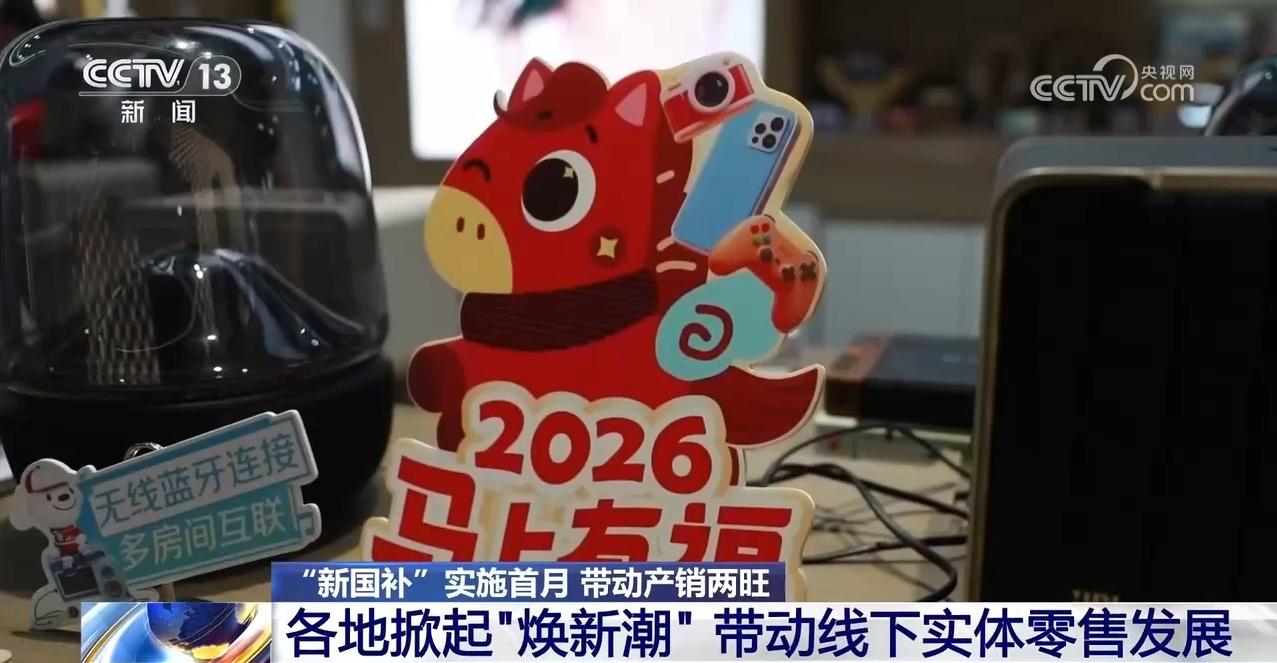
目前,2026年消费品以旧换新政策已经全面落地。"新国补"带来的真金白银优惠叠加春节大礼包,让消费者焕新热潮高涨。 记者在采访时发现,"新国补"的加力实施,正在带动线下实体零售发展,一些门店客流明显增多,业绩也实现了较快增长。商务部数据显示,1月份,家电 以旧换新、数码和智能产品购新线下销售接近8成,同比增长约20%。 政策红利的持续释放,也在带动休闲娱乐、交通出行、特色餐饮等跨场景消费。一些地方已经形成了以旧换新引流、多元消费增收的良性格局。 记者从商务部了解到,随着2026年消费品以旧换新加力实施,各地掀起了"焕新潮"。"新国补"实施首月,消费品以旧换新惠及1613万人次,销售汽车、家 电、数码和智能产品925.6亿元。 ...

“新国补”实施首月 带动产销两旺 各地掀起“焕新潮”
Yang Shi Wang· 2026-02-04 23:17
Group 1 - The core viewpoint of the article highlights the significant impact of the "New National Subsidy" policy, which has led to a surge in consumer participation in the trade-in program, benefiting 16.13 million people and generating sales of 92.56 billion yuan in various consumer goods [1][3]. - The implementation of the "New National Subsidy" has fully rolled out, creating a strong consumer enthusiasm for upgrading products, especially during the festive season [3]. - The policy is driving growth in offline retail, with a notable increase in foot traffic and sales performance, particularly in the home appliance and digital product sectors, which saw nearly 80% of new purchases coming from trade-ins, reflecting a year-on-year growth of approximately 20% [5]. Group 2 - The continuous release of policy benefits is fostering cross-scenario consumption in leisure, transportation, and specialty dining, establishing a positive cycle of trade-ins and diversified consumer spending [5].
贷款贴息“红包”更大了
Ren Min Ri Bao Hai Wai Ban· 2026-02-04 22:59
Core Viewpoint - The Chinese government is enhancing financial support through interest subsidies for consumer loans and small and micro enterprises, aiming to stimulate domestic demand and support the real economy [8][9][12]. Group 1: Consumer Loan Policies - The upgraded consumer loan subsidy policies will provide a 1% interest subsidy on personal consumption loans and service industry loans, benefiting both consumers and businesses [9][10]. - The policies have been optimized to include credit card installment payments, allowing more consumers to benefit from the subsidies [11]. - The implementation period for these policies has been extended to December 31, 2026, with potential for further extensions based on effectiveness [17][19]. Group 2: Support for Small and Micro Enterprises - A new interest subsidy policy for small and micro enterprises will provide a 1.5% subsidy on loans, with a maximum loan amount of 50 million yuan and a subsidy period of up to two years [14][16]. - The policy targets key industries such as new energy vehicles, industrial robots, and medical equipment, aiming to alleviate financing difficulties for private enterprises [14][16]. - The equipment update loan subsidy policy has been expanded to include fixed asset loans related to equipment updates and technology innovation [15][16]. Group 3: Implementation and Efficiency - The government aims to streamline the process for accessing these subsidies, ensuring that consumers and businesses can benefit from the policies with minimal bureaucratic hurdles [18][19]. - There is a focus on making the subsidy process more efficient, with an emphasis on automatic recognition of eligible transactions to facilitate immediate benefits for consumers [18][19]. - The policies are designed to create a favorable consumption environment by reducing credit costs and enhancing consumer purchasing power [19].