
地产

Search documents
A股:缩量洗盘!不出意外的话,午后会迎来新行情了
Sou Hu Cai Jing· 2025-06-12 10:11
午后会迎来新行情了 大家,目前还相信牛市吗? 如果,你不相信牛市肯定就等不到牛市了。证券已经拉升了,牛市旗手已经有一个提前上涨了,关键是等地产、白酒的补涨,只有联动上涨才会有大行情。 不要担心白酒的回调,目前就是用银行、证券的拉升对冲它的下跌,等它跌透了就可以一起拉升了,证券的空间远不止这个,特别是港股证券。 大盘指数还会继续拉升,大家炒股能不能挣钱与大盘指数涨跌关系有限,这是我们指数ETF玩家关心的事情,我们不可能去关注题材、概念、热点、游资、 龙虎榜吧。 大家不相信牛市而踏空行情,又因为不甘心而追涨。指数已经没有问题,关键是自己的选择筹码问题了。结构性行情,一定要踏准筹码节奏。 大盘指数上涨了,一样有很多行业下跌,白酒就是典型,只是它的跌幅太慢了,有人踏空大幅低开,放量跌停就好了。 今日的A股又缩量了,三大指数继续上涨,股票继续普跌。白酒砸盘的情况下,大盘指数震荡向上。证券、医疗再次上涨,港股恒生医疗再次大涨了。 这个位置的行情,我们指数玩家很容易面对,白酒如果跌到浮亏10%的时候补仓就完事了,市场还需要等它止跌反弹,与证券、地产等加速上涨。否则,没 有办法快速拉升上证指数,就不能放量…… 不出意外,接下 ...


关注能源、化工上游价格变动
Hua Tai Qi Huo· 2025-06-12 05:32
1. Report Industry Investment Rating No information provided. 2. Core Viewpoints of the Report - The production industry has seen an increase in new energy vehicle production and sales, with exports also growing significantly. The service industry should pay attention to the promotion of elderly - care service - related programs [1]. - Upstream, international oil prices have risen slightly, while urea and soda ash prices have declined. In the mid - stream, PX and pig product processing开工率 have increased. Downstream, first - and second - tier city property sales are at a near - three - year low, and domestic flight frequencies have decreased periodically [2][3][4]. - The credit spreads of the pharmaceutical and chemical industries have recently declined slightly [5]. 3. Summary by Related Catalogs 3.1. Mid - view Event Overview 3.1.1. Production Industry - From January to May, China's automobile production and sales reached 12.826 million and 12.748 million vehicles respectively, with year - on - year growth of 12.7% and 10.9%. New energy vehicle production and sales were 5.699 million and 5.608 million vehicles, growing by 45.2% and 44% year - on - year, accounting for 44% of total new car sales. Automobile exports were 2.49 million vehicles, with new energy vehicle exports at 855,000 vehicles, a 64.6% year - on - year increase [1]. 3.1.2. Service Industry - The International Organization for Standardization has released an international standard on the inclusive digital economy for an aging society led by China, providing specific suggestions for high - frequency digital economy scenarios for the elderly [1]. 3.2. Industry Overview 3.2.1. Upstream - Energy: International oil prices have risen slightly. - Chemical: Urea and soda ash prices have declined [2]. 3.2.2. Mid - stream - Chemical: PX开工率 has recovered. - Agriculture: Pig product processing开工率 has increased [3]. 3.2.3. Downstream - Real Estate: First - and second - tier city property sales are the same as last year and at a near - three - year low. - Service: Domestic flight frequencies have decreased periodically [4]. 3.3. Market Pricing - The credit spreads of the pharmaceutical and chemical industries have recently declined slightly [5]. 3.4. Industry Credit Spread Tracking (as of 6/11) | Industry | Last Year | One Quarter Ago | One Month Ago | Last Week | This Week | Quantile | | --- | --- | --- | --- | --- | --- | --- | | Agriculture, Forestry, Animal Husbandry and Fishery | 63.38 | 88.71 | 77.76 | 59.48 | 59.28 | 0.70 | | Mining | 35.48 | 25.94 | 47.91 | 38.57 | 39.39 | 9.40 | | Chemical | 67.32 | 72.87 | 63.09 | 21.15 | 50.99 | 0.10 | | Steel | 42.16 | 65.09 |... | 45.94 | 46.91 | 10.50 | | Non - ferrous Metals | 44.71 | 65.43 | 58.77 | 51.36 | 51.00 | 12.00 | | Electronics | 61.94 | 86.94 | 77.65 | 58.50 | 58.89 | 8.40 | | Automobile | 63.19 | 71.17 | 51.29 | 40.74 | 41.64 | 0.70 | | Household Appliances | 42.03 | 60.23 | 53.02 | 45.87 | 46.68 | 12.50 | | Food and Beverage | 42.30 | 54.60 | 45.51 | 35.32 | 36.25 | 2.20 | | Textile and Apparel | 51.27 | 64.99 | 55.00 | 51.41 | 51.69 | 9.10 | | Light Industry Manufacturing | 49.82 | 203.78 | 165.50 | 148.84 | 145.95 | 7.10 | | Pharmaceutical and Biological | 23.69 | 75.25 | 73.82 | 61.08 | 59.40 | 8.60 | |... | 26.29 | 41.31 | 33.99 | 26.24 | 27.04 | 9.80 | | Transportation | 32.99 | 45.47 | 38.14 | 30.12 | 31.18 | 6.10 | | Real Estate | 221.47 | 158.34 | 125.70 | 101.21 | 103.67 | 6.40 | | Commercial Trade | 46.51 | 59.70 | 51.36 | 42.04 | 41.84 | 4.00 | | Leisure Services | 80.78 | 112.28 | 127.15 | 121.37 | 122.09 | 98.10 | | Bank | 27.73 | 36.23 | 19.75 | 19.17 | 18.01 | 4.40 | | Non - bank Finance | 28.71 | 42.60 | 35.76 | 29.23 | 29.51 | 6.80 | | Comprehensive | 69.20 | 59.32 | 51.02 | 41.51 | 42.20 | 1.30 | | Building Materials | 35.82 | 55.75 | 47.38 | 37.31 | 38.25 | 8.10 | | Building Decoration | 43.77 | 66.60 | 56.84 | 59.22 | 60.30 | 28.40 | | Electrical Equipment | 53.06 | 93.59 | 83.42 | 79.80 | 79.15 | 41.80 | | Mechanical Equipment | 32.71 | 51.69 | 48.31 | 42.07 | 43.99 | 24.30 | | Computer | 69.67 | 76.76 | 62.98 | 48.56 | 46.46 | 0.00 | | Media | 227.40 | 53.06 | 46.41 | 38.66 | 39.69 | 1.00 | | Communication | 31.64 | 44.82 | 28.75 | 24.87 | 25.36 | 1.40 | [49] 3.5. Key Industry Price Index Tracking (as of 6/10) | Industry | Index Name | Frequency | Unit | Update Time | Value | Year - on - Year | | --- | --- | --- | --- | --- | --- | --- | | Agriculture | Spot price: Corn | Daily | Yuan/ton | 6/10 | 2308.6 | 0.50% | | | Spot price: Eggs | Daily | Yuan/kg | 6/10 | 5.8 | - 2.02% | | | Spot price: Palm oil | Daily | Yuan/ton | 6/10 | 8630.0 | - 0.07% | | | Spot price: Cotton | Daily | Yuan/ton | 6/10 | 14623.0 | 0.44% | | | Average wholesale price: Pork | Daily | Yuan/kg | 6/10 | 20.3 | - 1.41% | | | Spot price: Copper | Daily | Yuan/ton | 6/10 | 79293.3 | 1.03% | | | Spot price: Zinc | Daily | Yuan/ton | 6/10 | 22146.0 | - 2.50% | | Non - ferrous Metals | Spot price: Aluminum | Daily | Yuan/ton | 6/10 | 20193.3 | 0.28% | | | Spot price: Nickel | Daily | Yuan/ton | 6/10 | 123000.0 | - 0.52% | | | Spot price: Aluminum | Daily | Yuan/ton | 6/10 | 16706.3 | 1.10% | | | Spot price: Rebar | Daily | Yuan/ton | 6/10 | 3090.2 | 1.29% | | Ferrous Metals | Spot price: Iron ore | Daily | Yuan/ton | 6/10 | 746.1 | - 0.56% | | | Spot price: Wire rod | Daily | Yuan/ton | 6/10 | 3267.5 | 0.23% | | | Spot price: Glass | Daily | Yuan/sq.m | 6/10 | 13.8 | - 2.82% | | Non - metals | Spot price: Natural rubber | Daily | Yuan/ton | 6/10 | 13670.8 | 2.72% | | | China Plastics City price index | Daily | - | 6/10 | 824.4 | - 0.25% | | | Spot price: WTI crude oil | Daily | US dollars/barrel | 6/10 | 65.3 | 4.43% | | Energy | Spot price: Brent crude oil | Daily | US dollars/barrel | 6/10 | 67.0 | 3.73% | | | Spot price: Liquefied natural gas | Daily | Yuan/ton | 6/10 | 3998.0 | - 2.01% | | | Coal price: Coal | Daily | Yuan/ton | 6/10 | 748.0 | - 0.53% | | | Spot price: PTA | Daily | Yuan/ton | 6/10 | 4880.5 | - 1.38% | | Chemical | Spot price: Polyethylene | Daily | Yuan/ton | 6/10 | 7346.7 | - 0.14% | | | Spot price: Urea | Daily | Yuan/ton | 6/10 | 1821.7 | - 3.92% | | | Spot price: Soda ash | Daily | Yuan/ton | 6/10 | 1370.0 | - 4.20% | | | Cement price index: National | Daily | - | 6/10 | 140.9 | 0.84% | | Real Estate | Building materials comprehensive index | Daily | Points | 6/10 | 111.6 | 0.30% | | | Concrete price index: National index | Daily | Points | 6/10 | 99.1 | - 0.24% | [50]
A股:大幅缩量,坏信号来了?周四,大盘走势分析
Sou Hu Cai Jing· 2025-06-11 07:36
Core Viewpoint - The A-share market is currently experiencing a consolidation phase around the 3400-point level, with significant fluctuations in trading volume, indicating a psychological battle among investors [1][3]. Market Analysis - The market has seen a reduction in trading volume, with approximately 170 billion yuan in volume today, suggesting that large funds are locking in positions rather than selling off [3]. - The 3400-point level is viewed as a short-term target, with expectations for a rebound in sectors such as liquor, real estate, and insurance, which could lead to a larger market rally [3][5]. - The A-share market has lagged behind Hong Kong and U.S. markets, but there is optimism that the index could accelerate its recovery if key sectors reverse their downward trends [5]. Sector Performance - The TMT (Technology, Media, and Telecommunications) sector has seen a significant drop in trading volume, down by two-thirds compared to March, which raises concerns about its performance [5]. - Other sectors, including rare earths, healthcare, and food and beverage, have shown positive growth, while the liquor sector has also underperformed [5]. Investor Guidance - Investors are advised to maintain a simple holding strategy, focusing on position management and asset allocation, rather than being overly optimistic or pessimistic [7]. - The likelihood of the index continuing to rise is high, with no substantial logic for a major pullback, suggesting that the market may respond positively to favorable news [7].
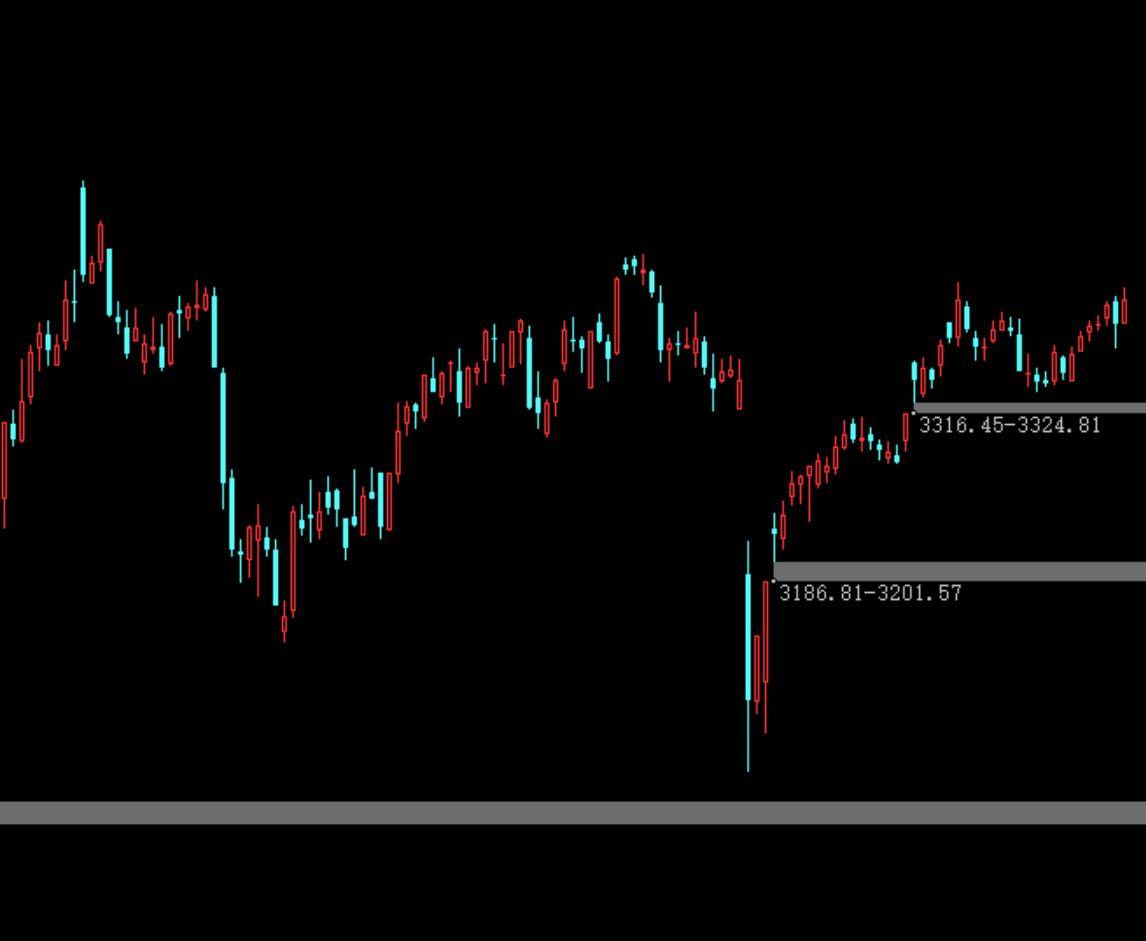
“私募魔女”李蓓反思,到底错在哪里
2 1 Shi Ji Jing Ji Bao Dao· 2025-06-11 07:12
Core Viewpoint - The article discusses the reflections and investment strategies of Li Bei, a prominent private equity fund manager, who acknowledges her underperformance over the past two years due to a lack of understanding of domestic policy-making and execution mechanisms [1][6]. Investment Performance - Li Bei admits that her investment performance has been poor in the last two years, missing opportunities in sectors like small-cap stocks, new consumption, technology, and pharmaceuticals, which led to mediocre equity returns [2][3]. - The performance of her fund, the Honghu Zhongyu Macro Hedge Fund, has shown a cumulative return of 121.91% since its inception, significantly outperforming the CSI 300 index's 21.94% over the same period, but has lagged in the last two years with a return of -15.63% compared to the index's 0.97% [9]. Investment Strategy - Li Bei emphasizes her commitment to avoiding large positions in pharmaceuticals and new consumption, as well as not participating in small-cap stocks, while focusing on cyclical, high-dividend, and low price-to-book ratio stocks [1][6]. - She proposes three improvement measures: enhancing foreign capital tracking, selecting stocks with alpha potential, and prioritizing safety and risk-reward ratios by choosing low PB and high dividend stocks [3]. Portfolio Composition - Li Bei presents two investment portfolios for consideration, with her preference for Portfolio B, which includes low PB and high dividend stocks, indicating a focus on safety and long-term value [4][5]. - The current asset allocation includes 55%-60% in equities, 10%-15% in gold for hedging against dollar risks, and a focus on low-carry commodities and government bonds [5][6]. Market Analysis - Li Bei reflects on the changing dynamics of policy execution in China, noting a significant decrease in the effectiveness and duration of policy implementation over the past two years, which has contributed to her investment misjudgments [3][8]. - The article highlights the challenges faced by Li Bei in making accurate market predictions, particularly in the context of her macro hedge strategy, which relies heavily on timing and market trend analysis [8].
A股:重返3400点,行情不同了,释放了2个信号
Sou Hu Cai Jing· 2025-06-11 04:49
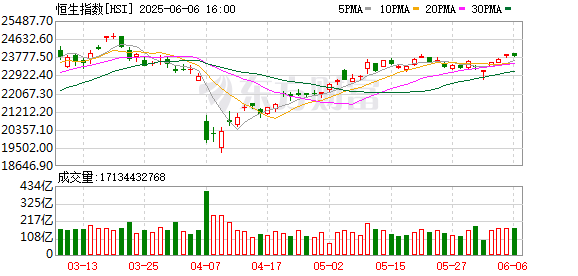
Group 1 - The A-share market is showing strength, with the index recovering from previous declines, but sectors like liquor and real estate are not performing well [1][3] - The current market rebound to 3400 points is fundamentally different from the previous one, as it lacks the strong upward momentum from liquor and real estate, indicating a more natural market recovery [3][5] - The index's performance is primarily driven by heavyweight sectors, and without the participation of liquor and real estate, further upward movement may be limited [1][3] Group 2 - There are two key signals observed: the index has risen, but many retail investors have not outperformed the index, indicating a disconnect between individual stock performance and index movements [5][7] - The market is experiencing net capital inflow, with major players focusing on broad-based ETFs rather than individual stocks, suggesting a shift in investment strategy [7][8] - The current index levels are 3400 for the Shanghai Composite and 24000 for the Hang Seng Index, reflecting a general upward trend in both markets [5][7]

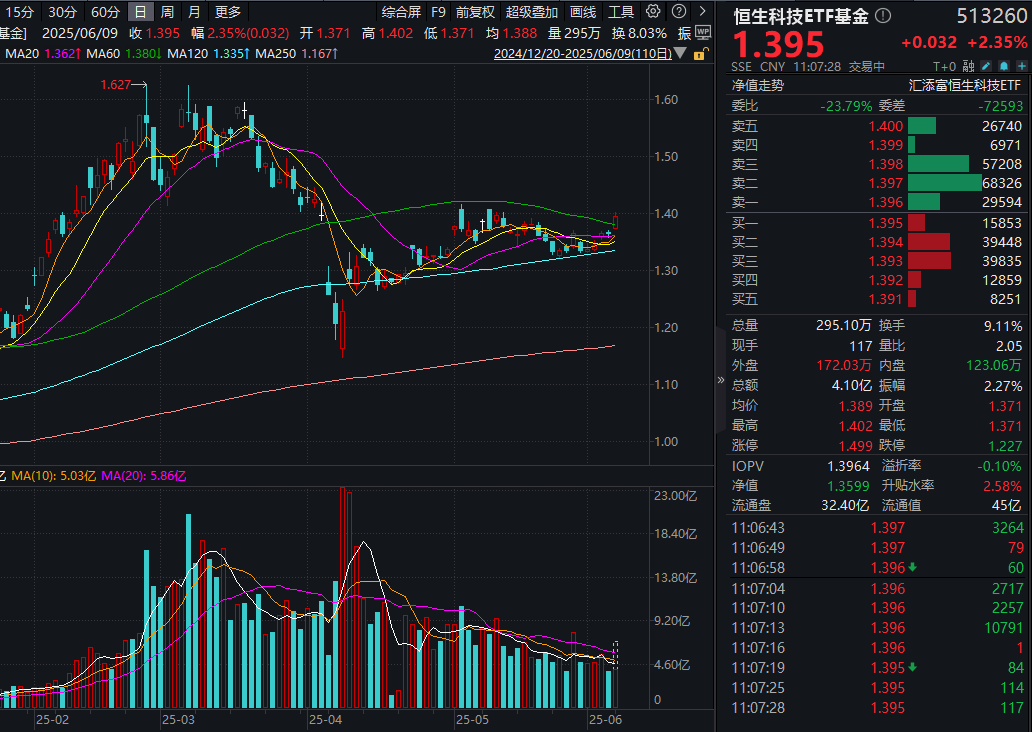
美团涨超4%,港股集体回暖!恒生科技ETF基金(513260)大涨超2%!机构:港股是本轮行情的主战场
Xin Lang Cai Jing· 2025-06-09 03:48
Group 1 - The core viewpoint is that the Hong Kong stock market is experiencing a positive trend, driven by factors such as improved risk appetite due to easing US-China trade relations and significant inflows into the Hang Seng Tech ETF [2][3][8] - The Hang Seng Tech ETF has seen over 2% increase in intraday trading, with net inflows exceeding 2.1 billion yuan in the past 60 days [1][5] - The current market environment is characterized by a shift in consumption patterns and technological advancements, particularly in AI, which are attracting investor interest in Hong Kong stocks [4][7][9] Group 2 - Hong Kong stocks are expected to outperform A-shares due to their unique asset characteristics and the scarcity of certain stocks related to new consumption and AI applications [3][7] - The Hang Seng Tech Index is currently valued at a price-to-earnings ratio of 20.7, which is considered attractive compared to global standards [9] - The influx of southbound capital indicates a strong demand for Hong Kong stocks, particularly from domestic institutions, which is expected to continue supporting the market [8][9]

促消费!行情明牌了?下周,A股走势分析
Sou Hu Cai Jing· 2025-06-08 01:02
Group 1 - The market sentiment is stabilizing with the Shanghai Composite Index approaching 3400 points, indicating a shift in market dynamics [1] - There is a divergence in the banking sector, with some stocks experiencing declines while others show potential for growth, particularly in the liquor, securities, and real estate sectors [1][7] - The current market environment suggests that individual investors face difficult choices, with the potential for profit often linked to periods of discomfort [1] Group 2 - Continuous improvement in consumer spending mechanisms is essential, as income growth is the foundation for sustainable consumption [3] - Short-term stimulus can boost consumption, but long-term growth relies on increasing household income and financial stability [3] - The recovery of the real estate and stock markets is seen as a quicker way to enhance wealth compared to wage increases, with significant gains possible in a short time frame [3] Group 3 - Large funds remain locked in, and the CSI 300 index has reached bear market levels, suggesting a potential for upward movement as market sentiment shifts [5] - The stock market tends to reward those who are skeptical about its growth, indicating that a lack of belief in a bull market could lead to unexpected gains [5] - The current market is characterized by a potential upward trend, with both weekly and monthly rebounds likely, although it is still in a phase of accumulating shares [5] Group 4 - The likelihood of the A-share market returning to 3400 points is high, with attention needed on which sectors will drive the index upward [7] - Sectors such as liquor, securities, and real estate are expected to lead the rally, while banks and insurance also show potential for growth despite recent declines [7] - The recent pullback in major stocks may set the stage for a stronger upward movement in the index, as limited downside suggests a rebound is imminent [7]

汇丰私行:外资正流入港股 青睐AI、高息板块
2 1 Shi Ji Jing Ji Bao Dao· 2025-06-06 11:44
Group 1 - The core viewpoint is that international investors are increasingly focusing on Chinese assets, particularly in the context of uncertainty surrounding US dollar policies and the search for investment opportunities outside the US [1][2] - HSBC has observed a flow of foreign capital into the Hong Kong stock market, although the overall scale is still below historical highs, indicating room for further foreign investment in Hong Kong stocks [1] - Investment from foreign capital is primarily concentrated in the artificial intelligence sector and high-dividend stocks [1] Group 2 - In the field of artificial intelligence, China has surpassed the US and Europe in research output, and while Chinese AI-related stocks have been revalued, their valuations still lag behind their US counterparts [1] - The pace of share buybacks in Asia (excluding Japan) is breaking records, with expected equity returns rising from approximately 11% last year to 12.5% by 2026 [1] - The People's Bank of China will provide refinancing tools for commercial banks in 2024 to support share buybacks by listed companies and major shareholders, leading to a positive outlook for high-dividend quality state-owned enterprises, Hong Kong insurance companies, telecom stocks, and real estate stocks [1] Group 3 - The impact of the US tariff war on China's capital markets has weakened, with Chinese goods accounting for only about 13% of total US imports, compared to 2018 [2] - Despite initial expectations that Asian stock markets would be most affected by the tariff war, the mainland and Hong Kong stock markets have remained relatively stable [2] - HSBC Private Banking maintains a high allocation to gold over the next six months, anticipating strong demand from global investors for risk diversification and hedging [2] Group 4 - HSBC forecasts a target price of 25,830 points for the Hang Seng Index this year, indicating potential for upward movement [4] - As the focus of US tariff policies shifts, risk sentiment in Asian markets is gradually stabilizing [4] - HSBC plans to increase holdings in Asian stock markets driven by domestic demand and supportive stimulus policies, including those in China, India, and Singapore [4]

盈信量化(首源投资)::放量了!接下来,市场会迎来重返3400点吗?
Sou Hu Cai Jing· 2025-06-06 09:51
Market Overview - The market experienced a complex morning with the three major indices peaking at 3391 points before retreating, while Hong Kong stocks slightly corrected and A-shares lacked upward momentum [1] - Trading volume exceeded 30 billion, with nearly 3000 stocks declining, indicating mixed market sentiment with some investors reducing positions and others increasing [1] Trading Dynamics - The market showed significant volume from the opening until 11:30 AM, suggesting that some investors were exiting positions after three consecutive days of gains [3] - Key sectors like liquor and banking saw upward movement followed by pullbacks, while the securities sector failed to maintain its upward trend, making it difficult for the overall index to gain traction [3] Conditions for Market Recovery - For the market to return to 3400 points, two conditions must be met: a noticeable inflow of northbound capital and significant gains in sectors like liquor and securities, which are currently not in place [5] - The absence of a clear main trading theme and the recent cooling off of the TMT sector indicate a lack of strong market drivers, although the absence of any stocks hitting the daily limit down suggests a stable market sentiment [5] Future Outlook - The market is expected to trend upwards with fluctuations, and individual trading strategies may vary, emphasizing the importance of position management [7] - Despite nearly 3000 stocks declining, the overall index did not drop significantly, indicating potential for future market movements as the market adjusts [7]

关注美国新关税政策对上游价格的影响
Hua Tai Qi Huo· 2025-06-06 03:03
Report Summary 1) Report Industry Investment Rating No information provided regarding the industry investment rating. 2) Core Viewpoints - Keep an eye on the impact of the new US tariff policy on upstream prices and the advancement of pension - service - related programs [1] - Observe the trends of prices,开工率, sales volume, and credit spreads across different industries [2][3][4][5] 3) Summary by Directory A. Mid - view Event Overview - **Production Industry**: The US has raised the tariffs on imported steel, aluminum, and their derivatives from 25% to 50, and China will build 10 national data element comprehensive experimental zones [1] - **Service Industry**: The ISO has released an international standard on the inclusive digital economy for an aging society led by China [1] B. Industry Overview - **Upstream**: The price of soda ash in the chemical industry has dropped significantly, and the price of glass in the black industry has continued to decline [2] - **Mid - stream**: The PX operating rate in the chemical industry and the asphalt operating rate in the infrastructure industry have both increased [3] - **Downstream**: The sales of commercial housing in the real - estate industry have seasonally declined to a near - three - year low, and the number of domestic flights in the service industry has cyclically decreased [4] - **Market Pricing**: The credit spreads across all industries are fluctuating [5] C. Data Graphs - There are 24 graphs showing various indicators such as coal consumption, inventory, operating rates of different industries, traffic congestion indices, movie box - office, and flight execution [6] D. Industry Credit Spread Tracking - Credit spreads of different industries have different trends, with some increasing and some decreasing compared to previous periods [45] E. Key Industry Price Index Tracking - Prices of various products in key industries have different changes, including increases and decreases in prices of agricultural products, metals, energy, and chemical products [46]