支付

Search documents
2025年1-7月境内银联钱包在柬交易额同比增长近2倍
Jing Ji Guan Cha Wang· 2025-08-14 07:30
经济观察网 8月14日,中国银联宣布,在中柬两国央行共同指导下,银联国际持续深化中柬二维码支付 互联互通建设,成效逐渐显现。2025年1—7月,境内银联合作钱包在柬埔寨的交易金额同比提升近2 倍,彰显出双方支付合作的强劲活力。(编辑 胡群) ...
贝莱德Q2重仓美股“七巨头” 建仓Circle(CRCL.US)、eToro(ETOR.US)
Zhi Tong Cai Jing· 2025-08-13 08:48
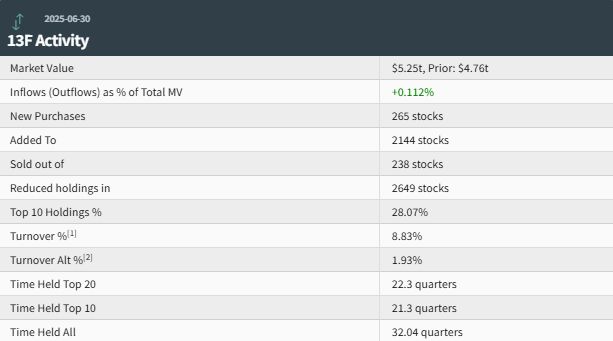
Core Insights - BlackRock reported a total market value of $5.25 trillion for its Q2 2025 holdings, up from $4.76 trillion in the previous quarter, reflecting a quarter-over-quarter increase of 0.112% [1][2] - The fund added 265 new stocks, increased holdings in 2,144 stocks, reduced holdings in 2,649 stocks, and completely sold out of 238 stocks during the quarter [1][2] - The top ten holdings accounted for 28.07% of the total market value [1][2] Holdings Overview - The top five holdings included NVIDIA (NVDA) with approximately 1.91 billion shares valued at about $301.73 billion, Microsoft (MSFT) with approximately 582 million shares valued at about $289.28 billion, Apple (AAPL) with approximately 1.15 billion shares valued at about $235.71 billion, Amazon (AMZN) with approximately 713 million shares valued at about $156.39 billion, and Meta (META) with approximately 166 million shares valued at about $122.77 billion [3][4] - The top ten holdings also featured Broadcom (AVGO), Alphabet Class A (GOOGL), Tesla (TSLA), Alphabet Class C (GOOG), and JPMorgan Chase (JPM) [3][4] Trading Activity - The top five purchases by percentage change included NVIDIA, Broadcom, Netflix (NFLX), Amazon, and Tesla [5][6] - The top five sales by value included Procter & Gamble (PG), Visa (V), Chevron (CVX), Merck (MRK), and Thermo Fisher Scientific (TMO) [5][6] - The turnover rate for the portfolio was 8.83%, with a time held for the top 20 holdings averaging 22.3 quarters [2][4]




全球支付品牌ONERWAY完成1000万美元A+轮融资
Sou Hu Cai Jing· 2025-08-13 02:56
Core Viewpoint - ONERWAY has successfully completed a $10 million A+ round of financing, which will accelerate its global expansion and enhance its cross-border payment infrastructure [2] Company Overview - Founded in 2017, ONERWAY focuses on providing secure and efficient cross-border payment solutions for businesses [2] - The company has established itself as a leader in overseas enterprise account solutions, serving global e-commerce platforms, game developers, and AIGC startups [2] Financing Details - The recent financing round was led by Yunqi Capital, with participation from existing investors including BlueRun Ventures, Jingya Capital, and Mingyu Ventures [2] - The funds will be used to improve technology research and development, expand global authorization, and deepen strategic partnerships [2] Product Development - ONERWAY plans to launch new AI-based products, such as stablecoin payments and agency payments, to enrich its product matrix [2] - The company supports over 170 payment methods and covers 110 currencies, with a global presence in over 60 countries and regions [2] Future Plans - The CEO, Andy Wang, emphasized that the funding will help redefine how businesses conduct transactions globally and reduce friction in cross-border transactions [2] - ONERWAY aims to conduct a B round of financing in 2026 to further solidify its position as a leading global payment solution provider [2]

奥比中光有望摘U “3D视觉第一股”拐点将至?
2 1 Shi Ji Jing Ji Bao Dao· 2025-08-12 09:52
Core Viewpoint - Aobi Zhongguang has reported its first half-year profit since its IPO, with significant revenue growth and a turnaround from losses to profits, indicating potential for future market performance [1][2]. Financial Performance - Aobi Zhongguang's revenue for the first half of 2025 reached 435 million yuan, a year-on-year increase of 104.14% - The net profit attributable to shareholders was 60.19 million yuan, reversing a loss of nearly 114 million yuan from the previous year, representing a year-on-year growth of 212.77% [1]. Market Reaction - Despite the positive financial results, Aobi Zhongguang's stock price fell by 5.8% to 79.98 yuan per share on August 12, indicating that market expectations may have been overly high [2]. Business Drivers - The company's turnaround is primarily driven by the successful implementation of offline payment solutions, particularly through its partnership with Alipay [3][5]. - Aobi Zhongguang has been a key supplier for Alipay's "Tap to Pay" service, which has gained significant traction since its launch [4][5]. Strategic Partnerships - Aobi Zhongguang's collaboration with Alipay has resulted in substantial revenue, with related transactions amounting to approximately 131 million yuan, accounting for over 30% of its revenue [5]. - The company has also engaged in partnerships with various robotics firms, enhancing its position in the AIoT sector [6][7]. Technological Advancements - Aobi Zhongguang has made significant progress in 3D vision technology, launching new products aimed at enhancing robotic capabilities [7]. - The company is positioned to capitalize on the growing global demand for 3D scanning technology, with the market projected to grow from 4.9 billion USD in 2024 to 8.8 billion USD by 2030 [6]. Future Outlook - As the global robotics industry undergoes an intelligent upgrade, Aobi Zhongguang has the potential to replicate its success in payment solutions and 3D printing within the humanoid robotics sector, which could lead to expanded valuation opportunities [8].

端午假期银联、网联共处理支付交易笔数同比增长13%
Xin Hua Wang· 2025-08-12 05:52
Core Insights - During the Dragon Boat Festival holiday from May 31 to June 2, payment transactions processed by UnionPay and Wanglian reached 14.05 billion, amounting to 4.8 trillion yuan, representing a year-on-year increase of 13% and 3.4% respectively [1][1][1] - The number and amount of payment transactions from overseas visitors to China saw significant growth, with increases of 118.6% and 58.8% compared to the same holiday period last year [1][1][1]
万达集团被执行24亿|首席资讯日报
首席商业评论· 2025-08-12 04:06
Group 1 - The core viewpoint of the article highlights significant developments in various companies and industries, including breakthroughs in technology, financial updates, and market reactions [2][3][4][10]. Group 2 - Giant Wheel Intelligent has achieved a major breakthrough in high-precision RV reducer technology for robots, breaking foreign manufacturing monopolies and reaching international advanced levels in various technical indicators [2]. - The animated film "Wang Wang Mountain Little Monster" has surpassed a cumulative box office of 574 million, setting a new record for domestic 2D animated films in China [3]. - Tenpay has increased its registered capital from 15.3 billion to 22.3 billion RMB, marking an increase of approximately 46% [3]. - Wanda Group has been executed for over 2.4 billion RMB, with total execution amounts exceeding 7.6 billion RMB across multiple cases [4]. - The founder of Pang Donglai responded to the controversy surrounding the recruitment of released prisoners, indicating a significant shift in the company's approach [5]. - Dell has denied rumors regarding an "exit plan timeline," emphasizing its focus on business development and customer service in China [8]. - The Indian government has extended its $1.2 billion electric vehicle subsidy plan for two more years, aiming to accelerate EV adoption and infrastructure development [9]. - Beijing Huiyuan Food and Beverage Company has publicly called for shareholders and creditors to protect their rights, accusing its major shareholder of failing to fulfill capital injection obligations [10].

聚焦机器人与AI视觉 奥比中光上半年营收翻倍净利润大增
Zheng Quan Shi Bao Wang· 2025-08-11 13:35
Core Insights - The rapid development of AI large models has led to significant progress for the company, marking a "turning point" in its operations [1] - In the first half of 2025, the company reported revenue of 435 million yuan, a year-on-year increase of 104.14%, and a net profit of 60.19 million yuan, up 212.77% [1] Group 1: Business Development - The company has signed a cooperation agreement with Horizon Robotics and its subsidiary, Diguo Robotics, to deepen collaboration in the field of robot intelligence [2] - The company has developed a comprehensive range of 3D visual perception products for various types of robots, including service robots, industrial robots, and humanoid robots [2] - The company is building a "robot and AI visual industry platform" to enhance research and development in 3D visual perception technology [2] Group 2: Service Robots - The company has established partnerships with several domestic and international service robot clients, covering applications such as lawn mowing, hotel delivery, and commercial cleaning [3] - In collaboration with RoboCare, a leading Korean nursing robot company, the company has launched multiple robot products aimed at elderly care [3] - The company's 3D visual sensors have been successfully integrated into humanoid robots, with notable achievements such as winning the world's first humanoid robot marathon [3] Group 3: Industry Applications - The company is accelerating the promotion and implementation of 3D visual perception technology across various industries, driven by advancements in large model technology and intelligent device upgrades [4] - The company has strengthened market promotion efforts, leading to increased applications of 3D visual sensors in offline retail, self-service kiosks, and other payment scenarios [4] - As a core supplier for Alipay's "tap to pay" service, the company has facilitated the large-scale implementation of this innovative payment method in elevator scenarios [4][5] Group 4: Innovation and Patents - The company is in a critical development phase for 3D visual perception, with numerous potential applications and market opportunities [6] - At the 2025 World Robot Conference, the company launched new perception products for the robotics sector, including the PulsarME450 and Gemini345Lg [6] - The company has applied for a total of 1,903 patents, including 990 invention patents, and has obtained 1,112 patents, with a focus on enhancing its core technologies [7]
埃及计划到2030年绿色能源生产电力到24%;TikTok Shop日本首月GMV破2450万;上半年全球电视出货量同比增长2%|一周「出海参考」
Tai Mei Ti A P P· 2025-08-11 12:25
Group 1 - MGX, an Abu Dhabi investment group, plans to raise up to $25 billion for AI infrastructure investments, aiming to become one of the largest entities in this sector globally [1] - Egypt aims to achieve 42% of its electricity from renewable sources by 2030, attracting over $10 billion in private investments and has already raised about $4 billion [2] - Vietnam's Prime Minister has announced a plan to establish international financial centers in Ho Chi Minh City and Da Nang by the end of 2025, emphasizing the importance of attracting foreign investment and enhancing the country's competitiveness [3] Group 2 - Indonesia is planning to expand the digital park on Batam Island to attract global data center investments, with a projected market growth rate of 15.2% annually, reaching $3.43 billion by 2028 [4] - TikTok has integrated Amazon's "Buy with Prime" checkout system into its advertising platform, allowing users to complete purchases without leaving TikTok [5] - TikTok Shop in Japan achieved a GMV of approximately $3.36 million in its first month, with mobile and digital products leading sales [6][7] Group 3 - TikTok Shop Thailand announced new fulfillment rules effective October 2025, imposing penalties for delayed shipments [8] - TikTok Shop in the U.S. is upgrading its logistics system to enhance efficiency and reduce costs for cross-border merchants [9] - TikTok has partnered with Booking.com to allow users to search and book accommodations directly through the platform, marking a significant step in its local services strategy in the U.S. [10] Group 4 - Amazon is intensifying compliance checks, targeting sellers with problematic brand authorizations and address inconsistencies, with potential account suspensions for violations [11] - Amazon Mexico launched a low-price shopping section called "Amazon Bazaar," featuring products primarily under 199 pesos [12] - Amazon Global Logistics has introduced a new cross-border shipping service between China and Japan to enhance delivery efficiency [13] Group 5 - Temu has partnered with Korea's FITI Research Institute to enhance quality control for textiles sold on its platform [14] - AliExpress reported a 100% increase in sales of Chinese beauty products overseas, with significant growth in Europe, Mexico, Brazil, and Japan [15] - Alibaba International Station has implemented a "three-day design" service standard to improve response times for custom product requests [16] Group 6 - Shopee Philippines launched an Express Air Local service to expedite order delivery times between islands [17] - Shopee announced the establishment of three new logistics hubs in Brazil, enhancing service capabilities in the Rio de Janeiro metropolitan area [18] - eBay introduced a new policy to automatically delete negative reviews caused by customs delays, aiming to support international sellers [19] Group 7 - eBay is restructuring its core business departments to optimize seller service experiences [20] - Ozon is implementing a special fee rate policy for products priced below 300 rubles, reducing seller costs by 50% [22] - Global TV brand shipments reached 92.5 million units in the first half of 2025, showing a 2% year-on-year increase [23] Group 8 - Global tablet shipments grew by 9% in Q2 2025, with Huawei, Lenovo, and Xiaomi showing significant growth [24] - Chinese mobile game publishers accounted for 34% of the global revenue of the top 100 mobile game publishers in July 2025 [26] - PingPong will support Wero transactions, covering 75% of core customers in Europe [27][28]
聚焦核心主业,支付龙头“甩包袱”
Bei Jing Shang Bao· 2025-08-11 11:43
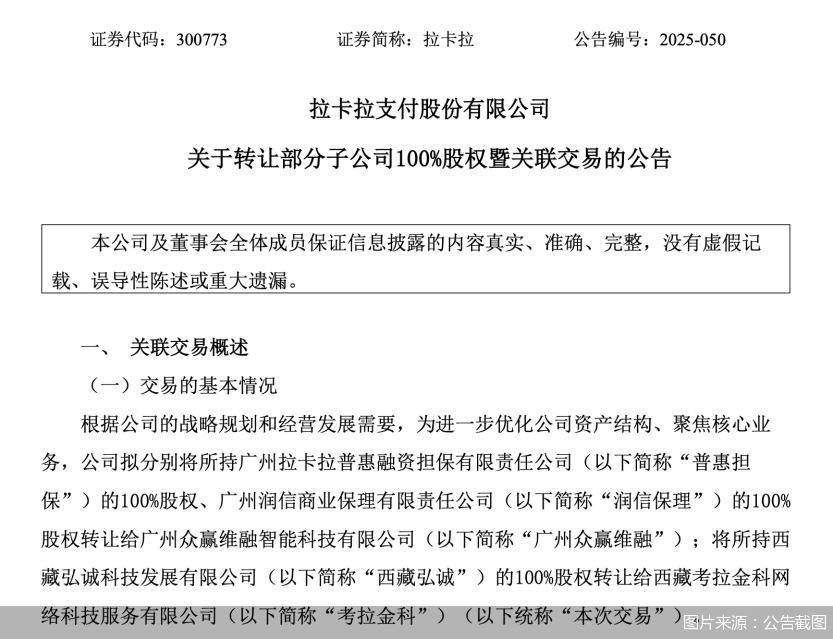
Core Viewpoint - Lakala is transferring 100% equity of three subsidiaries to optimize its asset structure and focus on core payment business, which is part of its strategic planning [1][4]. Group 1: Transaction Details - Lakala plans to transfer its 100% stake in Guangzhou Lakala Puhui Financing Guarantee Co., Ltd., Guangzhou Runxin Commercial Factoring Co., Ltd., and Tibet Hongcheng Technology Development Co., Ltd. to Guangzhou Zhongying Weirong Intelligent Technology Co., Ltd. and Tibet Kaola Jinke Network Technology Service Co., Ltd. [1] - The total transaction amount is expected to be 351 million yuan, which indicates that Lakala may "recycle" over 300 million yuan in funds [4]. Group 2: Financial Performance of Subsidiaries - As of 2024, the three subsidiaries are in a loss state, with a combined revenue of 71.73 million yuan and a net loss of 59.14 million yuan [4]. - The subsidiaries' total revenue accounts for only 1% of Lakala's total revenue as of May 31, 2025, indicating their limited impact on the overall financials of the parent company [4]. Group 3: Strategic Intentions - The transaction aims to reduce financial risk exposure and concentrate resources on the core payment business [4]. - This move may also be influenced by compliance requirements for Lakala's ongoing IPO process in Hong Kong, as financial guarantee and factoring businesses carry significant compliance risks [5]. Group 4: Industry Context - Other companies in the payment industry, such as UnionPay and Tianyi E-commerce, have also been divesting similar financial licenses to focus on their core operations [6][7]. - The payment industry is facing challenges, with Lakala's revenue declining by 13.01% year-on-year in Q1 2025, and net profit down by 51.71% [7].

京东三个月连投6家具身智能企业;Temu东南亚月活用户突破2200万|36氪出海·要闻回顾
36氪· 2025-08-10 13:34
Core Viewpoint - The article highlights the increasing investments and developments in the field of embodied intelligence and cross-border e-commerce, showcasing significant growth in user engagement and logistics capabilities across various companies and sectors. Group 1: Investments in Embodied Intelligence - JD.com has invested in six companies related to embodied intelligence within three months, indicating a strong focus on this sector as a competitive area in the AI era [4] - Other major internet companies like Alibaba, Meituan, and Tencent are also actively investing in the embodied intelligence field, making it a key battleground for tech giants [4] Group 2: Growth of Temu in Southeast Asia - Temu's monthly active users in Southeast Asia have surpassed 22 million, with significant growth in the Philippines and Thailand, which account for approximately 86% of its total traffic in the region [4] Group 3: Logistics and Cross-Border Services - Cainiao has upgraded its G2G cross-border logistics service in Europe, now supporting e-commerce express delivery between 35 European countries, covering 99% of the region [5][6] - The average cost per kilogram for shipping has decreased by 1-2 euros, enhancing the competitiveness of cross-border logistics [5] Group 4: Expansion of Chinese Brands Overseas - Heytea has seen its overseas store count grow over six times in the past year, now exceeding 100 locations across multiple countries [8] - The new tea brand Tianlala has opened three stores in Bali, with significant daily revenue and customer traffic, bringing its total overseas signed stores to over 200 [8] Group 5: Regulatory Approvals and Market Expansion - Ant International's WorldFirst has received approval for a cross-border payment service license in Malaysia, expanding its reach in key trade regions [6] - The RWA registration platform has launched in Hong Kong, facilitating the tokenization of real-world assets [13] Group 6: Trade Partnerships and Export Growth - ASEAN, EU, and the US are China's top three trade partners, with trade values of 4.29 trillion yuan, 3.35 trillion yuan, and 2.42 trillion yuan respectively [12] - China's exports in July increased by 7.2% year-on-year, with expectations of a 2.5% growth in the second half of the year [12] Group 7: Innovations in Robotics and AI - The Chinese robotics industry has seen a revenue growth of 27.8% in the first half of the year, with significant increases in both industrial and service robots [14] - The demand for humanoid robots is rising, particularly in performance and interactive service sectors, indicating a growing market for advanced robotics [14]