制造业等

Search documents
IMF:大幅调高中国今年经济增速预期,美国通胀预计将持续高于2%目标水平
Di Yi Cai Jing Zi Xun· 2025-07-29 08:33
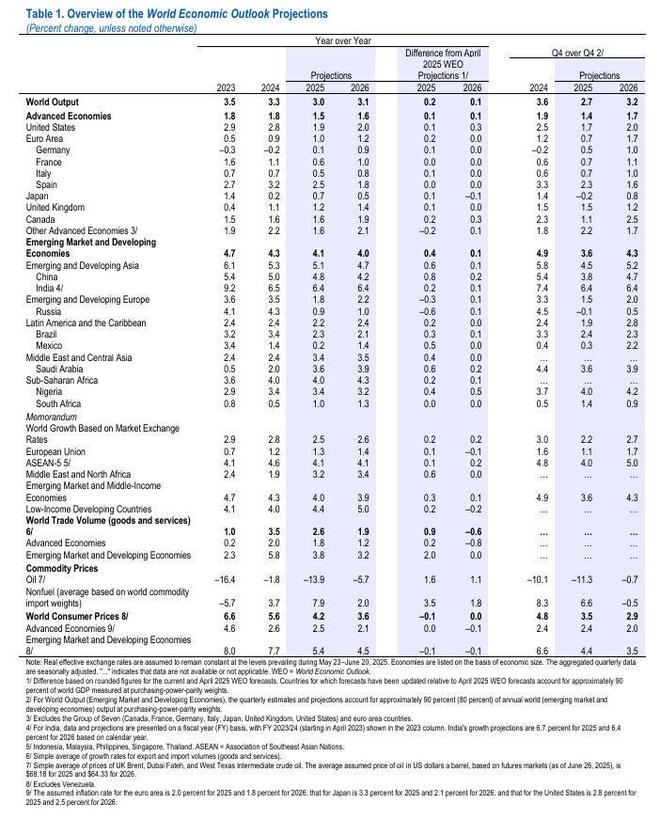
在7月29日发布的最新《世界经济展望》(WEO)报告中,国际货币基金组织(IMF)将全球经济情况 描述为"在持续的不确定性中,保持脆弱的韧性"。 IMF预计2025年全球经济增长率为3.0%,2026年为3.1%,分别比2025年4月WEO的预测调高0.2个和0.1 个百分点。IMF称,这反映出由于加征关税的预期,全球经济活动提前的水平强于此前预期。 此外,IMF预计全球整体通胀率将在2025年降至4.2%,在2026年降至3.6%,与4月预测相似,但各经济 体间的通胀水平仍将存在明显分化,比如IMF预测美国的通胀率将保持在目标水平之上,其他大型经济 体的通胀率则将更低。 IMF建议,全球政策需要通过缓和紧张局势、维护价格和金融稳定、恢复财政缓冲和实施急需的结构性 改革,从而带来信心、可预测性和可持续性。 | 1001 0401 1 091 | | | | | | | | | | | --- | --- | --- | --- | --- | --- | --- | --- | --- | --- | | Difference from April | | | | | | | | 04 over 04 2/ ...

冲击4连涨!中证A500ETF南方(159352)最新单日净流入1.79亿元,全球资金积极增配中国资产,A股运行中枢有望迈上新台阶
Xin Lang Cai Jing· 2025-07-22 03:51
Group 1 - The core viewpoint of the news highlights the positive performance of the China A500 ETF and the increasing interest from sovereign wealth funds in Chinese assets, particularly in sectors like digital technology and renewable energy [1][2]. - The China A500 ETF Southern (159352) has shown a 0.10% increase, marking its fourth consecutive rise, with the underlying index, the China A500 Index, up by 0.14% [1]. - Sovereign wealth funds, especially from the Middle East, are planning to increase their allocation to Chinese assets over the next five years, with around 60% of them expressing this intention [1]. Group 2 - The market is exhibiting positive signals, with the Shanghai Composite Index remaining above 3500 points, indicating a potential upward trend in the A-share market [2]. - The upcoming Central Political Bureau meeting is expected to focus on key policy areas, which could influence market dynamics [2]. - The China A500 Index is designed to reflect the performance of the top 500 leading securities across various industries, selected based on market capitalization and liquidity [2][3]. Group 3 - The China A500 Index employs an adjusted market capitalization weighting method and covers a wide range of industries, including both emerging and traditional sectors [3]. - The top ten weighted stocks in the index include major companies such as Kweichow Moutai, CATL, and Ping An Insurance [3]. - The management and custody fees for the China A500 ETF Southern are among the lowest in the ETF market, with a management fee of 0.15% and a custody fee of 0.05% [3].




重磅来了!中国资产是下一个投资风口的十大理由
Zhong Guo Ji Jin Bao· 2025-07-16 15:10
Core Viewpoint - Wellington Management believes that "China" is a key investment opportunity as the narrative of "American exceptionalism" fades, evidenced by global fund managers reducing their U.S. stock allocations [1] Group 1: Attractive Valuation and Potential - Chinese stocks currently exhibit attractive trading prices based on relative and historical data, with early signs of profit turning points and low foreign ownership potentially driving further interest from international investors [1] - The fundamental improvement in Chinese companies is reflected in higher dividend payout rates, stock buybacks, and stricter debt management, enhancing the resilience of balance sheets and aligning corporate strategies with investor interests [2] Group 2: Economic Resilience and Policy Support - The ongoing deleveraging in China's real estate market and increased willingness of the government to use policy tools are reducing systemic financial risks, particularly in the banking sector [3] - Chinese policymakers are increasingly focusing on the development of the private sector, supporting innovation, and accelerating the transition to a knowledge-intensive economy [4] Group 3: Consumer and Market Stability - Consumer confidence is showing signs of improvement, supported by high household savings rates, which provide strong funding for consumption [5] - The downward trend in the real estate market appears to have bottomed out, with signs of stabilization and even recovery in major cities [6] Group 4: Fiscal Support and Diversification - With local government finances stabilizing, an increase in local government bond issuance is expected to support infrastructure construction and consumption, thereby boosting domestic demand [7] - Chinese stocks offer significant diversification benefits due to their low correlation with global markets, which is expected to increase as de-globalization trends deepen [8] Group 5: Reduced Dependence on U.S. Capital Markets - Chinese companies are systematically reducing their reliance on U.S. capital markets, shifting their listing locations to domestic markets or Hong Kong, creating more diversified investment opportunities [9][10] - China is actively seeking to diversify its trade partners, particularly strengthening economic ties with Europe, with a consensus reached on deepening bilateral economic relations by early 2025 [11]
今年中国经济总量预计可达140万亿元左右
Ren Min Ri Bao Hai Wai Ban· 2025-07-09 23:33
Core Insights - The Chinese economy is projected to reach approximately 140 trillion yuan this year, with an incremental growth exceeding 35 trillion yuan, which is comparable to the combined economic output of Guangdong, Jiangsu, and Shandong provinces, and surpasses the economic total of the world's third-largest economy [1] - Major indicators from the "14th Five-Year Plan" have shown progress in economic growth, labor productivity, and R&D investment, with several social indicators exceeding expectations [1][2] - China has become a significant contributor to global economic growth, maintaining a contribution rate of around 30% [1] Economic Growth and R&D - R&D investment in China reached a record high, with a nearly 50% increase compared to the end of the "13th Five-Year Plan," amounting to 1.2 trillion yuan, and R&D intensity rising to 2.68% [2] - The establishment of the largest education, social security, and healthcare systems globally, with participation rates in compulsory education and basic insurance exceeding 95% [2] Environmental and Governance Achievements - Significant improvements in environmental metrics, including a forest coverage rate exceeding 25% and a stable air quality good days ratio of around 87%, which is a 3% increase from the "13th Five-Year Plan" [3] - The establishment of a unified national market and the reduction of restrictions on foreign investment, with the number of private enterprises increasing by over 40% since the end of the "13th Five-Year Plan" [2] Infrastructure and Security - The construction of over 1 billion acres of high-standard farmland, enhancing food security, and the establishment of the world's largest power infrastructure system, accounting for one-third of global installed capacity [3] - The development of a comprehensive manufacturing system, improving the resilience and security of industrial and supply chains [3]
甘肃:纳税以“信”为本 益企乐享其“诚”
Zhong Guo Xin Wen Wang· 2025-07-02 09:24
Core Viewpoint - Gansu tax authorities are enhancing the tax credit evaluation and management system to support high-quality enterprise development and contribute to the social credit system through effective tax credit utilization [1][2]. Group 1: Tax Credit Evaluation and Management - Tax credit levels serve as an "economic ID" reflecting a company's compliance and operational integrity, assessed through tax declarations, payments, and record management [2]. - Gansu tax authorities are promoting compliance and integrity among enterprises by implementing various initiatives, including legal education and policy guidance, to enhance tax compliance [2][3]. Group 2: Benefits of Tax Credit for Enterprises - Companies like Taishan Gypsum (Gansu) Co., which holds an A-level tax credit, benefit from enhanced corporate image and business opportunities due to public recognition by tax authorities [2]. - Gansu tax authorities are expanding the application of tax credit services, providing personalized services such as "green channels" and expedited processing for A-level taxpayers, thereby encouraging compliance and trust [2]. Group 3: Financing Support through Tax Credit - Gansu tax authorities are facilitating access to financing for enterprises by leveraging their tax credit ratings, enabling businesses to secure loans more easily [4]. - For instance, a retail store received a 600,000 yuan credit loan facilitated by tax authorities, demonstrating the tangible benefits of maintaining a good tax credit rating [4]. Group 4: Initiatives for Credit Restoration - Gansu tax authorities are actively helping enterprises restore their tax credit ratings through a comprehensive service model that includes preemptive reminders and post-incident support [6][7]. - Companies that have faced credit downgrades due to external factors are receiving guidance to rectify their credit status, thus minimizing negative impacts on their operations [7].
以数观势丨“小块头”迸发“大能量” 中小企业发展韧劲足
Xin Hua She· 2025-07-02 06:45
Core Viewpoint - The health and resilience of small and medium-sized enterprises (SMEs) are crucial for the overall stability and growth of the Chinese economy, contributing significantly to GDP, innovation, and employment [1][2]. Group 1: Economic Performance of SMEs - SMEs have shown stable economic performance in 2023, with a year-on-year increase of 8.0% in the added value of large-scale industrial SMEs from January to May [3]. - In May, the SME export index was at 50.7%, indicating expansion for 14 consecutive months [3]. - The digital transformation of SMEs is accelerating, with over 3,500 digital service providers selected and more than 40,000 SMEs supported in their digital upgrades [3]. Group 2: Innovation and Technology - Over 600,000 technology and innovation-oriented SMEs have been cultivated, with more than 140,000 specialized and innovative SMEs and 14,600 "little giant" enterprises [4]. - The 20th China International Small and Medium Enterprises Expo showcased new technologies and products from SMEs, highlighting their commitment to technological empowerment and new productivity [4]. Group 3: Policy Support - Continuous policy support from central and local governments has effectively reduced burdens on SMEs, enhancing their confidence and capabilities [5]. - Initiatives include financial support for specialized and innovative SMEs, collaboration with educational institutions on technology projects, and prioritizing "little giant" enterprises in key product applications [5]. - The focus on enhancing innovation capabilities and core competitiveness among SMEs is expected to strengthen the resilience and dynamism of the Chinese economy [5].
日经突破40000点大关,投资者爆买看涨期权,波动率与股指齐涨
Hua Er Jie Jian Wen· 2025-07-01 02:20
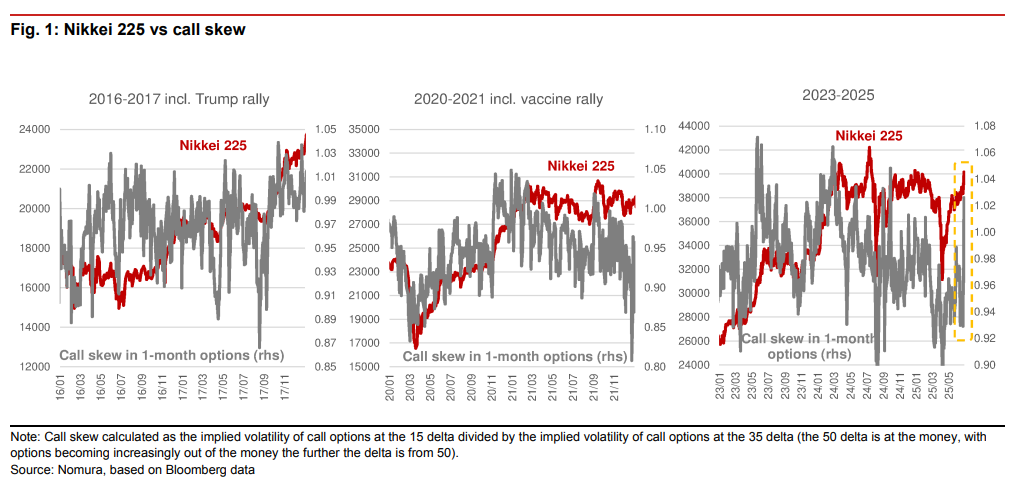
Core Viewpoint - The Nikkei 225 index has confirmed a breakthrough above 40,000 points, creating a favorable dual scenario of "index rise and increased volatility," with options market sentiment shifting to support further short-term gains [1]. Group 1: Market Performance - On June 30, Nomura Securities reported that the Nikkei 225 index has significantly risen over several trading days, reaching a new high for the year by surpassing 40,000 points [1]. - Historical data from Nomura indicates that after a sharp rise in call option skew, the index has averaged a gain of over 3% in subsequent trading days since 2010 [5]. Group 2: Options Market Sentiment - The call option skew has sharply increased, rising above the 95th percentile historically, indicating a strong foundation for further increases in the Nikkei 225 index in the short term [1]. - Nomura's analysis suggests that the current market structure and options flow provide strong technical support for the Japanese stock market, with a key resistance level at approximately 41,500 points [8]. Group 3: ETF Dividend Impact - Nomura expects that the upcoming ETF dividends, estimated at around 600 billion yen on July 8 and 900 billion yen on July 10, will not exert significant pressure on the market due to anticipated buying from CTA funds [9][10]. - The firm notes that investors are likely to remember last year's experience when ETF dividends did not catalyze selling pressure, and instead, the Nikkei 225 index reached new highs [9]. Group 4: CTA Fund Activity - Nomura estimates that CTA funds will net buy approximately 600 billion yen in Nikkei 225 index futures over the next four weeks, which could offset any selling pressure related to ETF dividends [10]. - The accumulation of long positions by CTA funds has been noted as a market-moving factor, particularly after the Nikkei 225 index surpassed 39,500 points [12].
“投资青海”推介会签约18个项目 总金额近2.5亿元
Sou Hu Cai Jing· 2025-06-25 12:36
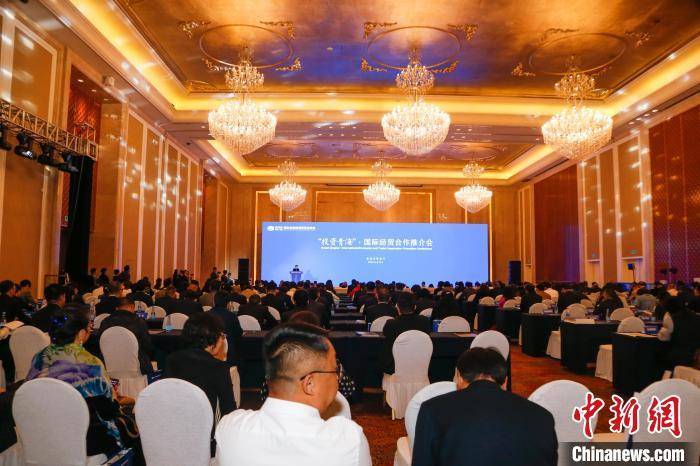
Core Viewpoint - The "Invest in Qinghai" international economic and trade cooperation promotion conference aims to showcase Qinghai's economic vitality, innovation potential, and investment opportunities to global investors, highlighting its new advantages and broad cooperation prospects [3][5]. Group 1: Economic and Resource Highlights - Qinghai is known as the "Water Tower of China" and the source of the Yangtze, Yellow, and Lancang rivers, possessing rich salt lake resources and clean energy resources, with lithium and potassium mineral reserves ranking among the top in the country [3]. - The province has significant potential for the development of clean energy, including solar and wind power [3]. Group 2: Investment Promotion and Project Signing - The promotion conference is part of the 26th China-Qinghai Green Development Investment and Trade Fair, aiming to facilitate practical investment connections and project cooperation [3][5]. - A total of 18 key projects were signed during the event, with a total contract amount of nearly 250 million yuan, covering various sectors such as agricultural products, communication technology, international brands, import-export trade, and financial services [5]. Group 3: Investment Trends and Future Outlook - In the first quarter of this year, Qinghai signed 111 investment projects with a total contract amount exceeding 100 billion yuan, indicating increasing engagement from Fortune 500 and China 500 companies in sectors like new energy, manufacturing, and services [7]. - Qinghai aims to create a new pattern of comprehensive openness, focusing on optimal service for businesses and enhancing the investment environment through six major actions [7].
前5个月山东经济运行总体平稳
Da Zhong Ri Bao· 2025-06-25 01:10
Core Insights - Shandong's economy has shown overall stability in the first five months of the year, with coordinated efforts leading to improved supply and demand dynamics [2] Economic Performance - Industrial production remains stable, with a 7.8% year-on-year increase in the added value of industrial enterprises above a designated size, with 85.4% of 41 industries reporting positive growth [2] - The added value of equipment manufacturing increased by 13.6%, contributing 3.3 percentage points to overall industrial growth [2] - The service sector also experienced steady growth, with a 6.2% increase in revenue from large-scale service enterprises from January to April, achieving positive growth across all ten major industry categories [2] Market Demand - Fixed asset investment in Shandong rose by 1.3% year-on-year in the first five months, with significant growth in the primary (6.5%) and secondary (16.4%) industries [3] - Manufacturing investment increased by 11.7%, outpacing overall investment growth by 10.4 percentage points [3] - Social retail sales totaled 1,654.13 billion yuan, marking a 5.8% increase, with retail sales above a designated size growing by 7.4% [3] - The province's total import and export volume reached 1,424.11 billion yuan, a 7.7% increase, with exports and imports growing by 7.2% and 8.3%, respectively [3] Emerging Industries - The added value of high-tech manufacturing increased by 11.1%, exceeding the overall industrial growth rate by 3.3 percentage points [3] - Investment in new industries is accelerating, with "four new" investments growing by 2.1% and high-tech industry investments increasing by 7.8% [3] - Retail through public networks reached 88.48 billion yuan, growing by 17.5%, significantly higher than the overall retail growth rate [3] Financial and Fiscal Health - Public budget revenue reached 355.82 billion yuan, a 1.7% year-on-year increase, while expenditures grew by 5.6% to 506.76 billion yuan [4] - Financial institutions' loans increased by 9.4%, with corporate loans rising by 12.9% [4] - The private economy remains active, with the added value of private industrial enterprises growing by 10.3% [4] Employment and Consumer Prices - Urban employment increased by 519,000 in the first five months, while consumer prices saw a slight decline of 0.1% [4] - Investment in the service and healthcare sectors grew significantly, with the former increasing by 22.4% [4]
一大波公司,即将退市……
IPO日报· 2025-06-23 13:19
Core Viewpoint - The article highlights the increasing number of companies facing delisting from the stock market, with *ST Jin Gang being one of the latest to receive a delisting notice due to financial issues and major violations [1][10]. Group 1: Delisting Decisions - *ST Jin Gang (600190.SH) announced it will be delisted on June 20, 2025, with the last trading date expected to be July 18, 2025 [1]. - As of June 23, 2025, a total of 10 companies have received delisting decisions and are entering the delisting preparation period [3][8]. - The delisting companies include *ST Zhongcheng, *ST Jin Gang, *ST Hengli, *ST Jiu You, *ST Gong Zhi, *ST Hai Yue, *ST Ren Le, *ST Peng Bo, *ST Long Yu, and *ST Long Jin [3][4]. Group 2: Reasons for Delisting - Among the 10 companies, 2 are facing delisting due to major violations, while 8 are due to financial issues [8][10]. - The regulatory environment has tightened, with increased scrutiny on financial fraud leading to stricter delisting standards [10][11]. Group 3: Regulatory Environment - The article notes that the regulatory authorities are adopting a "zero tolerance" approach towards financial fraud, which is reflected in the recent delisting decisions [11]. - Companies that have been found to engage in financial misconduct are facing severe penalties, reinforcing the need for compliance among market participants [11]. Group 4: Recent Delistings - Since the beginning of 2025, 13 companies have completed the delisting process in the A-share market, with various reasons including financial issues and major violations [12].