存储芯片

Search documents
逆势暴涨,后悔没看春晚!
格隆汇APP· 2026-02-20 08:39
大年初四,港股马年开启首个交易日。 然而,第一天没等来开门红,三大指数早间低开后持续震荡走低。截止收盘,恒生指 数跌 1.10%,恒生科技指数下跌2.91% 。 得益于假期较多催化事件,其中就包括春晚超高热度的机器人表演,今天逆势暴涨的板块落在了 AI 、机器人等科技主题。 看了表演的股民都不禁感叹:为什么除夕夜不开盘? 作者 | 弗雷迪 数据支持 | 勾股 大数 据(www.gogudata.com) 多家外国媒体报道,在近几日美军向中东大幅增兵后,美国军方已做好最早在本周末对伊朗发动打击的准备。不过,美国总统特朗普尚未最终 决定。 受上述消息影响, 国际油价、金价、银价同步拉升 ,当晚 WTI 原油、 ICE 布油盘中涨幅均超过 2% ;纽约金主连价格突破 5000 美元 / 盎司;纽约银主连价格突破 77 美元 / 盎司,欧线集运价格最高飙超 6% 。 港股今天油气、航运板块开盘即迅速拉升,两桶油各涨超 3% 。 | | | | 港股行业表现 | | | | --- | --- | --- | --- | --- | --- | | 序号 | 代码 | 名称 | 最新价 | 涨跌额 | 涨跌幅 √ | ...

港股AI应用、存储芯片股,集体爆发!
Xin Lang Cai Jing· 2026-02-20 04:09
Market Overview - On February 20, the Hong Kong stock market experienced a decline on its first trading day of the Year of the Horse, with the Hang Seng Index, Hang Seng Tech Index, and other indices showing weakness, particularly the Hang Seng Tech Index which fell over 2% [1][8] - The Hang Seng Index closed at 26,544.62, down 161.32 points or 0.60%, while the Hang Seng Tech Index was at 5,245.10, down 122.42 points or 2.28% [2][9] AI and Robotics Sector Performance - Despite the overall market decline, AI application stocks surged, with Haizhi Technology Group rising over 28% to a peak of 154.4 HKD per share, marking a new high since its listing. Other notable gains included Zhiyuan up nearly 20%, and Yujian up over 18% [2][9] - The Spring Festival Gala showcased humanoid robots from four companies, highlighting advancements in robotics and AI technology, which have garnered significant public interest [4][11] - Douyin e-commerce reported a substantial increase in sales of robot products during the Spring Festival, with GMV growing 1680% and order volume increasing 655% from February 16 to 18 [4][11] Industry Insights - Dongwu Securities emphasized that advancements in core robotic capabilities are crucial for the technology's transition from laboratory to factory settings [5][12] - According to a recent report by招商证券, the AI application sector is witnessing simultaneous technological breakthroughs and intensified commercial competition, supported by national strategies for long-term development [6][12] - The report also noted that while index valuations are slightly high, the dual drivers of industry trends and policy benefits suggest potential upward movement in the market [6][12] Storage Sector Developments - On the same day, storage concept stocks in Hong Kong showed slight gains, with companies like 澜起科技 rising over 8% and 兆易创新 nearly 4% [6][12] - Reports indicated that Samsung Electronics is negotiating pricing for its latest generation of AI storage chips, which could be up to 30% higher than the previous generation [6][12]



美股存储芯片概念股盘前上涨,Sandisk、美光科技均涨超1%
Mei Ri Jing Ji Xin Wen· 2026-02-19 09:17
Group 1 - The core viewpoint of the article highlights that U.S. stocks related to storage chips experienced a pre-market increase, with companies like Sandisk and Micron Technology rising over 1% [1] Group 2 - The article specifically mentions the performance of Sandisk and Micron Technology, indicating a positive market sentiment towards these companies within the storage chip sector [1]

美股存储芯片概念股盘前上涨,Sandisk、美光科技均涨超1%。
Xin Lang Cai Jing· 2026-02-19 09:10
Group 1 - The core viewpoint of the article highlights the pre-market rise of U.S. storage chip stocks, specifically mentioning that Sandisk and Micron Technology both saw increases of over 1% [1] Group 2 - The article indicates a positive market sentiment towards the storage chip sector, as evidenced by the upward movement in stock prices [1] - The performance of Sandisk and Micron Technology serves as a key indicator of investor confidence in the storage chip industry [1]
券商股,大爆发!韩国股市创新高
Xin Lang Cai Jing· 2026-02-19 07:43
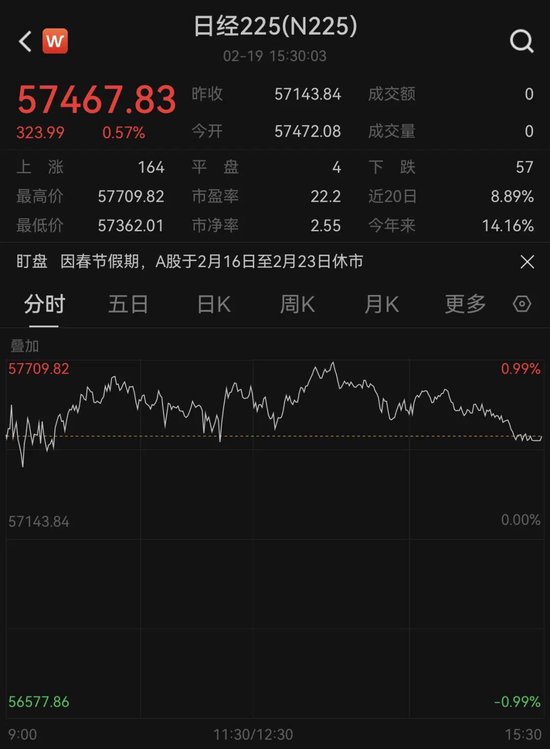
春节后首个交易日,韩国股市创出新高。 2月19日,日韩股市收涨,截至收盘,日经225指数涨0.57%,报57467.83点;韩国综合指数涨3.09%,报 5677.25点,创收盘新高。 其中,韩国综合指数成份股中,券商股强势爆发,截至收盘,SANGSANGININV&SEC、SK证券、韩 华投资证券等30%涨停,HMC投资证券涨超29%,Eugene涨超25%,NH投资证券涨近19%。 | 1 | | --- | 此外,当天上午KOSDAQ 150指数与期货同步急速上涨,触发韩国交易所Sidecar机制,韩国宣布短时暂 停KOSDAQ市场程序化股票交易。 消息面上,据人民日报,2月19日,韩国前总统尹锡悦因内乱头目罪一审被判无期徒刑。在此之前,尹 锡悦因妨碍执行特殊公务等罪名一审被判有期徒刑5年。 韩国负责调查紧急戒严事件的特别检察组1月13日晚以涉嫌带头发动内乱为由,要求法庭判处尹锡悦死 刑。根据韩国法律,针对内乱头目可判处死刑或无期徒刑。 综合自:市场行情、人民日报等 责编:李丹 责任编辑:王珂 春节后首个交易日,韩国股市创出新高。 | 福彩 成分 | 资讯 | 相关基金 | 月度收益 | | --- | ...
券商股,大爆发!韩国股市创新高
证券时报· 2026-02-19 07:34
春节后首个交易日,韩国股市创出新高。 2月19日,日韩股市收涨,截至收盘,日经225指数涨0.57%,报57467.83点;韩国综合指数涨3.09%,报5677.25点,创收盘新高。 日经225(N225) < W 02-19 15:30:03 57467.83 昨收 57143.84 成交额 0 成交量 57472.08 0 专开 323.99 0.57% 上 涨 下 跌 57 164 平 盘 4 最高价 57709.82 22.2 市盈率 近20日 8.89% 14.16% 最低价 57362.01 市净率 2.55 今年来 盯盘 因春节假期,A股于2月16日至2月23日休市 × 分时 五日 日K 周K 月K 曲子 (0) 疊加 57709.82 0.99% 0.00% 57143.84 56577.86 -0.99% 9:00 11:30/12:30 15:30 其中,韩国综合指数成份股中,券商股强势爆发,截至收盘,SANGSANGININV&SEC、SK证券、韩华投资证券等30%涨停,HMC投资证券涨超29%, Eugene涨超25%,NH投资证券涨近19%。 W 韩国综合指数(KS11) 5677. ...

西部数据清仓式减持闪迪,213亿债务置换加速去杠杆
Huan Qiu Wang· 2026-02-19 01:46
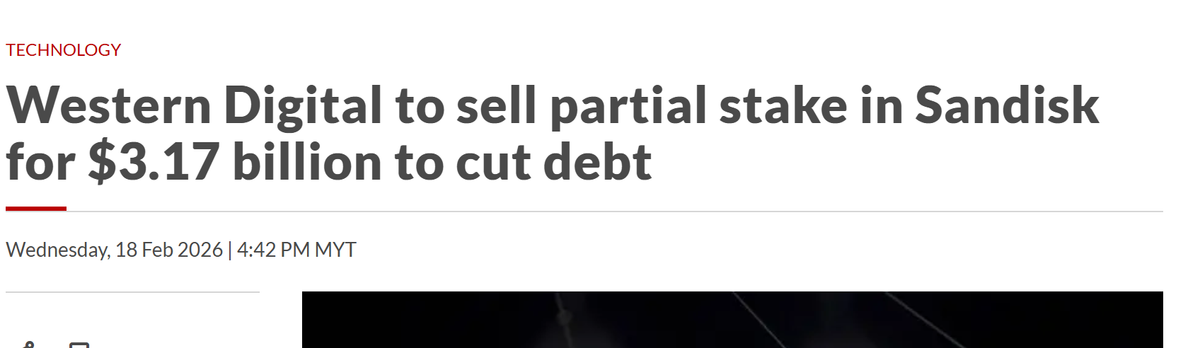
Group 1 - Western Digital plans to swap its SanDisk shares with debt held by Morgan Stanley and Bank of America affiliates, with approximately 5.8 million shares priced at $545 each, reflecting a 7.7% discount from SanDisk's closing price [1] - The transaction is expected to complete by February 19, and is part of Western Digital's strategy to de-leverage ahead of the one-year anniversary of its spin-off [1] - Analyst Amit Daryanani from Evercore ISI noted that this transaction could accelerate Western Digital's de-leveraging efforts and potentially lead to a net cash position, with an expected 4% to 6% increase in earnings per share in the short to medium term [1] Group 2 - Multiple institutions have given Western Digital a "buy" rating, with Bank of America raising its target price to $257 and Morgan Stanley to $306, indicating confidence in the company's capital allocation flexibility [4] - Proceeds from the sale are intended for further debt reduction, enhancing Western Digital's strategic focus on its HDD business [4] - Since the spin-off, SanDisk's stock has surged over 1500%, with a 148.8% increase in 2026 alone, while Western Digital's stock has risen 65%, ranking third in the S&P 500 [4]

Kimi连续融资超12亿美元,估值翻倍突破100亿美元;宇树CEO王兴兴:春晚机器人摔倒是剧情需要;2026春节档票房破16亿丨邦早报
创业邦· 2026-02-18 01:08
Box Office Performance - The 2026 Spring Festival box office exceeded 1.6 billion, with "Flying Life 3," "Silent Awakening," and "Boon Year" ranking as the top three films [2] - On the first day of the Lunar New Year, over 569,000 screenings were held, setting a new record for single-day screenings in history [2][3] Financing and Valuation - Kimi completed over $1.2 billion in financing, with a valuation doubling to over $10 billion [2] - The latest financing round was led by existing shareholders including Alibaba and Tencent, indicating strong investor confidence in Kimi's growth potential [2] AI Shopping and Engagement - Over 130 million people experienced AI shopping for the first time during the Spring Festival, with AI ticket orders increasing by 372 times [2] - Doubao, an AI assistant, achieved 1.9 billion interactions on New Year's Eve, surpassing competitors in app store rankings [2] Company Financials - iFlytek reported operating receipts exceeding 27 billion, with cash flow reaching a record high of 3 billion, marking a 28% year-on-year increase [6] - The gross profit of its open platform model increased by 244%, with a user base of over 100 million for its AI marketing overseas [6] Robotics and Technology Developments - Yushun Technology aims to deliver 10,000 humanoid robots this year, showcasing advancements in autonomous control technology [8] - The Spring Festival featured a high concentration of robots, highlighting the development of China's robotics industry [8] Market Trends and Predictions - Tesla's Cybercab is set to begin production in April 2026, reflecting the company's commitment to innovative transportation solutions [15] - Apple is accelerating the development of three new wearable devices, including AI-driven smart glasses, as part of its strategy to integrate AI into hardware [16] IPO Activity - A total of 143 companies have submitted IPO applications in Hong Kong this year, with expectations for a robust market ahead [16]
美光科技斥资2000亿美元建厂 以突破AI内存瓶颈
Ge Long Hui· 2026-02-17 05:17
美光科技是美国最大的存储芯片制造商,这种微小的硅片用于存储和传输数据,为从智能手机、汽车电 脑到笔记本电脑和数据中心等各种设备提供动力支持。美光科技正加紧增加产能,以应对存储行业40多 年来最严重的供应紧张。在公司总部所在地博伊西,美光科技正斥资500亿美元,将其占地450英亩的园 区面积扩大一倍以上,其中包括建造两座新的芯片工厂(即晶圆厂)。第一座晶圆厂的首批硅晶圆预计 将于2027年年中下线,用于生产DRAM,这是一种用于制造高带宽存储(HBM)芯片的存储器,而HBM 对于先进的人工智能(AI)计算日益重要。两家工厂都应会在2028年底前投产。这还不是全部。在锡拉丘 兹附近,美光科技刚刚破土动工一个耗资1,000亿美元的晶圆厂综合体,这是纽约州有史以来最大的私 人投资。去年年底,美光科技宣布在日本广岛投资96亿美元建设晶圆厂,而其竞争对手SK海力士(SK Hynix)在1月份宣布,将在韩国建造一座耗资130亿美元的晶圆厂,此外该公司正在印第安纳州建造一个 耗资40亿美元的制造综合体。这场疯狂的制造业军备竞赛背后是AI热潮。"我在这里工作了28年,从未 见过像AI这样具有颠覆性的东西,"负责美光科技2,00 ...
港股收红!
Shang Hai Zheng Quan Bao· 2026-02-16 06:23
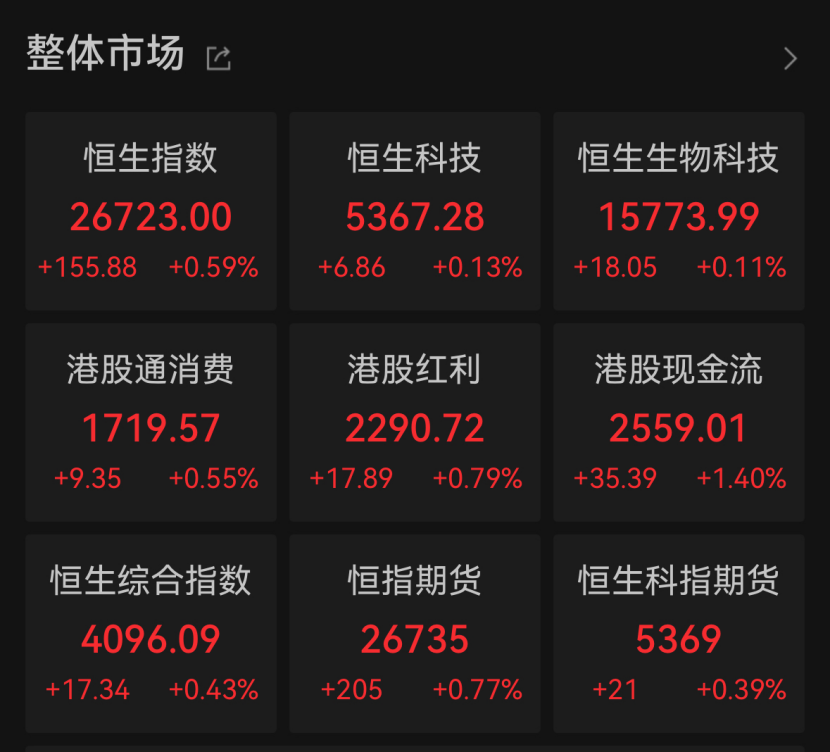
Market Performance - The Hong Kong stock market showed active performance on February 16, with major indices such as the Hang Seng Index, Hang Seng Tech Index, and Hang Seng Composite Index closing higher. The Hang Seng Index closed at 26,723 points, up 0.59% [1][2] - The Hang Seng Tech Index closed at 5,367.28 points, up 0.13%, while the Hang Seng Composite Index closed at 4,096.09 points, up 0.43% [1][2] Semiconductor Sector - The semiconductor sector in Hong Kong exhibited structural differentiation, with stocks like Zhaoyi Innovation and Lanke Technology reaching new highs, with Zhaoyi Innovation's stock price peaking at 435 HKD per share, up over 17% [2][3] - Major storage chip manufacturers are raising chip prices, with Kioxia expected to implement a revised pricing policy for North American customers starting Q1 2026, anticipating an average sales price increase of approximately 50% [2][3] AI Application Sector - The AI application sector in Hong Kong continued its upward trend, with Haizhi Technology Group's stock reaching a high of 125.6 HKD per share, closing at 120 HKD per share, up 29.59% [3] - MINIMAX-WP's stock hit a new high, rising 24.56%, while Zhiyu closed at 508 HKD per share, up 4.74% [3] Non-Ferrous Metals Sector - The non-ferrous metals sector strengthened, with the Wind Hong Kong Non-Ferrous Metals Index rising by 3.64%. Stocks like China Nonferrous Mining and Luoyang Molybdenum Co. saw gains of over 5% [3] - Other stocks in this sector, including Lingbao Gold and Jiangxi Copper, also experienced significant increases, with some rising over 3% [3] Gold Market - The gold market is experiencing a seasonal uptick in demand due to the traditional peak sales period before the Spring Festival, alongside diverse needs for gifting and investment, leading to increased gold consumption [5] Analyst Insights - Analysts from Huatai Securities noted that the Hong Kong market remains volatile, influenced by factors such as the US stock market, domestic consumption during the Spring Festival, and advancements in AI [6] - Recommendations include balanced allocation in the Hong Kong market, with a focus on semiconductor hardware, specialty consumption, and electrical equipment in the short term [6]