
电信

Search documents
香港电讯-SS(06823.HK):接获进一步投资附属公司的要约
Ge Long Hui· 2026-02-09 08:53
2026年2月7日,香港电讯接获CM Silk Road CapitalManagement Limited(一家由招商局资本独家控制的公 司)提出的要约,以向香港电讯集团收购(i)目标公司额外9%的股权;及(ii)目标集团欠付目标公司现有股 东若干股东应收账款的9%("进一步投资")。 格隆汇2月9日丨香港电讯-SS(06823.HK)发布公告,诚如先前公告所披露,投资者(一家由招商局资本控 股有限责任公司("招商局资本")独家管理及控制的公司)已向香港电讯集团收购目标公司40%的股权及应 收账款。目标公司为香港电讯的间接附属公司,而目标集团从事无源网络业务,即在香港及大湾区提供 铜缆及光纤接入服务,以及营运、维护及扩展铜缆及光纤接入网络的无源组件并提供相关服务的业务。 ...

港股收评:恒指涨1.76%重回二万七关口,科技逾金融普涨,AI应用概念股大幅拉升
Ge Long Hui· 2026-02-09 08:25
Core Viewpoint - The Hong Kong stock market experienced a collective rise, with the Hang Seng Index increasing by 1.76% to surpass the 27,000-point mark, driven by positive market sentiment following a significant rise in US stocks and a rebound in commodities like gold and silver [1] Group 1: Market Performance - The Hang Seng Index rose by 1.76%, while the Hang Seng China Enterprises Index and the Hang Seng Tech Index increased by 1.52% and 1.34%, respectively [1] - Major technology and financial stocks were active, contributing to the market's upward movement, with Baidu rising approximately 4% and China Ping An leading insurance stocks with a nearly 5% increase [1] Group 2: Sector Highlights - AI application stocks surged, with Zhizhu Technology soaring over 40% to reach a new high following Elon Musk's statement about AI deployment in space [1] - Gold stocks led a rally in the metals sector, with a focus on opportunities in non-ferrous metals as indicated by Guotai Junan [1] - Other sectors such as semiconductors, wind power, heavy machinery, gambling, coal, dining, and domestic real estate stocks also saw gains [1] Group 3: Underperforming Stocks - The three major telecom operators faced pressure, with China Telecom declining nearly 3% [1] - Several beverage stocks that had risen previously experienced declines, and the oil prices showed volatility amid renewed US-Iran negotiations, affecting the three major oil companies [1] - Lanke Technology saw a significant increase of nearly 64% on its first trading day [1]

港股“春季躁动”遇上“解禁高峰” 投资者将如何应对?
Sou Hu Cai Jing· 2026-02-09 05:49
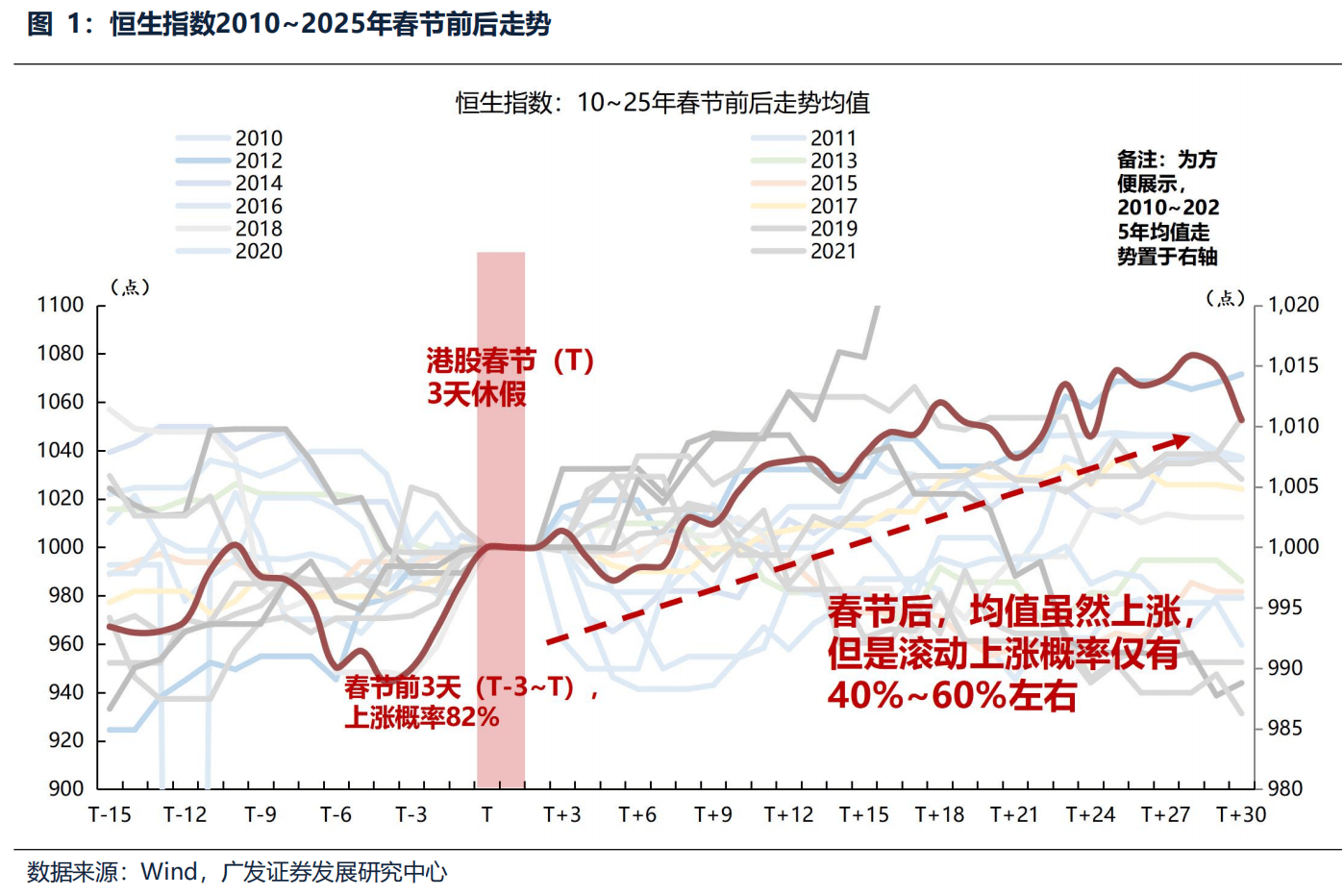
来源:智通财经 图 2:春季~两会,A股上涨明显;港股没有明显的目历效应 E SECTION FOR ■ 上涨概率:春节->两会(2010年~2015年 100% 93.8% -93.8% 93.8% 87.5% 90% 81.39 it 80% 72.7% 184 2 5: 70% 62.5% 62.5% 56.3% 54 .! 60% 50% 40% 30% 20% 10% 0% el ch 02肖 717 班 极 数据来源:Wind,广发证券发展研究中心。备注:恒生科技、恒生港股通、港股通高股息采用 2016~2 图 3: 过去15年,春节后港股各指数日历效应 | 上涨概率 | 圣诞节-春节前 | 春节后-两会 | 两会期间 | 两会-3月底 | 1月 | | --- | --- | --- | --- | --- | --- | | 恒生科技 | 72.7% | 72.7% | 45.5% | 50.0% | 63.6% | | 恒生指数 | 80.0% | 46.7% | 40.0% | 42.9% | 73.3% | | 恒生中国企业指数 | 73.3% | 40.0% | 46.7% | 57. ...

港股午评:恒指收涨1.44% 大市一度再上两万七关口
Jin Rong Jie· 2026-02-09 04:28
上周五美股三大股指全线造好,港股今日高开高走,恒指高开422点报26982点后,升幅一度收窄至319 点,低见26879点,盘中重整旗鼓再度拉升514点高见27074点,再度升穿两万七关口。截至收盘,恒指 早盘收涨1.17%,科指早盘收涨1.02%,恒指大市成交额1362.5亿港元。盘面上,光通讯、光伏设备、风 电股涨幅居前,内房股异动拉升,半导体股延续强势;新消费概念、电信、家电、石油股走势疲软。个 股方面,信达生物(01801.HK)涨近6%,泡泡玛特(09992.HK)涨超5.7%,中国人寿(02628.HK)、龙湖集团 (00960.HK)、紫金矿业(02899.HK)、华虹半导体(01347.HK)涨超5%,快手(01024.HK)跌超4.2%,中国电 信(00728.HK)、中国移动(00941.HK)均跌超1.5%。 本文源自:金融界AI电报 ...
覆盖能源、航空、房地产等领域
Xin Lang Cai Jing· 2026-02-08 21:40
沙特阿拉伯7日宣布推出针对叙利亚的重大投资计划,覆盖能源、航空、房地产和电信领域。路透社认 为,此举表明沙特将自身定位为叙利亚新政权的主要支持者。 沙特投资大臣哈立德·法利赫说,沙特在叙利亚设立"埃拉夫"投资基金,计划投入75亿沙特里亚尔(约 合20亿美元),分阶段开发叙利亚阿勒颇市的两座机场。按法利赫的说法,该基金旨在为叙利亚大型项 目提供资金支持,沙特私营部门也将参与其中。 (来源:天津日报) 转自:天津日报 在民航领域,沙特纳斯航空公司同叙利亚民航局签署协议,联合成立一家新航空公司,预计2026年第四 季度投入运营。 另据沙特通讯社报道,沙特最大电信运营商沙特电信公司还将投资逾30亿沙特里亚尔(8亿美元),用 于"完善叙利亚基础电信设施,并通过一条总长超4500公里的光纤网络,实现叙利亚与周边国家地区互 联互通"。 新华社微特稿 ...
【环球财经】沙特宣布对叙利亚重大投资计划
Xin Hua She· 2026-02-08 16:22
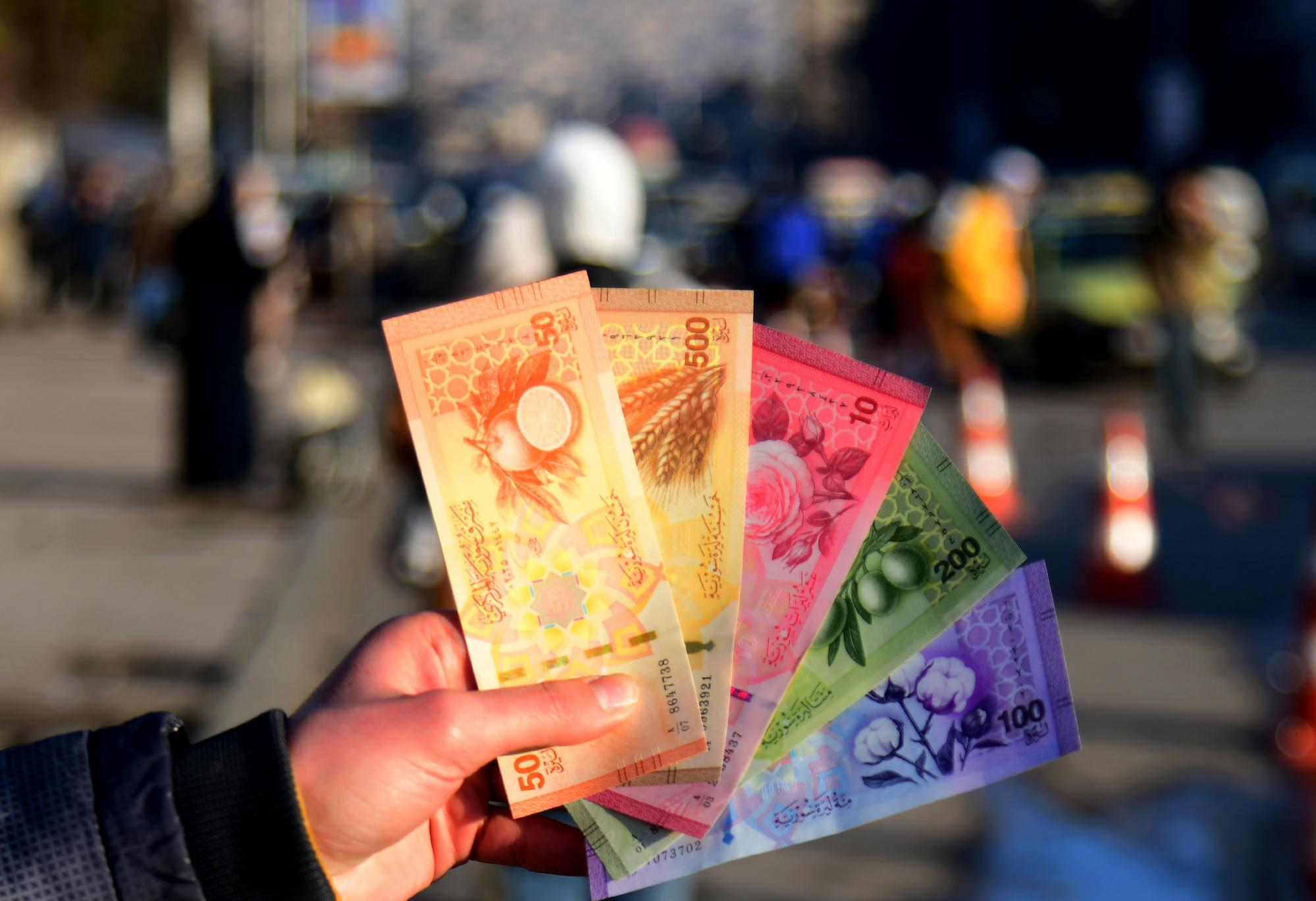
这是1月4日在叙利亚大马士革拍摄的叙利亚镑新纸币。新华社发(阿马尔·萨法尔贾拉尼摄) 在民航领域,沙特纳斯航空公司同叙利亚民航局签署协议,联合成立一家新航空公司,预计2026年第四季度投入运营。 另据沙特通讯社报道,沙特最大电信运营商沙特电信公司还将投资逾30亿沙特里亚尔(8亿美元),用于"完善叙利亚基础电信设施,并通过一条总长超4500 公里的光纤网络,实现叙利亚与周边国家地区互联互通"。 2024年12月叙利亚阿萨德政权被推翻后,沙特成为叙利亚新政权的主要支持方之一。路透社指出,这也是2025年12月美国全面解除对叙利亚制裁以来,沙特 公布的最大规模对叙投资。(游梓扬李祎凡) (文章来源:新华社) 新华财经北京2月8日电沙特阿拉伯7日宣布推出针对叙利亚的重大投资计划,覆盖能源、航空、房地产和电信领域。路透社认为,此举表明沙特将自身定位 为叙利亚新政权的主要支持者。 沙特投资大臣哈立德·法利赫说,沙特在叙利亚设立"埃拉夫"投资基金,计划投入75亿沙特里亚尔(约合20亿美元),分阶段开发叙利亚阿勒颇市的两座机 场。按法利赫的说法,该基金旨在为叙利亚大型项目提供资金支持,沙特私营部门也将参与其中。 ...
固定收益周报:短期不悲观-20260208
Huaxin Securities· 2026-02-08 11:29
1. Report Industry Investment Rating No relevant content provided. 2. Core Viewpoints - In the short - term (the remaining two trading weeks in February), the macro - liquidity environment is acceptable, and there seems no reason for continuous decline in A - shares, so there is no need to be overly pessimistic. However, if the macro - liquidity tightens in March, it will be a real concern [8][23] - In the de - leveraging cycle, the stock - bond ratio favors equities to a limited extent, and the value style is more likely to outperform [11][62] 3. Summary of Each Section 3.1 National Asset Liability Sheet Analysis - **Liability Side** - In December 2025, the liability growth rate of the real - sector was 8.4% (previous value 8.6%), in line with expectations. It's expected to drop to around 8.3% in January 2026, rebound slightly to around 8.4% in February, and decline in March [1][18] - In the financial sector, last week's capital market loosened marginally, with the peak in February expected to occur this week [1][18] - In December 2025, the government debt growth rate was 12.4% (previous value 13.1%), expected to rebound to around 12.6% in January 2026 and likely decline in February [2][19] - Last week, the government bond net increase was 734.3 billion yuan (slightly higher than the planned 721.4 billion yuan), and next week's planned net increase is 7.02 billion yuan [2][19] - **Monetary Policy** - Last week, the average weekly capital trading volume increased, the capital price decreased, the term spread narrowed slightly, and the capital market loosened marginally [2][19] - The one - year Treasury bond yield rose unilaterally last week, closing at 1.32% on the weekend. It's expected to have a lower limit of about 1.3%, a central value of around 1.4%, and a 10 - basis - point interest rate cut in 2026 [2][19] - The term spread between the ten - year and one - year Treasury bonds narrowed to 49 basis points. The spread between the ten - year and one - year, and the thirty - year and ten - year Treasury bonds is expected to be in the range of 20 - 60 basis points. The future yield fluctuation ranges of the ten - year and thirty - year Treasury bonds are expected to be around 1.6% - 1.9% and 1.8% - 2.3% respectively [2][19] - **Asset Side** - In December 2025, physical quantity data continued to operate stably compared to November. Attention should be paid to whether the economy can continue to stabilize or even rise marginally [3][20] - The annual real economic growth target for 2025 set by the Two Sessions is around 5%, and the nominal economic growth target is around 4.9%. It needs further observation whether 5% will be the central target for China's nominal economic growth in the next 1 - 2 years [3][20] 3.2 Stock - Bond Cost - effectiveness and Stock - Bond Style - Since 2011, China has entered a downward cycle of potential economic growth, which seems to have ended in Q4 2024, followed by a low - level narrow - range oscillation in the profit cycle. The government put forward three policy goals in 2016, and the convergence of the liability side is not over but has limited room [6][21] - Sino - US relations are in a state of equal - strength competition. If the valuation of the US technology sector is re - evaluated, global funds may flow from the US to China. Attention should be paid to the RMB exchange rate [6][21] - Last week, the capital market loosened marginally, equities declined significantly, the value style continued to outperform, and the stock - bond ratio favored bonds. The ten - year Treasury bond yield remained stable at 1.81%, the one - year Treasury bond yield rose 2 basis points to 1.32%, and the thirty - year Treasury bond yield fell 4 basis points to 2.25% [7][22] - The full - position equity strategy with a balanced style underperformed, and the broad - based rotation strategy underperformed the CSI 300 index by - 0.37pct last week. Since its establishment in July 2024, it has underperformed the CSI 300 index by - 2.52pct, with a maximum drawdown of 12.1% [7][22] - The market performance last week was unexpected. Funds may have flowed out of the stock and bond markets to buy safer assets. The decline in US technology stocks may have affected domestic growth stocks. This week, the Shanghai 50 Index (50% position) and the CSI 1000 Index (50% position) are recommended [8][23] - The current broad - based index recommendation strategy focuses on position selection and style analysis, can accommodate large - scale funds, has small fluctuations and good liquidity, and will receive more attention in the context of the marginal convergence of the national asset - liability sheet [9][24] 3.3 Industry Recommendations - **Industry Performance Review** - This week, A - shares fell with shrinking volume. The Shanghai Composite Index fell 1.3%, the Shenzhen Component Index fell 2.1%, and the ChiNext Index fell 3.3% [32] - Among the Shenwan primary industries, food and beverage, beauty care, power equipment, comprehensive, and transportation had the largest increases, while non - ferrous metals, communication, electronics, steel, and computer had the largest declines [32] - **Industry Crowding and Trading Volume** - As of February 6, the top five crowded industries were electronics, power equipment, non - ferrous metals, machinery, and communication, while the bottom five were comprehensive, beauty care, steel, social services, and coal [33] - This week, the top five industries with increased crowding were power equipment, pharmaceutical biology, machinery, national defense and military industry, and automobiles, while the top five with decreased crowding were non - ferrous metals, electronics, agriculture, forestry, animal husbandry and fishery, petroleum and petrochemicals, and non - bank finance [33] - As of February 6, the crowding of communication, power equipment, non - ferrous metals, national defense and military industry, and petroleum and petrochemicals was at relatively high percentiles since 2018, while that of transportation, non - bank finance, real estate, pharmaceutical biology, and food and beverage was at relatively low percentiles [33] - This week, the average daily trading volume of the entire A - share market was 2.4 trillion yuan, up from last week's 3.06 trillion yuan. Food and beverage, beauty care, transportation, coal, and media had the highest year - on - year trading volume growth rates, while steel, non - ferrous metals, building decoration, pharmaceutical biology, and petroleum and petrochemicals had the largest trading volume declines [35] - **Industry Valuation and Earnings** - This week, in the Shenwan primary industries, real estate, food and beverage, beauty care, comprehensive, and power equipment had the largest increases in PE(TTM), while non - ferrous metals, communication, electronics, steel, and computer had the largest declines [39] - As of February 6, 2026, industries with high 2024 full - year profit forecasts and relatively low current valuations compared to history include banking, insurance, power, public utilities, transportation, pharmaceutical biology, beauty care, new energy, and consumer electronics [40] - **Industry Prosperity** - **External Demand**: Mixed performance. In December, the global manufacturing PMI rose from 50.4 to 50.9, and most economies' PMI data in January showed an upward trend. The CCFI index fell 4.55% week - on - week. Port cargo throughput increased. South Korea's export growth rate rose to 13.4% in December and 33.9% in January, and Vietnam's export growth rate rose from 23.9% in December to 34.3% in January [44] - **Domestic Demand**: The second - hand housing price remained flat last week, and quantity indicators showed mixed performance. Highway truck traffic volume increased. The capacity utilization rate of ten industries declined from September to October 2025, increased from November to December, and slightly decreased in January. Automobile sales were weaker than the historical seasonality, new - home sales were at a historical low, and second - hand home sales were relatively strong compared to the historical seasonality. As of February 1, the national second - hand housing listing price index remained flat compared to last week. As of January 30, the production material price index rose 0.9% week - on - week [44] - **Public Offering Market Review** - In the first week of February (February 2 - 6), most active public equity funds underperformed the CSI 300. The weekly growth rates of the 10%, 20%, 30%, and 50% quantiles were 0.8%, 0%, - 0.6%, and - 1.8% respectively, while the CSI 300 fell 1.3% [59] - As of February 6, the net asset value of active public equity funds was estimated to be 3.94 trillion yuan, up from 3.66 trillion yuan in Q4 2024 [59] - **Industry Recommendations** - In the de - leveraging cycle, the stock - bond ratio favors equities to a limited extent, and the value style is more likely to outperform. Dividend - type stocks should generally have three characteristics: no balance - sheet expansion, good profitability, and ability to survive [11][62] - Combining the above three characteristics and the under - allocation in the public offering's fourth - quarter report, the recommended A + H dividend portfolio includes 13 A + H stocks, and the A - share portfolio includes 20 A - share stocks, mainly concentrated in industries such as banking, telecommunications, petroleum and petrochemicals, and transportation [11][62]
AT&T Plans to Return $45 Billion to Shareholders. Is the Stock a Buy for 2026?
The Motley Fool· 2026-02-07 18:45
Core Viewpoint - AT&T is positioned to return $45 billion to investors between 2026 and 2028, following a significant dividend cut and a focus on debt reduction after the WarnerMedia spinoff [1][3][4]. Financial Performance - AT&T cut its dividend by nearly 50% in 2022 to strengthen its balance sheet, resulting in a lower total debt and reduced leverage over four years [3]. - In 2025, AT&T returned $12 billion through dividends and stock buybacks, with plans to increase this to $45 billion over the next three years [4]. Stock Valuation - Following the announcement of the $45 billion return plan, AT&T's stock price increased by 15% in five days, indicating a potential shift in investor sentiment [5]. - Current valuation metrics show that AT&T's price-to-sales and price-to-book-value ratios are above their five-year averages, suggesting the stock may be considered expensive [6]. Investment Appeal - The current 4% dividend yield is attractive, but the lack of dividend growth may deter dividend investors, as similar yields are available from companies with a history of dividend increases [8]. - Growth investors may find AT&T less appealing, as the company is not primarily a growth story despite plans for investment in fiber optic cables [9].


上海两会|上海持续打造国际一流营商环境,变企业“需求清单”为“服务清单”
Sou Hu Cai Jing· 2026-02-07 07:53
人民网上海2月7日电 (记者葛俊俊)2月7日上午,上海市人民政府举行记者会,上海市商务委主任申卫华 出席并回答记者提问。 上海将采取哪些更有针对性的稳外资举措?针对这一提问,申卫华表示,上海历来是外商投资中国的重 要目的地也是首选地,外资在全市经济社会发展中具有重要地位和作用。 近年来,上海利用外资有以下几个特点: 一是规模稳。2025年,全市实际使用外资达到160.6亿美元,总量占全国比重上升,达到了15.3%,规模 在全国各省市中排到第二位。 二是质量优。"十四五"期间上海高技术产业实际使用外资占比达到33%,较"十三五"提高了10个百分 点。同样体现外资质量的地区总部持续上升,截止去年底,累计认定跨国公司地区总部、外资研发中心 1076家、636家。 三是动能足。2025年,全市新设外资企业达到6300家,新设外资企业家数是增长的,增长了6.8%;合 同外资根据统计是180亿美元,增长了近20%,充分说明在当前环境形势下,上海仍是外商投资的首选 地,是跨国公司全球产业链和供应链布局的首选地之一。 申卫华表示,下一步,将全力做好稳外资的各项工作,着力塑造吸引外资新优势,推动外资稳量提质。 一是扩大高水平对 ...
上海将采取哪些更具针对性的稳外资举措?市商务委回应
Xin Lang Cai Jing· 2026-02-07 07:23
2月7日,上海市人民政府主题记者会在上海世博中心举行,市发展改革委、市经济信息化委、市商务 委、市科委、市民政局、市人力资源和社会保障局负责人出席,回答中外记者关心的问题。 联合早报记者提问,稳外资已经连续两年被列为上海市政府的首要工作目标,但从数据上看,上海过去 两年实际使用外资规模仍未止跌,如何解读这一变化?在当前外部环境持续变化背景下,上海将采取哪 些更具针对性的稳外资举措? 上海市商务委主任申卫华表示,上海历来是外商投资中国的重要目的地,新加坡也是上海重要的利用外 资的来源国之一,外资在全市经济社会发展中具有重要地位和作用。近年来,上海坚持扩大开放不动 摇,优化营商环境不停步,紧抓投资促进不放松,进一步促进外资提质增效。上海利用外资具有以下特 征: 一是规模稳,2025年,全市实际使用外资达到160.6亿美元,降幅收窄到个位数,总量占全国比重提升 到15.3%,规模位居全国第二。 二是质量优。"十四五"期间上海高技术产业实际使用外资占比升至33%,较"十三五"提高了10个百分 点。同样体现外资质量的地区总部持续上升,到去年底,跨国公司地区总部累计认定1076家,功能型总 部不断集聚;外资研发中心累计认 ...