聚氨酯

Search documents
研报掘金丨东海证券:首予汇得科技“买入”评级,认为未来公司将始终保持高质量成长轨道
Ge Long Hui· 2025-12-11 08:33
Core Viewpoint - Huide Technology is a leading player in the polyurethane solutions sector, actively seizing industry trends [1] Group 1: Company Overview - Huide Technology's polyurethane production accounts for 10.9% of the total domestic output, ranking fourth in market share nationwide [1] - From 2019 to 2024, the company's polyurethane production and sales rate has consistently maintained above 98% [1] Group 2: Market Conditions - The downstream demand for the company remains robust, with key chemical raw material prices entering a downward trend [1] - The company has achieved full production capacity with its established facilities [1] Group 3: Future Outlook - The company is actively positioning itself in the environmentally friendly and recycled polyurethane market segment, indicating a commitment to sustainable growth [1] - Given the favorable market conditions and strategic initiatives, the company is expected to maintain a high-quality growth trajectory, leading to an initial "buy" rating [1]

MDI市场近况与展望
2025-12-10 01:57
MDI Market Overview and Outlook Industry Overview - The global MDI market is currently experiencing a supply-demand imbalance, primarily due to new capacities from China and South Korea, coupled with the impact of US-China tariffs, which limit price increase momentum. The domestic market has entered a low season, and short-term prices are expected to remain stable [1][2] - Global MDI demand growth is lower than expected but still positive. Recent domestic prices for polymer MDI are around 14,500-14,600 RMB/ton, while pure MDI has decreased to approximately 19,500 RMB/ton [1][2] Key Points and Arguments - **Price Dynamics**: The MDI industry has seen significant changes in 2025, with slow recovery in domestic and overseas demand. The expected global demand growth was initially set at 3-4%, with domestic expectations at 5-6%, but actual growth has fallen short [2][5] - **Regional Price Comparison**: Recent price adjustments in Asia were lower than anticipated, with a recent increase of $100 instead of the expected $200. Current prices in Europe and domestically are close, while the US market remains stable due to anti-dumping policies and stable demand [2][3] - **Production Rates**: Domestic MDI operating rates have dropped to around 70%, with planned maintenance by companies like Wanhua Ningbo and BASF Chongqing having limited supply impact. European operating rates are also around 70%, while US production has returned to normal levels [4][6] - **Demand Drivers**: Domestic demand for MDI is positively influenced by growth in refrigerator and freezer production, automotive production, and cold storage capacity. The demand for formaldehyde-free board materials is increasing, and wind turbine blade demand is also growing [5][7] Additional Important Insights - **Inventory Levels**: MDI inventory is distributed among factories, traders, and end customers. Factory inventories are normal, while traders are keen to stock up, and downstream customers are maintaining low inventory levels due to seasonal price fluctuations [11] - **Future Demand Outlook**: The outlook for 2026 is optimistic, with reduced tariff impacts and recovery in the refrigerator and freezer supply chain. The automotive sector is expected to maintain high growth, although slightly lower than in 2025. Exports may rebound, particularly from Europe, Africa, and India, compensating for weakness in the US market [9][10] - **Cost Structures**: Domestic production costs vary, with Wanhua using a coal chemical route at a lower cost compared to others using natural gas. European production costs are higher due to stable natural gas prices, while US production costs remain the lowest globally [13][15] Conclusion - The MDI market is navigating through a complex landscape of supply-demand dynamics, pricing pressures, and regional variations. The outlook for 2026 appears positive, with several growth drivers in place, although challenges remain in the form of geopolitical tensions and market fluctuations.
本周Henry天然气、乙烷、辛醇价格涨幅居前:基础化工行业周报(20251201-20251207)-20251208
Huachuang Securities· 2025-12-08 07:14
Investment Rating - The report maintains a "Recommended" investment rating for the basic chemical industry [2] Core Views - The basic chemical industry is expected to see a layout period at the end of the year, with a high overall weighted operating rate and low price differentials indicating potential for a reversal [14] - The tire industry has shown signs of recovery, with leading companies expected to return to high growth by 2026 due to easing tariffs and recovering raw material costs [15] - The introduction of the "Stabilizing Growth Work Plan for the Petrochemical and Chemical Industry (2025-2026)" is anticipated to accelerate industry transformation and upgrading [16] Summary by Sections Industry Basic Data - The industry comprises 494 listed companies with a total market value of 54,965.58 billion and a circulating market value of 48,900.97 billion [2] Price and Performance - The report indicates a 2.0% absolute performance increase over one month, 28.6% over six months, and 25.6% over twelve months [3] - Key price increases this week include Henry natural gas (+18.5%), ethane (+10.4%), and octanol (+7.8%) [13] Sector Tracking - The tire sector is highlighted for its recovery, with nine out of eleven listed companies reporting profit growth in Q3 [15] - The agricultural chemical sector is noted for recent price increases in small pesticide varieties and the essential nature of fertilizers [7] - The phosphorous chemical sector is under observation for changes in industry dynamics due to favorable policies [7] Investment Strategies - Suggested investment routes include early-stage recovery stocks, scarce resource leaders, high-growth potential companies, and sectors with favorable supply-demand structures [14] - The report emphasizes the importance of focusing on the fluorine, silicon, and phosphorus sectors for their valuation elasticity and potential for new cycle star products [17][18] Policy and Regulatory Developments - The Ministry of Industry and Information Technology has initiated discussions on PTA industry development to prevent excessive competition and promote stable operations [16] - The report notes that the petrochemical sector is expected to undergo significant changes due to new policies aimed at optimizing supply and enhancing technological innovation [19]




基础化工行业周报(20251201-20251207):供需拐点临近,看好化工行业景气持续修复-20251207
EBSCN· 2025-12-07 11:41
Investment Rating - The report maintains an "Overweight" rating for the basic chemical industry [6] Core Views - The chemical industry is expected to see a continuous recovery in its economic environment, driven by improving supply-demand dynamics and macroeconomic conditions [5][3] - The Consumer Price Index (CPI) has turned positive, and the Producer Price Index (PPI) decline is narrowing, indicating a potential stabilization in chemical product prices [1] - Capital expenditures in the chemical industry are decreasing, which, combined with recovering demand, is likely to improve the supply-demand balance and enhance industry prosperity [3] Summary by Sections 1. Market Overview - The basic chemical sector has experienced a slight decline of 0.5% in the past week, ranking 21st among all sectors [10] - The basic chemical index's Price-to-Earnings (PE) ratio is at 43.8 times, while the Price-to-Book (PB) ratio is at 2.47 times, indicating a higher PE valuation compared to historical PB levels [2] 2. Supply and Demand Dynamics - The chemical industry has passed its peak production capacity, leading to a reduction in capital expenditures, with fixed asset investments down by 5.6% year-on-year in the first nine months of 2025 [3] - The report highlights that the chemical product price index (CCPI) was 3882 points as of December 4, 2025, reflecting a 10.4% decrease since the beginning of the year [1] 3. Policy and Regulatory Environment - Recent government initiatives aim to optimize market competition and eliminate outdated production capacity in the chemical sector, which is expected to foster healthy industry development [4] - The Ministry of Industry and Information Technology has introduced a growth stabilization plan for the petrochemical and chemical industry, targeting an average annual growth of over 5% from 2025 to 2026 [4] 4. Investment Recommendations - The report suggests focusing on leading companies in sectors such as phosphate chemicals, potassium fertilizers, pesticides, MDI, titanium dioxide, and lithium battery materials, which have strong cost control capabilities [5] - It also recommends companies in semiconductor materials, OLED materials, and other high-tech chemical fields that possess technological barriers and customer validation advantages [5]
磷酸铁锂掀涨价潮!化工板块继续猛攻,化工ETF(516020)涨超1%!机构:未来行业景气有望边际回暖
Xin Lang Cai Jing· 2025-12-05 05:56
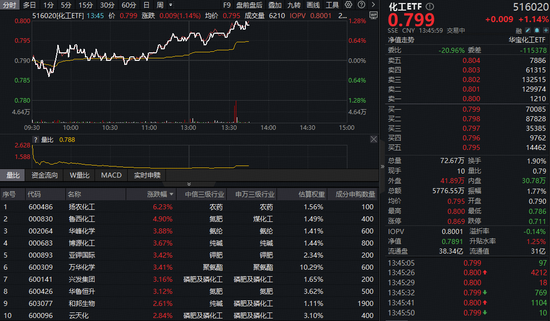
Group 1 - The chemical sector is experiencing a strong upward trend, with the Chemical ETF (516020) showing a maximum intraday increase of 1.27% and a current increase of 1.14% [1][6] - Key stocks in the sector include agricultural chemicals, nitrogen fertilizers, polyurethane, and phosphate chemicals, with notable gains from Yangnong Chemical (over 6%), Luxi Chemical (over 4%), and several others rising over 3% [1][6] - The lithium iron phosphate industry is undergoing a collective price increase, driven by rising raw material costs and expanding market demand, which is seen as the core driver for this price adjustment [7][8] Group 2 - Analysts indicate that strong demand in power and energy storage is pushing the lithium battery supply chain to a turning point, with tight capacity leading to price increases [8] - By 2025, the lithium iron phosphate industry is expected to see a significant shift, with processing fees potentially increasing by 3,000 yuan per ton, raising the average profit margin to 7.5%, an increase of over 7 percentage points from current levels [8] - The current valuation of the chemical sector remains attractive, with the Chemical ETF's underlying index price-to-book ratio at 2.32, positioned at the 39.61 percentile over the past decade, indicating a favorable long-term investment opportunity [9] Group 3 - Looking ahead, the chemical industry is expected to see a recovery in demand starting in 2024, driven by improvements in both domestic and international demand, particularly in sectors like automotive, home appliances, and textiles [10] - The Chemical ETF (516020) tracks the CSI segmented chemical industry theme index, covering various sub-sectors, with nearly 50% of its holdings in large-cap leading stocks such as Wanhua Chemical and Salt Lake Co., thus providing a robust investment opportunity [10]




近2000亿主力资金狂涌!化工板块震荡盘整,机构看好三大主线布局机会
Xin Lang Cai Jing· 2025-12-05 02:50
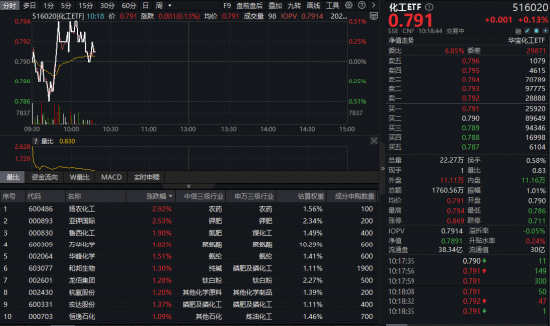
Group 1 - The chemical sector experienced fluctuations on December 5, with the chemical ETF (516020) showing a price increase of 0.13% [1][9] - Key stocks in the sector, including agricultural chemicals, potassium fertilizers, and polyurethane, saw significant gains, with Yangnong Chemical and Yaqi International both rising over 2% [1][9] - The basic chemical sector has attracted substantial capital recently, with a net inflow of over 2.2 billion yuan on the day, ranking fifth among 30 sectors [12][13] Group 2 - The chemical ETF (516020) has a price-to-book ratio of 2.32, which is at a relatively low level compared to the past decade, indicating potential value for long-term investment [4][11] - Future demand in the chemical industry is expected to recover gradually, driven by improvements in macroeconomic conditions and consumption stimulus policies [5][6] - Investment opportunities may arise in sectors such as organic silicon, polyester filament, and phosphate chemicals, which are expected to benefit from favorable supply-demand dynamics and government policies [12][13] Group 3 - Salt Lake Co. reported stable operations in its lithium salt project, achieving a daily output of 60-70 tons with a purity of over 99.7%, indicating strong production performance [10][11] - The basic chemical sector has seen a cumulative net inflow of 196.8 billion yuan over the past 60 days, ranking third among 30 sectors [12][13] - The chemical ETF (516020) provides exposure to a diversified range of chemical sub-sectors, with nearly 50% of its holdings in large-cap leading stocks [13]


“十五五”化工新材料积蓄创新新动能
Zhong Guo Hua Gong Bao· 2025-12-05 02:21
Core Insights - The "14th Five-Year Plan" period has seen rapid development in China's chemical new materials industry, with continuous expansion of industry scale and enhancement of technological innovation capabilities. The "15th Five-Year Plan" will focus on three key paths: pursuing high-end development, promoting green intelligence, and facilitating collaboration [1] Pursuing High-End Development - There is a significant imbalance in the development of chemical new materials in China, necessitating enhanced R&D for high-end materials. The self-sufficiency rate for engineering plastics is improving, but high-end products like optical-grade PC and medical polyether ether ketone have a domestic production rate of less than 30% [2] - The electronic chemicals sector faces challenges with insufficient high-end products. While mature processes have achieved domestic production for certain chemicals, the overall domestic production rate for advanced process chemicals remains low, indicating a critical area for future development [2] Promoting Green Intelligence - Green transformation is becoming a global imperative. The engineering plastics industry is encouraged to transition towards a "green circular" model, focusing on bio-based alternatives, recycling, and clean production methods [4] - The synthetic rubber industry is directed towards "green symbiosis" and "intelligent integration," emphasizing the development of bio-based and green materials, as well as the application of artificial intelligence to optimize production processes [4] Facilitating Collaboration - Collaborative innovation is essential for overcoming industry development bottlenecks. The engineering plastics sector is advised to establish a comprehensive collaborative innovation system, integrating various stages from monomer synthesis to application verification [5] - Standardization is highlighted as a crucial support for the electronic chemicals industry, with a need for a complete standard system to enhance consensus between chemical producers and downstream chip manufacturers [6]
亨斯迈MDI装置意外停车,己内酰胺减产逐步落地价格拉涨 | 投研报告
Zhong Guo Neng Yuan Wang· 2025-12-04 02:03
Industry Overview - The chemical sector's overall performance ranked 13th this week (2025/11/24-2025/11/28) with a change of 2.98%, positioned in the upper-middle of the market. The Shanghai Composite Index rose by 1.40%, while the ChiNext Index increased by 4.54%. The Shenwan Chemical sector outperformed the Shanghai Composite by 1.58 percentage points but underperformed the ChiNext by 1.56 percentage points [1]. Key Insights - The chemical industry is expected to continue its trend of divergence in 2025, with recommendations to focus on synthetic biology, pesticides, chromatography media, sweeteners, vitamins, light hydrocarbon chemicals, COC polymers, and MDI [1]. Synthetic Biology - A pivotal moment for synthetic biology is anticipated, driven by energy structure adjustments. Traditional chemical companies will face competition based on energy consumption and carbon tax costs. Companies that adopt green energy alternatives and leverage integrated and scaled advantages are likely to reduce energy costs and expand into larger overseas markets. The demand for bio-based materials is expected to surge, leading to potential profitability and valuation increases. Key companies to watch include Kasei Bio and Huaheng Bio [1]. Refrigerants - The implementation of quota policies is expected to usher in a high-growth cycle for third-generation refrigerants. Starting in 2024, the supply of these refrigerants will enter a "quota + continuous reduction" phase, while second-generation refrigerants will be phased out more rapidly. The demand for refrigerants is projected to grow steadily due to the development of heat pumps, cold chain markets, and the expansion of the air conditioning market in Southeast Asia. Companies with high quota shares, such as Juhua Co., Sanmei Co., Haohua Technology, and Yonghe Co., are expected to benefit significantly [2]. Electronic Specialty Gases - Electronic specialty gases are critical to the electronics industry and represent a core component of domestic industrialization. The domestic market is experiencing rapid upgrades in wafer manufacturing, but there is a mismatch with the fragmented and insufficient capacity of high-end electronic specialty gases. Companies that establish high-end capacity and possess substantial technical reserves are likely to seize opportunities for growth. Demand is driven by integrated circuits, displays, and photovoltaics. Key players include Jinhong Gas, Huate Gas, and China Shipbuilding Gas [3]. Light Hydrocarbon Chemicals - The trend towards light raw materials in the global olefin industry has been significant over the past decade, with a shift from heavy naphtha to lighter low-carbon alkanes like ethane and propane. This transition is characterized by shorter processes, higher yields, and lower costs. Light hydrocarbon chemicals also align with global low-carbon and energy-saving initiatives. Companies in this sector, such as Satellite Chemical, are expected to see their values reassessed [4]. COC Polymers - The industrialization of COC/COP (cyclic olefin copolymer) is accelerating in China, driven by domestic companies achieving breakthroughs after years of R&D. The shift of downstream industries, such as consumer electronics and new energy vehicles, to domestic sources is increasing the demand for these materials. The market is currently constrained by high prices, but domestic companies are expected to break through and expand market space. Key company to watch is Acolyte [5]. Potash Fertilizers - Potash fertilizer prices are expected to rebound as the industry enters a destocking cycle. Canpotex has withdrawn new quotes, and Nutrien has announced production cuts, leading to a short-term decline in supply. The termination of the Black Sea Grain Export Agreement has increased the prices of wheat and corn, boosting the demand for potash fertilizers. Companies like Yara International, Salt Lake Potash, and Zangge Mining are positioned to benefit from this trend [6]. MDI Market - The MDI market is characterized by oligopoly, with demand steadily improving due to the expansion of polyurethane applications. The global MDI production capacity is concentrated among five major chemical giants, which account for 90.85% of total capacity. Despite current price fluctuations, MDI remains a high-margin product. Companies like Wanhua Chemical are expected to benefit from a favorable supply structure as demand recovers [7]. Price Tracking - The top five price increases this week included methanol (East China) at 6.27%, NYMEX natural gas (futures) at 5.90%, and caprolactam (East China CPL) at 5.49%. The top five price decreases included liquid chlorine (East China) at -7.82% and propylene oxide (East China) at -5.85% [8]. Supply Side Tracking - This week, 168 chemical enterprises had their production capacities affected, with 9 new repairs and 3 restarts reported [9].
意外停产叠加行业检修潮,MDI巨头宣布每吨涨价2400元
Xuan Gu Bao· 2025-12-03 23:26
Group 1 - Hungary's BorsodChem announced a price increase of €300 per ton (approximately 2400 RMB) for all MDI products starting December 1 [1] - Hunstman’s MDI facility in Rozenburg, Netherlands, with a capacity of 280,000 tons/year, unexpectedly went offline for maintenance around November 21, with expected downtime of at least one month [1] - The MDI industry is entering a period of intensive maintenance, leading to supply contraction and prompting price increases from major players like BASF and Wanhua Chemical [1] Group 2 - Wanhua Chemical, a leading player in the global MDI industry and the largest MDI manufacturer in China and the Asia-Pacific region, has a production capacity of 3.8 million tons [2] - Wanhua Chemical announced a price increase of $200 per ton for its polymer MDI and pure MDI products in Southeast Asia and South Asia starting December 1 [2] - Chlor-alkali Chemical holds a 30% stake in Shanghai Hunstman Polyurethane and a 15% stake in Shanghai Lianheng, with Shanghai Hunstman having an MDI capacity of 38,000 tons and Shanghai Lianheng having 590,000 tons of MDI mother liquor and 220,000 tons of MDL distillate products [2]
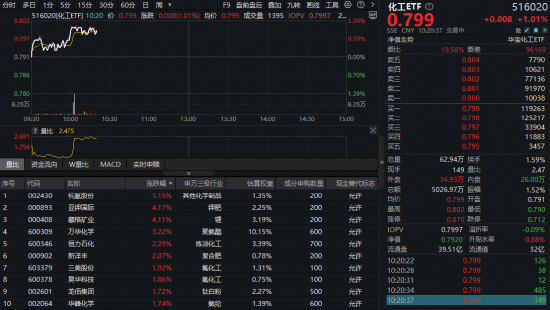
锂电储能迎利好催化,化工ETF(516020)盘中涨超1%!机构:化工板块2026年或迎“戴维斯双击”
Xin Lang Cai Jing· 2025-12-03 02:39
Group 1 - The chemical sector has regained momentum, with the Chemical ETF (516020) experiencing a maximum intraday increase of 1.39% and closing up 1.01% [1][6] - Key stocks in the sector include Hangzhou Oxygen Plant, which surged over 5%, and other significant gains from Yara International and Zangge Mining, both exceeding 4% [1][6] - The domestic first large-capacity all-solid-state battery production line has been completed and is in small-batch testing, potentially doubling battery energy density by 2026 [1][6] Group 2 - CITIC Securities highlights strong investment enthusiasm in energy storage, with policies supporting capacity compensation and a high growth rate in demand for renewable energy [3][8] - The chemical sector is currently viewed as having a favorable cost-performance ratio, with the Chemical ETF's price-to-book ratio at 2.33, placing it in the lower 39.73% of the last decade [3][9] - China Galaxy Securities anticipates a negative growth in capital expenditure for the chemical industry starting in 2024, with supply-side contraction expected due to the "anti-involution" trend and the clearing of outdated overseas capacity [4][10] Group 3 - The Chemical ETF (516020) tracks the CSI segmented chemical industry theme index, covering various sub-sectors, with nearly 50% of its holdings in large-cap leading stocks like Wanhua Chemical and Salt Lake Potash [4][10] - The ETF provides a more efficient way to capitalize on the rebound opportunities in the chemical sector, with a balanced exposure to different chemical sub-sectors [4][10]