
采矿业

Search documents
“超级周期”持续,铜价或有更多上涨空间
Wen Hua Cai Jing· 2026-01-28 10:02
Core Viewpoint - Analysts predict that copper prices are expected to continue a strong upward trend in 2026 due to tightening supply and accelerating demand from the energy transition sector, presenting an opportunity for investors to enhance portfolio returns [1]. Supply Constraints - Insufficient capital expenditure in copper mining over the years is beginning to impact supply, with a lack of new investments expected to slow production growth and further tighten market supply [1]. - Several large copper mines are facing operational disruptions, weakening global output, while declining ore grades and labor disputes in major producing countries like Chile and Peru are exacerbating supply chain pressures [1]. Demand from Energy Transition - Demand momentum continues to strengthen among major copper consumers, driven by electric vehicles, solar and wind power generation facilities, grid infrastructure upgrades, and energy storage projects [3]. - These structural trends indicate that the rise in copper prices is not merely cyclical but is supported by long-term shifts in global energy and manufacturing supply chains [3]. Market Dynamics - The market initially anticipated new import tariffs in the U.S. by the end of 2025, leading to panic buying and creating an artificial shortage in the spot market [2]. - Speculative positions in copper surged to a record $30 billion, as more investors view copper as a hedge against inflation, further driving up prices [2].
2025年12月工业企业利润点评:环比也在改善
Changjiang Securities· 2026-01-28 07:01
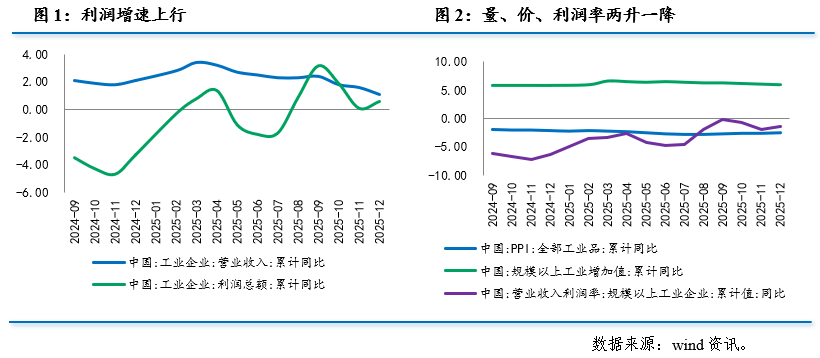
1. Report Industry Investment Rating - Not mentioned in the provided content 2. Core Viewpoints of the Report - In 2025, the profit growth rate of industrial enterprises above designated size increased, with improved single - month profitability in December, accelerated inventory destocking, and increased production - sales ratio. The operating pressure may have marginally eased, and the enterprise profit repair trend is initially evident. However, the performance of revenue and profit margin is still divergent, the profit quality is somewhat restricted, and there are also differences among industries, with the mid - upstream performing well and the downstream under pressure. The "anti - involution" measures may have some effects, but the sustainability of profit repair depends on whether policies can stimulate the improvement of terminal demand and drive price stabilization and recovery. The bond market's reaction to the fundamentals may still show the characteristic of "being insensitive to positive news and sensitive to negative news", and the structural highlights of the economic fundamentals may limit the downward space of interest rates. The view of short - term long - bond oscillation is maintained [3][9] 3. Summary by Related Catalogs 3.1 Event Description - In 2025, the cumulative operating revenue of industrial enterprises above designated size was 139.2 trillion yuan, a year - on - year increase of 1.1%; the cumulative operating cost was 118.75 trillion yuan, a year - on - year increase of 1.3%; the cumulative total profit was 7.4 trillion yuan, a year - on - year increase of 0.6%; the operating profit margin increased by 0.02 pct to 5.31% compared with the first 11 months. In December, the year - on - year growth rate of industrial enterprise profits increased by 18.4 pct to 5.3% compared with November [6] 3.2 Event Comments - **Profit growth rate recovery and strong seasonality in the month - on - month aspect**: From January to December 2025, the profits of industrial enterprises above designated size in China increased by 0.6% year - on - year, and the cumulative growth rate increased by 0.5 pct compared with November. The low - base effect contributed, and the month - on - month growth rate was also at a relatively high level in the same period over the years, indicating the improvement of enterprise profitability. The reasons for the recovery of the profit growth rate of industrial enterprises above designated size in December are: active production (the year - on - year growth rate of industrial added value rebounded and the capacity utilization rate improved), weakened drag on the price side (the year - on - year decline of PPI narrowed and the production - sales ratio also improved slightly), and the year - on - year growth rate of the operating profit margin turned from negative to positive (an 8.6% year - on - year increase in December, a 22 pct increase compared with the previous month) [9] - **Marginal pressure on revenue and improved profit margin**: In December, the year - on - year revenue of industrial enterprises above designated size was - 3.2%, and the decline increased by 3 pct compared with November. In terms of cost and expenses, the cost per 100 yuan of operating revenue of industrial enterprises above designated size for the whole year was 85.31 yuan, and the expenses were 8.62 yuan. The total amount, cumulative year - on - year, and month - on - month growth rates all increased compared with January - November. In terms of profit efficiency, the cumulative value of the operating profit margin from January to December increased from the previous 5.29% to 5.31%, but the profit quality needs to be improved due to the year - on - year increase in cost and expenses and the impact of investment income [9] - **Differentiated profit performance**: In December, the non - ferrous and high - tech manufacturing industries performed well, while the downstream was still under pressure. Throughout the year, the black metal industry improved significantly, and the equipment manufacturing industry had a stable growth rate. By industry, the profits of the mid - stream non - ferrous, railway and shipbuilding, and downstream furniture manufacturing industries improved significantly in December. From the perspective of the two - year average growth rate, the profit growth rates of the mining, raw material, and equipment manufacturing industries all rebounded. Among them, the ferrous metal smelting and rolling processing industry recorded a profit of 109.83 billion yuan, a three - fold increase compared with the previous year; the mid - stream equipment manufacturing industry provided strong support, driving the profit growth of industrial enterprises above designated size by 2.8 pct throughout the year; the high - tech manufacturing industry had a remarkable growth rate, with the profit of high - tech manufacturing industries above designated size increasing by 13.3% compared with the previous year, 12.7 pct higher than the profit growth rate of all industrial enterprises above designated size. By business entity, the profit growth rates of small and medium - sized enterprises, foreign - invested and Hong Kong, Macao, and Taiwan - invested enterprises turned from negative to positive, and the profits of joint - stock and state - owned holding enterprises improved significantly [9] - **Both nominal and real inventories decreased, and inventory destocking accelerated**: In December, the year - on - year growth rate of finished product inventories of industrial enterprises was 3.9%, a decrease of 0.7 pct compared with the previous month. After excluding price factors, the real inventory was 5.9% year - on - year, a decrease of 1 pct compared with the previous month. The turnover days of finished products were 19.9 days, slightly lower than the previous month, and inventory turnover accelerated seasonally. By industry, some mid - stream manufacturing and downstream consumer goods industries were still in the process of inventory replenishment, while industries such as black metal and textile were actively destocking, and nearly 20% of industries destocked in December. The inventory - to - sales ratio decreased compared with the previous month. Notably, the production - sales ratio of industrial enterprises rebounded to near the median of the same period in history, and the asset - liability ratio continued to reach a new high in the same period over the years, which may reflect the marginal improvement of enterprise operating pressure [9]
中国工业利润三年跌势扭转,今年稳增长行动思路明确
第一财经· 2026-01-28 06:01
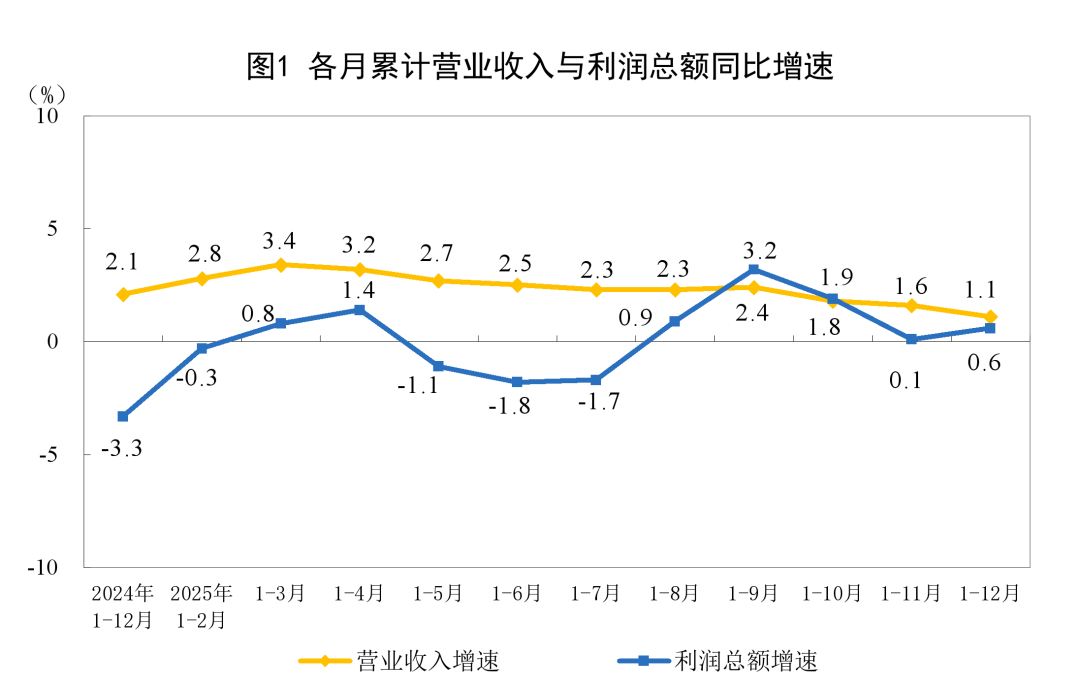
Core Viewpoint - In 2025, China's industrial profits showed a positive growth of 0.6%, reversing a three-year decline, with significant contributions from equipment manufacturing and high-tech industries, indicating an improvement in the industrial economic structure and quality [3][5][10]. Industrial Profit Improvement - The total profit of industrial enterprises above designated size reached 73,982 billion yuan in 2025, marking a 0.6% increase year-on-year, with a notable recovery in December where profits grew by 5.3% compared to November's decline of 13.1% [3][5]. - The profit growth trend was characterized by a "low first, high later" pattern, with significant policy effects from growth stabilization measures and "anti-involution" policies contributing to improved inventory and capacity utilization [5][10]. Cost and Expense Analysis - In 2025, the cost per 100 yuan of revenue for industrial enterprises was 85.31 yuan, an increase of 0.16 yuan year-on-year, while expenses decreased to 8.62 yuan, down 0.02 yuan [6]. - The average accounts receivable collection period decreased to 67.9 days by the end of December 2025, reflecting improved cash flow due to government actions to clear debts [6][10]. Profit Structure Improvement - In 2025, profits from small and medium-sized enterprises, as well as foreign-invested enterprises, turned positive, growing by 1.4% and 4.2% respectively, while state-owned and joint-stock enterprises also saw significant profit improvements [8]. - The manufacturing sector's profits increased by 5.0%, with equipment manufacturing and high-tech manufacturing being the main drivers, contributing 2.8 percentage points to overall profit growth [8][9]. High-Tech Manufacturing Growth - High-tech manufacturing profits rose by 13.3%, significantly outpacing the overall industrial profit growth, with smart electronic products and semiconductor-related industries showing remarkable profit increases [9]. - Specific sectors such as smart unmanned aerial vehicles and semiconductor manufacturing saw profits grow by 102.0% and 172.6% respectively, highlighting the rapid development in these areas [9]. Outlook for 2026 - Industrial profits are expected to continue their recovery in 2026, supported by stable domestic consumption, gradual investment recovery, and improved export quality [10]. - The "anti-involution" policies are anticipated to alleviate cost pressures and enhance profit margins, while ongoing industrial modernization efforts will further improve the operating environment for industrial enterprises [10][12].


工业利润超季节性反弹
CAITONG SECURITIES· 2026-01-28 05:45
Profit Growth Insights - In December, the profit of industrial enterprises increased by 5.3% year-on-year, a significant recovery from the previous value of -13.1%[9] - The total profit in December reached 771.3 billion yuan, an increase of 94.8 billion yuan from November, marking the highest level for the same period since 2021[16] Production and Price Dynamics - The industrial added value in December grew by 5.2% year-on-year, up from 4.8% in November[12] - The Producer Price Index (PPI) showed a year-on-year decline of 1.9%, a slight improvement from the previous month's decline of 2.2%[13] Profit Margin Recovery - The profit margin for industrial enterprises turned positive in December, reaching 4.1%, compared to -11.5% in November[14] - The increase in profit margin was supported by non-operating income, contributing 0.76% to the profit margin change[20] Inventory and Production Signals - As of the end of December, the inventory of finished products for industrial enterprises increased by 3.9% year-on-year, with a slight decline in growth rate from November[39] - The manufacturing inventory index in December showed a seasonal increase, indicating potential overproduction concerns[39] Sector Performance Variations - The upstream mining sector experienced a significant decline in profit and revenue, with profit growth dropping to -11.2% and revenue growth to -1.8% in December[34] - The equipment manufacturing sector maintained strong performance, with revenue growth of 3.8% and profit growth of 17.0% in December[38]
首次突破14万亿元!江苏省2025年经济数据公布
Xin Lang Cai Jing· 2026-01-28 04:17
Economic Overview - The overall economic operation in Jiangsu Province is stable with progress, achieving a GDP of 142,351.5 billion yuan in 2025, a year-on-year growth of 5.3% [1] - The primary industry value added is 5,369.7 billion yuan, growing by 3.5%; the secondary industry value added is 60,038.2 billion yuan, increasing by 4.7%; and the tertiary industry value added is 76,943.7 billion yuan, rising by 5.8% [1] Agriculture - The total output value of agriculture, forestry, animal husbandry, and fishery is 9,526.1 billion yuan, with a year-on-year growth of 4.0% [1] - Grain planting area is 82,303,000 acres, with a total grain output of 763.05 billion jin, an increase of 1.03 billion jin [1] Industrial Production - The industrial added value above designated size increased by 6.5%, with the manufacturing sector growing by 6.7% and equipment manufacturing increasing by 8.8% [2] - The profit of industrial enterprises above designated size increased by 8.8% from January to November [2] Service Sector - The tertiary industry added value grew by 5.8%, with significant contributions from wholesale and retail, transportation, and information technology services [2] - The revenue of the service industry above designated size increased by 8.3% from January to November [2] Consumer Market - The total retail sales of social consumer goods reached 46,394.2 billion yuan, growing by 3.3% [3] - Sales of green and smart products showed strong growth, with new energy vehicles increasing by 21.2% [3] Fixed Asset Investment - Fixed asset investment decreased by 12.7%, with the first industry investment increasing by 1.7% while the second and third industries saw declines [4] - Equipment purchase investment grew by 9.1%, accounting for 21.0% of total investment [4] Price Trends - The consumer price index decreased by 0.2%, with food prices dropping by 1.1% [5] - The industrial producer price index fell by 2.6%, consistent with the previous year [5] Income and Employment - Per capita disposable income reached 57,971 yuan, a growth of 4.6% [6] - The urban survey unemployment rate averaged 4.6%, slightly up from the previous year [6] Emerging Industries - High-tech industries accounted for 52.1% of industrial output, with a growth rate of 11.9% [7] - Online retail sales reached 1,373.91 billion yuan, growing by 7.8% [7] Conclusion - The economic performance in Jiangsu Province demonstrates resilience and vitality, with ongoing challenges and the need for strategic adjustments to ensure sustainable growth [8]
温彬:工业企业利润有望从阶段性修复向温和增长过渡
Di Yi Cai Jing· 2026-01-28 04:02
Core Insights - The overall profit growth of industrial enterprises in 2025 showed significant fluctuations but maintained a long-term positive trend, with a steady recovery in the profit foundation of enterprises [3][15]. Group 1: Profit Growth Overview - In 2025, the total profit of industrial enterprises above designated size reached 73,982 billion yuan, a year-on-year increase of 0.6%, with December showing a 5.3% increase year-on-year [1][15]. - The profit growth rate for December 2025 rebounded sharply from -13.1% in the previous month to 5.3%, an increase of 18.4 percentage points [2]. - For the entire year, the profit growth rate exhibited a "low first, high later, and fluctuating" trend, improving from -3.3% in 2024 [3]. Group 2: Sector Performance - In the mining sector, profits decreased by 26.2% year-on-year, but the decline narrowed by 1 percentage point compared to the previous month, indicating a continuous improvement over five months [6]. - The manufacturing sector saw a profit increase of 5% year-on-year, remaining stable compared to the previous month, with upstream raw material manufacturing profits growing by 10.6% [6][7]. - The equipment manufacturing sector contributed significantly to overall industrial profit growth, with a profit increase of 7.7%, driving a 2.8 percentage point increase in total profits for industrial enterprises [7]. Group 3: Inventory and Receivables - By the end of December, the nominal growth rate of finished goods inventory for industrial enterprises fell by 0.7 percentage points to 3.9%, indicating a reduction in inventory pressure due to improved sales [12]. - The average collection period for accounts receivable for industrial enterprises was 67.9 days, a decrease of 2.5 days from the previous value, reflecting improved cash flow management [14]. Group 4: Future Outlook - For 2026, industrial profits are expected to continue their recovery trend, supported by stable domestic consumption growth, gradual stabilization of investment, and improved export quality [18]. - The "anti-involution" policy is anticipated to ease cost pressures on enterprises, further supporting profit improvements [18].
2025年1—12月份仪器仪表制造业利润同比增长3.1%
Guo Jia Tong Ji Ju· 2026-01-28 03:46
Core Insights - In 2025, the total profit of industrial enterprises above designated size in China reached 73,982 billion yuan, a year-on-year increase of 0.6% [1] - The manufacturing sector saw a profit increase of 5.0%, while the mining sector experienced a significant decline of 26.2% [4] - The equipment manufacturing industry played a crucial role in supporting industrial upgrades, with profits rising by 7.7% [4] Summary by Category Overall Industrial Performance - The total revenue of industrial enterprises above designated size was 139.20 trillion yuan, up 1.1% from the previous year [2] - Operating costs increased by 1.3% to 118.75 trillion yuan, resulting in a profit margin of 5.31%, a slight decrease of 0.03 percentage points [2] - By the end of 2025, total assets reached 188.41 trillion yuan, a 4.3% increase, while total liabilities grew by 4.2% to 108.58 trillion yuan [2] Sector-Specific Performance - The profits of the black metal smelting and rolling industry surged by 300%, while the non-metallic mineral products industry saw a decline of 1.7% [2] - High-tech manufacturing profits increased by 13.3%, significantly outpacing the overall industrial growth [5] - The profits of the equipment manufacturing sector accounted for 39.8% of total industrial profits, marking a 2.6 percentage point increase from the previous year [4] Emerging Trends - The smart electronics sector drove a 48.0% profit increase in smart consumer device manufacturing, with specific industries like smart drones and vehicle devices seeing profits rise by 102.0% and 88.8%, respectively [5] - Traditional industries are also showing improvement, with sectors like biochemical pesticides and cultural information chemicals achieving profit growth above the industry average [6] - Small and medium-sized enterprises, as well as foreign-invested enterprises, reported profit growth of 1.4% and 4.2%, respectively, reversing previous declines [6]
V型反弹!12月工业企业利润增速大幅回升
Jin Rong Shi Bao· 2026-01-28 03:12
国家统计局1月27日发布数据显示,2025年,全国规模以上工业企业实现利润总额73982.0亿元人民币,比上年增长0.6%,扭转了连续三年下降态势。与此 同时,受益于价格改善和盈利能力走强,2025年12月份规模以上工业企业利润同比增长5.3%,增速大幅回升。 利润增速边际回暖 三大门类增速"两升一平" 新动能支撑作用明显 从三大门类看,2025年利润增速表现为"两升一平"。制造业增长5.0%,增速较2024年大幅回升8.9个百分点;电力、热力、燃气及水生产和供应业增长 9.4%;采矿业下降26.2%。 "价格改善对冲了利润率边际回落的拖累,制造业利润延续正增长态势。"温彬分析称,其中,上游原材料制造业受益于价格改善,利润保持较快增长;中 游装备制造业利润保持较快增长,对工业利润形成重要支撑。采矿业利润总额同比下降,但在价格、利润率改善的共同作用下,降幅继续收窄,实现了连 续5个月改善。 值得关注的是,装备制造业和高技术制造业都为工业高质量发展提供坚实支撑。2025年,规模以上装备制造业利润较上年增长7.7%,拉动全部规模以上 工业企业利润增长2.8个百分点;规模以上高技术制造业利润较上年增长13.3%,高于 ...
2025年我国规模以上工业企业利润增长0.6%
Jin Rong Shi Bao· 2026-01-28 02:31
国家统计局1月27日发布的数据显示,2025年,全国规模以上工业企业实现利润总额73982.0亿元人民 币,比上年增长0.6%,扭转了连续3年下降态势。与此同时,受益于价格改善和盈利能力走强,2025年 12月,规模以上工业企业利润同比增长5.3%,增速大幅回升。 "总体来看,2025年规模以上工业企业利润呈现'前低后高、震荡波动'走势,全年利润增速波动较大, 但中长期向好趋势未变,企业盈利基础仍在稳步修复。"民生银行首席经济学家温彬表示,展望2026 年,规模以上工业企业利润有望延续修复态势,由阶段性修复向温和增长过渡。 三大门类增速"两升一降"新动能支撑作用明显 "2025年,各地区各部门加紧实施更加积极有为的宏观政策,加快推进新型工业化,推动工业经济稳定 向好运行。"国家统计局工业司首席统计师于卫宁表示,尤其是装备制造业、高技术制造业等新动能支 撑作用明显,传统产业利润结构持续优化,工业经济发展质效不断提升。 从三大门类看,2025年规模以上工业企业利润增速表现为"两升一降"。制造业利润增长5.0%,增速较 2024年大幅回升8.9个百分点;电力、热力、燃气及水生产和供应业增长9.4%;采矿业下降26. ...
中国上市公司质量ESG指数报告-北京师范大学
Sou Hu Cai Jing· 2026-01-28 02:09
Core Viewpoint - The "China Listed Company Quality / ESG Index Report No.5 (2025)" aims to enhance the quality of listed companies in China by aligning with global ESG trends and establishing a scientific evaluation system [1][7]. Group 1: Evaluation Framework - The report is based on the State Council's opinions on improving the quality of listed companies and emphasizes the integration of corporate governance with ESG principles [1][7]. - The evaluation system includes three main dimensions: corporate governance (81 indicators, 55% weight), social responsibility (44 indicators, 35% weight), and environmental protection (7 indicators, 10% weight) [1][12]. - The evaluation covers 5,292 A-share listed companies in Shanghai, Shenzhen, and Beijing that have been listed for at least one year as of April 30, 2025 [1][14]. Group 2: Evaluation Results - From 2020 to 2024, the average index for non-financial companies first declined, then rose, and slightly decreased again, with a score of 68.14 in 2024, down by 0.79 from the previous year [2][20]. - State-owned enterprises consistently outperformed non-state-owned enterprises, with central enterprises showing the best performance [2][22]. - The eastern region ranked highest, with Tianjin, Shanghai, and Anhui being the top three provinces; the mining industry led while the education sector ranked lowest [2][32]. Group 3: Policy Recommendations - The report suggests that corporate governance should align with international standards, enhancing protections for minority investors and board independence [2][19]. - Social responsibility and environmental protection should be grounded in practical realities, incorporating economic and innovation responsibilities while prioritizing stakeholder rights [2][19]. Group 4: Significance of the Index - The index serves multiple stakeholders, including regulators, investors, and companies, by providing insights into the quality and ESG performance of listed companies [2][20]. - It aims to reduce information asymmetry for investors, helping them identify long-term investment opportunities and enhancing market stability [2][20]. - The index also assists companies in recognizing performance gaps and taking corrective actions to improve competitiveness [2][20].
