非银金融

Search documents
风险月报 | 多维度指标分歧明显改善
中泰证券资管· 2025-11-27 11:32
Core Viewpoint - The overall market sentiment has improved significantly, but there remains a notable divergence in various sentiment indicators, indicating a complex market environment [3]. Group 1: Market Risk Assessment - The risk score for the stock market, as per the Zhongtai Asset Management risk system, is 52.77, an increase from 45.79 last month, driven by marginal improvements in market sentiment [2]. - The valuation of the CSI 300 index has slightly decreased to 60.68 from 64.74, remaining in a relatively high range over the past six months, with significant valuation disparities across different sectors [2]. - The market expectation score has decreased to 52.00 from 55.00, reflecting weaker macroeconomic data, particularly in fixed asset investment growth [2]. Group 2: Sector Performance - Among the 28 Shenwan first-level industries, sectors such as steel, electronics, real estate, and defense continue to have valuations above the historical 60th percentile, while agriculture and non-bank financials remain below the 10th percentile [2]. - The consumer market showed a slight rebound in October, with retail sales growing by 4.28%, although this was a decrease of 0.22% from the previous month [8]. Group 3: Economic Indicators - Fixed asset investment growth has declined to -1.7%, with significant weakness in real estate and building materials, while industrial value-added growth remains stable at 4.9% year-on-year [7][8]. - The overall liquidity in the market is under pressure, with social financing and M2 growth rates declining, indicating a need for close monitoring of these trends [10][11].


高切低市场风格下的ETF投资主线
Huafu Securities· 2025-11-27 08:20
- The report discusses the macroeconomic recovery in China, highlighting the transition from "weak recovery" to "marginal improvement" as a key phase for economic activity and liquidity structure, which lays the foundation for subsequent profitability recovery and market style shifts towards dividends and low valuation assets [11][16][17] - A macro scoring model is referenced, indicating that the macroeconomic environment has been in a neutral to slightly pessimistic range in 2025, with the latest score (September 2025) being 7, reflecting a neutral to slightly optimistic outlook [13][14] - Dividend strategies (high dividend yield strategies) are emphasized as a classic value investment method, with their core logic analyzed from three dimensions: investor behavior, corporate operating characteristics, and market valuation systems. The dividend yield is identified as the core metric for evaluating dividend strategies [21][23] - The report highlights the strategic allocation value of dividend assets, emphasizing their long-term stable return characteristics and risk diversification functions, making them suitable as a "ballast" in investment portfolios, especially in a low-interest-rate environment [21][23][25] - The report introduces the "stability value + growth premium" logic for the power and power grid sectors, emphasizing their stable cash flow, regulatory framework ("permitted cost + reasonable return"), and policy support for energy transition and power security [26] - The report provides valuation metrics for high dividend yield-related ETF products tracking indices as of October 20, 2025. For example, the PE ratios for the National New Hong Kong Stock Connect Central Enterprise Dividend Index, Smart High Dividend Index, CSI Dividend Index, and CSI All Power Index are 8.88, 8.73, 8.29, and 17.60, respectively, with corresponding PB ratios of 0.85, 1.11, 0.80, and 1.76 [27][30] - The cyclical sector investment direction is analyzed, with key drivers identified as domestic demand policies and global demand recovery. Non-bank financials and consumer sectors benefit from dual drivers, while financial real estate and infrastructure are supported by domestic policies, and materials benefit from global restocking [40][42][47] - Valuation metrics for cyclical-related ETF products tracking indices are provided as of October 20, 2025. For example, the PE ratios for the Hong Kong Stock Connect Non-Bank, Financial Real Estate, 800 Consumer, All Materials, and Infrastructure Engineering indices are 9.44, 9.10, 19.20, 26.90, and 8.51, respectively, with corresponding PB ratios of 1.13, 0.86, 4.36, 2.10, and 0.72 [51][55] - The report emphasizes the role of broad-based assets like the SSE 50 ETF and CSI 300 ETF as core holdings in portfolios, supported by policy efforts to stabilize the market and attract long-term funds, as well as their low historical valuations and high safety margins [64][65][66] - Valuation metrics for broad-based ETF products tracking indices are provided as of October 20, 2025. For example, the PE ratios for the SSE 50 and CSI 300 indices are 11.99 and 14.22, respectively, with corresponding PB ratios of 1.30 and 1.48. Both indices are near the 68th percentile of their five-year PB range [69][70][71]
浙商早知道-20251127
ZHESHANG SECURITIES· 2025-11-26 23:30
Market Overview - On November 26, the Shanghai Composite Index decreased by 0.15%, while the CSI 300 increased by 0.61%, the STAR Market 50 rose by 0.99%, the CSI 1000 fell by 0.02%, and the ChiNext Index increased by 2.14%. The Hang Seng Index rose by 0.13% [4][6] - The best-performing sectors on November 26 were telecommunications (+4.64%), comprehensive (+1.79%), electronics (+1.58%), retail (+1.11%), and home appliances (+0.96%). The worst-performing sectors were defense and military (-2.25%), social services (-0.97%), media (-0.82%), oil and petrochemicals (-0.8%), and banking (-0.79%) [4][6] - The total trading volume for the A-share market on November 26 was 17,971.9 billion yuan, with a net outflow of 3.952 billion Hong Kong dollars from southbound funds [4][6] Important Recommendations - The report recommends Chengda Biological (688739) due to the synergistic effects of shareholder involvement and continuous innovation. The company is expected to see accelerated transformation and revenue growth driven by mergers and acquisitions and new vaccine commercialization [7] - Revenue forecasts for Chengda Biological from 2025 to 2027 are 1,347.93 million yuan, 1,418.37 million yuan, and 1,530.02 million yuan, with growth rates of -19.59%, 5.23%, and 7.87% respectively. Net profit is projected to be 200.23 million yuan, 222.63 million yuan, and 253.73 million yuan, with growth rates of 41.59%, 11.19%, and 13.97% respectively [7] Industry Insights Agriculture, Forestry, Animal Husbandry, and Fishery - The core viewpoint emphasizes deepening value in the agricultural sector and positioning for new cyclical opportunities. The market outlook indicates continued pressure on pig prices, uncertainty in beef prices, and persistent low prices for poultry, with intensified competition in feed and animal health sectors [8][9] - The report suggests that leading pig enterprises can maintain profitability through cost advantages and structural optimization despite production capacity constraints. The feed sector is expected to see growth potential for companies with cost control and integrated supply chains, while the animal health sector may benefit from pet care and international expansion [9][12] Non-Banking Financial Sector - The non-banking financial sector is anticipated to experience a rebound in 2026, characterized by a combination of high probability and favorable odds. The market outlook for this sector is cautious due to the high base in 2025, but a potential recovery is expected amid a long-term "slow bull" market for equities [10][13] - The report highlights that the asset and liability sides of the financial sector are expected to resonate positively, supporting the overall growth of the sector [13]
固收定期报告:估值有支撑,关注“更高阶”低估
CAITONG SECURITIES· 2025-11-26 12:37
1. Report Industry Investment Rating - No information provided in the given content 2. Core Viewpoints of the Report - In 2026, the "fixed - income asset shortage" and "high equity market sentiment" that drove the convertible bond market in 2025 may continue. The convertible bond market is expected to have a return opportunity of over 10% next year [4]. - The supply - demand structure of the convertible bond market will continue to evolve in 2026, with the term structure becoming "dumbbell - shaped", the "aging" of convertible bonds slowing down slightly, the proportion of funds held in convertible bonds remaining high, and the influence of convertible bond ETFs becoming more prominent [4]. - In 2026, the valuation of convertible bonds is likely to remain high. The market risk appetite is not weak, the convertible bond positions of low - risk - preference investors are at a historical low, and the probability of extreme credit risk events in the short term is limited [4]. - In terms of strategy, attention should be paid to "higher - order" undervaluation. The contradiction between the high demand for undervalued convertible bonds from "fixed - income +" investors with a bond - biased approach and the "weak supply" of traditional low - priced convertible bonds needs to be resolved by constructing more complex undervaluation evaluation criteria [4]. - In the context of the "involution" of clause games, more attention should be paid to the odds. In the high - valuation environment, the valuation of convertible bonds is rapidly compressed before the call - back, and the game space for downward revisions has reached a historical low [4]. 3. Summary According to the Directory 3.1 Convertible Bond "Ecological Niche" Advantage Remains Unchanged, with a Decent Return Space in 2026 - The two factors that drove the convertible bond market in 2025, "fixed - income asset shortage" and "high equity market sentiment", may continue in 2026. As of November 20, 2025, the median parity of the convertible bond market exceeded 100 yuan, and the overall equity nature of convertible bonds was at a historical high. The strong equity market is expected to be the most important support for convertible bonds in 2026 [8]. - The demand for convertible bonds from "fixed - income +" investors, especially bond - biased accounts with stock position limits, is expected to remain high due to the low long - term interest rate environment, which will support the valuation of convertible bonds [8]. - The convertible bond index is expected to have a return space of over 10% in 2026. Based on the delta calculation, if the Shanghai Composite Index reaches 4500 - 5000 points in 2026, the overall return of convertible bonds may be around 8% - 17%, and the actual return space may be higher [8]. 3.2 The "Aging" Speed May Slow Down Slightly, and the Dumbbell Structure Gradually Appears - The contraction speed of the convertible bond market in 2026 is expected to be slightly lower than that in 2025, and the stock size may reach 450 - 500 billion yuan. As of November 21, 2025, the stock size of the convertible bond market was about 550 billion yuan, a decrease of nearly 180 billion yuan from the end of 2024. The net supply of convertible bonds in 2026 may be - 100 billion yuan [13]. - The "aging" of convertible bonds in 2026 may slow down slightly, and the median remaining term of convertible bonds at the end of next year may be about 2.2 years. The main reasons are the redemption of many short - term convertible bonds since 2025 and the recovery of convertible bond supply starting from mid - 2025 [15]. - In 2026, the number of medium - term convertible bonds will significantly decrease, and the term structure will evolve into a "dumbbell - shaped" structure. By the end of 2026, the number of 3 - 4 - year convertible bonds will decline from over 100 at the beginning of the year to about 30. The market may form a structure with medium - and large - sized convertible bonds within 3 years at one end and small - and medium - sized growth technology - related convertible bonds over 4 years at the other end [16]. - In terms of industries, the convertible bonds of non - bank finance, commercial retail, and consumer service industries will all mature by the end of 2026. The non - bank finance industry involves the largest scale and the most targets, with 4 convertible bonds worth 15 billion yuan maturing. The remaining industries' distributions may not change much, and the balance of convertible bonds in the banking, power equipment and new energy, and basic chemical industries significantly leads the others [18]. 3.3 The Proportion of Funds May Further Increase, Pay Attention to Convertible Bond ETFs - As of the end of October 2025, the proportion of convertible bonds held by funds is estimated to reach 47%, the highest level since the data was released. The increase in the proportion of convertible bonds held by public funds is mainly due to the decrease in the scale of convertible bonds held by insurance and annuity funds. By October 2025, the scale of convertible bonds held by insurance may be less than 50 billion yuan, a decrease of nearly 30% from August 2025, and the scale of convertible bonds held by annuities may be close to 130 billion yuan, a record low [20]. - In 2026, the proportion of convertible bonds held by funds is expected to remain high and may even reach a new high. Retail investors have a long - term trend of reducing their holdings of convertible bonds. Insurance and annuity funds may participate in the convertible bond market through FOFs in 2026 due to the low net supply of large - scale and high - rating convertible bonds and the high overall valuation of convertible bonds [22]. - The scale of convertible bond ETFs may continue to expand, and attention should be paid to the potential impact of the high proportion of ETFs on the convertible bond market. As of the end of October 2025, the market value of convertible bonds held by convertible bond ETFs reached 67.84 billion yuan, accounting for nearly 10% of the convertible bond market. The high valuation of newly issued convertible bonds may be related to convertible bond ETFs [27]. 3.4 Valuation is Supported, and There is Room for More Optimism - In 2025, the valuation of convertible bonds increased significantly, and the implied volatility returned to the central level of 2023. As of November 20, 2025, the premium rate per 100 yuan of convertible bonds continued to break through historical highs, and the median implied volatility of convertible bonds exceeded 40% [30]. - In 2026, the valuation of convertible bonds is likely to remain high. The current market risk appetite is not weak, the convertible bond positions of low - risk - preference investors are at a historical low, and the probability of extreme credit risk events in the short term is limited [30]. - The high point of convertible bond valuation may be around 35% - 40%, and considering the possible decline in long - term interest rates and the increase in the bond floor of convertible bonds in 2026, the high point of valuation may be even higher [33]. 3.5 In the High - Valuation Environment, It is Recommended to Focus on "Higher - Order" Undervaluation - In 2025, convertible bond investors clearly preferred undervalued targets. As of November 21, 2025, the return of the low - price strategy was 21.1%, with an excess return of 4.6% compared to the CSI Convertible Bond Index. The relatively "abnormal" excess return may be mainly due to institutional behavior [37]. - In 2026, it may be more difficult for the pure low - price strategy to obtain excess returns. The market is facing the contradiction between the high demand for undervalued convertible bonds from "fixed - income +" investors with a bond - biased approach and the "weak supply" of traditional low - priced convertible bonds. It is recommended to focus on "higher - order" undervaluation [41]. - The convexity strategy may be a good entry point for "higher - order undervaluation". Since 2025, the series of convexity strategies have achieved excellent results, with a Calmar ratio of over 3 and a return of over 20% [42]. 3.6 The "Involution" of Clause Games, and More Attention Should Be Paid to the Odds - In the fourth quarter of 2025, the experience of convertible bond clause games was not good. In the high - level volatile environment of the equity market, listed companies became more cautious in considering convertible bond clauses. As of November 21, 2025, only 1 convertible bond proposed a downward revision in that month, and the ratio of downward - revision announcements to possible downward - revision announcements was 0.04:1, both the lowest levels since March 2023. The ratio of call - back announcements to non - call - back announcements in November was 1.57:1, the highest level in 2025 [45]. - In the high - valuation environment, the convertible bond call - back game has become "involution". The difference in the average conversion premium rate of convertible bonds with a call - back progress of 80% - 100% and those with a progress of 0 - 20% has rapidly expanded since September 2025, and the conversion premium rate of convertible bonds with a high call - back progress has fallen to a historical low [47]. - The game space for convertible bond downward revisions is narrowing. Under the dual influence of high valuation and institutional preference for undervalued convertible bonds, the average difference between the prices of all convertible bonds eligible for downward revision and the expected price after a full downward revision has narrowed to a relatively low level since 2021 [48]. - The report also lists the convertible bonds whose cooling - off periods for downward revisions and call - backs will end in 2026 [52][53][54].
万科和CPO小作文
Datayes· 2025-11-26 11:31
Group 1: Vanke Debt Situation - Vanke's debt situation is under scrutiny as a report suggests that the local government is considering a "market-oriented" approach to handle its debt [1][2] - A working group previously estimated a funding gap of approximately 150 billion RMB (about 21.1 billion USD) for Vanke, with total interest-bearing liabilities reported at around 362.9 billion RMB (51.1 billion USD) as of September 30 [3] - Vanke faces imminent challenges with two domestic bonds maturing in December, totaling 2 billion RMB and 3.7 billion RMB, respectively [4] Group 2: Market Reactions and Implications - The market is reacting to rumors that Shenzhen has sought assistance from Beijing regarding Vanke's debt situation, leading to speculation about potential outcomes [4] - The report indicates that the Shenzhen government can no longer support Vanke independently, suggesting a need for intervention from higher authorities [2] Group 3: Industry Trends and Stock Performance - The TMT sector has experienced significant fluctuations, with the rolling 40-day excess return narrowing to a historical low of around -7.5%, indicating a potential bottoming out [10] - Recent reports highlight a strong performance in the optical communication sector, driven by rumors of Google placing a substantial order, which has positively impacted related stocks [14][22]



主力资金丨3股尾盘获主力资金大幅抢筹
Zheng Quan Shi Bao Wang· 2025-11-26 11:21
Group 1 - The A-share market showed mixed performance on November 26, with major indices fluctuating, while sectors like pharmaceuticals and semiconductors saw gains, whereas shipbuilding and aerospace sectors faced declines [1] - The net outflow of main funds in the Shanghai and Shenzhen markets reached 11.01 billion yuan, with 15 sectors experiencing net inflows, particularly automotive, textile and apparel, and comprehensive industries, each exceeding 300 million yuan [1] - The basic chemical industry led the net outflow with 1.13 billion yuan, followed by social services, real estate, and non-bank financial sectors, each exceeding 600 million yuan [1] Group 2 - Five stocks recorded net inflows exceeding 1 billion yuan, with a total of 63 stocks seeing net inflows above 100 million yuan [2] - The CPO concept stocks continued to strengthen, with New Yisheng and Zhongji Xuchuang attracting net inflows of 1.646 billion yuan and 1.306 billion yuan, respectively [3] - Yangguang Power saw a net inflow of 1.243 billion yuan, while Inspur Information reported a net inflow of 1.128 billion yuan, with the company announcing a share buyback of 2.25 billion yuan [4] Group 3 - At the market close, the main funds experienced a net outflow of 1.541 billion yuan, with retail and food and beverage sectors leading in net inflows [5] - Three stocks, including Yaowang Technology and Dongxin Co., saw net inflows exceeding 100 million yuan at the close, with Dongxin Co. hitting the daily limit [6]





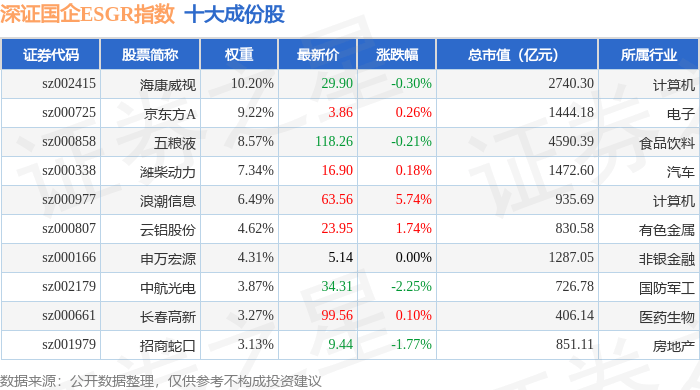
11月26日深证国企ESGR(470055)指数涨0.31%,成份股泰达股份(000652)领涨
Sou Hu Cai Jing· 2025-11-26 10:35
Core Viewpoint - The Shenzhen State-Owned Enterprise ESGR Index (470055) closed at 1552.92 points, up 0.31%, with a trading volume of 27.52 billion yuan and a turnover rate of 0.83% on November 26 [1] Group 1: Index Performance - The ESGR Index had 16 constituent stocks rising, with Taida Co., Ltd. leading at a 10.07% increase, while 31 stocks declined, with Zhonglai Co., Ltd. leading the decline at 4.21% [1] - The top ten constituent stocks of the ESGR Index include Hikvision, BOE Technology Group, Wuliangye, Weichai Power, Inspur Information, Yun Aluminum, Shenwan Hongyuan, AVIC Optoelectronics, Changchun High-tech, and China Merchants Shekou, with varying weights and market capitalizations [1] Group 2: Capital Flow - The net inflow of main funds into the ESGR Index constituent stocks totaled 845 million yuan, while retail investors experienced a net outflow of 370 million yuan [1] - Specific stocks such as Inspur Information saw a significant net inflow of 113.7 million yuan from main funds, while retail investors had a net outflow of 64 million yuan [2] - Other notable stocks include Taida Co., Ltd. with a main fund net inflow of 113 million yuan and a retail net outflow of 52.45 million yuan, and Weichai Power with a main fund net inflow of 15.46 million yuan [2]

南向资金近期动向探究
Mei Ri Jing Ji Xin Wen· 2025-11-25 12:44
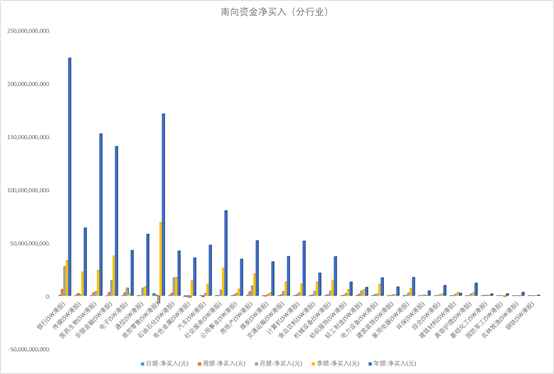
Group 1 - The core concept of "Southbound Capital" refers to mainland investors using the Stock Connect mechanisms to invest in stocks listed on the Hong Kong Stock Exchange, serving as a key source of liquidity for the Hong Kong market [1] Group 2 - As of November 20, 2023, the cumulative net inflow of Southbound capital has exceeded HKD 1.36 trillion, representing a growth of over 68% compared to the total inflow of HKD 807.8 billion for the entire year of 2024, and is 1.7 times the net buying amount for 2024 [2] - The cumulative trading volume of Southbound capital has surpassed HKD 26.37 trillion, which is an increase of over 135% compared to the cumulative trading volume of HKD 11.22 billion for the entire year of 2024, making it 2.35 times the total for 2024 [2] - Since the launch of the Stock Connect, the cumulative net inflow has exceeded HKD 5 trillion, setting a historical record since the mechanism's inception [2] Group 3 - As of November 19, 2023, the top five sectors for Southbound capital holdings are: banking, retail, non-bank financials, pharmaceuticals, and media, with the banking sector receiving the most significant net buying across various time frames [3] - The monthly frequency of net buying in the banking sector accounts for 1.54% of the total market capitalization, indicating a substantial increase in investment in this sector [3] - Other sectors that have seen significant increases in investment over the past month include non-bank financials, real estate, oil and petrochemicals, and transportation [3] Group 4 - The primary drivers for the recent Southbound capital flows are institutional funds such as insurance capital and public funds, attracted by the high dividend yield of Hong Kong stocks (average yield of 5.57%) in a low-interest-rate environment [5] - The banking, non-bank financials, real estate, oil and petrochemicals, and transportation sectors have seen increased investment due to their valuation advantages, particularly in the context of Hong Kong's market being perceived as undervalued globally [6] - The price-to-book ratio (PB) of the Hong Kong banking sector is currently at 0.52, representing a discount of over 40% compared to similar sectors in A-shares, which attracts funds seeking value [6] Group 5 - For individual investors, participating directly in Hong Kong stocks may involve risks such as exchange rate fluctuations and differences in trading rules, making ETFs a preferable option for exposure [6] - Recent trends indicate that Southbound capital is increasingly focused on high-dividend, low-volatility ETFs, which cater to investors with moderate risk preferences [6] - The Hong Kong Central State-Owned Enterprises Dividend ETF and other similar products allow investors to benefit from the inflow of Southbound capital while diversifying their investment risks [6]
11月25日深证国企股东回报(970064)指数涨0.73%,成份股中材科技(002080)领涨
Sou Hu Cai Jing· 2025-11-25 11:01
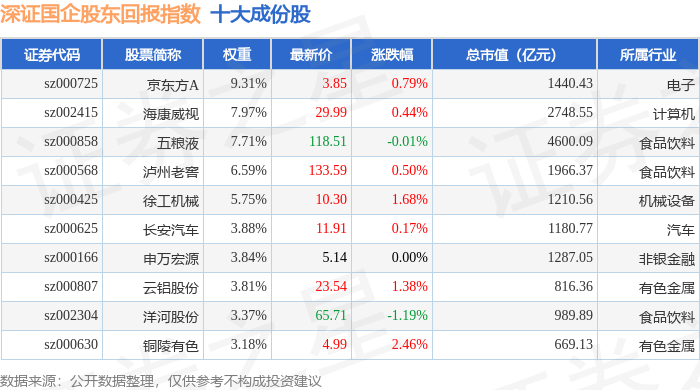
Core Points - The Shenzhen State-Owned Enterprises Shareholder Return Index (970064) closed at 1612.77 points, up 0.73%, with a trading volume of 20.124 billion yuan and a turnover rate of 0.78% [1] - Among the index constituents, 33 stocks rose, with China National Materials Technology leading at a 10.01% increase, while 12 stocks fell, with CITIC Special Steel leading the decline at 2.97% [1] Index Constituents Summary - The top ten constituents of the Shenzhen State-Owned Enterprises Shareholder Return Index include: - BOE Technology Group (sz000725) with a weight of 9.31%, latest price at 3.85, and a market cap of 144.043 billion yuan [1] - Hikvision (sz002415) with a weight of 7.97%, latest price at 29.99, and a market cap of 274.855 billion yuan [1] - Wuliangye Yibin (sz000858) with a weight of 7.71%, latest price at 118.51, and a market cap of 460.009 billion yuan [1] - Luzhou Laojiao (sz000568) with a weight of 6.59%, latest price at 133.59, and a market cap of 196.637 billion yuan [1] - XCMG Machinery (sz000425) with a weight of 5.75%, latest price at 10.30, and a market cap of 121.056 billion yuan [1] - Changan Automobile (sz000625) with a weight of 3.88%, latest price at 11.91, and a market cap of 118.077 billion yuan [1] - Shenwan Hongyuan (sz000166) with a weight of 3.84%, latest price at 5.14, and a market cap of 128.705 billion yuan [1] - Yunnan Aluminum (sz000807) with a weight of 3.81%, latest price at 23.54, and a market cap of 81.636 billion yuan [1] - Yanghe Brewery (sz002304) with a weight of 3.37%, latest price at 65.71, and a market cap of 68.686 billion yuan [1] - Tongling Nonferrous Metals (sz000630) with a weight of 3.18%, latest price at 6.67, and a market cap of 66.913 billion yuan [1] Capital Flow Summary - The net inflow of main funds into the index constituents totaled 425 million yuan, while retail funds saw a net outflow of 319 million yuan [3] - Key stocks with significant capital flow include: - China National Materials Technology with a net inflow of 210 million yuan from main funds [3] - Luzhou Laojiao with a net inflow of 91.542 million yuan from main funds [3] - Tongling Nonferrous Metals with a net inflow of 60.685 million yuan from main funds [3]




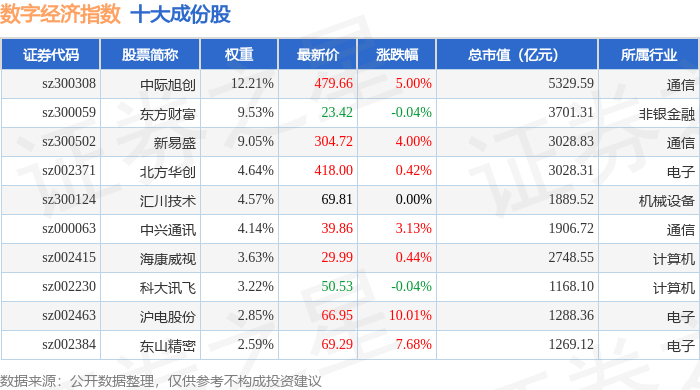
11月25日数字经济(399262)指数涨2.39%,成份股沪电股份(002463)领涨
Sou Hu Cai Jing· 2025-11-25 10:20
Group 1 - The Digital Economy Index (399262) closed at 2581.82 points, up 2.39%, with a trading volume of 120.24 billion yuan and a turnover rate of 2.16% on November 25 [1] - Among the index constituents, 40 stocks rose, with Huadian Co., Ltd. leading with a 10.01% increase, while 9 stocks fell, with Gaode Infrared leading the decline at 2.24% [1] - The top ten constituents of the Digital Economy Index include Zhongji Xuchuang (12.21% weight, 5.00% increase), Dongfang Fortune (9.53% weight, -0.04% decrease), and Xinyi Sheng (9.05% weight, 4.00% increase) [1] Group 2 - The net inflow of main funds for the Digital Economy Index constituents totaled 2.775 billion yuan, while retail funds experienced a net outflow of 1.181 billion yuan [1] - The detailed fund flow indicates that Huadian Co., Ltd. had a net inflow of 973 million yuan, while Zhongji Xuchuang saw a net outflow of 605 million yuan [2] - The overall market sentiment reflects a mixed response, with significant inflows into certain stocks while others faced outflows, indicating varying investor confidence across the sector [2]