
建筑业

Search documents
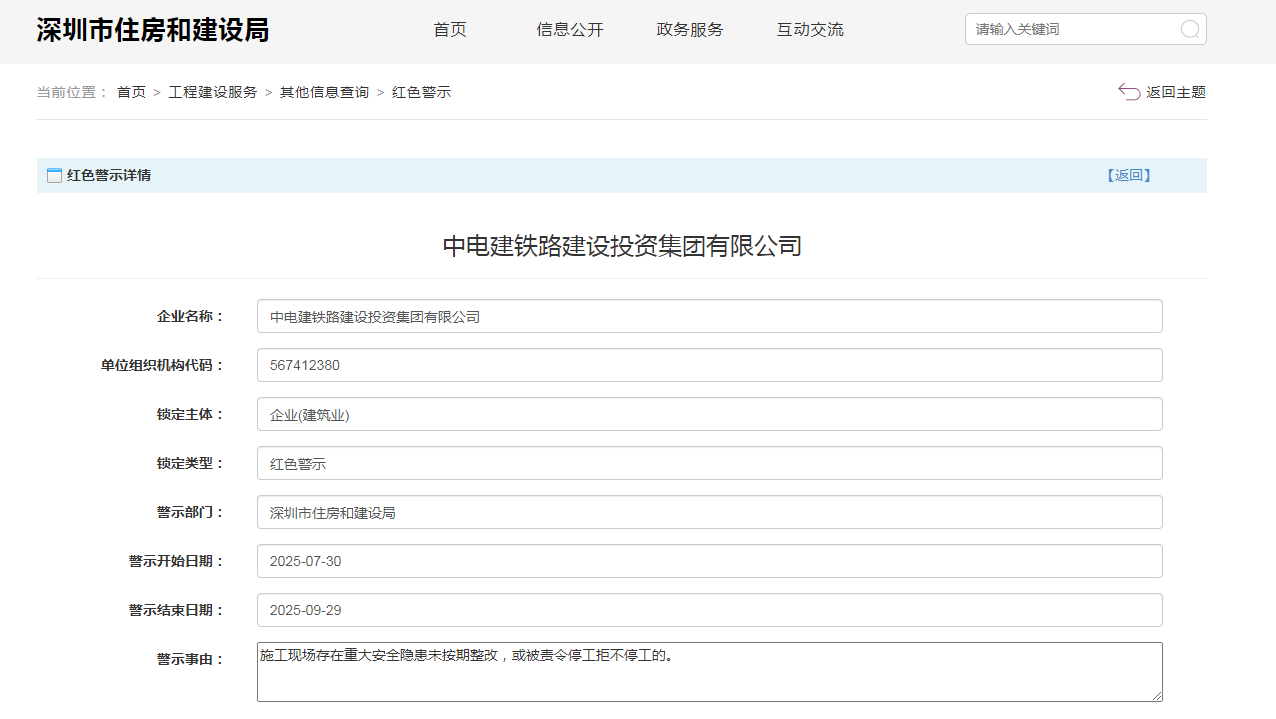
电建铁路公司入列红色警示两个月:因施工现场存在重大安全隐患等
Qi Lu Wan Bao· 2025-08-01 02:24
Group 1 - The core issue is that China Electric Power Construction Group's subsidiary, China Electric Power Construction Railway Investment Group Co., Ltd., has been placed under a red warning by the Shenzhen Housing and Construction Bureau due to significant safety hazards at construction sites that were not rectified on time [1][3] - The warning is effective from July 30, 2025, to September 29, 2025, indicating a serious compliance issue within the construction industry [3] - The company operates under the umbrella of a Fortune Global 500 enterprise and is involved in various infrastructure projects both domestically and internationally, with a total contract amount of approximately 470 billion yuan [5] Group 2 - China Electric Power Construction Railway Investment Group Co., Ltd. was established in 2011 with a registered capital of 600 million yuan and is wholly owned by China Electric Power Construction Group [7] - The company has a total asset value of 30.383 billion yuan as of the end of 2024 and employs nearly 900 people across 42 subordinate units [5]


经济总体产出保持扩张
Jing Ji Ri Bao· 2025-08-01 01:47
Economic Overview - The overall economic output in China continues to expand, despite fluctuations due to extreme weather conditions and a weak demand side [2][4]. Manufacturing Sector - In July, the Manufacturing Purchasing Managers' Index (PMI) dropped to 49.3%, a decrease of 0.4 percentage points from the previous month, indicating a contraction in manufacturing activity [2]. - The new orders index for manufacturing was at 49.4%, down 0.8 percentage points, while the production index remained at 50.5%, indicating continued expansion for three consecutive months [2]. - High-tech manufacturing and equipment manufacturing PMIs were 50.6% and 50.3%, respectively, both above the critical point, showing sustained growth in these sectors [2]. Price Trends - The purchasing price index for major raw materials rose to 51.5%, marking the first increase above the critical point since March, while the factory price index was at 48.3% [3]. - Industries such as petroleum, coal, and black metal processing saw significant improvements in their purchasing and factory price indices [3]. Business Activity in Non-Manufacturing Sector - The non-manufacturing business activity index was at 50.1%, down 0.4 percentage points, but still above the critical point [5]. - The construction sector experienced a slowdown, with its business activity index at 50.6%, a decrease of 2.2 percentage points [5]. - Service sector activity remained stable, with a business activity index of 50%, slightly down by 0.1 percentage points [5]. Future Outlook - Manufacturing enterprises maintain a positive outlook, with the production and business activity expectation index rising to 52.6%, an increase of 0.6 percentage points from the previous month [4]. - Non-manufacturing enterprises also show stable optimism, with a business activity expectation index of 55.8%, up 0.2 percentage points [5].
7月份制造业PMI回落,新动能持续增长——经济总体产出保持扩张
Zhong Guo Jing Ji Wang· 2025-08-01 00:53
Economic Overview - In July, the manufacturing Purchasing Managers' Index (PMI) dropped to 49.3%, a decrease of 0.4 percentage points from the previous month, influenced by seasonal production slowdowns and extreme weather conditions [1] - The non-manufacturing business activity index and the comprehensive PMI output index were 50.1% and 50.2%, respectively, both down by 0.4 and 0.5 percentage points, yet remaining above the critical point [1] - Despite short-term fluctuations due to extreme weather, production activities maintained expansion, indicating a solid foundation for economic recovery [3] Manufacturing Sector - The manufacturing new orders index fell to 49.4%, down 0.8 percentage points from last month, while the production index was at 50.5%, still in the expansion zone for three consecutive months [1] - The equipment manufacturing PMI and high-tech manufacturing PMI were 50.3% and 50.6%, respectively, both above the critical point, indicating ongoing expansion in high-end equipment manufacturing [1] - The consumer goods industry PMI was 49.5%, down 0.9 percentage points, while the high-energy-consuming industries PMI improved slightly to 48%, up 0.2 percentage points [1] Price Trends - The main raw materials purchasing price index rose to 51.5%, and the factory price index was at 48.3%, increasing by 3.1 and 2.1 percentage points, respectively, indicating an overall improvement in manufacturing market prices [2] - The purchasing price index for major raw materials in sectors like petroleum and coal processing, as well as black metal smelting, showed significant recovery [2] Business Activity by Company Size - In July, the PMI for large enterprises was 50.3%, down 0.9 percentage points, with production and new orders indices at 52.1% and 50.7%, respectively, indicating sustained good operational conditions [2] - The PMI for medium-sized enterprises increased to 49.5%, up 0.9 percentage points, showing continued improvement in business sentiment [2] - The PMI for small enterprises was 46.4%, down 0.9 percentage points, reflecting weaker business conditions [2] Non-Manufacturing Sector - The non-manufacturing business activity index was 50.1%, down 0.4 percentage points, with construction activity slowing due to adverse weather conditions [4] - The business activity index for the service sector was 50%, slightly down by 0.1 percentage points, while sectors related to travel and consumption showed strong performance with indices above 60% [4] - Non-manufacturing enterprises maintained stable optimism, with a business activity expectation index of 55.8%, up 0.2 percentage points, indicating positive outlooks for the second half of the year [4]
7月份制造业PMI回落、新动能持续增长 经济总体产出保持扩张
Jing Ji Ri Bao· 2025-07-31 23:17
国家统计局服务业调查中心、中国物流与采购联合会发布的数据显示,7月份,受制造业进入传统生产 淡季,部分地区高温、暴雨洪涝灾害等因素影响,制造业采购经理指数(PMI)降至49.3%,比上月下降 0.4个百分点。非制造业商务活动指数和综合PMI产出指数分别为50.1%和50.2%,比上月下降0.4个和0.5 个百分点,均持续高于临界点。国家统计局服务业调查中心高级统计师赵庆河表示,我国经济总体产出 保持扩张。 7月份,我国多地遭遇高温热浪、暴雨洪涝以及干旱等极端天气,给户外施工作业、居民日常生活等带 来阻碍,进而影响到市场需求释放。制造业新订单指数为49.4%,较上月下降0.8个百分点。生产指数为 50.5%,虽较上月下降0.5个百分点,仍连续3个月运行在扩张区间。中国物流信息中心专家文韬认为, 虽然制造业生产活动扩张势头短期有所放缓,但稳中有增态势没有改变。 新动能持续增长。7月份,装备制造业和高技术制造业PMI分别为50.3%和50.6%,均持续高于临界点, 高端装备制造业保持扩张;消费品行业PMI为49.5%,比上月下降0.9个百分点;高耗能行业PMI为 48%,比上月上升0.2个百分点,景气度有所改善。 ...
21评论丨短期扰动不改经济向好趋势
2 1 Shi Ji Jing Ji Bao Dao· 2025-07-31 22:57
Group 1 - The manufacturing PMI in July was 49.3%, a decrease of 0.4 percentage points from the previous month, indicating a return to below the critical point after two months [1] - The non-manufacturing business activity index and comprehensive PMI output index were 50.1% and 50.2% respectively, both remaining in the expansion zone despite a slight decline [1] - The decline in manufacturing PMI is attributed to seasonal factors and extreme weather, with production index at 50.5%, down 0.5 percentage points, indicating weakened production momentum but still in the expansion zone [1][3] Group 2 - The non-manufacturing business activity index remains at 50.1%, supported by stable service sector performance, although the construction industry faced challenges due to extreme weather [2] - The service sector showed structural differentiation, with some areas like transportation and entertainment performing well due to summer consumption, while real estate-related activities remained weak [2] - The service industry business activity expectation index rose to 56.6%, indicating optimistic market expectations overall [2] Group 3 - New growth drivers continue to emerge, with sectors like equipment manufacturing and high-tech manufacturing maintaining good expansion levels, supporting economic structure optimization [3] - Industries such as railway, aerospace, and electronics are showing strong production and new order indices, indicating robust growth momentum [3] - The overall economic operation remains stable, with internal demand recovering and new growth drivers countering downward pressures from old drivers [3] Group 4 - The recent Central Political Bureau meeting highlighted the resilience and vitality of the economy, while acknowledging ongoing risks and challenges [4] - The meeting emphasized the need for macro policies to remain effective and stable, with potential targeted policies to be introduced if significant economic fluctuations occur [4]
7月份制造业PMI回落 新动能持续增长——经济总体产出保持扩张
Jing Ji Ri Bao· 2025-07-31 21:42
Economic Overview - In July, the manufacturing Purchasing Managers' Index (PMI) dropped to 49.3%, a decrease of 0.4 percentage points from the previous month, influenced by seasonal production slowdowns and extreme weather conditions [1] - The non-manufacturing business activity index and the comprehensive PMI output index were 50.1% and 50.2%, respectively, both down by 0.4 and 0.5 percentage points, yet remaining above the critical point [1] Manufacturing Sector - The manufacturing new orders index fell to 49.4%, down 0.8 percentage points from last month, while the production index was at 50.5%, a decrease of 0.5 percentage points but still indicating expansion for three consecutive months [1] - The equipment manufacturing PMI and high-tech manufacturing PMI were 50.3% and 50.6%, respectively, both above the critical point, indicating continued expansion in high-end equipment manufacturing [1] Price Trends - The main raw materials purchasing price index rose to 51.5%, an increase of 3.1 percentage points, marking the first time since March that it exceeded the critical point, while the factory price index was at 48.3%, up 2.1 percentage points [2] - Industries such as petroleum, coal, and black metal processing saw significant rebounds in their purchasing and factory price indices, indicating improved market prices [2] Business Activity by Enterprise Size - In July, the PMI for large enterprises was 50.3%, down 0.9 percentage points, with production and new orders indices at 52.1% and 50.7%, respectively, indicating sustained expansion [2] - The PMI for medium-sized enterprises increased to 49.5%, up 0.9 percentage points, while small enterprises saw a PMI of 46.4%, down 0.9 percentage points [2] Non-Manufacturing Sector - The non-manufacturing business activity index was 50.1%, down 0.4 percentage points, with construction activity slowing due to adverse weather, reflected in a business activity index of 50.6%, down 2.2 percentage points [4] - Sectors related to travel and consumption, such as railway and air transport, maintained high business activity indices above 60%, indicating robust growth [4] Future Outlook - Despite short-term fluctuations due to extreme weather, the overall economic foundation remains solid, with large enterprises continuing to play a stabilizing role [3] - The manufacturing sector's production activity expectation index rose to 52.6%, indicating optimism for future performance [3] - Non-manufacturing enterprises maintain stable optimism, with a business activity expectation index of 55.8%, suggesting continued growth in investment and consumption activities in the second half of the year [4]
浙江交科: 2025年第二季度建筑业经营情况简报
Zheng Quan Zhi Xing· 2025-07-31 16:05
Summary of Key Points Core Viewpoint - Zhejiang Transportation Technology Co., Ltd. provides an update on the operational status of its subsidiary, Zhejiang Jiaogong Group Co., Ltd., for the second quarter of 2025, highlighting significant contract values and project progress. Group 1: Order Situation - As of the report date, the total contract amount for ongoing projects is 224.09 billion yuan, with confirmed revenue of 90.87 billion yuan and remaining uncompleted project value of 133.21 billion yuan [1] - The company has secured new contracts in the second quarter, contributing to its overall project pipeline [1] Group 2: Important Project Performance - The performance of key projects shows that the construction progress of the Rui-Cang Expressway (Long-Li to Yong-Tai-Wen) is at 85.90%, with no significant changes in the counterpart's performance capability [1] - The construction progress of the Zhejiang Jiaogong Group's Huanghe Expressway project is at 88.41%, indicating strong execution [2] - The Hang-Jin-Qu Expressway project has a completion rate of 82.66%, with no major issues reported regarding the counterpart's performance capability [2] Group 3: Other Investment Projects - A joint venture project involving multiple companies has been established, with a total investment of approximately 25.377 billion yuan, and the construction contract is yet to be signed [6] - A new energy vehicle and auto parts industrial park project has a total investment of about 3.559 billion yuan, with a construction period of 5 years and an operational period of 20 years [7][8]

首单获批的数据资产ABS发行,华鑫证券落笔“数字金融”大文章
Zhong Guo Zheng Quan Bao· 2025-07-31 15:05
Group 1 - The first approved data asset ABS in China, "Huaxin-Xinxin-Data Asset Phase 1 Asset-Backed Special Plan," was issued on July 31, with a scale of 133.7 million yuan and a priority interest rate of 2.0% [1] - The project is seen as a milestone in the financial market, reflecting high recognition of data as a new asset class and a significant breakthrough in financial services for the real economy [2][4] - The underlying assets of the project come from nine companies across various industries, including listed companies and private enterprises, indicating strong credit quality and stable repayment capacity [2][3] Group 2 - The issuance of the Xinxin data ABS coincides with a period of intensive policy releases regarding data elements, aiming to explore the inclusion of data rights into pledgeable intellectual property categories [4] - The successful issuance is a vivid interpretation of Huaxin Securities' service to national strategies, promoting the standardization of data asset recognition and evaluation across regions [4][5] - The deep impact of data asset securitization is expected to support the construction of a unified national data element market, potentially unlocking a trillion-level data asset market for sustainable economic growth [5]
7月PMI,淡季偏淡
HUAXI Securities· 2025-07-31 14:53
Group 1: Manufacturing Sector Insights - July Manufacturing PMI stands at 49.3%, below the expected 49.7% and previous value of 49.7%[1] - New orders in manufacturing decreased by 0.8 percentage points to 49.4%, while production fell by 0.5 percentage points to 50.5%[1] - Manufacturing new export orders dropped by 0.4 percentage points to 47.1%, slightly below the first half average of 47.3%[2] Group 2: Price and Demand Dynamics - Raw material purchase price index increased by 3.1 percentage points to 51.5%, while factory prices rose by 2.1 percentage points to 48.3%[3] - Procurement volume declined by 0.7 percentage points to 49.5%, indicating insufficient demand constraints[3] - Finished goods inventory decreased by 0.7 percentage points to 47.4%, reflecting a preference for reducing stock rather than increasing production[3] Group 3: Non-Manufacturing Sector Trends - Non-manufacturing PMI recorded at 50.1%, down from 50.5% in the previous month[1] - Construction activity index and new orders both fell by 2.2 percentage points, while service sector indices saw minor declines[4] - Employment indices in construction and manufacturing improved by 1.0 and 0.1 percentage points respectively, indicating a slight recovery in job markets[4] Group 4: Economic Outlook and Market Implications - Overall economic slowdown in July attributed to adverse weather conditions and previous export surges[5] - The composite PMI for July is at 50.2%, matching levels from April and July of the previous year[6] - Market risk appetite may be affected by the July PMI results, leading to potential volatility in stock markets[5]
强化产业升级、需求支撑、创新驱动,上海下半年经济任务明确
Di Yi Cai Jing· 2025-07-31 14:21
Economic Overview - Shanghai's GDP reached 2.62 trillion yuan in the first half of the year, with a year-on-year growth of 5.1% [1] - The city's industrial added value increased by 5.1% year-on-year, while the tertiary industry's added value grew by 5.4%, accounting for 79.1% of GDP [1] Investment and Consumption - Total fixed asset investment in Shanghai grew by 6.2% year-on-year, with major projects completing 50.9% of their annual plans [2] - Social retail sales increased by 1.7% year-on-year, with consumption subsidies driving over 54 billion yuan in social consumption [2] - International tourism saw 4.25 million inbound visitors, a 38.5% increase year-on-year [2] Trade Performance - Shanghai's total import and export volume reached 2.15 trillion yuan, growing by 2.4% year-on-year, with exports increasing by 11.1% [2] - Exports to non-U.S. markets rose by 16.1%, and trade with Belt and Road countries, ASEAN, and BRICS members grew by 11.8%, 10.9%, and 16.5% respectively [2] - Private enterprises' imports and exports increased by 23.6%, accounting for 38.1% of the city's total [2] Foreign Investment - Actual foreign investment in Shanghai decreased by 16.4% year-on-year, although manufacturing and business services saw increases of 48.7% and 47.7% respectively [2] - The city added 30 new regional headquarters for multinational companies and 19 foreign R&D centers, totaling 1,046 and 610 respectively [2] Strategic Focus for Future Development - Shanghai's economic development will focus on five key areas: national strategy, industrial upgrading, demand support, innovation-driven growth, and livelihood security [3] - The city plans to enhance its "five centers" construction and implement a new round of pilot programs for service industry expansion [3][4] - Emphasis will be placed on investment in key industries and regions, supporting industrial growth, and promoting high-quality development in technology and service sectors [4][5] Innovation and Technology - Shanghai aims to strengthen its international technology innovation center and focus on cutting-edge and disruptive technologies [5] - Plans include enhancing incubator functions and establishing high-quality concept verification platforms to support the growth of leading technology enterprises [5]